
01
Food · corn
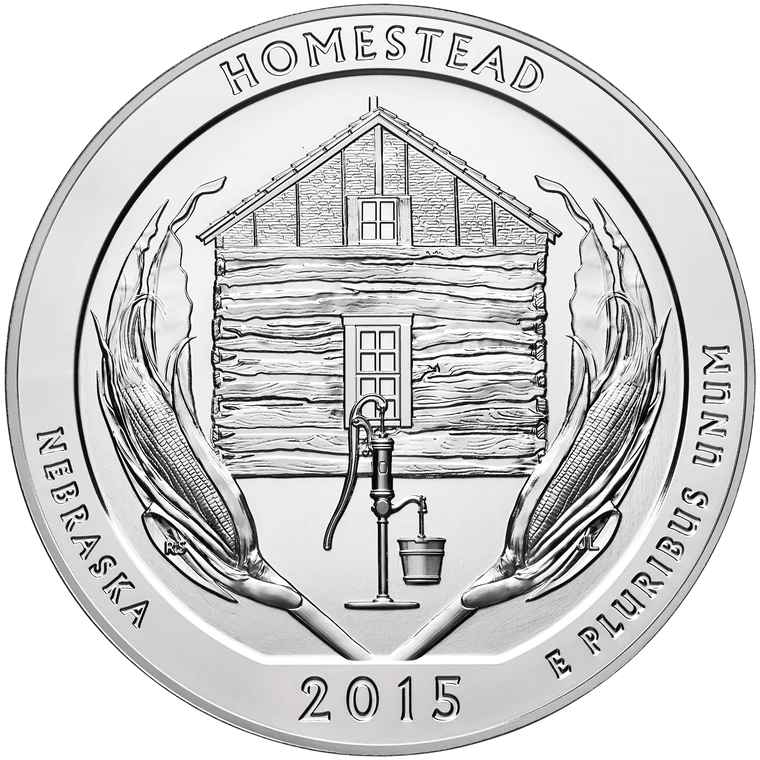
Visible cobs and husks form the frame. The crop is corn, not wheat.
Three essentials. A layered land story.
Corn, a cabin and a water pump share Nebraska’s reverse. The Mint connects the design to food, shelter and water. Those essentials open a history larger than the coin.
Read the reverse ⟶DenominationQuarter dollar
Weight5 troy ounces
Fineness99.9% silver
Diameter76.2 mm
Mint markNone · bullion
IssuerUnited States Mint
Reverse design anatomy
Two ears of corn frame the cabin; the pump occupies the lower center. The Mint attributes the design to three essentials of survival. This is a symbolic arrangement, not a survey of a particular homestead.
The following close reading describes visible forms. It does not assign undocumented intentions to the artists.
Visible cobs and husks form the frame. The crop is corn, not wheat.
The roof and log walls place shelter at the center of the composition.
A hand pump and hanging bucket supply the third object in the Mint’s reading.
The place behind the coin
The coin commemorates the Homestead Act of 1862. Food, shelter and water are its compact vocabulary; they are not a complete account of how land changed hands.
NPS interpretation places homesteading alongside Native American displacement. It also stresses that causes and timing differed by region; dispossession in Nebraska largely preceded the Act.
NPS · Native Americans and the Act ↗The cabin can represent shelter without making the surrounding land empty. Read the coin’s essentials beside the park’s sourced account of opportunity and displacement.
Editorial reading · based on NPS context ↗Coin-era name: Homestead National Monument of America. No photograph or reconstruction of an earlier homestead is implied.
Same design. A larger canvas.
The 2015 design also belongs to the circulating quarter. At 76.2 mm, the five-ounce silver coin is 3.14 times wider by diameter—not 3.14 times heavier.
The quarter is a measured outline: an exact authorized quarter photograph is not bound for this page. It is not a miniature bullion image.
Collect with context
Reverse design: Ronald D. Sanders; sculpt: Jim Licaretz.