Modified Canadian Arms
Modified Arms Fifty Cents
Modified Arms Fifty Cents covers 1959–present within the fifty cents denomination. Identify the canadian arms, updated to the current arms in 1997 reverse before applying the overlapping official technical standards or annual production rows.
Scope is limited to the verified type or program level. Issue mintages, prices, varieties, and survival estimates are not inferred from this summary.
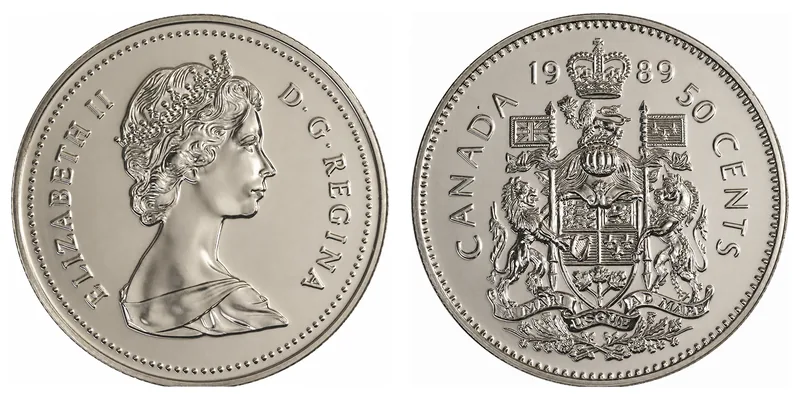
Major fifty cents types
Know the boundary before the date
Begin with the Canadian Arms, updated to the current arms in 1997 reverse, then confirm the Reigning monarch portrait obverse. Compare date, portrait, denomination, reeded edge, dimensions, weight, and metal response together. Wear, cleaning, plating disturbance, or environmental colour is not, by itself, evidence of a new type or variety.
- Primary identifiers — Reverse: Canadian Arms, updated to the current arms in 1997. Obverse: Reigning monarch portrait.
- Authority and dates — Canada; recorded range 1959–present.
- Evidence boundary — Unknown specifications remain unknown; unverified varieties, mintages, and prices stay outside the public catalog.
The historical scope of Modified Arms Fifty Cents
The cited evidence records Canada as the issuing authority and 1959–present as this type or program boundary. It belongs to the Fifty cents branch and is classified by authority, principal design, and documented physical generations. A narrower subtype should be added only when measurements, composition, or design evidence supports the split.
The catalog places this record in the Fifty cents branch, records its material scope as silver, nickel, and plated-steel generations, and records its finish as circulation. Those fields are supported by the sources listed below; missing issue-level transitions are not filled by inference.
- 1959 · Modified Arms — Thomas Shingles' treatment followed the government's updated Arms.
- 1967 · Centennial wolf — Alex Colville's howling wolf replaced the Arms for one year.
- 1968 · Nickel generation — Nickel replaced the silver circulation standard.
- 1997 · Order of Canada motto — The current Arms version added the Order of Canada motto.
- 2000 · Plated steel — The lighter plated-steel generation began.
- 2016 · Published table endpoint — The Mint page's annual table currently ends in 2016; later totals are not inferred.
Design and identification
Begin with the Canadian Arms, updated to the current arms in 1997 reverse, then confirm the Reigning monarch portrait obverse. Compare date, portrait, denomination, reeded edge, dimensions, weight, and metal response together. Wear, cleaning, plating disturbance, or environmental colour is not, by itself, evidence of a new type or variety.
- Modified Arms Fifty Cents · 1959–present · Thomas Shingles — Canadian Arms, updated to the current arms in 1997. Modified Canadian Arms.
Finish by checking the edge (reeded), composition (silver, nickel, and plated-steel generations), and any recorded dimensions or weight; colour or wear alone is not enough for attribution.
Official annual production
This page filters the published 1959–2016 annual rows to the Modified Arms Fifty Cents type boundary. Special reverses or parallel issues can be included in denomination-level annual totals; an unsplit total is not represented as design-only production.
Displayed-row sum: 129,136,167 · 57 official annual rows
Three anchors that do not depend on price
- Modified Arms — Thomas Shingles' treatment followed the government's updated Arms.
- Centennial wolf — Alex Colville's howling wolf replaced the Arms for one year.
- Nickel generation — Nickel replaced the silver circulation standard.
- Order of Canada motto — The current Arms version added the Order of Canada motto.
- Plated steel — The lighter plated-steel generation began.
- Published table endpoint — The Mint page's annual table currently ends in 2016; later totals are not inferred.
Specifications within this type
1920 – 1967 · Round
- Composition
- 80% silver, 20% copper
- Weight
- 11.66 g
- Diameter
- 29.72 mm
- Thickness
- Not stated
1968 – 1979 · Round
- Composition
- 99% nickel (minimum)
- Weight
- 8.1 g
- Diameter
- 27.13 mm
- Thickness
- 1.93 mm
1980 – 1999 · Round
- Composition
- 99% nickel (minimum)
- Weight
- 8.1 g
- Diameter
- 27.13 mm
- Thickness
- 1.9 mm
2000 – present · Round
- Composition
- 93.15% steel, 4.75% copper, 2.1% nickel plating
- Weight
- 6.9 g
- Diameter
- 27.13 mm
- Thickness
- 1.95 mm
Official annual production catalog
This page filters the published 1959–2016 annual rows to the Modified Arms Fifty Cents type boundary. Special reverses or parallel issues can be included in denomination-level annual totals; an unsplit total is not represented as design-only production.
| Year | Design context | Technical standard | Mintage |
|---|---|---|---|
| 1959 | Modified Canadian Arms | 29.72 mm · 11.66 g | 3,095,535 |
| 1960 | Modified Canadian Arms | 29.72 mm · 11.66 g | 3,488,897 |
| 1961 | Modified Canadian Arms | 29.72 mm · 11.66 g | 3,584,417 |
| 1962 | Modified Canadian Arms | 29.72 mm · 11.66 g | 5,208,030 |
| 1963 | Modified Canadian Arms | 29.72 mm · 11.66 g | 8,348,871 |
| 1964 | Modified Canadian Arms | 29.72 mm · 11.66 g | 9,377,676 |
| 1965 | Modified Canadian Arms | 29.72 mm · 11.66 g | 12,629,974 |
| 1966 | Modified Canadian Arms | 29.72 mm · 11.66 g | 7,683,228 |
| 1968 | Modified Canadian Arms | 27.13 mm · 8.1 g | 3,966,932 |
| 1969 | Modified Canadian Arms | 27.13 mm · 8.1 g | 7,113,929 |
| 1970 | Modified Canadian Arms | 27.13 mm · 8.1 g | 2,429,516 |
| 1971 | Modified Canadian Arms | 27.13 mm · 8.1 g | 2,166,144 |
| 1972 | Modified Canadian Arms | 27.13 mm · 8.1 g | 2,515,632 |
| 1973 | Modified Canadian Arms | 27.13 mm · 8.1 g | 2,546,096 |
| 1974 | Modified Canadian Arms | 27.13 mm · 8.1 g | 3,436,650 |
| 1975 | Modified Canadian Arms | 27.13 mm · 8.1 g | 3,710,000 |
| 1976 | Modified Canadian Arms | 27.13 mm · 8.1 g | 2,646,000 |
| 1977 | Modified Canadian Arms | 27.13 mm · 8.1 g | 709,939 |
| 1978 | Modified Canadian Arms | 27.13 mm · 8.1 g | 3,341,892 |
| 1979 | Modified Canadian Arms | 27.13 mm · 8.1 g | 3,425,000 |
| 1980 | Modified Canadian Arms | 27.13 mm · 8.1 g | 1,943,155 |
| 1981 | Modified Canadian Arms | 27.13 mm · 8.1 g | 2,588,900 |
| 1982 | Modified Canadian Arms | 27.13 mm · 8.1 g | 2,884,572 |
| 1983 | Modified Canadian Arms | 27.13 mm · 8.1 g | 1,177,000 |
| 1984 | Modified Canadian Arms | 27.13 mm · 8.1 g | 1,502,989 |
| 1985 | Modified Canadian Arms | 27.13 mm · 8.1 g | 2,188,374 |
| 1986 | Modified Canadian Arms | 27.13 mm · 8.1 g | 781,400 |
| 1987 | Modified Canadian Arms | 27.13 mm · 8.1 g | 373,000 |
| 1988 | Modified Canadian Arms | 27.13 mm · 8.1 g | 220,000 |
| 1989 | Modified Canadian Arms | 27.13 mm · 8.1 g | 266,419 |
| 1990 | Modified Canadian Arms | 27.13 mm · 8.1 g | 207,000 |
| 1991 | Modified Canadian Arms | 27.13 mm · 8.1 g | 490,000 |
| 1992 | Modified Canadian Arms | 27.13 mm · 8.1 g | 248,000 |
| 1993 | Modified Canadian Arms | 27.13 mm · 8.1 g | 393,000 |
| 1994 | Modified Canadian Arms | 27.13 mm · 8.1 g | 987,000 |
| 1995 | Modified Canadian Arms | 27.13 mm · 8.1 g | 626,000 |
| 1996 | Modified Canadian Arms | 27.13 mm · 8.1 g | 458,000 |
| 1997 | Modified Canadian Arms | 27.13 mm · 8.1 g | 387,000 |
| 1998 | Modified Canadian Arms | 27.13 mm · 8.1 g | 308,000 |
| 1999 | Modified Canadian Arms | 27.13 mm · 8.1 g | 496,000 |
| 2000 | Modified Canadian Arms | 27.13 mm · 6.9 g | 559,000 |
| 2001 | Modified Canadian Arms | 27.13 mm · 6.9 g | 403,000 |
| 2002 | Modified Canadian Arms | 27.13 mm · 6.9 g | 14,440,000 |
| 2003 | Modified Canadian Arms | 27.13 mm · 6.9 g | 0 |
| 2004 | Modified Canadian Arms | 27.13 mm · 6.9 g | 0 |
| 2005 | Modified Canadian Arms | 27.13 mm · 6.9 g | 200,000 |
| 2006 | Modified Canadian Arms | 27.13 mm · 6.9 g | 98,000 |
| 2007 | Modified Canadian Arms | 27.13 mm · 6.9 g | 250,000 |
| 2008 | Modified Canadian Arms | 27.13 mm · 6.9 g | 211,000 |
| 2009 | Modified Canadian Arms | 27.13 mm · 6.9 g | 150,000 |
| 2010 | Modified Canadian Arms | 27.13 mm · 6.9 g | 150,000 |
| 2011 | Modified Canadian Arms | 27.13 mm · 6.9 g | 175,000 |
| 2012 | Modified Canadian Arms | 27.13 mm · 6.9 g | 250,000 |
| 2013 | Modified Canadian Arms | 27.13 mm · 6.9 g | 375,000 |
| 2014 | Modified Canadian Arms | 27.13 mm · 6.9 g | 500,000 |
| 2015 | Modified Canadian Arms | 27.13 mm · 6.9 g | 625,000 |
| 2016 | Modified Canadian Arms | 27.13 mm · 6.9 g | 800,000 |
Collecting paths and checklist
A useful first set represents the design and technical boundaries documented across 1959–present; portrait, composition, or program generations can follow when their evidence is secure. Issue mintages, rarity labels, variety names, prices, and survivor estimates require separate verification and are not inferred from this type summary.
- One-coin type study — Choose one representative that clearly shows the principal obverse and reverse, then learn the type boundary.
- Design and technical generations — Add a generation only when sources confirm a change in composition, shape, size, edge, or principal design.
- Source-backed date study — Expand into dates or varieties only after issue identity, specifications, and production evidence are verified field by field.
Collector checklist
- Do not clean the coin; cleaning changes surfaces and can obscure evidence.
- Compare date, portrait, design, edge, weight, diameter, and metal response together.
- Have consequential or high-value attributions reviewed by an appropriate specialist or certification service.
- Catalog information is research context, not an appraisal, offer, or investment guarantee.
Data scope
This page publishes reviewed denomination- and major-type-level evidence. Years not published by the Mint remain unknown, zero appears only when the source reports zero, and prices or survivor estimates are not inferred from production.
Sources
- 50 centsRoyal Canadian Mint
Fifty-cent design generations, technical chronology, and infrequent circulation.
- Currency ActJustice Laws Website, Government of Canada
The Canadian dollar, cent relationship, current-coin definition, and legal-tender limits.
- Faces of the MonarchRoyal Canadian Mint
Canadian coin obverse portrait chronology through Charles III.