Canada series encyclopedia
Victoria One Cent (1876–1901)
The Dominion's first sustained one-cent series: British-made bronze cents, H-mint contracts, changing maple-leaf wreaths, and the 1891 attribution transition.
Twenty date-and-mint rows are reconciled below. Pre-1911 production remains explicitly estimated, and no population snapshot is presented as survival.
From Province surplus to Dominion series
Canada's large bronze cent began before Confederation. The Province of Canada ordered ten million cents dated 1858 and 1859, more than commerce immediately absorbed. That stock delayed the next one-cent issue until 1876, when the Dominion returned to the denomination with an H-marked contract issue.
The series reflects Canada's dependence on British coin production. Unmarked pieces were struck at the Royal Mint; H-marked issues came from Ralph Heaton & Sons in Birmingham. Library and Archives Canada documents Heaton's earlier Canadian contracts, while the date-and-mint catalog shows H returning in 1890, 1898 and 1900.
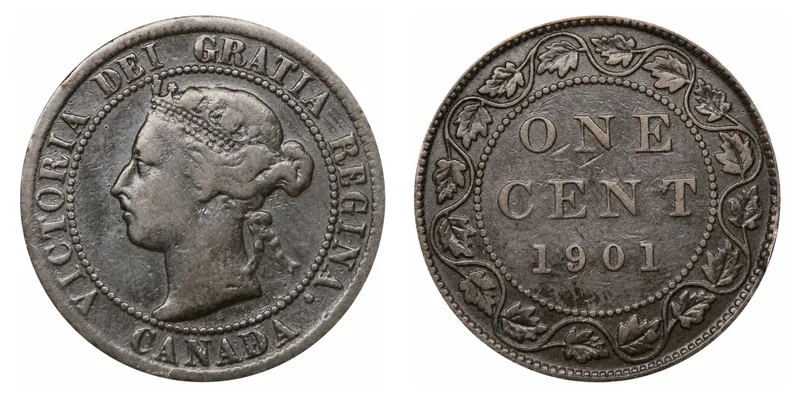
The coin kept a crowned portrait of Queen Victoria and a maple-leaf-vine reverse, but the reverse was not static. Specialist catalogs distinguish an early Wyon family, a broad-leaf revision, and the narrower, more deeply veined small-leaf design associated with George William de Saulles. In 1891 those elements overlap, creating the series' most demanding attribution year.
The 1901 issue ends the Victoria cent. Edward VII appears in 1902, while Canada continues to rely on British production until the Ottawa branch of the Royal Mint opens in 1908. That transition belongs to the next series and is not merged into this page.
- 1858–1859 · Province predecessor — Ten million Province of Canada cents create a long inventory overhang.
- 1876 · Dominion cent returns — The series opens with a Heaton-struck H issue.
- 1884 · Large-leaf revision — The revised Wyon wreath becomes the principal middle-period reverse.
- 1891 · Large- and small-leaf transition — Date size, leaf family and obverse hub must be attributed as a combination.
- 1892 · Three obverse identities — Obverses 2, 3 and 4 share the date; published splits remain estimates.
- 1900 · Two mint identities — H-marked and unmarked cents are separate issue rows.
- 1901 · Final Victoria issue — The portrait era closes before Edward VII's 1902 cent.
Portrait, legend and changing maple-leaf wreath
Crowned portrait and imperial legend
Leonard Charles Wyon's left-facing crowned portrait is surrounded by VICTORIA DEI GRATIA REGINA CANADA. Read the portrait hub and lettering together; wear at the hair and crown can conceal diagnostic detail.
Maple-leaf wreath, denomination and date
ONE CENT and the date sit inside a beaded circle and maple-leaf vine. The wreath's leaf width and vein treatment separate major design generations. On H issues, the mint mark below the date is part of the issue identity, not a variety nickname.
- 1876–1882 · Wyon original wreath (Leonard Charles Wyon) — The inherited maple-leaf-vine reverse continues the design family introduced for Province of Canada cents, with date-and-hub study required inside the group.
- 1884–1890 · Wyon large-leaf revision (Leonard Charles Wyon) — A revised wreath uses broader leaves and fewer prominent veins. Mint mark and obverse hub remain separate attribution fields.
- 1891–1901 · De Saulles small-leaf generation (George William de Saulles) — A narrower, more deeply veined small-leaf reverse enters during the complex 1891 transition and becomes the late-Victoria standard.
Professional specification reference
| Composition | Cu 95% · Sn 4% · Zn 1% |
|---|---|
| Weight | 5.67 g |
| Diameter | 25.4 mm |
| Thickness | 1.5 mm |
| Edge / alignment | Plain / medal |
The separately catalogued 4.56 g 1876 pattern does not replace the circulation standard.
Complete date-and-mint register
Most pre-1911 figures are specialist estimates; the row sum is not a survival or rarity statement.
| Issue | Mark | Mint | Design generation | Reported mintage | Evidence status |
|---|---|---|---|---|---|
| 1876-H | H | Ralph Heaton & Sons | Wyon original wreath | 4,000,000 | estimated |
| 1881-H | H | Ralph Heaton & Sons | Wyon original wreath | 2,000,000 | estimated |
| 1882-H | H | Ralph Heaton & Sons | Wyon original wreath | 4,000,000 | estimated |
| 1884 | None | Royal Mint | Wyon large-leaf revision | 2,500,000 | estimated |
| 1886 | None | Royal Mint | Wyon large-leaf revision | 1,500,000 | reconciled estimate |
| 1887 | None | Royal Mint | Wyon large-leaf revision | 1,500,000 | estimated |
| 1888 | None | Royal Mint | Wyon large-leaf revision | 4,000,000 | estimated |
| 1890-H | H | Ralph Heaton & Sons | Wyon large-leaf revision | 1,000,000 | estimated |
| 1891 | None | Royal Mint | Large- and small-leaf transition | 1,453,000 | conflicted estimate |
| 1892 | None | Royal Mint | De Saulles small-leaf reverse | 1,200,000 | estimated |
| 1893 | None | Royal Mint | De Saulles small-leaf reverse | 2,000,000 | estimated |
| 1894 | None | Royal Mint | De Saulles small-leaf reverse | 1,000,000 | estimated |
| 1895 | None | Royal Mint | De Saulles small-leaf reverse | 1,200,000 | estimated |
| 1896 | None | Royal Mint | De Saulles small-leaf reverse | 2,000,000 | estimated |
| 1897 | None | Royal Mint | De Saulles small-leaf reverse | 1,500,000 | estimated |
| 1898-H | H | Ralph Heaton & Sons | De Saulles small-leaf reverse | 1,000,000 | estimated |
| 1899 | None | Royal Mint | De Saulles small-leaf reverse | 2,400,000 | estimated |
| 1900-H | H | Ralph Heaton & Sons | De Saulles small-leaf reverse | 2,600,000 | estimated |
| 1900 | None | Royal Mint | De Saulles small-leaf reverse | 1,000,000 | estimated |
| 1901 | None | Royal Mint | De Saulles small-leaf reverse | 4,100,000 | estimated |
Why these dates matter
- 1876-H · Federal return — The first Dominion-era cent after the surplus Province of Canada issues delayed new production for seventeen years.
- 1881-H · Heaton study — A lower reported mintage and a broad specialist variety list make the date useful for learning H-mint and obverse diagnostics.
- 1891 · Design transition — Large leaves, small leaves, large date, small date and two obverse hubs combine into the series' central attribution problem.
- 1892 · Obverse hubs — Three obverse identities survive under one date; published production splits are estimates and must not be presented as official totals.
- 1901 · Last Victoria cent — The final issue closes the Victoria portrait era immediately before Edward VII appears in 1902.
Variety explorer
Start with major design identity: leaf family, date size and obverse hub. Minor doubled letters and repunched digits remain source-reported until exact diagnostic imagery is available.
- 1891 · Large Leaves / Large Date / Obverse 2 — design combination
- 1891 · Large Leaves / Large Date / Obverse 3 — design combination
- 1891 · Large Leaves / Small Date / Obverse 2 — design combination
- 1891 · Large Leaves / Small Date / Obverse 3 — design combination
- 1891 · Small Leaves / Small Date / Obverse 2 — design combination
- 1891 · Small Leaves / Small Date / Obverse 3 — design combination
- 1892 · Obverse 2 — obverse hub; estimated split 100,000
- 1892 · Obverse 3 — obverse hub; estimated split 550,000
- 1892 · Obverse 4 — obverse hub; estimated split 550,000
57 entries remain in the research layer; no premium claim is made without exact diagnostics.
Price, population and auction context
These are dated third-party guide observations, not offers, appraisals or guarantees. Variety, colour designation, surfaces, certification and market timing can materially change results.
Representative CAD guide observations
| Issue | G4 | VF20 | AU50 | MS63 | Source updated |
|---|---|---|---|---|---|
| 1876-H | $3.9 | $8.8 | $35.6 | $226 | 2026-06-26 |
| 1881-H | $5.9 | $15.1 | $46.4 | $341 | 2026-04-05 |
| 1891 | $7.8 | $25 | $78.7 | $547 | 2026-06-26 |
| 1892 | $19.6 | $65.7 | $164 | $1,080 | 2026-06-26 |
| 1901 | $2.9 | $8.8 | $23.4 | $106 | 2026-06-26 |
Certification snapshots
1876-H · PCGS
- BN
- 83
- RB
- 102
- RD
- 11
1881-H · PCGS
- BN
- 56
- RB
- 44
- RD
- 7
1891 · PCGS
- Large Leaves / Large Date BN
- 69
- Large Leaves / Large Date RB
- 50
- Large Leaves / Large Date RD
- 10
- Large Leaves / Small Date BN
- 71
- Large Leaves / Small Date RB
- 16
- Large Leaves / Small Date RD
- 1
- Small Leaves / Small Date BN
- 115
- Small Leaves / Small Date RB
- 35
- Small Leaves / Small Date RD
- 10
1892 · PCGS
- BN
- 54
- RB
- 52
- RD
- 24
1901 · PCGS
- BN
- 70
- RB
- 153
- RD
- 57
Certification counts change, can include resubmissions and do not measure survivors.
Selected auction records
| 2025-09-26 | 1891 · Small Leaves / Small Date / Obverse 3 | Belzberg Collection | ICCS MS64 RB | CAD 1,652 |
| 2007-01-07 | 1891 · Small Date / Large Leaves | Heritage Auctions 425 | About VF, cleaned | USD 126.5 |
| 2022-09-30 | 1892 · Obverse 4 | Sherbrooke Seminary Collection | ICCS MS63 RB | CAD 168 |
| 2019-08-15 | 1892 · Obverse 4 | Cook Collection | PCGS MS65 RB | CAD 1,078 |
| 2018-02 | 1901 · 1901 | Goldberg Coins and Collectibles | PCGS MS65 RB | USD 353 |
Bronze-cent grading and collecting
Grade the coin in hand, not a population or price row. Inspect wear, surface originality and problems before colour designation; PCGS and NGC use different RD/RB/BN thresholds.
A five-coin sampler teaches mint, design and attribution changes. A complete date-and-mint set has 20 rows; advanced sets add the 1891 combinations and 1892 obverse hubs.
- Inspect hair, crown and portrait relief, then reverse leaf veins and lettering.
- Check wiping, residue, porosity, corrosion, verdigris and unnatural colour first.
- Do not clean; handle by the edge and use inert PVC-free storage.
Five representative issue pages
Sources and evidence roles
- Canadian circulating coin mintages — 1 cent — Coins and Canada; issue hierarchy; reported mintages; reported varieties
- 1 cent 1876 prices and values — Coins and Canada; circulation specifications; designers; mint; dated price guide
- 1 cent 1881 prices and values — Coins and Canada; issue varieties; dated price guide
- 1 cent 1891 prices and values — Coins and Canada; major design combinations; dated price guide; selected auction records
- 1 cent 1892 prices and values — Coins and Canada; obverse identities; estimated variety split; dated price guide; selected auction records
- 1 cent 1901 prices and values — Coins and Canada; final issue identity; dated price guide; designers
- 1 cent — Royal Canadian Mint; denomination history; 1858–1911 reverse design and designer
- Coin care — Royal Canadian Mint; handling; storage; cleaning caution
- Whatever happened to the penny? A history of our one-cent coin — Bank of Canada Museum; 1858–1859 overproduction; 1876 federal return; pre-1908 British production; Ottawa Mint transition
- Canada, Victoria, 1 cent, 1882 — Bank of Canada Museum; Heaton H; copper; weight; diameter; plain edge; designer
- Canada, Victoria, 1 cent, 1901 — Bank of Canada Museum; Royal Mint; weight; diameter; plain edge; designers
- Canada, Victoria, 1 cent pattern, 1876 — Bank of Canada Museum; separately catalogued pattern; Heaton H; pattern weight and diameter
- Royal Canadian Mint fonds — Library and Archives Canada; federal responsibility; Heaton production 1871–1884; Ottawa branch legislation and opening
- Victoria 1858–1901 population report — PCGS; dated certification population snapshot
- Canada Cent 1901 PCGS MS65RB auction record — PCGS Auction Prices; Goldberg February 2018 result
- RD, RB and BN grading designations on copper coins — PCGS; PCGS copper colour thresholds
- Canada Cent KM#7 1876–1901 — NGC; series specification corroboration; issue mintage corroboration
- Learn grading: red and brown copper — NGC; NGC copper colour thresholds; altered-colour warning
- NGC Conservation — NGC; irreversible wear and corrosion; conservation limits
- 1 Cent — Victoria — Numista; specification corroboration; design-generation cross-check; mintage conflict record
- 1891 Small Date, Large Leaves cent auction lot — Heritage Auctions; problem-coin auction example; realized price
- One cent coins of Canada — Wikimedia Commons; rights-documented visual source index