Reduced-diameter small cent
Small Cent: Two Maple Leaves
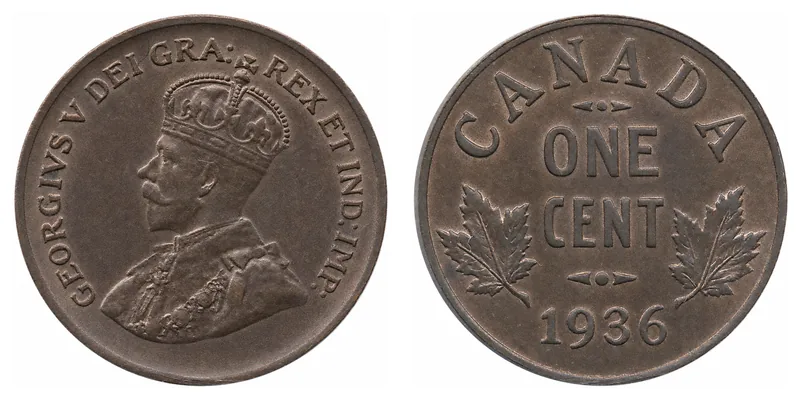
Fred Lewis's compact 1920–1936 cent places ONE CENT between two separate maple leaves. It established the 19.05 mm small-cent format before Canada's circulation designs were modernized in 1937.
Scope is limited to the verified type or program level. Issue mintages, prices, varieties, and survival estimates are not inferred from this summary.
Major one cent types
Know the boundary before the date
A genuine member of this branch is a 19.05 mm small cent dated 1920–1936 with ONE CENT between two distinct maple leaves rather than a shared twig. The Mint records a 3.24 g bronze standard and 1.65 mm thickness. The 1920 date requires a diameter check because both large and small cent formats carry that year.
- Primary identifiers — Reverse: ONE CENT between two separate maple leaves, CANADA above and date below. Obverse: George V portrait.
- Authority and dates — Canada; recorded range 1920–1936.
- Evidence boundary — Unknown specifications remain unknown; unverified varieties, mintages, and prices stay outside the public catalog.
The historical scope of Small Cent: Two Maple Leaves
The Bank of Canada Museum links the 1920 reduction to rising copper costs. The new cent retained the bronze composition recorded by the Mint but reduced the standard from 5.67 g and 25.4 mm to 3.24 g and 19.05 mm. It remained the regular reverse through 1936, before the national circulation redesign introduced Kruger-Gray's maple-leaf twig in 1937.
The catalog places this record in the One cent branch, records its material scope as 95.5% copper, 3% tin, 1.5% zinc, and records its finish as circulation. Those fields are supported by the sources listed below; missing issue-level transitions are not filled by inference.
- 1920 · Large and small in one year — Copper economics produced a reduced 19.05 mm, 3.24 g format.
- 1936 · Dot emergency coin — A small dot marked coins prepared in 1937 with the old date; the cent examples were not issued.
Design and identification
A genuine member of this branch is a 19.05 mm small cent dated 1920–1936 with ONE CENT between two distinct maple leaves rather than a shared twig. The Mint records a 3.24 g bronze standard and 1.65 mm thickness. The 1920 date requires a diameter check because both large and small cent formats carry that year.
- Small cent · two maple leaves · 1920–1936 · Fred Lewis — The reduced-diameter coin places ONE CENT between two separate maple leaves with CANADA above and the date below.
Finish by checking the edge (plain), composition (95.5% copper, 3% tin, 1.5% zinc), and any recorded dimensions or weight; colour or wear alone is not enough for attribution.
Official annual production
The 1920 annual total is shared with the final large cent because the Mint table does not divide that transition year by size.
Displayed-row sum: 124,820,687 · 17 official annual rows
Three anchors that do not depend on price
- 1920 · Two physical formats — Both the final large cent and first small cent carry this date; diameter is the immediate dividing test.
- 1936 dot · Three known examples — The Bank of Canada Museum reports that the dot cents were never issued and that three examples are known. Expert authentication is essential.
Specifications within this type
1920–1941 · Round
- Composition
- 95.5% copper, 3% tin, 1.5% zinc
- Weight
- 3.24 g
- Diameter
- 19.05 mm
- Thickness
- 1.65 mm
Official annual production catalog
The 1920 annual total is shared with the final large cent because the Mint table does not divide that transition year by size.
| Year | Design context | Technical context | Mintage |
|---|---|---|---|
| 1920 | Large bronze cent / Two-maple-leaf small cent | 25.4 mm · 5.67 g / 19.05 mm · 3.24 g | 22,246,170 |
| 1921 | Two-maple-leaf small cent | 19.05 mm · 3.24 g | 7,601,627 |
| 1922 | Two-maple-leaf small cent | 19.05 mm · 3.24 g | 1,243,635 |
| 1923 | Two-maple-leaf small cent | 19.05 mm · 3.24 g | 1,019,022 |
| 1924 | Two-maple-leaf small cent | 19.05 mm · 3.24 g | 1,593,195 |
| 1925 | Two-maple-leaf small cent | 19.05 mm · 3.24 g | 1,000,622 |
| 1926 | Two-maple-leaf small cent | 19.05 mm · 3.24 g | 2,143,372 |
| 1927 | Two-maple-leaf small cent | 19.05 mm · 3.24 g | 3,553,928 |
| 1928 | Two-maple-leaf small cent | 19.05 mm · 3.24 g | 9,144,860 |
| 1929 | Two-maple-leaf small cent | 19.05 mm · 3.24 g | 12,159,840 |
| 1930 | Two-maple-leaf small cent | 19.05 mm · 3.24 g | 2,538,613 |
| 1931 | Two-maple-leaf small cent | 19.05 mm · 3.24 g | 3,842,776 |
| 1932 | Two-maple-leaf small cent | 19.05 mm · 3.24 g | 21,316,190 |
| 1933 | Two-maple-leaf small cent | 19.05 mm · 3.24 g | 12,079,310 |
| 1934 | Two-maple-leaf small cent | 19.05 mm · 3.24 g | 7,042,358 |
| 1935 | Two-maple-leaf small cent | 19.05 mm · 3.24 g | 7,526,400 |
| 1936 | Two-maple-leaf small cent | 19.05 mm · 3.24 g | 8,768,769 |
Collecting paths and checklist
Start with the clear 1920 format boundary and treat the 1936 dot claim as a separate authentication problem: the Bank of Canada Museum reports three known examples and says the dot cents were not issued. The annual Mint table supplies production context for 1920–1936, but its 1920 total is not split between the two sizes and must not be doubled or assigned wholly to either type.
- One-coin type study — Choose one representative that clearly shows the principal obverse and reverse, then learn the type boundary.
- Design and technical generations — Add a generation only when sources confirm a change in composition, shape, size, edge, or principal design.
- Source-backed date study — Expand into dates or varieties only after issue identity, specifications, and production evidence are verified field by field.
Collector checklist
- Do not clean the coin; cleaning changes surfaces and can obscure evidence.
- Compare date, portrait, design, edge, weight, diameter, and metal response together.
- Have consequential or high-value attributions reviewed by an appropriate specialist or certification service.
- Catalog information is research context, not an appraisal, offer, or investment guarantee.
Two source conflicts remain visible
The Royal Canadian Mint technical table gives 25.4 mm for 1908–1920 large cents, while the Bank of Canada Museum narrative says the pre-1920 coin shrank from 24.4 mm. This page uses 25.4 mm in the specification table because it is the Mint's explicit technical value and does not silently merge the discrepancy. The Mint denomination page and 2012 report spell the 1911–1920 contributor “Blackmore”; the Royal Mint Museum and another Mint product record identify the resident engraver as W.H.J. Blakemore, the spelling used here.
Sources
- 1 centRoyal Canadian Mint
One-cent reverse designs, designers, technical generations, annual mintages from 1908 through 2012, and the end of production in 2012.
- Whatever happened to the penny? A history of our one-cent coinBank of Canada Museum
The 1858 introduction, Ottawa production, 1920 size change, 1936 dot coins, design transitions, metal changes, final 2012 strike, withdrawal, and rounded historical production total.
- Australian pattern florinRoyal Mint Museum
W.H.J. Blakemore's name spelling and role as a resident engraver at the Royal Mint.
- One cent coins of CanadaWikimedia Commons
High-resolution, license-documented visual references for the 1858, 1920, 1937, and 1967 reverse identities used to ground the project-owned editorial hero composite.
- Government of Canada and Royal Canadian Mint bid farewell to the Canadian pennyGovernment of Canada
Penny phase-out chronology and final distribution in February 2013.
- A History of the Canadian DollarBank of Canada
Decimal adoption, 1858 coinage, 1870 Dominion coinage, provincial issues, Newfoundland, and mint history.