Large Voyageur dollar lineage
Voyageur Dollar
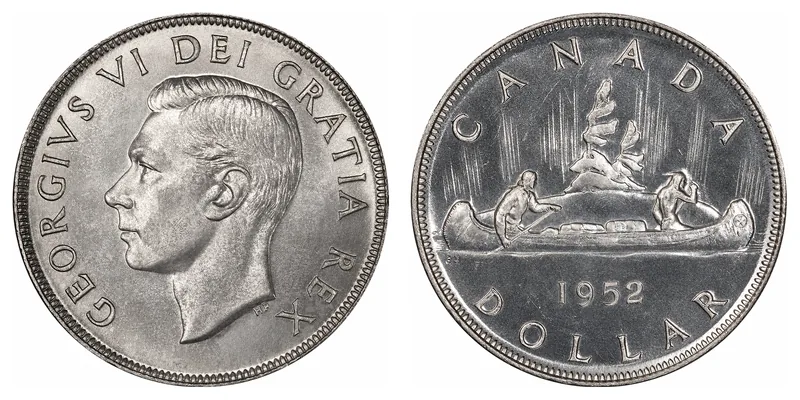
Voyageur Dollar covers 1935–1986 within the one dollar denomination. Identify the voyageur and indigenous guide paddling a canoe; commemorative reverses in selected years reverse before applying the overlapping official technical standards or annual production rows.
Scope is limited to the verified type or program level. Issue mintages, prices, varieties, and survival estimates are not inferred from this summary.
Major one dollar types
Know the boundary before the date
Silver-generation pieces measure 36.06 millimetres and weigh 23.3 grams according to the Mint; nickel-generation pieces are 32.13 millimetres and 15.62 grams. The standard reverse shows the canoe scene. A different historical reverse may be an authorized commemorative dollar, not an error.
- Primary identifiers — Reverse: Voyageur and Indigenous guide paddling a canoe; commemorative reverses in selected years. Obverse: Reigning monarch portrait.
- Authority and dates — Canada; recorded range 1935–1986.
- Evidence boundary — Unknown specifications remain unknown; unverified varieties, mintages, and prices stay outside the public catalog.
The historical scope of Voyageur Dollar
The lineage crosses a decisive material boundary. Issues through 1967 use the official 80% silver standard; the 1968–1986 generation is smaller and nickel. Selected years carry commemorative reverses, so 'large dollar' describes a format and monetary role rather than one unbroken reverse design.
The catalog places this record in the Large circulation dollar branch, records its material scope as 80% silver through 1967; nickel from 1968, and records its finish as circulation. Those fields are supported by the sources listed below; missing issue-level transitions are not filled by inference.
- 1935 · Voyageur dollar — Emanuel Hahn's canoe design launched Canada's silver dollar.
- 1939 · Royal Visit — A special Hahn reverse commemorated the royal visit.
- 1949 · Newfoundland — Thomas Shingles' Matthew reverse marked Newfoundland joining Confederation.
- 1967 · Centennial goose — Alex Colville's goose replaced the Voyageur.
- 1968 · Nickel large dollar — Nickel replaced silver for the large circulation format.
Design and identification
Silver-generation pieces measure 36.06 millimetres and weigh 23.3 grams according to the Mint; nickel-generation pieces are 32.13 millimetres and 15.62 grams. The standard reverse shows the canoe scene. A different historical reverse may be an authorized commemorative dollar, not an error.
- Voyageur Dollar · 1935–1986 · Emanuel Hahn — Voyageur and Indigenous guide paddling a canoe; commemorative reverses in selected years. Large Voyageur dollar lineage.
Finish by checking the edge (reeded), composition (80% silver through 1967; nickel from 1968), and any recorded dimensions or weight; colour or wear alone is not enough for attribution.
Official annual production
This page filters the published 1935–1986 annual rows to the Voyageur Dollar type boundary. Special reverses or parallel issues can be included in denomination-level annual totals; an unsplit total is not represented as design-only production.
Displayed-row sum: 121,619,941 · 52 official annual rows
Three anchors that do not depend on price
- Voyageur dollar — Emanuel Hahn's canoe design launched Canada's silver dollar.
- Royal Visit — A special Hahn reverse commemorated the royal visit.
- Newfoundland — Thomas Shingles' Matthew reverse marked Newfoundland joining Confederation.
- Centennial goose — Alex Colville's goose replaced the Voyageur.
- Nickel large dollar — Nickel replaced silver for the large circulation format.
Specifications within this type
1935 – 1967 · Round
- Composition
- 80% silver, 20% copper
- Weight
- 23.3 g
- Diameter
- 36.06 mm
- Thickness
- 2.84 mm
1968 – 1982 · Round
- Composition
- 99.9% nickel
- Weight
- 15.62 g
- Diameter
- 32.13 mm
- Thickness
- 2.62 mm
1982 – 1986 · Round
- Composition
- 99% nickel (minimum)
- Weight
- 15.62 g
- Diameter
- 32.13 mm
- Thickness
- 2.55 mm
Official annual production catalog
This page filters the published 1935–1986 annual rows to the Voyageur Dollar type boundary. Special reverses or parallel issues can be included in denomination-level annual totals; an unsplit total is not represented as design-only production.
| Year | Design context | Technical standard | Mintage |
|---|---|---|---|
| 1935 | Large Voyageur dollar lineage | 36.06 mm · 23.3 g | 428,707 |
| 1936 | Large Voyageur dollar lineage | 36.06 mm · 23.3 g | 306,100 |
| 1937 | Large Voyageur dollar lineage | 36.06 mm · 23.3 g | 241,002 |
| 1938 | Large Voyageur dollar lineage | 36.06 mm · 23.3 g | 90,304 |
| 1939 | Royal Visit | 36.06 mm · 23.3 g | 1,363,816 |
| 1940 | Large Voyageur dollar lineage | 36.06 mm · 23.3 g | 0 |
| 1941 | Large Voyageur dollar lineage | 36.06 mm · 23.3 g | 0 |
| 1942 | Large Voyageur dollar lineage | 36.06 mm · 23.3 g | 0 |
| 1943 | Large Voyageur dollar lineage | 36.06 mm · 23.3 g | 0 |
| 1944 | Large Voyageur dollar lineage | 36.06 mm · 23.3 g | 0 |
| 1945 | Large Voyageur dollar lineage | 36.06 mm · 23.3 g | 38,391 |
| 1946 | Large Voyageur dollar lineage | 36.06 mm · 23.3 g | 93,055 |
| 1947 | Large Voyageur dollar lineage | 36.06 mm · 23.3 g | 86,730 |
| 1948 | Large Voyageur dollar lineage | 36.06 mm · 23.3 g | 18,780 |
| 1949 | Newfoundland joins Confederation | 36.06 mm · 23.3 g | 672,218 |
| 1950 | Large Voyageur dollar lineage | 36.06 mm · 23.3 g | 261,002 |
| 1951 | Large Voyageur dollar lineage | 36.06 mm · 23.3 g | 416,395 |
| 1952 | Large Voyageur dollar lineage | 36.06 mm · 23.3 g | 406,148 |
| 1953 | Large Voyageur dollar lineage | 36.06 mm · 23.3 g | 1,074,578 |
| 1954 | Large Voyageur dollar lineage | 36.06 mm · 23.3 g | 246,606 |
| 1955 | Large Voyageur dollar lineage | 36.06 mm · 23.3 g | 268,105 |
| 1956 | Large Voyageur dollar lineage | 36.06 mm · 23.3 g | 209,092 |
| 1957 | Large Voyageur dollar lineage | 36.06 mm · 23.3 g | 496,389 |
| 1958 | British Columbia centennial | 36.06 mm · 23.3 g | 3,039,630 |
| 1959 | Large Voyageur dollar lineage | 36.06 mm · 23.3 g | 1,443,502 |
| 1960 | Large Voyageur dollar lineage | 36.06 mm · 23.3 g | 1,420,486 |
| 1961 | Large Voyageur dollar lineage | 36.06 mm · 23.3 g | 1,262,231 |
| 1962 | Large Voyageur dollar lineage | 36.06 mm · 23.3 g | 1,884,789 |
| 1963 | Large Voyageur dollar lineage | 36.06 mm · 23.3 g | 4,179,981 |
| 1964 | Confederation meetings | 36.06 mm · 23.3 g | 7,296,832 |
| 1965 | Large Voyageur dollar lineage | 36.06 mm · 23.3 g | 10,768,569 |
| 1966 | Large Voyageur dollar lineage | 36.06 mm · 23.3 g | 9,912,178 |
| 1967 | Centennial Canada goose | 36.06 mm · 23.3 g | 6,767,496 |
| 1968 | Large Voyageur dollar lineage | 32.13 mm · 15.62 g | 5,579,714 |
| 1969 | Large Voyageur dollar lineage | 32.13 mm · 15.62 g | 4,809,313 |
| 1970 | Manitoba centennial | 32.13 mm · 15.62 g | 4,140,058 |
| 1971 | British Columbia centennial | 32.13 mm · 15.62 g | 4,260,781 |
| 1972 | Large Voyageur dollar lineage | 32.13 mm · 15.62 g | 2,193,000 |
| 1973 | Prince Edward Island centennial | 32.13 mm · 15.62 g | 3,196,452 |
| 1974 | Winnipeg centennial | 32.13 mm · 15.62 g | 2,799,363 |
| 1975 | Large Voyageur dollar lineage | 32.13 mm · 15.62 g | 3,256,000 |
| 1976 | Large Voyageur dollar lineage | 32.13 mm · 15.62 g | 2,101,000 |
| 1977 | Large Voyageur dollar lineage | 32.13 mm · 15.62 g | 1,393,745 |
| 1978 | Large Voyageur dollar lineage | 32.13 mm · 15.62 g | 2,948,488 |
| 1979 | Large Voyageur dollar lineage | 32.13 mm · 15.62 g | 1,884,789 |
| 1980 | Large Voyageur dollar lineage | 32.13 mm · 15.62 g | 2,544,000 |
| 1981 | Large Voyageur dollar lineage | 32.13 mm · 15.62 g | 2,778,900 |
| 1982 | Constitution commemorative | 32.13 mm · 15.62 g | 13,356,398 |
| 1983 | Large Voyageur dollar lineage | 32.13 mm · 15.62 g | 2,267,525 |
| 1984 | Jacques Cartier commemorative | 32.13 mm · 15.62 g | 1,223,486 |
| 1985 | Large Voyageur dollar lineage | 32.13 mm · 15.62 g | 3,104,592 |
| 1986 | Large Voyageur dollar lineage | 32.13 mm · 15.62 g | 3,089,225 |
Collecting paths and checklist
Separate circulation dollars from the Annual Proof Silver Dollar program that began in 1971. They can share a one-dollar face value while differing in purpose, finish, distribution, and specifications. This page reports no price or rarity ranking because those require issue, condition, and market evidence.
- One-coin type study — Choose one representative that clearly shows the principal obverse and reverse, then learn the type boundary.
- Design and technical generations — Add a generation only when sources confirm a change in composition, shape, size, edge, or principal design.
- Source-backed date study — Expand into dates or varieties only after issue identity, specifications, and production evidence are verified field by field.
Collector checklist
- Do not clean the coin; cleaning changes surfaces and can obscure evidence.
- Compare date, portrait, design, edge, weight, diameter, and metal response together.
- Have consequential or high-value attributions reviewed by an appropriate specialist or certification service.
- Catalog information is research context, not an appraisal, offer, or investment guarantee.
Data scope
This page publishes reviewed denomination- and major-type-level evidence. Years not published by the Mint remain unknown, zero appears only when the source reports zero, and prices or survivor estimates are not inferred from production.
Sources
- 1 dollarRoyal Canadian Mint
Large-dollar and Loonie design and technical chronology.
- A Tale of Two Designs: How Canada's 1-dollar Coin Became the LoonieRoyal Canadian Mint
The 1935 silver dollar, planned Voyageur dies, and the 1987 Loonie transition.
- The History and Heritage Behind Canada's Favourite Annual Coins and SetsRoyal Canadian Mint
Proof Silver Dollar program since 1971 and annual uncirculated, specimen, and proof sets.