George VI reign and portrait era
George VI Ten Cents (1937–1952)
This page applies the requested 1937–1952 George VI browse lens to the reviewed ten cents design, technical-standard, and annual-production evidence.
Scope is limited to the verified type or program level. Issue mintages, prices, varieties, and survival estimates are not inferred from this summary.
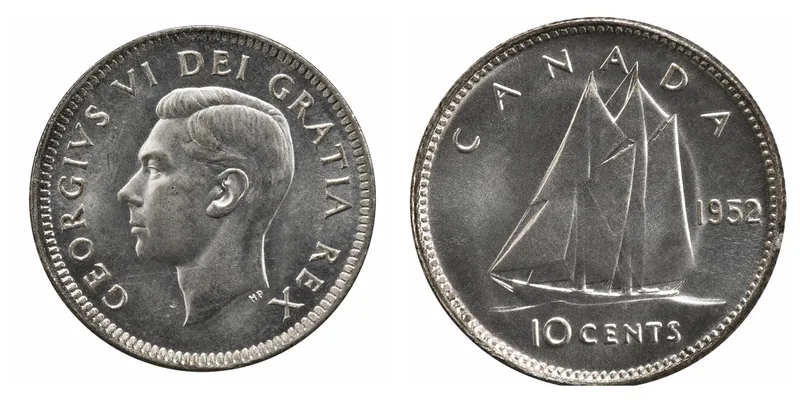
Ten cents reign and portrait eras
Know the boundary before the date
Begin with the recorded obverse (George VI effigy (Thomas Humphrey Paget portrait)) and reverse (Schooner under sail, identified by the Mint as Bluenose). Then compare date, denomination, portrait, edge, diameter, weight, composition, and finish; a colour change or worn detail alone is not a reliable attribution.
- Primary identifiers — Reverse: Schooner under sail, identified by the Mint as Bluenose. Obverse: George VI effigy (Thomas Humphrey Paget portrait).
- Authority and dates — Canada; recorded range 1937–1952.
- Evidence boundary — Unknown specifications remain unknown; unverified varieties, mintages, and prices stay outside the public catalog.
The historical scope of George VI Ten Cents (1937–1952)
The cited sources place this category under Canada and within the chronology shown here. Where a label crosses designs, authorities, metals, or portrait transitions, the page keeps those distinctions visible instead of merging them into one invented type.
The catalog places this record in the Ten cents branch, records its material scope as silver, nickel, and plated-steel generations, and records its finish as circulation. Those fields are supported by the sources listed below; missing issue-level transitions are not filled by inference.
- 1937 · Bluenose — Emanuel Hahn's schooner reverse modernized the denomination.
Design and identification
Begin with the recorded obverse (George VI effigy (Thomas Humphrey Paget portrait)) and reverse (Schooner under sail, identified by the Mint as Bluenose). Then compare date, denomination, portrait, edge, diameter, weight, composition, and finish; a colour change or worn detail alone is not a reliable attribution.
- Bluenose Ten Cents · 1937–present · Emanuel Hahn — Schooner under sail, identified by the Mint as Bluenose. Bluenose schooner family.
Finish by checking the edge (reeded), composition (silver, nickel, and plated-steel generations), and any recorded dimensions or weight; colour or wear alone is not enough for attribution.
Official annual production
Annual rows are denomination totals filtered to this requested era. They may combine portraits, commemorative reverses, or parallel formats and are not presented as portrait-only production.
Displayed-row sum: 164,668,907 · 16 official annual rows
Three anchors that do not depend on price
- 1937–1952 — The verified range assigned to George VI Ten Cents (1937–1952) in this catalog.
- Schooner under sail, identified by the Mint as Bluenose — The principal reverse is the first type-level attribution check.
- silver, nickel, and plated-steel generations — Compare it with the reeded edge and any recorded measurements.
Specifications within this type
1920 – 1967 · Round
- Composition
- 80% silver, 20% copper
- Weight
- 2.33 g
- Diameter
- 18.034 mm
- Thickness
- Not stated
Official annual production catalog
Annual rows are denomination totals filtered to this requested era. They may combine portraits, commemorative reverses, or parallel formats and are not presented as portrait-only production.
| Year | Design context | Technical standard | Mintage |
|---|---|---|---|
| 1937 | Bluenose schooner family | 18.034 mm · 2.33 g | 2,500,095 |
| 1938 | Bluenose schooner family | 18.034 mm · 2.33 g | 4,197,323 |
| 1939 | Bluenose schooner family | 18.034 mm · 2.33 g | 5,501,748 |
| 1940 | Bluenose schooner family | 18.034 mm · 2.33 g | 16,526,470 |
| 1941 | Bluenose schooner family | 18.034 mm · 2.33 g | 8,716,386 |
| 1942 | Bluenose schooner family | 18.034 mm · 2.33 g | 10,214,011 |
| 1943 | Bluenose schooner family | 18.034 mm · 2.33 g | 21,143,229 |
| 1944 | Bluenose schooner family | 18.034 mm · 2.33 g | 9,383,582 |
| 1945 | Bluenose schooner family | 18.034 mm · 2.33 g | 10,979,570 |
| 1946 | Bluenose schooner family | 18.034 mm · 2.33 g | 6,300,066 |
| 1947 | Bluenose schooner family | 18.034 mm · 2.33 g | 14,070,719 |
| 1948 | Bluenose schooner family | 18.034 mm · 2.33 g | 422,741 |
| 1949 | Bluenose schooner family | 18.034 mm · 2.33 g | 11,336,172 |
| 1950 | Bluenose schooner family | 18.034 mm · 2.33 g | 17,823,075 |
| 1951 | Bluenose schooner family | 18.034 mm · 2.33 g | 15,079,265 |
| 1952 | Bluenose schooner family | 18.034 mm · 2.33 g | 10,474,455 |
Collecting paths and checklist
Use the page first as a type or era checklist, then verify each dated issue independently before extending the set. Cleaned surfaces, plated-metal disturbance, patterns, special finishes, and commemorative reverses require separate treatment; catalog context is not an appraisal or investment promise.
- One-coin type study — Choose one representative that clearly shows the principal obverse and reverse, then learn the type boundary.
- Design and technical generations — Add a generation only when sources confirm a change in composition, shape, size, edge, or principal design.
- Source-backed date study — Expand into dates or varieties only after issue identity, specifications, and production evidence are verified field by field.
Collector checklist
- Do not clean the coin; cleaning changes surfaces and can obscure evidence.
- Compare date, portrait, design, edge, weight, diameter, and metal response together.
- Have consequential or high-value attributions reviewed by an appropriate specialist or certification service.
- Catalog information is research context, not an appraisal, offer, or investment guarantee.
Data scope
This page publishes reviewed denomination- and major-type-level evidence. Years not published by the Mint remain unknown, zero appears only when the source reports zero, and prices or survivor estimates are not inferred from production.
Sources
- 10 centsRoyal Canadian Mint
Ten-cent design, designer, and composition chronology.
- A History of the Canadian DollarBank of Canada
Decimal adoption, 1858 coinage, 1870 Dominion coinage, provincial issues, Newfoundland, and mint history.
- Faces of the MonarchRoyal Canadian Mint
Canadian coin obverse portrait chronology through Charles III.