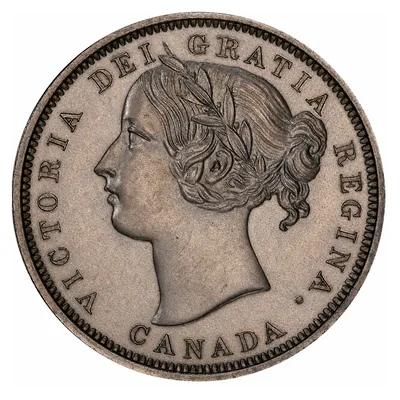
Canadian circulation coin · 1858
Denomination overview
The Province of Canada issued its twenty-cent coin only in 1858 as part of its first decimal coinage. Struck by the Royal Mint before Confederation, it was not continued in the federal series; the twenty-five-cent denomination introduced in 1870 fit the neighbouring United States system more closely.
Scope: 1 major type, 1 cited circulation standard, and 1 reported annual production row for 1858. Prices, survivor estimates, and unverified varieties are not inferred.
Move from denomination to major type
The circulation type carries Victoria on the obverse and a crowned maple wreath around 20 CENTS and 1858 on the reverse. Use the documented sterling-silver, 4.65 g, 23.3 mm, reeded-edge standard; the Bank of Canada Museum page cited here describes a separate pattern object with different measurements.
- Major types — Province of Canada twenty cents
- Identification order — The circulation type carries Victoria on the obverse and a crowned maple wreath around 20 CENTS and 1858 on the reverse. Use the documented sterling-silver, 4.65 g, 23.3 mm, reeded-edge standard; the Bank of Canada Museum page cited here describes a separate pattern object with different measurements.
- Production evidence — The cited 1858 circulation record appears in an adaptive square-root chart and complete one-row table.
The history of Province of Canada Twenty-Cent Coin
The Province of Canada issued its twenty-cent coin only in 1858 as part of its first decimal coinage. Struck by the Royal Mint before Confederation, it was not continued in the federal series; the twenty-five-cent denomination introduced in 1870 fit the neighbouring United States system more closely.
The circulation type carries Victoria on the obverse and a crowned maple wreath around 20 CENTS and 1858 on the reverse. Use the documented sterling-silver, 4.65 g, 23.3 mm, reeded-edge standard; the Bank of Canada Museum page cited here describes a separate pattern object with different measurements.
The circulation source, specialist catalog note, and museum pattern record are separate evidence. This page does not substitute the pattern object's measurements for the circulation coin or present the reported pre-1911 quantity as an official Mint-table total.
Treat the 1858 circulation coin and museum-catalogued pattern as different evidence classes. Begin with authenticity, alignment, edge, weight, diameter, and surface integrity; do not use the one published mintage as a survivor count or value guide.
- 1857 · Decimal authorization — The Province of Canada authorized a decimal currency framework.
- 1858 · Royal Mint production — The one-year twenty-cent circulation issue was struck in London.
- 1867 · Confederation — The provincial denomination did not continue as a federal issue.
- 1870 · Quarter succeeds it — The new federal quarter replaced the twenty-cent framework.
Design generations and identification
The circulation type carries Victoria on the obverse and a crowned maple wreath around 20 CENTS and 1858 on the reverse. Use the documented sterling-silver, 4.65 g, 23.3 mm, reeded-edge standard; the Bank of Canada Museum page cited here describes a separate pattern object with different measurements.
- Province of Canada Twenty Cents · 1858 · Leonard Charles Wyon — Victoria portrait with a crowned maple wreath around the denomination and date.
Attribute with denomination, date, portrait, principal reverse, diameter, weight, thickness, shape, edge, and metal response together; colour or wear alone does not establish a new type.
Read the reported production record on a square-root scale
The cited specialist source reports one 1858 circulation-mintage row of 730,392 pieces and cautions that pre-1911 quantities are often estimates.
The chart preserves the same adaptive scale used across the encyclopedia. This single reported quantity is not an official Royal Canadian Mint annual-table row or a survivor count.
Design and technology turning points
These anchors support identification and planning; they are not price or rarity rankings.
- Decimal authorization — The Province of Canada authorized a decimal currency framework.
- Royal Mint production — The one-year twenty-cent circulation issue was struck in London.
- Confederation — The provincial denomination did not continue as a federal issue.
- Quarter succeeds it — The new federal quarter replaced the twenty-cent framework.
Type, special reverse, and variety are different levels
Confirm the major type first, then the special reverse or technical generation; create a variety only when an authoritative source defines and supports it.
- Confirm denomination and principal design — The circulation type carries Victoria on the obverse and a crowned maple wreath around 20 CENTS and 1858 on the reverse. Use the documented sterling-silver, 4.65 g, 23.3 mm, reeded-edge standard; the Bank of Canada Museum page cited here describes a separate pattern object with different measurements.
- Match the technical standard — Match the circulation coin to the cited composition, weight, diameter, and reeded-edge record; do not substitute the museum pattern specification.
- Preserve the evidence boundary — Do not infer a variety, error, price, or survivor count from an annual total, colour, or wear.
Cited annual production record
The table preserves the reported 1858 circulation quantity and its estimate warning; it does not merge the separately catalogued museum pattern.
Annual figures are denomination-level production records; special reverses cannot always be separated from a same-year regular design.
| Year | Design context | Technical standard | Mintage |
|---|---|---|---|
| 1858 | Province of Canada twenty cents | 23.3 mm · 4.65 g | 730,392 |
Composition, weight, diameter, and edge
The circulation standard below comes from the cited specialist source. The Bank of Canada Museum record is retained separately because it identifies its different object as a pattern.
1858 · Round
- Composition
- 92.5% silver, 7.5% copper
- Weight
- 4.65 g
- Diameter
- 23.3 mm
- Thickness
- Not stated
Collecting paths and checklist
Treat the 1858 circulation coin and museum-catalogued pattern as different evidence classes. Begin with authenticity, alignment, edge, weight, diameter, and surface integrity; do not use the one published mintage as a survivor count or value guide.
- Major-type set — Choose one clearly attributable representative of every major type.
- Design generations — Add officially identified special reverses and design interruptions.
- Technical generations — Expand by composition, dimensions, weight, shape, and security features.
- Source-backed annual study — Study varieties, errors, grades, and markets only when issue-level evidence is sufficient.
Collector checklist
- Do not clean the coin.
- Compare date, portrait, reverse, edge, weight, and diameter together.
- Record special reverses separately from the base type.
- Annual mintage is not survival or rarity.
- Have consequential attributions reviewed by an appropriate specialist.
Data scope
This page publishes reviewed denomination- and major-type evidence. The 730,392 quantity is reported with a pre-1911 estimate warning, zero is never inferred, and prices or survivor estimates are not derived from production.
Sources
The specialist circulation record supports the reported mintage and physical standard; the museum record documents a separate pattern object, while government and Mint sources provide institutional context.
- A History of the Canadian DollarBank of Canada
Decimal adoption, 1858 coinage, 1870 Dominion coinage, provincial issues, Newfoundland, and mint history.
- Canada, Victoria, 20 Cents, 1858Bank of Canada Museum
Identity, date, authority, mint, and the separate 4.62 g, 23 mm, plain-edge specifications of a museum object explicitly catalogued as a pattern; these measurements are not assigned to the circulation type.
- 20 cents: circulating Canadian coin mintagesCoins and Canada
The reported 730,392 circulation mintage for 1858 and the warning that pre-1911 quantities are often estimates; the linked issue record supports the sterling-silver, 4.65 g, 23.3 mm, reeded-edge circulation standard.
- Transactions of the Canadian Numismatic Research Society, New Series, Vol. 4Canadian Numismatic Research Society
Specialist context for the 1858–1859 Province of Canada decimal introduction.