Canadian circulation coin · 1996–present
Denomination overview
The bimetallic two-dollar circulation coin replaced the note in 1996. Brent Townsend's polar bear established the denomination's identity; Nunavut, Path of Knowledge, anniversary, Quebec City, and later commemorative reverses expanded the series. A 2012 redesign introduced lighter plated components and visible security features.
Scope: 1 major types, 2 official technical standards, and 29 published annual rows from 1996 through 2024. Unpublished years, prices, survivor estimates, and unverified varieties are not inferred.
Move from denomination to major type
Confirm the bimetallic ring-and-core construction first, then identify the reverse. The 2012 generation adds edge lettering, laser maple leaves, and a virtual-image feature; special reverses such as Nunavut and Path of Knowledge are not polar-bear varieties.
- Major types — Bimetallic polar-bear two-dollar family
- Identification order — Confirm the bimetallic ring-and-core construction first, then identify the reverse. The 2012 generation adds edge lettering, laser maple leaves, and a virtual-image feature; special reverses such as Nunavut and Path of Knowledge are not polar-bear varieties.
- Production evidence — Official 1996–2024 rows appear in an adaptive square-root chart and full annual table.
The history of Canadian Two-Dollar Coin
The bimetallic two-dollar circulation coin replaced the note in 1996. Brent Townsend's polar bear established the denomination's identity; Nunavut, Path of Knowledge, anniversary, Quebec City, and later commemorative reverses expanded the series. A 2012 redesign introduced lighter plated components and visible security features.
Confirm the bimetallic ring-and-core construction first, then identify the reverse. The 2012 generation adds edge lettering, laser maple leaves, and a virtual-image feature; special reverses such as Nunavut and Path of Knowledge are not polar-bear varieties.
The Mint presents principal reverses, technical specifications, and annual mintages as separate evidence. This page preserves those boundaries rather than automatically assigning every denomination total to one special reverse.
A practical set pairs the 1996–2012 and post-2012 technical generations, then adds major special reverses. Handle ring/core separation, plating disturbance, and colour as condition questions, not automatic mint errors.
- 1996 · Two-dollar coin introduced — The bimetallic coin replaced the two-dollar note.
- 1999 · Nunavut — Germaine Arnaktauyok's design marked the new territory.
- 2000 · Path of Knowledge — Tony Bianco depicted a female polar bear and two cubs.
- 2006 · Tenth anniversary — Two reverse versions marked a decade of the circulation coin.
- 2008 · Quebec City 400 — A six-million special reverse circulated beside the traditional design.
- 2012 · Security redesign — Plated components, edge lettering, laser marks, and a virtual image arrived.
- 2017 · Canada 150 — The annual table reports only the special Canada 150 row.
- 2024 · Published table endpoint — The official annual table currently runs through 2024.
Design generations and identification
Confirm the bimetallic ring-and-core construction first, then identify the reverse. The 2012 generation adds edge lettering, laser maple leaves, and a virtual-image feature; special reverses such as Nunavut and Path of Knowledge are not polar-bear varieties.
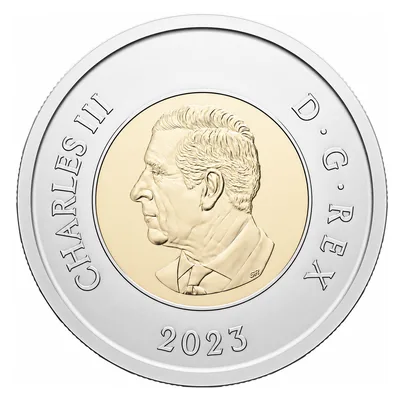
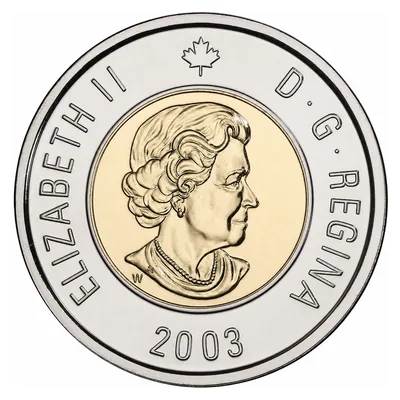
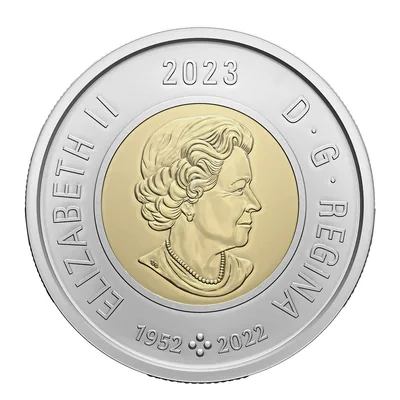
- Polar Bear Two Dollars (Toonie) · 1996–present · Brent Townsend — Polar bear on an ice floe; commemorative reverses in selected years. Bimetallic polar-bear two-dollar family.
Attribute with denomination, date, portrait, principal reverse, diameter, weight, thickness, shape, edge, and metal response together; colour or wear alone does not establish a new type.
Read long-run production on a square-root scale
The official table provides 29 annual rows from 1996 through 2024, summing to 1,077,596,500 pieces.
The square-root scale compresses extreme highs while keeping zero-production years visible; use the annual table for exact figures.
Design and technology turning points
These anchors support identification and planning; they are not price or rarity rankings.
- Two-dollar coin introduced — The bimetallic coin replaced the two-dollar note.
- Nunavut — Germaine Arnaktauyok's design marked the new territory.
- Path of Knowledge — Tony Bianco depicted a female polar bear and two cubs.
- Tenth anniversary — Two reverse versions marked a decade of the circulation coin.
- Quebec City 400 — A six-million special reverse circulated beside the traditional design.
- Security redesign — Plated components, edge lettering, laser marks, and a virtual image arrived.
- Canada 150 — The annual table reports only the special Canada 150 row.
- Published table endpoint — The official annual table currently runs through 2024.
Type, special reverse, and variety are different levels
Confirm the major type first, then the special reverse or technical generation; create a variety only when an authoritative source defines and supports it.
- Confirm denomination and principal design — Confirm the bimetallic ring-and-core construction first, then identify the reverse. The 2012 generation adds edge lettering, laser maple leaves, and a virtual-image feature; special reverses such as Nunavut and Path of Knowledge are not polar-bear varieties.
- Match the technical standard — Match the date to the official composition, weight, diameter, and thickness generation.
- Preserve the evidence boundary — Do not infer a variety, error, price, or survivor count from an annual total, colour, or wear.
Mint annual production table
The table preserves each published figure from 1996 through 2024, including zero-production rows and any split label stated by the Mint.
Annual figures are denomination-level production records; special reverses cannot always be separated from a same-year regular design.
| Year | Design context | Technical standard | Mintage |
|---|---|---|---|
| 1996 | Bimetallic polar-bear two-dollar family | 28 mm · 7.3 g | 375,483,000 |
| 1997 | Bimetallic polar-bear two-dollar family | 28 mm · 7.3 g | 16,942,000 |
| 1998 | Bimetallic polar-bear two-dollar family | 28 mm · 7.3 g | 5,309,000 |
| 1999 | Nunavut | 28 mm · 7.3 g | 25,130,000 |
| 2000 | Path of Knowledge | 28 mm · 7.3 g | 29,847,000 |
| 2001 | Bimetallic polar-bear two-dollar family | 28 mm · 7.3 g | 11,910,000 |
| 2002 | Bimetallic polar-bear two-dollar family | 28 mm · 7.3 g | 27,020,000 |
| 2003 | Bimetallic polar-bear two-dollar family | 28 mm · 7.3 g | 11,244,000 |
| 2004 | Bimetallic polar-bear two-dollar family | 28 mm · 7.3 g | 12,908,000 |
| 2005 | Bimetallic polar-bear two-dollar family | 28 mm · 7.3 g | 38,317,000 |
| 2006 | Polar-bear anniversary versions | 28 mm · 7.3 g | 35,319,000 |
| 2007 | Bimetallic polar-bear two-dollar family | 28 mm · 7.3 g | 38,957,000 |
| 2008 | Traditional bear and Quebec City 400 | 28 mm · 7.3 g | 18,400,000 |
| 2009 | Bimetallic polar-bear two-dollar family | 28 mm · 7.3 g | 38,430,000 |
| 2010 | Bimetallic polar-bear two-dollar family | 28 mm · 7.3 g | 8,220,000 |
| 2011 | Bimetallic polar-bear two-dollar family | 28 mm · 7.3 g | 27,488,000 |
| 2012 | Bimetallic polar-bear two-dollar family | 28 mm · 7.3 g / 28 mm · 6.92 g | 89,185,000 |
| 2013 | Bimetallic polar-bear two-dollar family | 28 mm · 6.92 g | 12,390,000 |
| 2014 | Bimetallic polar-bear two-dollar family | 28 mm · 6.92 g | 16,305,000 |
| 2015 | Bimetallic polar-bear two-dollar family | 28 mm · 6.92 g | 30,378,500 |
| 2016 | Bimetallic polar-bear two-dollar family | 28 mm · 6.92 g | 65,264,000 |
| 2017 | Canada 150 | 28 mm · 6.92 g | 10,000,000 |
| 2018 | Bimetallic polar-bear two-dollar family | 28 mm · 6.92 g | 26,730,000 |
| 2019 | Bimetallic polar-bear two-dollar family | 28 mm · 6.92 g | 25,995,000 |
| 2020 | Bimetallic polar-bear two-dollar family | 28 mm · 6.92 g | 17,235,000 |
| 2021 | Bimetallic polar-bear two-dollar family | 28 mm · 6.92 g | 24,875,000 |
| 2022 | Bimetallic polar-bear two-dollar family | 28 mm · 6.92 g | 20,580,000 |
| 2023 | Bimetallic polar-bear two-dollar family | 28 mm · 6.92 g | 1,045,000 |
| 2024 | Bimetallic polar-bear two-dollar family | 28 mm · 6.92 g | 16,690,000 |
Composition, weight, and dimension generations
A transition year can contain overlapping or parallel standards; the page preserves the Mint's published date labels.
1996 – 2012 · Round, bimetallic
- Composition
- outer ring 99% nickel, inner core 92% copper, 6% aluminum, 2% nickel
- Weight
- 7.3 g
- Diameter
- 28 mm
- Thickness
- 1.8 mm
2012 – present · Round, bimetallic
- Composition
- outer ring – multi-ply nickel plated steel, insert – multi-ply brass plated aluminum bronze
- Weight
- 6.92 g
- Diameter
- 28 mm
- Thickness
- 1.75 mm
Collecting paths and checklist
A practical set pairs the 1996–2012 and post-2012 technical generations, then adds major special reverses. Handle ring/core separation, plating disturbance, and colour as condition questions, not automatic mint errors.
- Major-type set — Choose one clearly attributable representative of every major type.
- Design generations — Add officially identified special reverses and design interruptions.
- Technical generations — Expand by composition, dimensions, weight, shape, and security features.
- Source-backed annual study — Study varieties, errors, grades, and markets only when issue-level evidence is sufficient.
Collector checklist
- Do not clean the coin.
- Compare date, portrait, reverse, edge, weight, and diameter together.
- Record special reverses separately from the base type.
- Annual mintage is not survival or rarity.
- Have consequential attributions reviewed by an appropriate specialist.
Data scope
This page publishes reviewed denomination- and major-type-level evidence. Years not published by the Mint remain unknown, zero appears only when the source reports zero, and prices or survivor estimates are not inferred from production.
Sources
Mint evidence anchors designs, specifications, and annual rows; the listed government, museum, or research sources supplement historical and legal context.
- 2 dollarsRoyal Canadian Mint
The 1996 introduction, polar-bear design, and 2012 security and composition changes.
- Currency ActJustice Laws Website, Government of Canada
The Canadian dollar, cent relationship, current-coin definition, and legal-tender limits.