Historical issuing authority
Newfoundland Coinage
Newfoundland maintained a distinctive decimal coinage from 1865 through 1947, before joining Canada in 1949. Its issues belong under their own authority and denomination hierarchy rather than being inserted into the date runs of federal Canadian types.
Scope is limited to the verified type or program level. Issue mintages, prices, varieties, and survival estimates are not inferred from this summary.
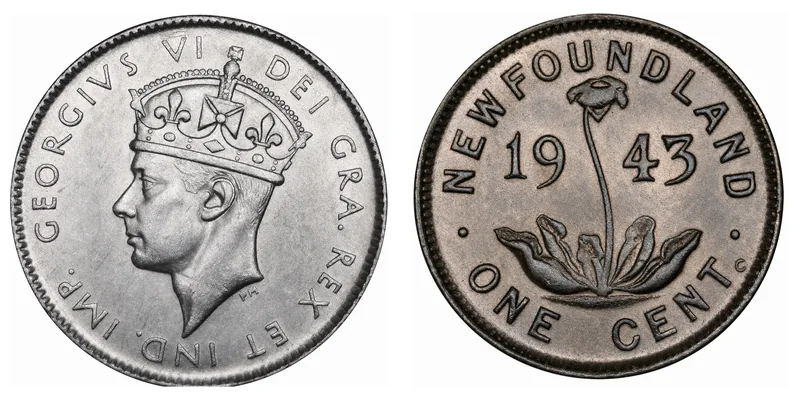
Field identification guide
Know the boundary before the date
Start with the Newfoundland inscription or design identity, denomination, date, and monarch. Similar face values do not make a Newfoundland coin a Canadian federal issue. The catalog currently withholds narrow date ranges and varieties where the available source set does not meet the same confidence threshold.
Primary identifiers
Reverse: Newfoundland denomination designs. Obverse: Reigning monarch portrait.
Authority and dates
Newfoundland; recorded range 1865–1947.
Evidence boundary
Unknown specifications remain unknown; unverified varieties, mintages, and prices stay outside the public catalog.
Chronology and authority
The historical scope of Newfoundland Coinage
Government monetary history records that Newfoundland retained distinctive coinage even after its currency was brought into consistency with Canada's in 1895. The documented denomination tree includes one, five, ten, twenty, twenty-five, and fifty cents plus a gold two-dollar coin.
The catalog places this record in the Provincial and dominion coinage branch, records its material scope as bronze, silver, and gold by denomination, and records its finish as circulation. Those fields are supported by the sources listed below; missing issue-level transitions are not filled by inference.
Evidence on the coin
Design and identification
Start with the Newfoundland inscription or design identity, denomination, date, and monarch. Similar face values do not make a Newfoundland coin a Canadian federal issue. The catalog currently withholds narrow date ranges and varieties where the available source set does not meet the same confidence threshold.
Obverse
Recorded design: Reigning monarch portrait. Portrait era: Victoria through George VI. Designer: Not established at this type level.
Reverse
Recorded design: Newfoundland denomination designs. Designer: Not established at this type level.
Finish by checking the edge (Not established at this type level), composition (bronze, silver, and gold by denomination), and any recorded dimensions or weight; colour or wear alone is not enough for attribution.
Verified production scope
Authority, material, and finish
Only confirmed production facts at type level appear here. Unestablished mints, mintages, and annual changes are not shown as zero or estimates.
Issuing authority
NewfoundlandCatalog range: 1865–1947.
Material scope
bronze, silver, and gold by denominationWhen material spans generations, the specification remains a range until issue evidence supports a split.
Finish and edge
circulationRecorded edge: Not established at this type level.
Collector landmarks
Three anchors that do not depend on price
These anchors establish the catalog boundary; they are not rarity or investment rankings.
1865–1947
The verified range assigned to Newfoundland Coinage in this catalog.
Newfoundland denomination designs
The principal reverse is the first type-level attribution check.
bronze, silver, and gold by denomination
Compare it with the Not established at this type level edge and any recorded measurements.
Type-level specifications
Values that vary by generation or remain unverified are stated as such; they are never filled by inference.
- Years
- 1865–1947
- Issuer
- Newfoundland
- Series
- Provincial and dominion coinage
- Composition
- bronze, silver, and gold by denomination
- Weight
- Not established at this type level
- Diameter
- Not established at this type level
- Thickness
- Not established at this type level
- Edge
- Not established at this type level
- Ruler / portrait era
- Victoria through George VI
- Reverse designer
- Not established at this type level
- Finish
- circulation
- Mintage
- Not established at this type level
Structured catalog
Issue catalog status
This release stops at type and program level. Issue rows will be added only after date, mint, mintage, specification, variety, and grade fields pass source-by-source review.
No issue records generated yet
This is not a claim of zero mintage or no known varieties; it means the issue-level evidence has not passed the public release gate.
Build a collection from evidence
Collecting paths and checklist
Build the branch by denomination and ruler, then verify each date and subtype against specialist references. This overview intentionally publishes no mintage, rarity, or value claims. The separate hierarchy prevents historical authority from being erased by modern geography.
One-coin type study
Choose one representative that clearly shows the principal obverse and reverse, then learn the type boundary.
Design and technical generations
Add a generation only when sources confirm a change in composition, shape, size, edge, or principal design.
Source-backed date study
Expand into dates or varieties only after issue identity, specifications, and production evidence are verified field by field.
Collector checklist
- Do not clean the coin; cleaning changes surfaces and can obscure evidence.
- Compare date, portrait, design, edge, weight, diameter, and metal response together.
- Have consequential or high-value attributions reviewed by an appropriate specialist or certification service.
- Catalog information is research context, not an appraisal, offer, or investment guarantee.
Related Canada pages
Traceable research trail
Sources
- A History of the Canadian DollarBank of Canada
Decimal adoption, 1858 coinage, 1870 Dominion coinage, provincial issues, Newfoundland, and mint history.
- Newfoundland CoinFactsProfessional Coin Grading Service
Independent cross-check of Newfoundland denomination branches.
- Welcoming Newfoundland to CanadaBank of Canada Museum
Newfoundland's decimal denominations, gold two-dollar coinage, production chronology, and relationship to the other provincial issues.