Wadō Kaichin: Japan's Documented 708 Court Coinage
Issued in 708 under Empress Genmei, Wadō Kaichin became the best documented landmark in Japan's early state coinage. Its four-character legend, round-square-hole form, and administrative role belong to a wider East Asian monetary tradition shaped by Tang Kaiyuan Tongbao. Archaeology now requires it to be described as a foundational documented issue, not an unqualified first Japanese coin.
和同開珎Wadō Kaichin
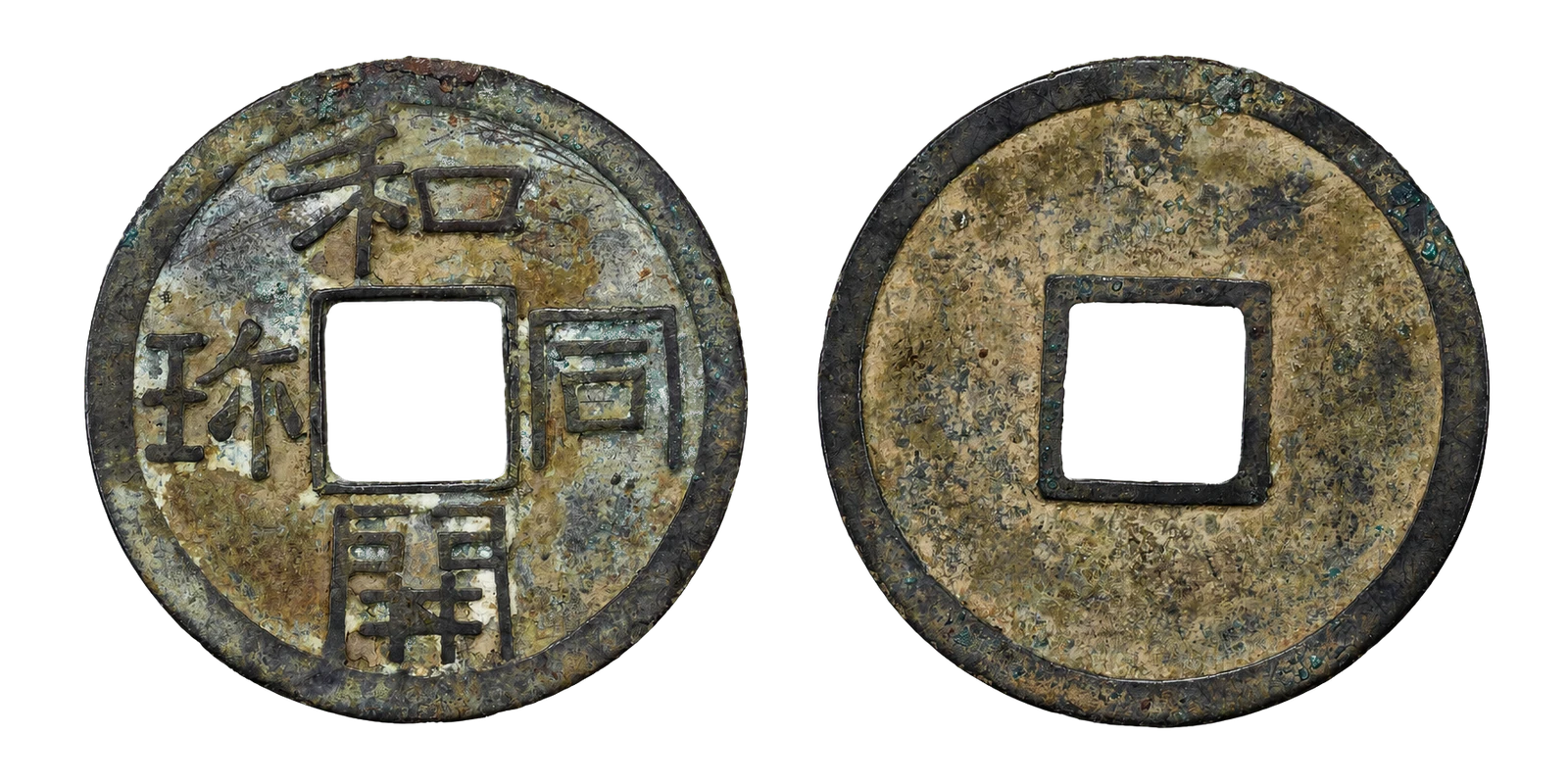
- Issue date
- 708-05-11
- Authority
- Imperial court under Empress Genmei
- Form
- cast round coin with central square hole
- Catalog mean
- 24.46 mm · 3.4 g
Centralization and monetary policy
The ritsuryō court used coin issuance to express authority and support administration. It promoted holding and using coin through rank incentives and used coin in payments connected with construction of Heijōkyō. These policies show intended use; they do not prove uniform acceptance in every region.
Tang model and local issue
The Currency Museum identifies Tang Kaiyuan Tongbao as the model. Wado Kaichin adopted the circular body, square central hole, and four-character legend while serving a Japanese court program with its own inscription, authority, and historical setting.
Acceptance and value
The court assigned a high official value and promoted accumulation, salaries, and state payments. Private casting, expansion of supply, and later reductions in statutory values demonstrate that official valuation and market trust were not the same thing.
Inscription analysis
和同開珎 · Wadō Kaichin
This catalog follows the Currency Museum's Wadō Kaichin treatment because contemporary evidence does not establish that 珎 abbreviated 寳 or was read hō. The historically common Wadō Kaihō remains searchable and disclosed.
top character; part of the issue name
bottom character; often associated with the Wado era name and contemporary wording
right character; its regular or clerical form helps distinguish traditional catalog groups
left character; the source of the Kaichin/Kaiho reading discussion
Reading orientation · top → bottom → right → left
Design and production
Coins were cast rather than struck. Molten alloy entered prepared molds, connected castings were separated, and edges could be filed. Outer rims, inner rims, square holes, surfaces, and legend strength vary. Claims about a specific mother coin, mold family, mint, or production date require specimen-level evidence.
Administrative use
Documented promotion included rank incentives for accumulated coin and payments associated with capital construction. Wage and tax claims are included only where the cited source supports the specific administrative context.
Catalog dimensions
Type and variety register
These source-named groupings do not create a modern subtype census.
| Grouping | Japanese | Metal | Calligraphy | Confidence | Status |
|---|---|---|---|---|---|
| Traditional old-style Wado grouping | 古和同 | copper alloy | traditionally associated with a more regular form of 開 and rougher fabric | medium as a catalog grouping; not a stand-alone mint or exact date | researching |
| Traditional new-style Wado grouping | 新和同 | copper alloy | traditionally associated with a clerical-style form of 開 comparable to the Kaiyuan model | medium as a catalog grouping; not a stand-alone mint or exact date | researching |
| Silver Wado Kaichin issue | 和同開珎銀銭 | silver | requires specimen-level comparison | high for the existence of a documented silver issue; specialist review required for subtype claims | review_required |
Archaeology
Documented find record
One record here does not imply only one find exists; it reflects the evidence normalized in this phase.
Sūfuku-ji Temple site
Ōtsu, Shiga Prefecture · temple-site excavated specimen
- Collection
- Tokyo National Museum / ColBase record
- Accession
- E-8770
- Scope
No market price, universal weight standard, mint attribution, subtype census, or authenticity verdict is inferred from a generic representative image.
Evidence
Sources and scope
These links support the claims on this page. Source authority does not imply permission to republish source images.
Fuhonsen and Mumon Ginsen context, the 708 issue of Wado Kaichin, state monetary policy, quality decline, the 958 final issue, and the return to commodity money.
Open sourceWado Kaichin specimen classification, calligraphic distinctions, measurement method, diameter, and weight evidence.
Open sourceMumon Ginsen, Fuhonsen, Wado Kaichin, Mannen Tsuho, Jingu Kaiho, documentary issue dates, circulation policy, and reading evidence.
Open sourceKaiyuan Tongbao as a model, four-character naming conventions, inscription orientation, casting, and wider East Asian context.
Open sourceMeasured copper, tin, lead, iron, arsenic, and antimony patterns across sampled ancient coins, with specimen-level limitations.
Open source