Authority model checked 2026-07-31
Japan's Overseas and Colonial Monetary Systems
An evidence-led map of Japanese colonial, overseas, military, and occupation monetary relationships without treating political control as coin issuance.
日本の植民地・海外・占領地における貨幣関係
- Jurisdictions
- 10
- Authorities
- 10
- Coin records
- 18
- Status
- Published
Identity first
Control is not the same as issuance
Every record keeps six relationships visible. This prevents a Japanese minting or control relationship from overwriting the issuer and jurisdiction printed into the coin's history.
Who exercised power over the jurisdiction.
The territory or state in which the system operated.
The government, central bank, colonial bank, or regime bank responsible.
The unit, parity, legal-tender basis, and note/coin layers.
A manufacturer may produce for a foreign issuer without owning the issue.
The country or historical jurisdiction under which the coin belongs.
Research paths
Browse the relationship architecture
Political and legal status, controlling power, and canonical catalog identity are displayed as separate fields.
authoritiesIssuing and Monetary AuthoritiesSovereign government, colonial note banks, central banks, regime banks, military authorities, and the producing mint remain distinct roles.
taiwanTaiwan under Japanese Rule: Currency ContextTaiwan had a territory-specific Bank of Taiwan note system while Japanese metropolitan coins supplied the coin layer; no separate colonial coin series is invented.
koreaKorea under Japanese Rule: Currency ContextBank of Chosen notes and Japanese subsidiary coins formed different layers; Korean Empire coins remain Korean, and Japanese coins retain Japanese identity.
karafutoSouth Karafuto Monetary ContextJapanese yen and metropolitan coins served South Karafuto; no distinct territorial issue corpus is verified.
south pacificSouth Pacific Mandate Monetary ContextJapanese yen became legal tender in the mandate; national Japanese coins remain circulation evidence rather than mandate-issued coins.
manchukuo contextJapan and the Manchukuo Monetary SystemManchukuo was Japan-dominated but maintained a separate central bank, yuan currency, and canonical coin identity.
military occupationMilitary Occupation and Metallic IssuesVerified Mengjiang and East Hebei metallic issues are separated from Dutch East Indies trials and from banknote-only military systems.
transitionsColonial and Postwar Currency TransitionsA sourced timeline covers colonial adoption, parity relationships, postwar succession, conversion rates, and unresolved gaps.
Political geography
Jurisdiction and canonical identity
The canonical country field governs catalog ownership; the controlling-power field preserves the political relationship.
| Jurisdiction | Political class | Control | Canonical catalog | Span |
|---|---|---|---|---|
| Metropolitan Japanjp-metropolitan | sovereign state | japan | japan | 1868–1945 |
| Taiwan under Japanese ruletaiwan-japanese-rule | colony | japan | taiwan | 1895–1945 |
| Korea under Japanese rulekorea-japanese-rule | colony | japan | korea | 1910–1945 |
| South Karafutosouth-karafuto | overseas territory | japan | sakhalin-historical | 1905–1945 |
| South Pacific Mandatesouth-pacific-mandate | league of nations mandate | japan | micronesia-historical | 1914–1945 |
| Manchukuomanchukuo | japan dominated state | japan | manchukuo | 1932–1945 |
| Mengjiangmengjiang | japan controlled regime | japan | china-historical-mengjiang | 1936–1945 |
| East Hebei Autonomous Governmenteast-hebei | japan supported regime | japan | china-historical-east-hebei | 1935–1938 |
| Japanese-occupied Dutch East Indiesoccupied-dutch-east-indies | military occupation | japan | indonesia-historical | 1942–1945 |
| Japanese military-occupied Southeast Asiasoutheast-asia-military-occupation | military occupation context | japan | multiple | 1941–1945 |
Authority hierarchy
Issuer, note bank, administration, and mint
A dash means the authority did not perform that issuing role; it does not mean the authority was absent from the wider system.
Currency layers
Coins and banknotes are modeled separately
Taiwan and Korea had territory-specific note systems while using Japanese metropolitan coins. Karafuto and the South Pacific Mandate used the Japanese yen directly. Manchukuo had a separate yuan system.
| System | Unit | Coin layer | Banknote layer |
|---|---|---|---|
| Japanese yen metropolitan systemjp-metropolitan | yen | Japanese metropolitan coins | Bank of Japan notes |
| Taiwan yen systemtaiwan-japanese-rule | yen | Japanese metropolitan coins; no separate colonial coin series verified | Bank of Taiwan notes |
| Chosen yen systemkorea-japanese-rule | yen | Japanese metropolitan subsidiary coins; no separate colonial coin series verified | Bank of Chosen notes |
| South Karafuto yen systemsouth-karafuto | yen | Japanese metropolitan coins; no distinct territorial coinage verified | Japanese national notes |
| South Pacific Mandate yen systemsouth-pacific-mandate | yen | Japanese metropolitan coins; no distinct mandate coinage verified | Japanese national notes |
| Manchukuo yuan systemmanchukuo | yuan | Central Bank of Manchukuo fen and chiao coinage | Central Bank of Manchukuo notes |
| Mengjiang currency systemmengjiang | yuan | Fen, chiao, and jiao metallic issues | Mengjiang Bank notes |
| East Hebei currency systemeast-hebei | yuan | Li, fen, and chiao metallic issues | Chi-Tung Bank notes |
| Japanese military occupation note systemssoutheast-asia-military-occupation | multiple | No single common occupation coin series verified | Territory-specific Japanese invasion money |
Coin evidence
Canonical issues and production evidence
Trial pieces and production records are labeled as such. Missing specifications remain unavailable and never become zero.
| Issue | Issuer | Canonical country | Object class | Specifications |
|---|---|---|---|---|
| Manchukuo Datong 2 five fen1933 · 5 fen | Central Bank of Manchukuo | manchukuocontrol: japan | circulation coin | cupronickel3.54 g · — |
| Manchukuo Datong 3 one fen1934 · 1 fen | Central Bank of Manchukuo | manchukuocontrol: japan | circulation coin | —— · — |
| Manchukuo Kangde 11 one fen1944 · 1 fen | Central Bank of Manchukuo | manchukuocontrol: japan | circulation coin | —— · — |
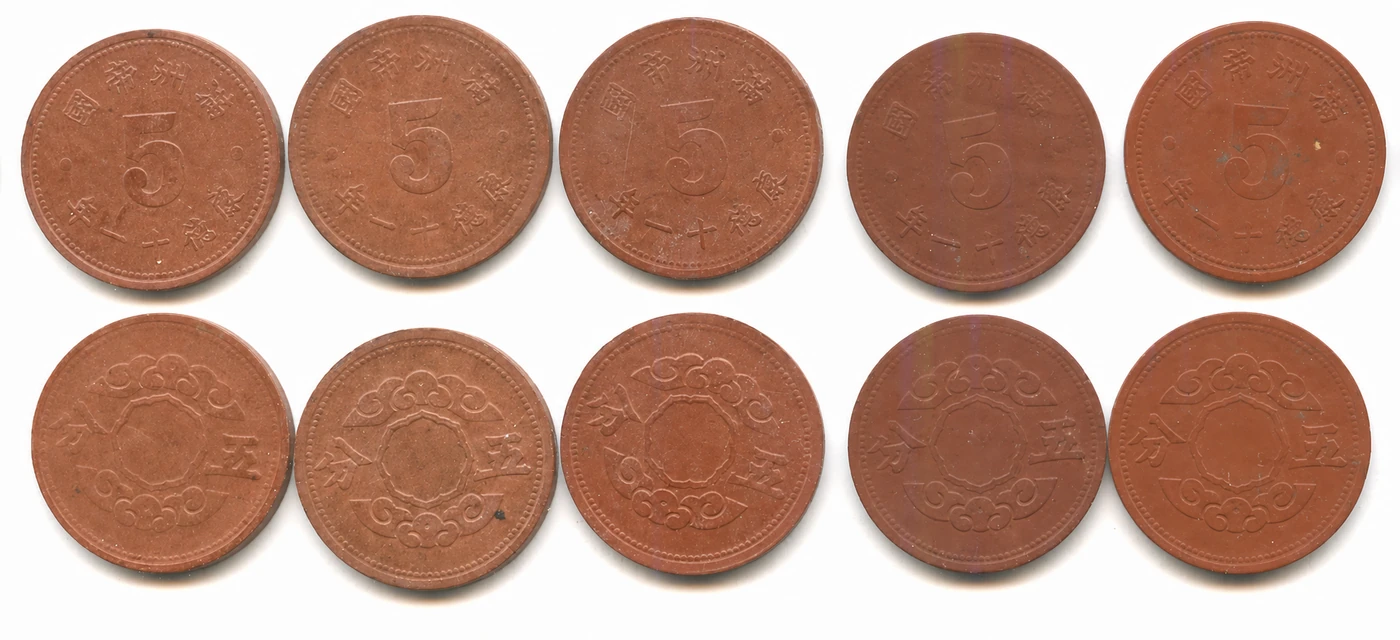
| Manchukuo Kangde 11 five-fen comparison1944 · 5 fen | Central Bank of Manchukuo | manchukuocontrol: japan | comparison study | —— · — |
| Mengjiang Bank five jiao1938 · 5 jiao | Mengjiang Bank | china-historical-mengjiangcontrol: japan | circulation coin | cupronickel5.49 g · 25 mm |
| Mengjiang one fen1942 · 1 fen | Mengjiang Bank | china-historical-mengjiangcontrol: japan | circulation coin | aluminum0.63 g · 15.96 mm |
| Mengjiang five fen1943 · 5 fen | Mengjiang Bank | china-historical-mengjiangcontrol: japan | circulation coin | aluminum0.99 g · 19.01 mm |
| Mengjiang one chiao1943 · 1 chiao | Mengjiang Bank | china-historical-mengjiangcontrol: japan | circulation coin | aluminum0.99 g · 22.01 mm |
| East Hebei five li1937 · 5 li | Chi-Tung Bank | china-historical-east-hebeicontrol: japan | circulation coin | bronze: Cu 95%, Sn 4%, Zn 1%3.5 g · 20.03 mm |
| East Hebei one fen1937 · 1 fen | Chi-Tung Bank | china-historical-east-hebeicontrol: japan | circulation coin | bronze: Cu 95%, Sn 4%, Zn 1%4.97 g · 23.01 mm |
| East Hebei five fen1937 · 5 fen | Chi-Tung Bank | china-historical-east-hebeicontrol: japan | circulation coin | cupronickel: Cu 75%, Ni 25%3.16 g · 19.01 mm |
| East Hebei one chiao1937 · 1 chiao | Chi-Tung Bank | china-historical-east-hebeicontrol: japan | circulation coin | cupronickel: Cu 75%, Ni 25%4.43 g · 22.02 mm |
| East Hebei two chiao1937 · 2 chiao | Chi-Tung Bank | china-historical-east-hebeicontrol: japan | circulation coin | cupronickel: Cu 75%, Ni 25%6.35 g · 25.03 mm |
| Dutch East Indies one-cent aluminum trial1943 · 1 cent | Unresolved | indonesia-historicalcontrol: japan | trial piece | aluminum— · — |
| Dutch East Indies one-cent aluminum trial1944 · 1 cent | Unresolved | indonesia-historicalcontrol: japan | trial piece | aluminum— · — |
| Dutch East Indies five-cent aluminum trial1943 · 5 cent | Unresolved | indonesia-historicalcontrol: japan | trial piece | aluminum— · — |
| Dutch East Indies ten-cent aluminum trial1943 · 10 cent | Unresolved | indonesia-historicalcontrol: japan | trial piece | aluminum— · — |
| Dutch East Indies ten-cent tin production record1944 · 10 cent | Unresolved | indonesia-historicalcontrol: japan | production evidence | tin— · — |
Change over time
Currency transitions
Adoption, parity, succession, and withdrawal are distinct events. A conversion rate appears only when a cited source states it.
- Taiwan under Japanese rule
The Bank of Taiwan began a territory-specific yen-denominated note system.
- Taiwan under Japanese rule
Taiwan's colonial note system was moved onto a gold basis aligned with Japan.
- Taiwan under Japanese rule
The postwar Bank of Taiwan introduced the Old Taiwan dollar.
- Taiwan under Japanese rule
The New Taiwan dollar replaced the Old Taiwan dollar at one to 40,000.
1 NTD = 40,000 Old Taiwan dollars - Korea under Japanese rule
The Bank of Chosen became the colonial note authority; pre-annexation Korean Empire coins remain canonically Korean.
- Korea under Japanese rule
The Bank of Korea inherited note circulation while Japanese subsidiary coins remained temporarily in use.
- Korea under Japanese rule
The hwan reform ended legal use of Bank of Chosen notes and Japanese one-jeon coins.
100 won = 1 hwan - South Karafuto
South Karafuto was legally integrated into Japan's home jurisdiction without a new territorial coinage.
- South Pacific Mandate
Japanese yen replaced the prior German-mark environment and became legal tender.
- South Pacific Mandate
Japanese administration ended; later trust-territory systems used the United States dollar.
- Manchukuo
The Central Bank of Manchukuo created a separate yuan currency under Japanese dominance.
Context only
Banknote systems are not coin objects
Bank of Taiwan yen notes define the territory-specific currency layer; Japanese metropolitan coins supplied the coin layer.
Excluded from coin issue countBank of Chosen yen notes are contextual; Japanese subsidiary coins remain Japanese issues.
Excluded from coin issue countCentral Bank notes are context for the separate Manchukuo coin system, not objects in the coin catalog.
Excluded from coin issue countJapanese invasion money is primarily a family of territory-specific military notes and does not justify a fictional common occupation coin series.
Excluded from coin issue countJapanese control does not make a foreign coin Japanese. Japanese use abroad does not create a colonial coin issue. Mint production does not prove circulation. No occupation countermark is published without institutional evidence.
Evidence
Sources and scope
These links support the claims on this page. Source authority does not imply permission to republish source images.
Comparative legal-tender and currency structure for Taiwan, Korea, South Karafuto, the South Pacific Mandate, and Manchukuo.
Open sourceBank of Taiwan establishment, silver-redeemable notes, and the 1904 gold-system transition.
Open sourceTerritory-specific Bank of Taiwan note system and yen denomination.
Open source1946 Old Taiwan dollar and 1949 New Taiwan dollar transition context.
Open sourceNew Taiwan dollar conversion at one to 40,000 Old Taiwan dollars.
Open source1950 succession from Bank of Joseon notes and continued use of Japanese subsidiary coins.
Open source100 won to one hwan conversion and withdrawal of Bank of Joseon notes and Japanese one-jeon coins.
Open sourceKorean Empire coinage remains Korean canonical context rather than Japanese colonial issuance.
Open sourceArchaeological presence of a Japanese metropolitan coin in Korea without changing its canonical Japanese identity.
Open sourceSouth Karafuto administration from 1905, 1943 jurisdictional change, and 1945 Soviet occupation.
Open sourceAdministrative context for the South Pacific Mandate.
Open sourcePostwar trust-territory context and modern United States dollar use.
Open sourceIssuer establishment, headquarters, and verified coin-object corpus.
Open sourceIssuer, denomination, material, weight, date, and Manchurian attribution.
Open sourceSeparate central bank and national currency under Japanese political dominance.
Open sourceJapanese-controlled political status and related 1938 coin objects.
Open sourceIssuer, denomination, metal, diameter, and weight for the 1938 five-jiao coin.
Open sourceSpecifications and production or trial status for East Hebei, Mengjiang, and wartime Dutch East Indies pieces.
Open sourceComparative scholarly distinction among colonial and wartime issuing authorities and currencies.
Open sourceJapanese invasion money was principally a military banknote system in occupied territories.
Open sourceExact paired specimen image under CC BY 3.0.
Open sourceExact paired specimen image under CC BY 3.0.
Open sourceComparative specimen image under CC BY 3.0; not used as an individual issue hero.
Open sourceExact paired specimen image under CC BY 3.0.
Open source