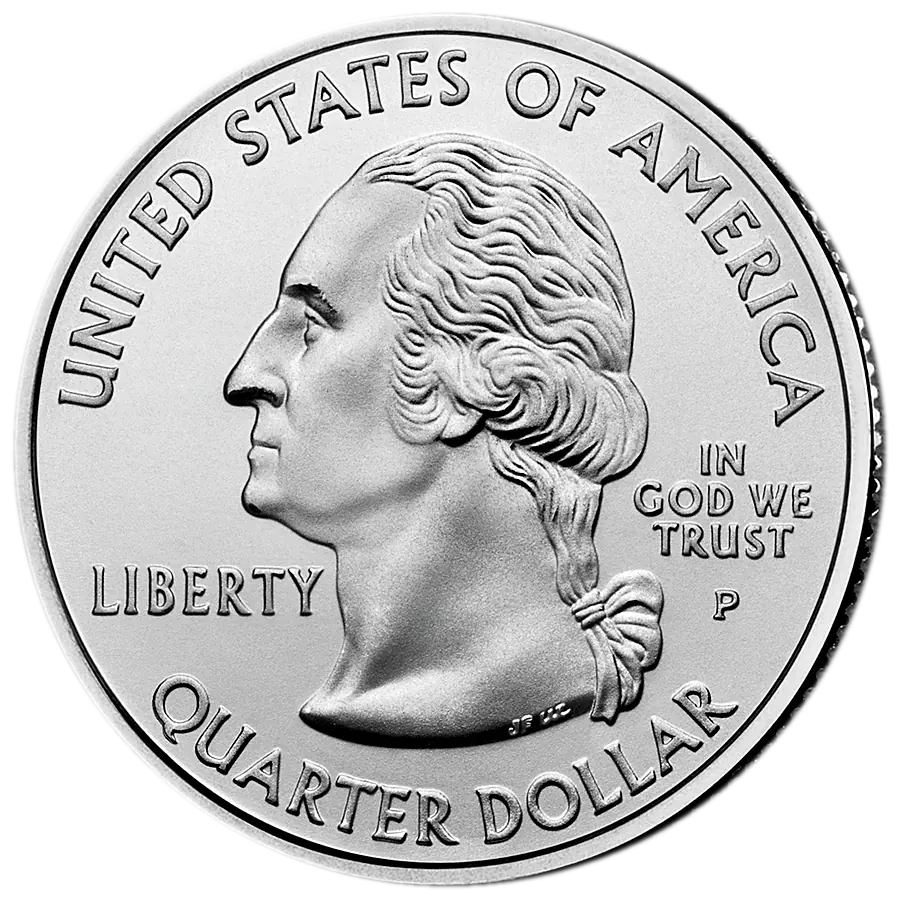
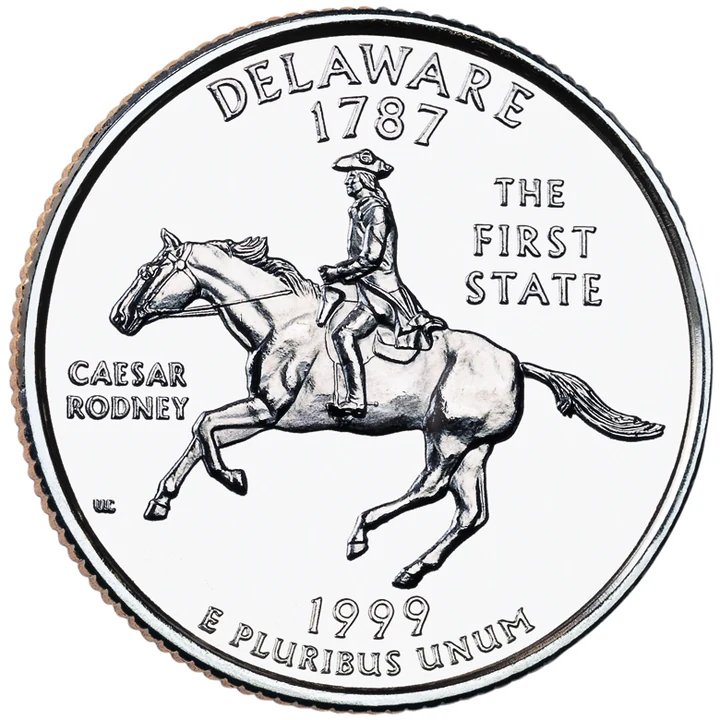
Exact Delaware reverse from the U.S. Mint; shared program obverse.
1 / 50release order
4mint/finish issues
P · D · Smint marks
1999release year
Story in 30 Seconds
The reverse shows Delaware delegate Caesar Rodney riding toward Philadelphia in July 1776, where he joined Thomas McKean to break the Delaware delegation’s deadlock in favor of independence.
Delaware chose a single moving figure to connect two claims of firstness: Rodney’s decisive independence vote and Delaware’s later status as the first state to ratify the Constitution. Residents could submit concepts; the Delaware Arts Council reviewed them and recommended five to Governor Thomas Carper before federal artistic and advisory review.
Collectors encounter four regular 1999 issues: P and D circulation strikes, an S copper-nickel clad proof, and an S 90% silver proof. The design has no variety listed in the current World Coin Book catalog; dramatic cracks, doubling, or off-center strikes require repeatable mint-made evidence, while scratches, flattened rims, staining, and plating experiments are damage.
Public Law 105-124 created five state reverses per year in constitutional-ratification or admission order. Delaware opened the program because it ratified the Constitution first. The challenge was to represent a whole state on one reverse; Delaware answered with one urgent action and one constitutional title.
Only two state facts are needed to decode the coin: Delaware separated from Britain in June 1776, and on December 7, 1787 it became the first state to ratify the Constitution. The reverse deliberately connects those milestones without depicting the state’s geography, economy, or later history.
The coin compresses a political crisis into one image. Delaware’s Continental Congress delegation was split: Thomas McKean supported independence and George Read opposed it. Caesar Rodney, away in Delaware, was summoned to Philadelphia and arrived in time to vote. The official state archive describes him as breaking the deadlock; the U.S. Mint frames the ride as the reason Delaware joined the independence majority.
The horse and rider emphasize urgency rather than a meeting room or document. That choice makes the action immediately legible on a small circulating coin, but it also leaves McKean, Read, the wider congressional debate, and Delaware’s already completed June 15 separation from Britain outside the frame. The coin is therefore a focused emblem, not a complete account of Delaware independence.
THE FIRST STATE shifts the story forward to December 7, 1787, when Delaware became the first state to ratify the Constitution. The 1776 ride and the 1787 inscription describe different events. Treating the motto as a caption for Rodney’s ride collapses eleven years of history.
Governor Thomas Carper’s Executive Order 51 encouraged Delaware residents to submit concepts and assigned the Delaware Arts Council to solicit and review them. The council had to consult historians, art and design experts, the Delaware Heritage Commission, the Delaware Historical Society, coin experts, and residents, then recommend five concepts to the governor.
The surviving federal review record shows four reverse designs before the Commission of Fine Arts on April 16, 1998. The commission approved Caesar Rodney on horseback as modified by the Citizens Commemorative Coin Advisory Committee, asked that FIRST STATE become THE FIRST STATE, requested a smaller CAESAR RODNEY label, questioned the horse’s leg anatomy, and warned that a quill might impair legibility.
The U.S. Mint states that each governor determined the state process, concepts went to the Mint and returned to the state for final selection, and the Treasury Secretary held final approval. The official records reviewed here establish resident participation and the five-to-four narrowing, but do not provide a complete public-submission list, vote tally, or authoritative visual inventory of every rejected design; those details remain unresolved.
Procedures varied by state and changed during the program; each researched state page must document its actual path.
Alternative Designs
Official records reviewed for this page document four designs at the federal art review but fully identify only the selected Rodney concept. A quill appears in the Commission of Fine Arts discussion, yet the record does not establish whether it was a separate finalist or an element of another composition. World Coin Book therefore does not name or illustrate additional finalists without stronger primary evidence.
Official explanation: The national motto remains on the reverse; WC is William Cousins’ artist signature.
Historical context: Cousins is officially credited as reverse designer and sculptor.
World Coin Book interpretation: The small peripheral lettering yields the visual center to the rider while preserving national authorship and program context.
1728–1784 Delaware statesman and Continental Congress delegate whose ride is pictured.
Thomas McKean
Delaware delegate whose call brought Rodney to the split independence vote.
George Read
Delaware delegate on the opposing side of the delegation’s deadlock.
Philadelphia
The Continental Congress destination implied by the horse’s movement, though no place is pictured.
December 7, 1787
The ratification event behind THE FIRST STATE and the date 1787.
Focused Timeline
Caesar Rodney is born near Dover
Delaware declares itself independent from Britain
Rodney reaches Philadelphia and breaks Delaware’s delegation deadlock
Delaware becomes the first state to ratify the Constitution
Public Law 105-124 authorizes the 50 State Quarters program
Executive Order 51 opens Delaware’s resident concept process
Commission of Fine Arts reviews four designs and recommends refinements
The Mint releases the Delaware quarter to the Federal Reserve
Official Explanation and Interpretation
Artists and relief
John Flanagan’s Washington portrait anchors the shared obverse. The U.S. Mint credits staff medallic artist William Cousins as both reverse designer and sculptor. The official record reviewed here does not assign final coin authorship to a state submitter, so this page does not convert secondary attribution disputes into a settled credit.
P and D are circulation issues. Both S issues were sold in proof products; the silver proof is a distinct 90% silver composition. Mintages are established catalog figures retained with an explicit source-audit note.
Identification Guide
Identify the reverse first: a single horse and rider, THE FIRST STATE above, DELAWARE and the two dates below. The P, D, or S mint mark is on the obverse to the right of Washington’s hair ribbon. P and D are circulation strikes; S coins are proofs. A copper-nickel clad proof shows a copper-colored core at the reeded edge, while the 90% silver proof lacks that copper stripe and weighs about 6.25 g rather than 5.67 g.
Condition Guide
On circulated pieces, inspect the rider’s head and torso, the horse’s shoulder and flank, and the highest parts of the legs for the first smoothing. On uncirculated coins, separate friction from flat strike by checking whether luster is broken. The open field around the horse readily shows contact marks; proof fields show hairlines, haze, spots, fingerprints, and loss of mirror contrast.
Strike sharpness can vary at the horse’s legs and fine rider details. Weakly defined relief without displaced metal is not automatically wear or an error. Grading remains an assessment of the individual coin, not a conclusion from these general checkpoints.
Mint Errors vs. Damage
Recognized catalog varieties: none are listed in the current World Coin Book Delaware issue records. This means no variety is asserted here; it does not prove that no die varieties exist.
Genuine mint errors can include off-center strikes, broadstrikes, clips, wrong-planchet strikes, and substantial die cracks, but attribution requires mint-made geometry, metal flow, weight, and repeatable diagnostics.
The so-called “Spitting Horse” is a nickname used for a raised die crack running from the horse’s mouth on some coins. A raised, continuous line produced by a cracked die is different from an incuse scratch. The nickname is not a separate official U.S. Mint issue and World Coin Book does not presently elevate it to a catalog variety without an adopted attribution source.
Scratches, gouges, flattened rims, dryer or spoon damage, stains, corrosion, glue, plating, and post-mint heat are damage. Machine doubling is flat and shelf-like; it should not be marketed as a doubled die without matching hub-doubling diagnostics.
Why Collectors Care
Durable value tiers
Worn P and D examples are normally collected as face-value program coins; original mint luster, unusually clean fields, strong strike, proof contrast, and intact government packaging can create collector premiums. Silver proofs also carry metal value. World Coin Book publishes no live Delaware price promise here: use the issue records as identification context, then compare recent dated references for the exact mint, finish, grade, and surface quality.
Official law and U.S. Mint records establish program facts and image identity. World Coin Book separates official explanation, historical analysis, and editorial interpretation.
Official descriptions, historical context, and World Coin Book interpretation are labeled separately. No live prices are asserted. Last verified:
The official sources reviewed do not publish the complete resident submission list or a definitive image set for every rejected finalist.
The precise public ballot totals and the relationship between any state artist’s sketch and William Cousins’ final relief remain attribution questions outside the confirmed official credit.
The current normalized mintages are retained from the established catalog; a future source audit should attach a direct U.S. Mint annual-production table to each figure.