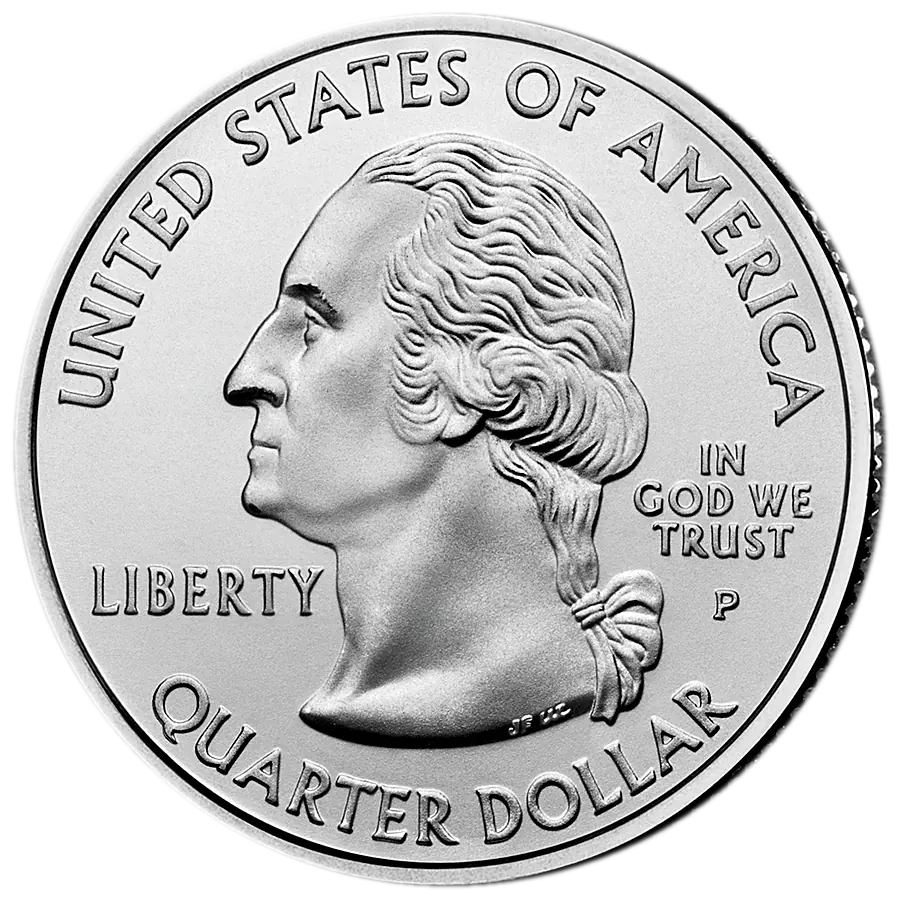
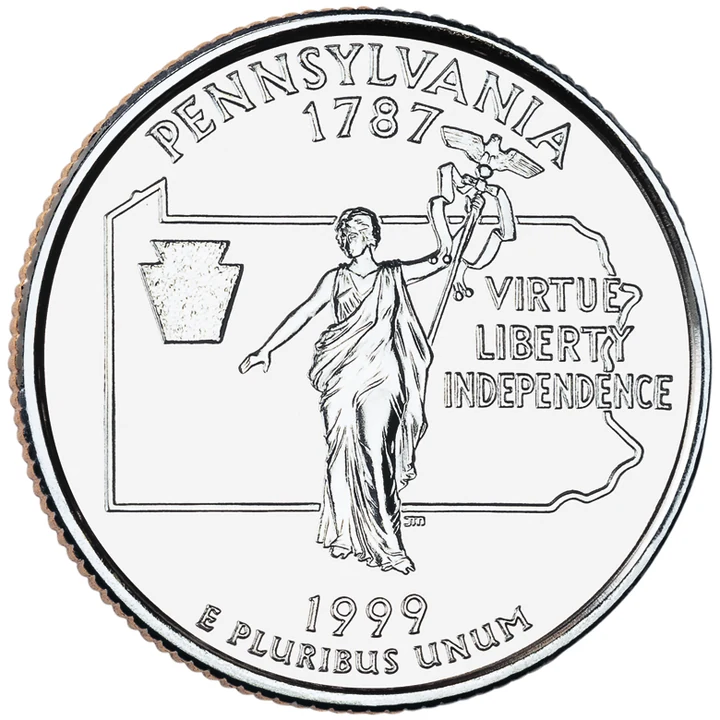
Exact Pennsylvania reverse from the U.S. Mint; shared program obverse.
2 / 50release order
4mint/finish issues
P · D · Smint marks
1999release year
Story in 30 Seconds
The reverse places Roland Hinton Perry’s gilded Commonwealth statue before Pennsylvania’s outline, beside the state motto VIRTUE LIBERTY INDEPENDENCE and above a keystone. The U.S. Mint explains the statue’s extended right arm as mercy and the ribbon mace in her left hand as justice.
Pennsylvania used a state Quarter Committee and invited public ideas before concepts entered the federal process. The Treasury’s published rules establish Mint coinability review, artistic development, Fine Arts Commission and Citizens Commemorative Coin Advisory Committee consultation, Treasury approval, return to the governor for state selection, and final Treasury approval. The surviving official sources reviewed here do not publish a complete submission list, finalist image set, vote tally, or full committee roster.
Collectors encounter P and D circulation strikes, an S copper-nickel clad proof, and an S 90% silver proof. The current World Coin Book records list no Pennsylvania design variety; genuine mint errors require displaced metal or repeatable die evidence, while scratches, flattened rims, stains, glue, plating, and dryer damage are post-mint damage.
Public Law 105-124 ordered five state reverses each year by constitutional-ratification or admission sequence. Pennsylvania, the second state to ratify the Constitution on December 12, 1787, therefore received release number two. Its design problem was unusually broad: represent a large, diverse commonwealth without reducing it to one city, battlefield, industry, or famous person.
Three state symbols unlock the reverse. “Commonwealth” is Pennsylvania’s traditional official designation, with no legal difference from “state.” The keystone is the central wedge that locks an arch; Pennsylvania’s official manual says the nickname was in common use soon after 1800 and that no single origin is settled. The motto VIRTUE, LIBERTY, AND INDEPENDENCE comes from the state coat of arms.
The design’s central figure is not a portrait of a historical Pennsylvanian. It is Commonwealth, Roland Hinton Perry’s allegorical female figure installed atop the Pennsylvania Capitol dome in Harrisburg in 1905. By lifting a state-building sculpture off its architectural setting and placing it on a coin, the reverse turns an object normally viewed from far below into the personification of the state itself.
The outline behind the statue tells the viewer that the figure stands for the entire state, while the keystone converts a nickname into a simple geometric sign. Together they avoid choosing between Philadelphia and Pittsburgh, agriculture and industry, Revolution and Civil War, or any one ethnic community. That breadth is the design’s strength, but also its omission: no ordinary Pennsylvanians, Indigenous nations, landscape, labor, migration, or specific event appears.
The U.S. Mint connects the keystone nickname to Pennsylvania’s strategic position during the Civil War. Pennsylvania’s own official manual is more cautious: it says the application cannot be traced to one source, records early-1800s political uses, and treats later origin stories as unresolved. The coin can securely be read as claiming centrality and structural importance; one neat origin legend should not replace the documented uncertainty.
VIRTUE LIBERTY INDEPENDENCE supplies values rather than a scene. The statue’s mercy and justice, the motto’s civic ideals, the state-shaped field, and the keystone’s structural metaphor create an institutional self-portrait. World Coin Book interpretation: the reverse presents Pennsylvania less as a collection of attractions than as a civic framework holding different histories together.
An official Pennsylvania Historical and Museum Commission record confirms that a Pennsylvania Quarter Committee worked on the 1999 design. Contemporary institutional and numismatic accounts describe a public call for ideas and a committee review, but the official online records located for this page do not preserve the complete notice, submission inventory, committee roster, scoring rules, or vote. Those details are not reconstructed from later summaries as if they were primary evidence.
The Treasury’s January 1998 process required each governor to send three to five concepts. The Mint screened them for appropriateness and coinability and created candidate designs. The Commission of Fine Arts was consulted and the Citizens Commemorative Coin Advisory Committee reviewed the candidates; the Treasury Secretary approved designs for return to the governor, the state made its final selection, and Treasury supplied final approval.
The selected composition joins four institutional symbols—Commonwealth, the state outline, the motto, and the keystone. Governor Tom Ridge made the state’s final selection under the federal framework. John Mercanti then carried the approved concept into the final reverse relief; the U.S. Mint credits him as reverse designer and sculptor. The sources reviewed do not establish which public submitter, if any, originated the exact combined composition.
Procedures varied by state and changed during the program; each researched state page must document its actual path.
Alternative Designs
Later accounts report thousands of public ideas and a narrowing to several concepts, and archival research has identified proposals ranging from familiar state products to a ruffed grouse and eastern hemlock. The official web-accessible records reviewed here do not supply a definitive finalist list or authenticated image set. World Coin Book therefore records that alternatives existed but does not label or display particular drawings as official finalists.
Use the complete text cards below as the keyboard and screen-reader equivalent of the image.
Commonwealth statue
Official explanation: The Mint identifies the Capitol-dome statue and says her extended right arm signifies mercy while the ribbon mace in her left hand signifies justice.
Historical context: Roland Hinton Perry’s gilded allegorical figure has stood above the Capitol dome since 1905.
World Coin Book interpretation: Her tall vertical silhouette becomes the visual axis and turns the state into a civic person rather than a landscape.
Official explanation: The Mint identifies the state outline as a principal reverse element.
Historical context: The map shape makes an allegorical figure specific to Pennsylvania without selecting one locality.
World Coin Book interpretation: The broad outline works as a shallow backdrop; the statue breaks its upper edge, making civic ideals appear larger than the border.
Official explanation: The Mint links the keystone to Pennsylvania’s Keystone State nickname.
Historical context: The official Pennsylvania Manual defines a keystone as the central wedge of an arch and says the nickname’s single origin is unresolved.
World Coin Book interpretation: Placed at the lowest center, it visually locks the composition together like the architectural object it represents.
The allegorical female statue on the Pennsylvania Capitol dome, shown as the personification of the state.
Roland Hinton Perry
American sculptor who created the architectural statue that the coin depicts.
Pennsylvania State Capitol
The Harrisburg building whose dome supports Commonwealth; the building itself is not pictured.
Keystone State
Pennsylvania’s long-used nickname, represented by the wedge-shaped architectural symbol.
December 12, 1787
The constitutional-ratification event represented by 1787 and release order two.
Virtue, Liberty, and Independence
Pennsylvania’s state motto, retained on the coin without translating or replacing its inscription.
Focused Timeline
Pennsylvania’s coat of arms carries the motto Virtue, Liberty, and Independence
Pennsylvania becomes the second state to ratify the Constitution
An early documented toast calls Pennsylvania a keystone in the federal union
Commonwealth is installed atop the Pennsylvania Capitol dome
Public Law 105-124 authorizes the 50 State Quarters program
Treasury publishes the governor-led state design process
The Pennsylvania Quarter Committee reviews public design ideas
The Mint records the first-day mintage used for commemorative covers
The Pennsylvania quarter enters Federal Reserve distribution and public circulation
Official Explanation and Interpretation
Artists and relief
John Flanagan’s Washington portrait remains on the shared obverse, adapted for the program by William Cousins. The U.S. Mint credits John Mercanti as reverse designer and sculptor. Mercanti translated the state-approved symbolic concept into coin relief, simplifying a tall architectural statue, map outline, motto, and keystone for a 24.26 mm field. The official sources reviewed do not assign final coin authorship to a public submitter.
P and D are circulation issues. Both S issues were sold in proof products; the silver proof is a distinct 90% silver composition. Mintages are established catalog figures retained with an explicit source-audit limit.
Identification Guide
Identify the reverse by the standing Commonwealth figure over the state outline, stacked VIRTUE LIBERTY INDEPENDENCE at right, and keystone below. P, D, or S appears on the obverse to the right of Washington’s hair ribbon. P and D are circulation strikes; S coins are proofs. A clad proof usually shows a copper core at the reeded edge, while the 90% silver proof lacks that stripe and weighs about 6.25 g rather than 5.67 g.
Condition Guide
On circulated coins, check Commonwealth’s head, chest, extended arm, mace, and the highest folds of the gown, then the high edges of the state outline and keystone. First wear smooths detail and interrupts luster. Weak relief with continuous luster is more consistent with strike softness than circulation wear.
The broad state-outline field and open spaces around the figure reveal contact marks, scrapes, and residue readily. Fine motto letters, the face and hands, mace details, and JM initials can be weak or obscured by marks. Proofs should be checked for hairlines, haze, spots, fingerprints, and reduced frost-to-mirror contrast. These are design-specific checkpoints, not a substitute for grading the individual coin.
Mint Errors vs. Damage
Recognized catalog varieties: none are listed in the current World Coin Book Pennsylvania issue records. This is an evidence limit, not proof that no die varieties exist.
Genuine mint errors may include off-center strikes, broadstrikes, clips, wrong-planchet strikes, struck-through material, or substantial die cracks. Confirm mint-made metal flow, weight, geometry, and repeatable die diagnostics before attribution.
Flat shelf-like doubling on letters is commonly mechanical or strike doubling, not a doubled die. A raised line may be a die crack, while an incuse line that cuts across relief is usually a scratch. Neither a dramatic appearance nor an online nickname creates a recognized variety.
Scratches, gouges, flattened or rolled rims, dryer damage, glue, stains, corrosion, plating, polishing, heat discoloration, and altered surfaces are post-mint damage. The state outline’s broad field makes such damage conspicuous and easy to mismarket as an error.
Why Collectors Care
Durable value tiers
Worn P and D examples usually occupy the face-value design-set tier. Better-preserved circulation coins can gain collector interest from full luster, clean state-outline fields, crisp motto letters, and strong statue detail. Clad proofs form a collector-product tier; silver proofs add 90% silver content and are a separate composition tier. Exceptional certified grades may behave differently, but World Coin Book gives no live price promise: compare dated references for the exact mint, finish, grade, strike, and surface quality.
Official law and U.S. Mint records establish program facts and image identity. World Coin Book separates official explanation, historical analysis, and editorial interpretation.
Official descriptions, historical context, and World Coin Book interpretation are labeled separately. No live prices are asserted. Last verified:
The official online records reviewed do not publish the complete public submission inventory, exact submission count, committee roster, scoring method, or vote tally.
A definitive official list and authenticated image set for all concepts returned for Pennsylvania’s final selection was not located; later archival summaries are useful leads but not substituted for that missing primary record.
The relationship between public proposals, the state committee’s combined concept, and John Mercanti’s final relief is not documented closely enough to credit a public submitter as final coin designer.
The normalized mintages remain established catalog figures; a future source audit should attach direct U.S. Mint annual-production evidence to each number.