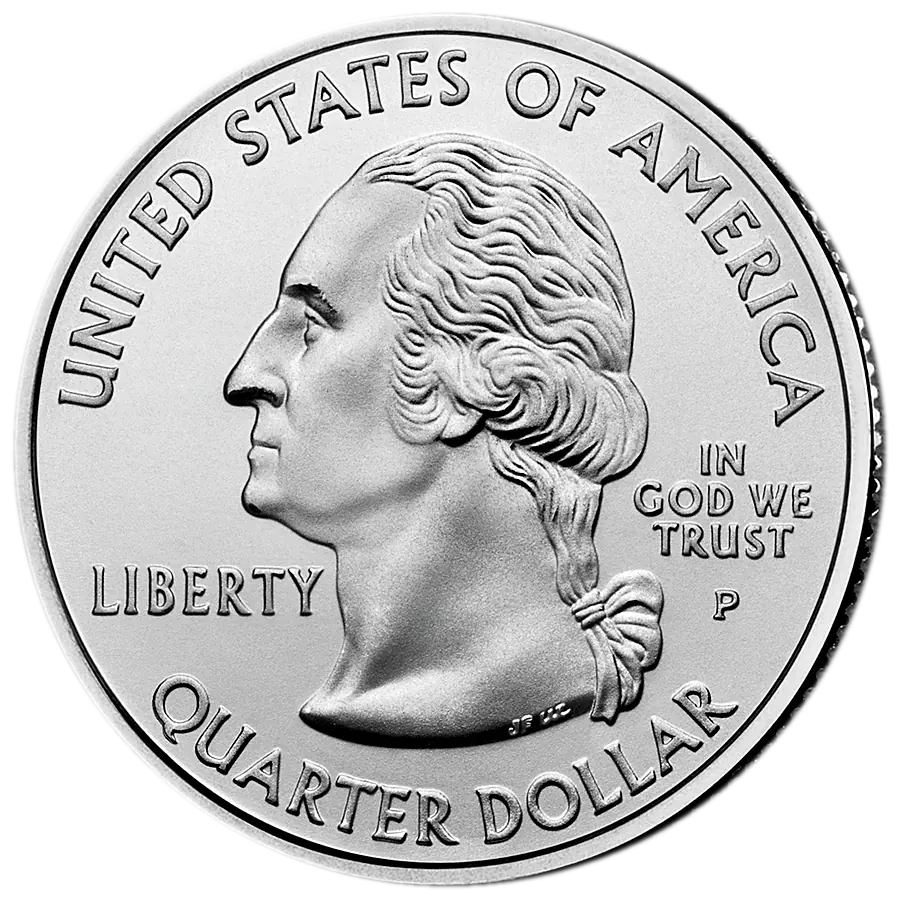
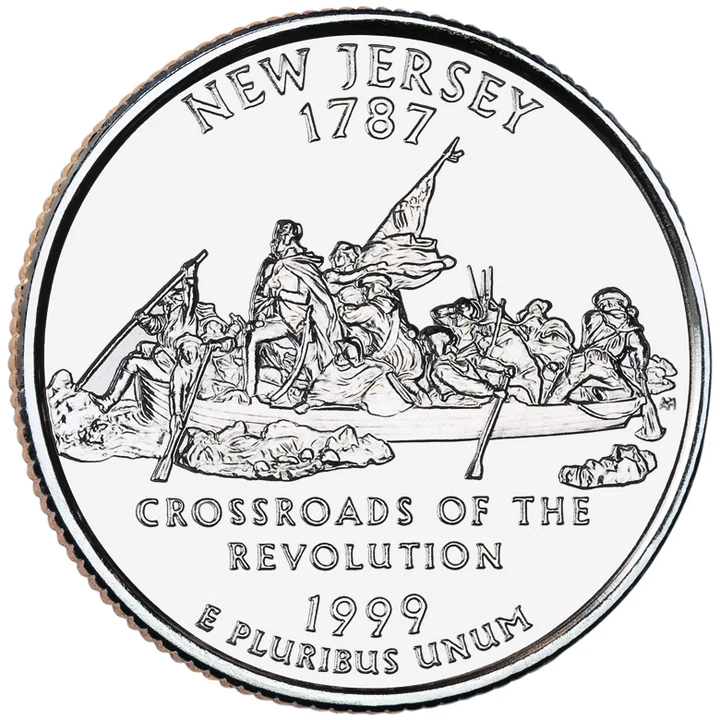
Exact New Jersey reverse from the U.S. Mint; shared program obverse.
3 / 50release order
4mint/finish issues
P · D · Smint marks
1999release year
Story in 30 Seconds
The reverse is Alfred Maletsky’s compact coin relief based on Emanuel Leutze’s 1851 painting Washington Crossing the Delaware. It represents General George Washington and Continental troops crossing on Christmas night 1776 before landing in New Jersey, marching to Trenton, and winning a morale-restoring victory on December 26.
New Jersey chose the crossing because it joined a nationally recognizable turning point to the state’s Revolutionary landscape and Crossroads of the Revolution identity. A 15-member public commission reviewed public ideas, consulted the Philadelphia Mint, and sent five documented concepts; after federal review, the commission selected the crossing design with Governor Christine Todd Whitman’s approval.
Collectors encounter P and D circulation strikes, an S copper-nickel clad proof, and an S 90% silver proof. No New Jersey variety is asserted in the current World Coin Book records; genuine mint errors need repeatable mint-made evidence, while scratches, flattened rims, stains, plating, and dryer damage are post-mint damage.
Public Law 105-124 placed New Jersey third because it was the third state to ratify the Constitution, on December 18, 1787. The one-reverse challenge was to represent a geographically and socially varied state. New Jersey selected a Revolutionary event whose decisive outcome unfolded on New Jersey ground, while the 1787 and 1999 inscriptions keep statehood order and modern issue date distinct.
Only a narrow state context is needed: the Continental Army crossed from Pennsylvania, landed on the New Jersey bank, marched about nine miles through a winter storm, and attacked the Hessian garrison at Trenton. Trenton and Princeton belong to the Ten Crucial Days that made New Jersey a crossroads of military movement. The coin does not depict the state’s shore, agriculture, industry, cities, later immigration, or everyday communities.
The historic crossing began on Christmas night, December 25, 1776. Boats and ferries carried troops, horses, and cannon from Pennsylvania to the New Jersey side in worsening sleet, hail, and snow. After landing, the army marched to Trenton and defeated the Hessian garrison on December 26. The success restored morale and opened the Ten Crucial Days culminating at Princeton; it was not itself the Battle of Trenton, and the coin freezes the approach rather than the fighting.
Emanuel Leutze painted Washington Crossing the Delaware in 1851, about seventy-five years after the event. His monumental history painting dramatizes Washington standing in a crowded boat amid angular ice and a prominent flag. It became a national icon, but it is an artistic interpretation, not an eyewitness record: the boat, flag, daylight, poses, and compressed group should not be read as a literal reconstruction of the night crossing.
Alfred Maletsky then translated the famous painting into a shallow 1999 relief. The coin crops away most of Leutze’s huge canvas, reduces atmosphere and distant boats, simplifies people and ice into readable masses, and fits the group beneath statutory inscriptions. World Coin Book interpretation: the left-to-right boat turns memory into forward motion toward New Jersey, while the slogan broadens one episode into a statewide Revolutionary identity.
New Jersey created its Commemorative Coin Design Commission by Joint Resolution No. 7 on December 30, 1997. Fifteen New Jersey residents—five appointed each by the governor, Senate president, and Assembly speaker—were chosen for backgrounds in history, art, and numismatics. The commission organized on February 24, elected Glen Beebe chair on March 3, and reviewed ideas previously sent by the public to the governor and secretary of state.
The commission set criteria of timelessness, clarity, recognizability, education, collectibility, and dignity. Members visited the Philadelphia Mint, learned the technical limits of coin relief, and asked to consult as Mint sculptor-engravers developed designs. On March 10 the commission approved five concepts: Washington Crossing the Delaware; a Revolutionary battle scene including women, Black, and white participants; Garden State agriculture; a turn-of-the-century beaches-and-boardwalks scene; and research and invention.
Treasury’s contemporary record says New Jersey submitted those five concepts, federal artistic and advisory review followed, and three approved designs returned. The commission, with Governor Christine Todd Whitman’s approval, selected Washington Crossing the Delaware; Treasury Secretary Robert Rubin accepted the recommendation. The official records establish public idea input but no statewide popular vote, and they do not identify a public submitter as designer of Maletsky’s final relief.
Procedures varied by state and changed during the program; each researched state page must document its actual path.
Alternative Designs
The official commission report documents all five submitted concepts, not merely unnamed possibilities. Besides the selected crossing, they were a Revolutionary battle scene with a cannon and inclusive participants, a Garden State produce basket with violets, a turn-of-the-century boardwalk scene with beachgoers and rolling chairs, and a research-and-invention allegory with laboratory vessel and light bulb. The report’s example images are concept references, not authenticated U.S. Mint finalist coin models; the three federally approved return designs are not completely identified in the reviewed record.
Official explanation: The reverse depicts Washington and Continental troops crossing the river on December 25, 1776.
Historical context: The actual operation carried men, horses, and cannon for hours through a severe winter storm before the march to Trenton.
World Coin Book interpretation: Overlapping bodies and diagonal oars create effort; simplified ice identifies danger without claiming documentary precision.
Official explanation: The Mint states that the coin design is based on Emanuel Leutze’s 1851 painting.
Historical context: Leutze used a later flag and daylight drama in a symbolic history painting made decades after the crossing.
World Coin Book interpretation: The small flag preserves immediate recognition of the famous composition while relief removes most painterly atmosphere.
Official explanation: The inscription presents New Jersey’s location and many Revolutionary engagements as the state identity attached to the scene.
Historical context: The crossing led into the Trenton and Princeton campaign on New Jersey ground; the slogan is broader than this one boat scene.
World Coin Book interpretation: Set below the boat, the slogan acts as the conclusion: one famous approach stands for a network of movements and battles.
Continental Army commander represented through Maletsky’s relief after Leutze’s painting.
Continental Army
The troops, boat crews, horses, and artillery involved in the crossing and Trenton campaign; only a small boat group appears.
Delaware River
The river crossed from Pennsylvania to the New Jersey landing area before the march to Trenton.
Trenton
The New Jersey objective and December 26 battle; the city and battle are implied, not pictured.
Emanuel Leutze
German-born American history painter whose 1851 composition supplied the coin’s visual framework.
Alfred Maletsky
U.S. Mint sculptor-engraver officially credited with the reverse design and sculpture.
Focused Timeline
Washington’s forces begin crossing from Pennsylvania to New Jersey
The Continental Army wins the Battle of Trenton
Victory at Princeton closes the Ten Crucial Days
New Jersey becomes the third state to ratify the Constitution
Emanuel Leutze completes the painting used as the coin’s visual source
New Jersey creates its 15-member coin design commission
The commission approves five concepts for Mint development
Treasury accepts New Jersey’s final design recommendation
The New Jersey quarter enters Federal Reserve distribution
Official Explanation and Interpretation
Artists and relief
John Flanagan’s Washington portrait, adapted for the program by William Cousins, appears on the shared obverse—so Washington is represented on both sides. Emanuel Leutze created the 1851 painting that supplied the reverse composition, but he did not design the coin. The U.S. Mint credits staff sculptor-engraver Alfred Maletsky as reverse designer and sculptor. Maletsky selected, cropped, simplified, and layered the painting’s figures for shallow relief; the official record reviewed does not credit a public submitter with final coin authorship.
P and D are circulation issues. Both S issues were sold in proof products; the silver proof is a distinct 90% silver composition. Mintages are established catalog figures retained with an explicit source-audit limit.
Identification Guide
Identify the reverse by Washington standing near the bow of a crowded boat, diagonal oars and ice, and CROSSROADS OF THE REVOLUTION below. P, D, or S appears on the obverse to the right of Washington’s hair ribbon. P and D are circulation strikes; S coins are proofs. A clad proof generally shows a copper core at the reeded edge, while the 90% silver proof lacks that stripe and weighs about 6.25 g rather than 5.67 g.
Condition Guide
On circulated coins, inspect Washington’s head, shoulder, coat, and forward leg, then the highest heads and shoulders of the clustered troops and the boat rim. First wear smooths those points and breaks luster. Softly struck fine faces, hands, flag details, oars, and AM initials can remain lustrous; that is strike weakness rather than wear.
The open sky and water fields show contact marks, scrapes, residue, and cleaning readily, while the crowded central relief can hide small hits. Check proofs for hairlines, haze, spots, fingerprints, and diminished frost-to-mirror contrast. Compare apparent missing oar, flag, face, or ice detail with known examples before calling a filled die or struck-through error.
Mint Errors vs. Damage
Recognized catalog varieties: none are listed in the current World Coin Book New Jersey issue records. This evidence limit does not prove that no die varieties exist.
Genuine mint errors may include off-center strikes, broadstrikes, clips, wrong-planchet strikes, struck-through material, retained cuds, or substantial die cracks. Confirm mint-made metal flow, weight, geometry, and repeatable die diagnostics.
Flat shelf-like doubling on inscriptions or boat details is usually mechanical or strike doubling, not a doubled die. A raised line can be a die crack; an incuse line crossing relief is normally a scratch. Weak or missing fine detail in the crowded relief may reflect strike pressure, die fill, or wear and needs comparison, not a viral nickname.
Scratches, gouges, flattened or rolled rims, dryer damage, glue, staining, corrosion, plating, polishing, heat discoloration, and altered surfaces are post-mint damage. The river field and thin oars make ordinary hits particularly easy to misread as dramatic errors.
Why Collectors Care
Durable value tiers
Worn P and D examples usually occupy the face-value design-set tier. Better-preserved circulation coins can gain collector interest from full luster, clean river fields, a strong central group, and crisp oars and lettering. Clad proofs form a collector-product tier; silver proofs add 90% silver content as a separate composition tier. Exceptional certified grades may differ, but World Coin Book gives no live price promise: compare dated references for the exact mint, finish, grade, strike, and surfaces.
Official law and U.S. Mint records establish program facts and image identity. World Coin Book separates official explanation, historical analysis, and editorial interpretation.
Official descriptions, historical context, and World Coin Book interpretation are labeled separately. No live prices are asserted. Last verified:
The reviewed official record says three federally approved designs returned to New Jersey but does not completely identify that three-design set or preserve authenticated Mint models for all three.
The commission report confirms public ideas but does not publish a complete submission inventory, exact total, or evidence of a statewide public vote; no vote total is asserted.
The exact step-by-step relationship among concept references, Mint candidate drawings, and Alfred Maletsky’s final relief is not documented closely enough to assign final authorship beyond the Mint’s official credit.
The normalized mintages remain established catalog figures; a future source audit should attach direct U.S. Mint annual-production evidence to each number.