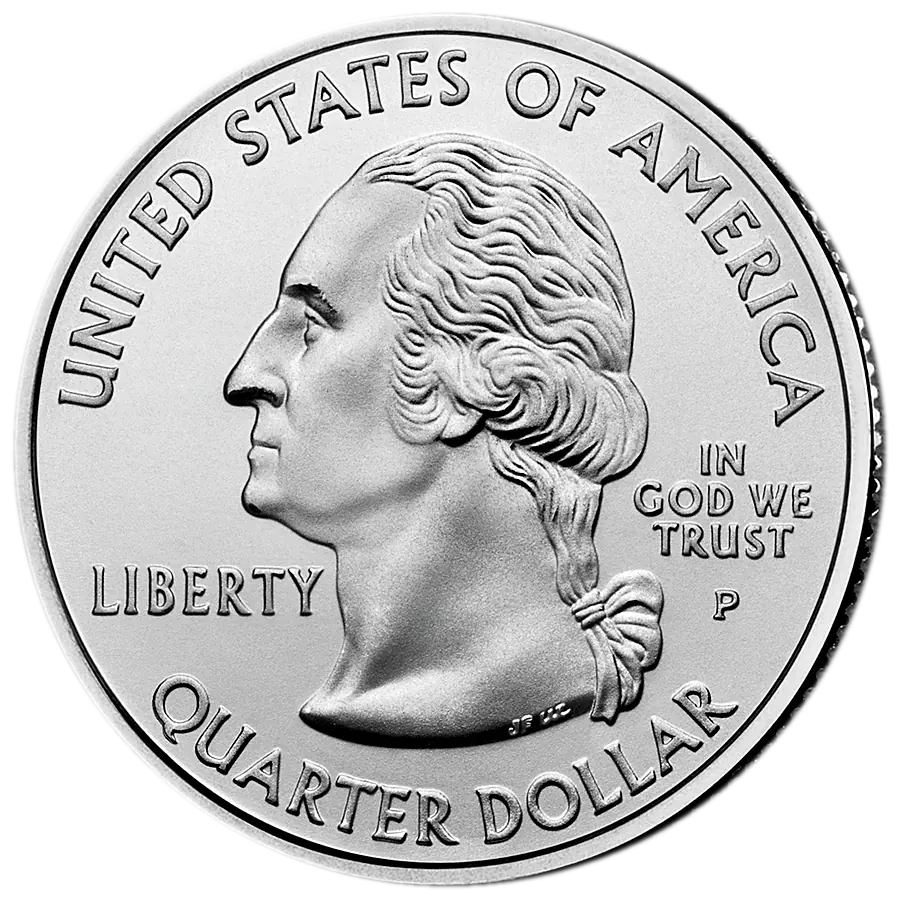
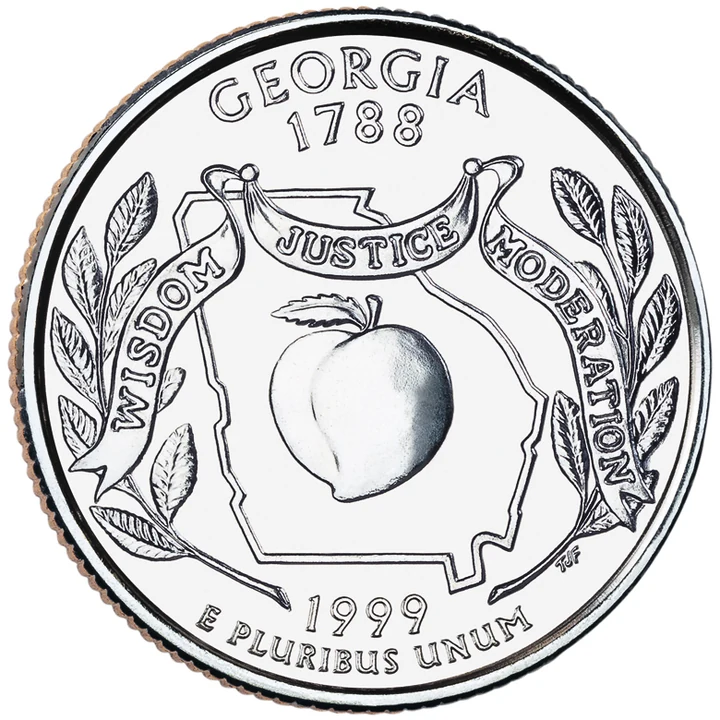
Exact Georgia reverse from the U.S. Mint; shared program obverse.
4 / 50release order
4mint/finish issues
P · D · Smint marks
1999release year
Story in 30 Seconds
The reverse places a peach inside Georgia’s outline, frames it with live-oak sprigs, and drapes the state motto Wisdom, Justice, Moderation above. The U.S. Mint identifies the peach as a state symbol and the live oak as the state tree.
Georgia selected a compact emblem rather than one person or event. Governor Zell Miller asked the Georgia Council for the Arts to develop and select the design; the council submitted five concepts, federal reviewers evaluated candidate designs, and Miller and the council made the state’s final selection before Treasury approval.
Collectors encounter P and D circulation strikes, an S copper-nickel clad proof, and an S 90% silver proof. World Coin Book asserts no recognized Georgia variety; the outline’s simplified northwest corner, flat peach details, scratches, plating, and dryer damage are not errors without mint-made evidence.
Public Law 105-124 placed Georgia fourth because it was the fourth state to ratify the Constitution, on January 2, 1788. A single reverse could not represent the state’s full geography, Indigenous and colonial history, slavery and Civil War history, civil-rights leadership, cities, coast, mountains, agriculture, and industry. Georgia instead chose a readable cluster of established state emblems and civic language.
Only a narrow context is needed to read the coin. Georgia’s Peach State identity grew from commercial peach culture after the Civil War, although Georgia is not always the nation’s largest peach producer. The live oak evokes the coastal plain and maritime landscape as well as its legal status as state tree. Wisdom, Justice, Moderation belongs to Georgia’s civic seal tradition. Together these symbols claim agricultural recognition, natural endurance, geographic identity, and constitutional government without narrating one historical episode.
The peach is the visual center because the fruit had become Georgia’s most portable nickname and marketing identity. Institutional history places the Peach State reputation in the decades after the Civil War, when commercial orchards, improved varieties, rail shipment, and access to eastern markets expanded the crop’s fame. The coin therefore represents a constructed economic identity, not a claim that peaches began in Georgia or that Georgia always leads national production.
Two live-oak sprigs broaden that agricultural emblem toward the state’s natural landscape. Their dense leaves curve inward like a wreath, stabilizing the peach and outline. Live oak is especially associated with Georgia’s coastal environment, but the reverse does not show a complete tree, habitat, mountain, river, city, or coast; it uses clipped botanical emblems instead of landscape.
The banner adds government to fruit and geography. Georgia’s official digital-seal guidance links Wisdom, Justice, Moderation to the constitutional principles traditionally represented by the state seal’s three pillars. World Coin Book interpretation: placing the motto over the state outline makes those principles a canopy for the whole state, while the centered peach supplies immediate popular recognition. The result is inclusive in the abstract but omits named people and the conflicts through which Georgia history developed.
Treasury’s contemporary record says Governor Zell Miller asked the Georgia Council for the Arts to develop and select Georgia’s quarter design. The council submitted five design concepts. The reviewed official sources do not publish who proposed each concept, the council roster or scoring method, a complete submission inventory, or evidence of a statewide public vote.
The federal process invited governors to send state concepts to the U.S. Mint. Mint artists developed coinable candidates; the Mint, Citizens Commemorative Coin Advisory Committee, and Commission of Fine Arts reviewed them. Treasury Secretary Robert Rubin approved three to five candidate designs for each state and returned them to the governor for the state selection.
Treasury records that Miller and the council made Georgia’s final selection and that Rubin retained final approval. The Mint’s release later described agreement by Governor Roy Barnes and the Georgia Council for the Arts; Barnes had succeeded Miller before the coin entered circulation. Read together, the records distinguish concept-era selection under Miller from release-era endorsement under Barnes, but they do not document every refinement from concept drawing to T. James Ferrell’s relief.
Procedures varied by state and changed during the program; each researched state page must document its actual path.
Alternative Designs
Official Treasury evidence establishes five Georgia concepts and three-to-five federally approved candidates, but the reviewed record does not name all concepts, identify the returned finalist set, preserve authenticated images, or report a vote. World Coin Book therefore does not repeat secondary finalist lists or display unverified drawings. The selected concept is the only candidate described here as documented at design level.
Use the complete text cards below as the keyboard and screen-reader equivalent of the image.
Peach and leaf
Official explanation: The Mint identifies the central fruit as the beloved Georgia peach and a state symbol.
Historical context: Georgia’s Peach State identity expanded with commercial orchards, transport, and marketing after the Civil War; the fruit is now the state fruit.
World Coin Book interpretation: Its large round mass gives the small coin one immediate focal point; the leaf prevents the fruit from becoming a generic circle.
Official explanation: The Mint says the peach appears within a silhouette outline of Georgia.
Historical context: The outline locates otherwise portable symbols in one state; it is a relief emblem, not a survey map or county-boundary chart.
World Coin Book interpretation: The outline works as a shield-like field behind the peach. Small edge simplifications should not be turned into geographic or mint-error claims.
Official explanation: The inscriptions identify the state, ratification year, issue year, and national motto; TJF is T. James Ferrell’s signature.
Historical context: The 1788 date marks Georgia’s fourth-place constitutional ratification, not the origin date of the peach or live oak symbols.
World Coin Book interpretation: Peripheral dates anchor the botanical center in program chronology while the tiny signature records the Mint artist’s authorship.
Fruit emblem tied to Georgia’s post-Civil War commercial orchards and Peach State identity.
Live oak
Georgia’s state tree, represented by two sprigs rather than a full tree or landscape.
Wisdom, Justice, Moderation
Georgia civic motto and constitutional principles associated with the state seal’s three pillars.
Georgia Council for the Arts
State body asked by Governor Zell Miller to develop and select the quarter design.
Zell Miller
Governor who initiated the council-led concept and selection process.
T. James Ferrell
U.S. Mint sculptor-engraver officially credited as reverse designer and sculptor.
Focused Timeline
Georgia becomes the fourth state to ratify the Constitution
Georgia adopts the Great Seal tradition later associated with the three civic principles
Commercial peach culture builds Georgia’s Peach State identity
Georgia designates the live oak as state tree
Georgia designates the peach as state fruit
Public Law 105-124 authorizes the 50 State Quarters program
Treasury accepts Georgia’s final design recommendation
The Mint ships Georgia quarters to the Federal Reserve
Official Explanation and Interpretation
Artists and relief
John Flanagan’s Washington portrait, adapted for the program by William Cousins, appears on the shared obverse. The U.S. Mint credits staff sculptor-engraver T. James Ferrell as both designer and sculptor of the Georgia reverse. Ferrell organized the state outline, peach, sprigs, banner, inscriptions, and shallow relief into a coinable hierarchy. The reviewed official record does not name a public concept submitter or document enough intermediate drawings to divide final authorship beyond the Mint’s credit.
P and D are circulation issues. Both S issues were sold in proof products; the silver proof is a distinct 90% silver composition. Mintages are established catalog figures retained with an explicit source-audit limit.
Identification Guide
Identify the reverse by the central peach inside Georgia’s outline, paired live-oak sprigs, and the Wisdom, Justice, Moderation banner. The P, D, or S mint mark is on the obverse to the right of Washington’s hair ribbon. P and D are circulation strikes; S coins are proofs. A clad proof shows a copper-colored core at the reeded edge, while the 90% silver proof lacks that stripe and weighs about 6.25 g rather than 5.67 g.
Condition Guide
On circulated pieces, inspect the peach’s rounded center and leaf, the banner folds and lettering, and the highest leaves of the oak sprigs for first smoothing. Confirm wear by broken luster across high points; softly struck or grease-filled details can remain flat without circulation friction.
The open fields around the outline and between the sprigs readily show contact marks. Fine leaf veins, motto letters, the peach cleft and stem, and the narrow northwest outline can be weak or obscured. Proofs should be checked for hairlines, haze, spots, fingerprints, impaired mirrors, and reduced frost rather than graded from cameo contrast alone.
Mint Errors vs. Damage
Recognized catalog varieties: none are listed in the current World Coin Book Georgia issue records. This is an evidence boundary, not proof that no die varieties exist.
Genuine mint errors may include off-center strikes, broadstrikes, clips, wrong-planchet strikes, retained cuds, struck-through material, or substantial die cracks. Attribution requires mint-made metal flow, weight, geometry, and repeatable die evidence.
The viral claim that the coin accidentally omits Dade County treats a tiny stylized relief outline as a survey map. The reviewed official Mint and Georgia sources do not identify an omission or error. A simplified northwest corner is part of the approved design unless a specific coin shows displaced or missing metal from production.
Flat peach or motto details may result from weak strike, die wear, or grease-filled dies; shelf-like doubling is usually mechanical doubling. Scratches, gouges, flattened rims, dryer damage, corrosion, stains, glue, plating, polishing, and heat color are post-mint damage.
Why Collectors Care
Durable value tiers
Worn P and D examples usually occupy the face-value design-set tier. Better circulation coins can gain collector interest from full luster, clean fields, a well-defined peach, complete motto letters, and crisp oak leaves. Clad proofs form a collector-product tier; silver proofs add 90% silver content as a separate composition tier. Exceptional certified grades may differ, but World Coin Book gives no live price promise: compare dated references for the exact mint, finish, grade, strike, and surfaces.
Official law and U.S. Mint records establish program facts and image identity. World Coin Book separates official explanation, historical analysis, and editorial interpretation.
Official descriptions, historical context, and World Coin Book interpretation are labeled separately. No live prices are asserted. Last verified:
The reviewed official record establishes five state concepts and three-to-five federally approved candidates but does not publish a complete concept list, authenticated finalist image set, council roster, scoring record, or vote tally.
No official evidence of a statewide popular vote was located. The exact level and form of public idea participation remain unresolved and no submitter is credited as final coin designer.
The step-by-step relationship among council concepts, Mint candidate drawings, federal refinements, and T. James Ferrell’s final relief is not documented closely enough to assign authorship beyond the Mint’s official credit.
The normalized mintages remain established catalog figures; a future source audit should attach direct U.S. Mint annual-production evidence to each number.