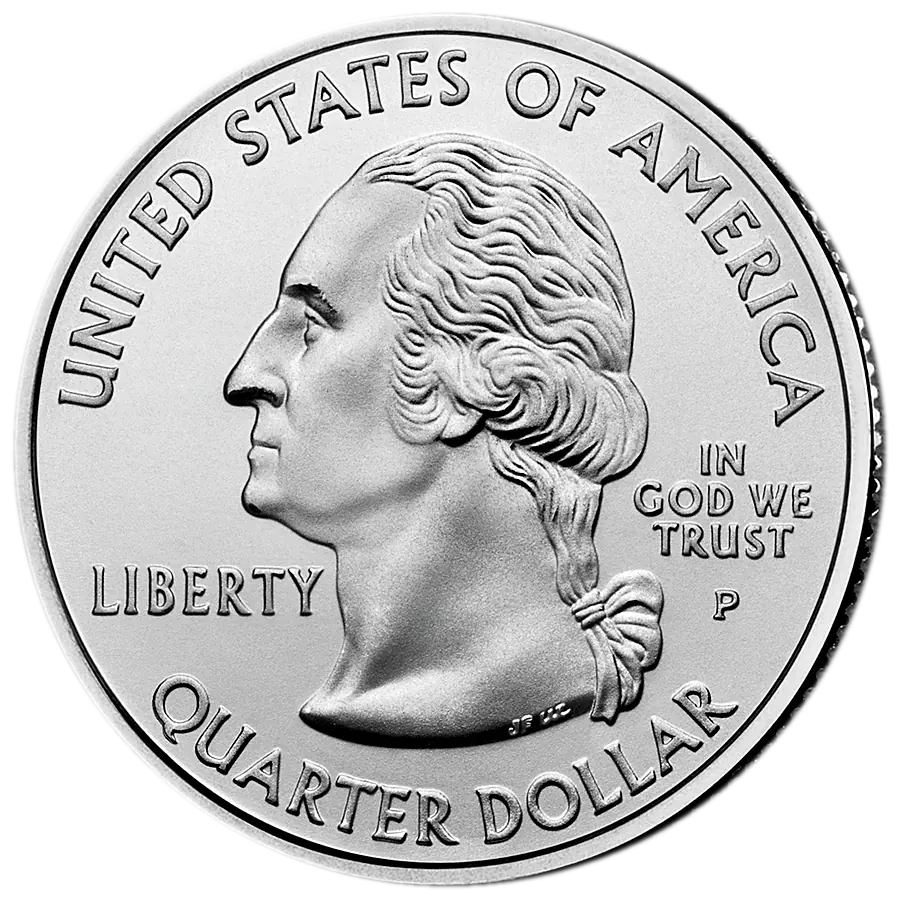
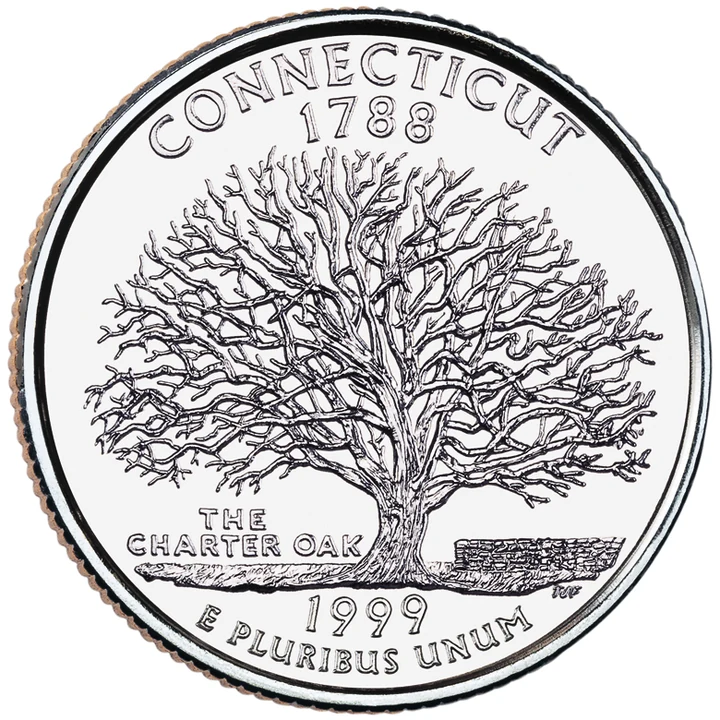
Exact Connecticut reverse from the U.S. Mint; shared program obverse.
5 / 50release order
4mint/finish issues
P · D · Smint marks
1999release year
Story in 30 Seconds
The reverse shows the Charter Oak, a white oak that stood on Hartford’s Wyllys estate until 1856. Connecticut tradition says Captain Joseph Wadsworth hid the colony’s 1662 royal charter in its hollow during Sir Edmund Andros’s 1687 attempt to take control of the colony.
Governor John G. Rowland opened the Connecticut Coin Design Competition to state residents. Concepts went to the Connecticut Commission on the Arts; five renditions of one concept advanced, and a review committee selected the final state design with the governor’s approval. A state page identifies Andy Jones of Hampton as the submitter of the Charter Oak concept.
Collectors encounter P and D circulation strikes, an S copper-nickel clad proof, and an S 90% silver proof. World Coin Book asserts no recognized Connecticut variety; flat leaves, weak lettering, stains, scratches, plating, and dryer damage are not errors without mint-made evidence.
Public Law 105-124 placed Connecticut fifth because it was the fifth state to ratify the Constitution, on January 9, 1788. One reverse could not represent the state’s Indigenous past and present, colonial settlement, maritime and industrial history, cities, landscapes, immigration, or unequal paths to political participation. Connecticut chose one compact political-natural emblem: a vanished tree whose legend came to stand for chartered rights and self-rule.
Connecticut’s official name as the Constitution State and its statutory white-oak state tree make the reverse unusually close to the state’s civic identity. The 1662 charter granted broad local government under the Crown and remained Connecticut’s governing framework after independence until the 1818 constitution. The quarter’s 1788 date instead marks ratification of the federal Constitution. Those documents and dates are related through self-government, but they are not interchangeable.
The story begins with Connecticut’s 1662 royal charter, obtained from King Charles II. When King James II consolidated New England under Sir Edmund Andros, Connecticut leaders resisted surrendering it. Tradition places the confrontation in Hartford on October 31, 1687: the room went dark, the charter disappeared, and Joseph Wadsworth carried it to a hollow oak on the Wyllys estate.
That dramatic sequence is a legend, not a fully documented eyewitness account. Connecticut State Library-associated historical analysis says contemporary evidence for Wadsworth’s action is lacking and that the familiar story developed and accumulated detail later. Connecticut nevertheless entered the Dominion of New England; the charter’s disappearance did not simply defeat Andros on the spot. The durable meaning lies in how later generations used the tree to express resistance, chartered rights, and representative self-government.
The oak itself eventually eclipsed the people and paper in public memory. It fell in a storm on August 21, 1856, after which its wood became civic relics and its image circulated in paintings, stamps, and coins. World Coin Book interpretation: T. James Ferrell’s broad canopy and exposed roots make endurance the visual subject. Yet the coin omits the charter, Wadsworth, Andros, the Wyllys estate, Indigenous histories of the land, and the limits of participation under colonial government. It presents a state memory, not the entire event.
Treasury’s contemporary record says Governor John G. Rowland held the Connecticut Coin Design Competition and encouraged every state resident to submit concepts to the Connecticut Commission on the Arts. The state Department of Banking page identifies Andy Jones of Hampton as the submitter of the Charter Oak concept. The reviewed sources do not provide the total submission count, all submitter names, judging rubric, or a public vote.
Treasury says five renditions of a single design concept were selected. The Connecticut Commemorative Coin Design Competition Review Committee, with Rowland’s approval, selected the final state design. This wording documents public concept participation and committee selection, but not five different subjects or a statewide ballot.
Under the federal process, the Mint converted state concepts into coinable drawings; Mint staff, the Citizens Commemorative Coin Advisory Committee, and Commission of Fine Arts reviewed candidates. Treasury Secretary Robert Rubin accepted Connecticut’s recommendation and retained final approval. The surviving official summary does not map Andy Jones’s submission through each of the five renditions to T. James Ferrell’s final relief.
Procedures varied by state and changed during the program; each researched state page must document its actual path.
Alternative Designs
The official record documents five renditions of one Charter Oak concept, not five named alternative subjects. No authenticated complete rendition set, artist-by-rendition list, scoring sheet, or vote tally was located. World Coin Book therefore displays no supposed finalists and does not convert undocumented secondary lists into fact.
Use the complete text cards below as the keyboard and screen-reader equivalent of the image.
Spreading white-oak canopy
Official explanation: The Mint identifies the full tree as the Charter Oak, the white oak associated with the hiding of Connecticut’s charter.
Historical context: Connecticut law designates white oak as the state tree; the specific Charter Oak fell in 1856.
World Coin Book interpretation: The canopy fills most of the field and reads as shelter, reach, and continuity; its asymmetry keeps the static subject alive.
Official explanation: The official narrative identifies the tree’s hollow as the charter’s legendary hiding place.
Historical context: The coin does not show the document or reenact the candlelit episode; institutional history warns that direct contemporary evidence is lacking.
World Coin Book interpretation: The heavy trunk and exposed roots make rooted government—not a chase scene—the compositional center.
The Hartford white oak transformed by state memory into an emblem of chartered rights and self-government.
Connecticut Charter of 1662
Royal charter granting Connecticut broad local government; it remained the governing framework until 1818.
Joseph Wadsworth
Colonial officer traditionally credited with hiding the charter; direct contemporary evidence for the act is lacking.
Sir Edmund Andros
Royal governor who sought control of Connecticut under the Dominion of New England.
Andy Jones
Hampton resident identified by Connecticut as submitter of the selected Charter Oak concept.
T. James Ferrell
U.S. Mint sculptor-engraver officially credited as reverse designer and sculptor.
Focused Timeline
Connecticut formally receives its royal charter from Charles II
Andros confronts Connecticut leaders; the legendary Charter Oak episode is placed on this night
Connecticut becomes the fifth state to ratify the U.S. Constitution
Connecticut adopts a state constitution replacing the 1662 charter as its governing framework
The Charter Oak falls in a storm and its wood becomes civic memorial material
Connecticut designates white oak as the state tree
Public Law 105-124 authorizes the 50 State Quarters program
Treasury accepts Connecticut’s final design recommendation
The Mint releases Connecticut’s quarter to the Federal Reserve system
Official Explanation and Interpretation
Artists and relief
John Flanagan’s Washington portrait, adapted for the program by William Cousins, appears on the shared obverse. Connecticut identifies Andy Jones of Hampton as submitter of the selected Charter Oak concept. The U.S. Mint credits staff sculptor-engraver T. James Ferrell as reverse designer and sculptor; he translated a full spreading oak, roots, label, dates, and required inscriptions into shallow coin relief. The reviewed record does not identify the makers of all five renditions or document each production refinement, so concept submission and final Mint authorship remain distinct credits.
P and D are circulation issues. Both S issues were sold in proof products; the silver proof is a distinct 90% silver composition. Mintages are established catalog figures retained with an explicit source-audit limit.
Identification Guide
Identify the reverse by the single spreading Charter Oak and THE CHARTER OAK beneath its roots. The P, D, or S mint mark is on the obverse to the right of Washington’s hair ribbon. P and D are circulation strikes; S coins are proofs. A clad proof shows a copper-colored core at the reeded edge, while the 90% silver proof lacks that stripe and weighs about 6.25 g rather than 5.67 g.
Condition Guide
On circulated pieces, inspect the broad central trunk, upper root ridges, and the highest leaf clusters for first smoothing. Confirm wear through broken luster across high points; individually flat leaves or weak letters may reflect strike pressure, die wear, or grease rather than circulation.
The open fields around the canopy and beside the trunk readily show contact marks. Fine twig gaps, leaf texture, root lines, THE CHARTER OAK, and peripheral letters can be incomplete. Proofs should be checked for hairlines, haze, spots, fingerprints, impaired mirrors, and diminished frost rather than judged from cameo contrast alone.
Mint Errors vs. Damage
Recognized catalog varieties: none are listed in the current World Coin Book Connecticut issue records. This is an evidence boundary, not proof that no die varieties exist.
Genuine mint errors may include off-center strikes, broadstrikes, clips, wrong-planchet strikes, retained cuds, struck-through material, or substantial die cracks. Attribution requires mint-made metal flow, weight, geometry, and repeatable die evidence.
A leaf, branch, root, or letter that seems missing is not a secret design, extra tree, or rare variety by itself. Weak strike, die polishing, die wear, or grease-filled recesses can suppress shallow detail; shelf-like doubling is usually mechanical doubling. Claims that the tree proves the 1687 hiding as eyewitness fact confuse the coin’s official narrative with the legend’s evidence status.
Scratches through branches, gouged trunks, flattened rims, dryer damage, corrosion, stains, glue, plating, polishing, and heat color are post-mint damage. An apparent extra branch or doubled leaf needs raised, repeatable die evidence rather than displaced metal or image sharpening.
Why Collectors Care
Durable value tiers
Worn P and D examples usually occupy the face-value design-set tier. Better circulation coins can gain collector interest from full luster, clean fields, a sharply separated canopy, complete root lines, and readable inscriptions. Clad proofs form a collector-product tier; silver proofs add 90% silver content as a separate composition tier. Exceptional certified grades may differ, but World Coin Book gives no live price promise: compare dated references for the exact mint, finish, grade, strike, and surfaces.
Official law and U.S. Mint records establish program facts and image identity. World Coin Book separates official explanation, historical analysis, and editorial interpretation.
Official descriptions, historical context, and World Coin Book interpretation are labeled separately. No live prices are asserted. Last verified:
The reviewed official record does not publish the total concept count, complete submitter list, committee roster, judging rubric, or any vote tally. No statewide public ballot is asserted.
Treasury records five renditions of one concept, but no authenticated complete rendition set or artist-by-rendition record was located.
The route from Andy Jones’s concept through those renditions, federal review, and T. James Ferrell’s final relief is not documented closely enough to divide authorship beyond the separate official credits.
The exact 1687 hiding episode and Wadsworth’s role lack contemporary corroboration. The page treats them as enduring tradition and legend, not proven eyewitness fact.
The normalized mintages remain established catalog figures; a future source audit should attach direct U.S. Mint annual-production evidence to each number.