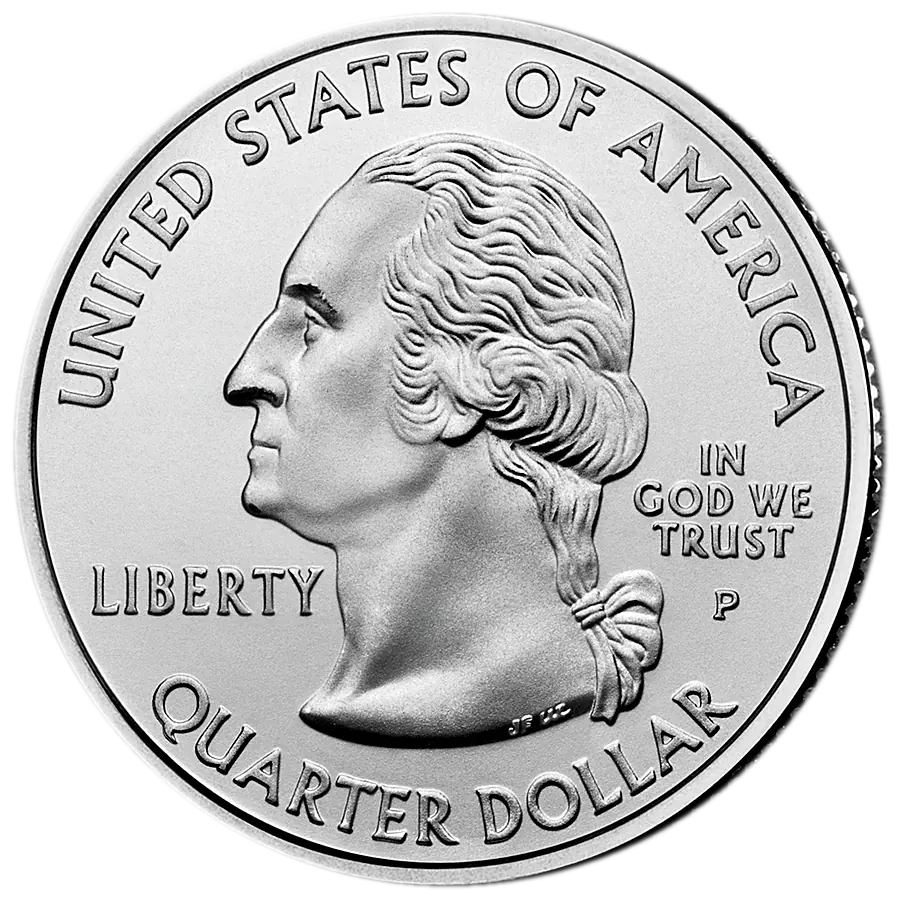
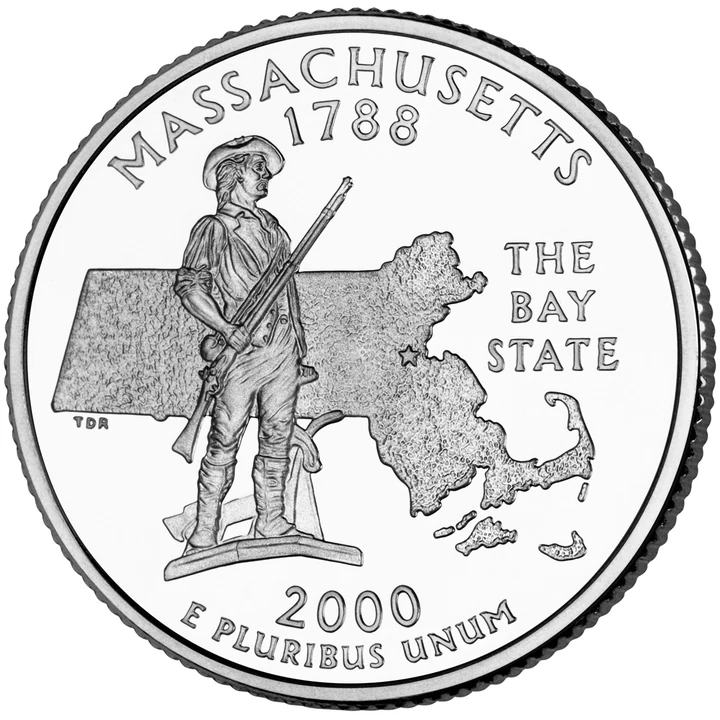
Exact Massachusetts reverse from the U.S. Mint; shared program obverse.
6 / 50release order
4mint/finish issues
P · D · Smint marks
2000release year
Story in 30 Seconds
The reverse adapts Daniel Chester French’s 1875 Minute Man statue at Concord’s North Bridge, places it before an outline of Massachusetts, marks Boston with a star, and adds THE BAY STATE.
Governor Paul Cellucci opened a contest to Massachusetts elementary-school pupils. More than 100 school entries reached his office; a ten-member advisory panel narrowed them to five. The Mint identifies Xander Kotsatos and Kathleen Raughtigan as submitters of the winning Minuteman concept, which Cellucci announced in June 1999 before final federal approval.
Collectors encounter P and D circulation strikes, an S copper-nickel clad proof, and an S 90% silver proof. World Coin Book asserts no recognized Massachusetts variety; apparent extra fingers, doubled weapons, missing map lines, plating, scratches, and flattened rims need mint-made evidence before being called errors.
Public Law 105-124 placed Massachusetts sixth because it ratified the Constitution sixth, on February 6, 1788. A single reverse could not represent the Commonwealth’s Indigenous nations, maritime economy, abolition, immigration, industry, education, landscapes, cities, or the full complexity of Revolution. The selected design chose one already familiar memorial image to make citizen readiness and the state’s Revolutionary role legible at coin scale.
Massachusetts calls itself a Commonwealth, while THE BAY STATE is a longstanding nickname rather than its constitutional name. The quarter links Boston, marked by a star, with Concord’s North Bridge, where colonial militia and minute companies confronted British regulars on April 19, 1775. The map unifies those places, but the statue is an 1875 centennial memorial—an ideal figure created a century after the fighting—not a portrait of one documented combatant.
French’s statue stands near Concord’s North Bridge, where provincial forces returned British fire on April 19, 1775. Unveiled for the battle’s centennial in 1875, the bronze was cast from Civil War cannon. French represented an ideal farmer-citizen-patriot: musket in one hand, the other resting on a plow, coat left on the implement, and body poised to move from ordinary labor to communal defense.
The quarter greatly simplifies that monument. Thomas D. Rogers retained the advancing figure but omitted the plow, coat, pedestal, bridge, river, Emerson inscription, and surrounding battlefield. The result reads more immediately as an armed Minuteman, yet loses French’s strongest visual statement that the citizen has just left civilian work. It also compresses Lexington, Concord, militia, minute companies, and the broader Revolution into one male martial emblem.
World Coin Book interpretation: the figure overlaps the map so memory becomes geography, while Boston’s star balances a Concord monument with the state capital. THE BAY STATE broadens the image from one battlefield to statewide identity. What remains outside the frame includes women, free and enslaved Black residents, Indigenous communities, Loyalists, noncombatants, and the long political consequences of Revolution. The coin is a selective civic memory, not a complete social history.
Cellucci’s Executive Order 402 made every public, private, and parochial elementary school eligible to submit one design by June 1, 1998. Each school could choose its own internal process, but student-generated ideas and study of Commonwealth history and culture were required. This was structured school participation, not a statewide popular vote.
The order created a ten-member advisory panel: representatives of the Massachusetts Historical Society, Massachusetts Art Commission, Department of Education, and Secretary of the Commonwealth; one elementary history teacher; and five regionally diverse residents. It had to evaluate submissions and recommend designs to the governor. The Mint later reported more than 100 school entries and five concepts after panel review.
The U.S. Mint credits seventh-grader Xander Kotsatos and sixth-grader Kathleen Raughtigan with submitting the winning Minuteman concept and says Cellucci and Lieutenant Governor Jane Swift announced it in June 1999. Under the federal process, the Mint converted state concepts into coinable designs, advisory bodies reviewed them, the state made its final choice, and the Treasury Secretary held final approval. The reviewed records do not publish the five finalist subjects, scores, vote, or a step-by-step concept-to-relief file.
Procedures varied by state and changed during the program; each researched state page must document its actual path.
Alternative Designs
Official sources establish five concepts after advisory-panel review but do not name or reproduce the four rejected concepts. No authenticated finalist gallery, ranking, or tally was located. World Coin Book therefore does not repeat unsourced lists or treat ordinary school submissions as official finalists.
Official explanation: The figure stands before the state outline; a star marks Boston, the capital.
Historical context: The represented statue itself stands at North Bridge in Concord, not at the star.
World Coin Book interpretation: Overlapping figure and map turns one Concord memorial into a statewide emblem, while the star anchors political geography.
French’s 1875 ideal farmer-citizen memorial at Concord’s North Bridge, adapted for the reverse.
Daniel Chester French
Massachusetts-associated sculptor who created the represented statue; he did not design the quarter relief.
Xander Kotsatos and Kathleen Raughtigan
Students officially credited with submitting the winning Minuteman concept.
Paul Cellucci
Governor who created the contest and panel and made the state selection.
Thomas D. Rogers, Sr.
U.S. Mint sculptor-engraver officially credited as reverse designer and sculptor.
Minute Man National Historical Park
Federal park preserving the North Bridge landscape and represented statue.
Focused Timeline
Provincial militia and minute companies confront British regulars at Lexington and Concord
Massachusetts becomes the sixth state to ratify the U.S. Constitution
French’s bronze Minute Man is unveiled at Concord’s North Bridge
Public Law 105-124 authorizes the 50 State Quarters program
Executive Order 402 creates the school contest and advisory panel
Deadline for one design from each participating elementary school
Cellucci and Swift announce the winning Minuteman concept
The Mint releases Massachusetts quarters to the Federal Reserve system
Official Explanation and Interpretation
Artists and relief
John Flanagan’s Washington portrait, adapted by William Cousins, appears on the shared obverse. Daniel Chester French created the 1875 statue that supplied the reverse’s visual source; students Xander Kotsatos and Kathleen Raughtigan submitted the selected Minuteman concept. The U.S. Mint credits Thomas D. Rogers, Sr. as reverse designer and sculptor. These are different roles: memorial sculptor, concept submitters, and Mint relief artist. The reviewed record does not identify the makers of all five federalized concepts or document each production refinement.
P and D are circulation issues. Both S issues were sold in proof products; the silver proof is a distinct 90% silver composition. Mintages are established catalog figures retained with an explicit source-audit limit.
Identification Guide
Identify the reverse by the armed figure over the Massachusetts outline, Boston star, and THE BAY STATE. The P, D, or S mint mark is on the obverse to the right of Washington’s hair ribbon. P and D are circulation strikes; S coins are proofs. A clad proof shows a copper stripe at the reeded edge; the 90% silver proof lacks it and weighs about 6.25 g rather than 5.67 g.
Condition Guide
On circulated pieces, inspect the face, chest, forward thigh and knee, forearm, and musket relief for first smoothing. Confirm wear through broken luster across several high points. A flat hand, weak musket, or incomplete coastline can instead reflect strike pressure, die wear, or grease.
The open fields inside and around the map show contact marks readily; the hand, fingers, face, musket, star, coastline, and small letters are vulnerable to weak definition. Proofs should be checked for hairlines, haze, spots, fingerprints, impaired mirrors, and diminished frost rather than cameo contrast alone.
Mint Errors vs. Damage
Recognized catalog varieties: none are listed in the current World Coin Book Massachusetts issue records. This is an evidence boundary, not proof that no die varieties exist.
Genuine mint errors can include off-center strikes, broadstrikes, clips, wrong-planchet strikes, retained cuds, struck-through material, or substantial die cracks. Attribution requires mint-made metal flow, correct diagnostics, weight, geometry, and where applicable repeatable die evidence.
Apparent extra fingers, a doubled musket, missing coastline, floating star, or altered map is not a rare variety by appearance alone. Mechanical doubling, die deterioration, grease-filled recesses, glare, compression, and image sharpening can create those impressions. The figure is French’s idealized Concord statue, not Captain John Parker, Isaac Davis, or a literal portrait of a named Minuteman.
Scratches, gouges, flattened rims, dryer damage, corrosion, stains, glue, plating, polishing, and heat color are post-mint damage. A supposed doubled hand or extra weapon needs raised, repeatable die evidence rather than displaced metal or a single photograph.
Why Collectors Care
Durable value tiers
Worn P and D examples usually occupy the face-value design-set tier. Better circulation coins can gain collector interest from full luster, clean map fields, a well-defined face and hand, complete musket, crisp coastline, and readable inscriptions. Clad proofs form a collector-product tier; silver proofs add 90% silver content as a separate composition tier. World Coin Book gives no live price promise: compare dated references for the exact mint, finish, grade, strike, and surfaces.
Official law and U.S. Mint records establish program facts and image identity. World Coin Book separates official explanation, historical analysis, and editorial interpretation.
Official descriptions, historical context, and World Coin Book interpretation are labeled separately. No live prices are asserted. Last verified:
The five finalist subjects, finalist artwork, panel deliberations, scores, and vote tally were not located in the reviewed official record; no statewide public vote is asserted.
The official sources do not explain whether Kotsatos and Raughtigan submitted matching independent concepts, collaborated, or were jointly credited after concept consolidation.
The complete path from school drawings through Mint-prepared candidates and advisory review to Rogers’s final relief is not documented closely enough to assign intermediate authorship.
The quarter omits the plow and coat that identify French’s statue as an embattled farmer; the reviewed Mint record does not document why those elements were removed.
The normalized mintages remain established catalog figures; a future source audit should attach direct U.S. Mint annual-production evidence to each number.