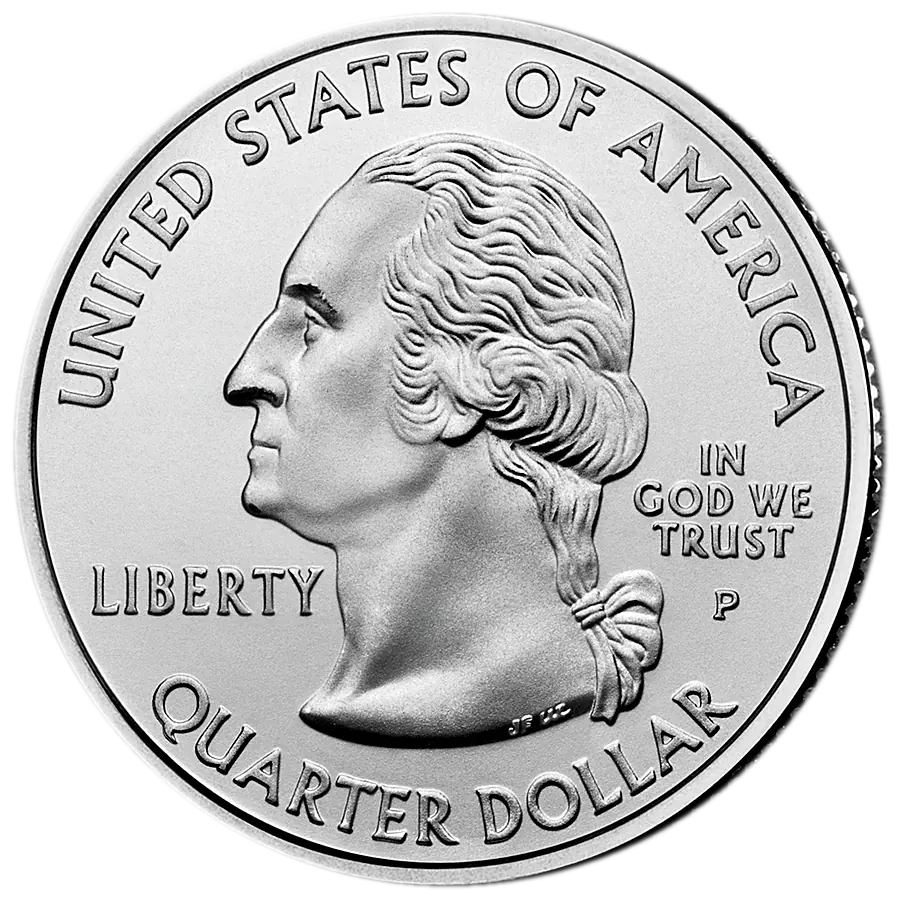
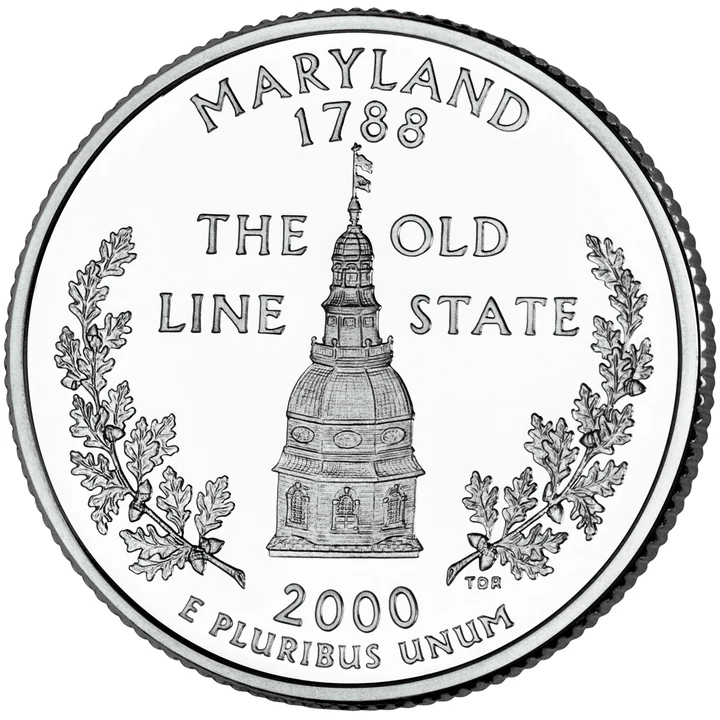
Exact Maryland reverse from the U.S. Mint; shared program obverse.
7 / 50release order
4mint/finish issues
P · D · Smint marks
2000release year
Story in 30 Seconds
The reverse centers the wooden dome of the Maryland State House in Annapolis, frames it with white-oak leaf clusters, and places THE OLD LINE STATE above it.
Maryland invited public suggestions and received 280 entries. A governor-appointed design committee selected five proposals for Mint refinement; Governor Parris N. Glendening later selected the State House design. The Treasury Secretary retained final federal approval. The reviewed record documents participation, but not a statewide public vote.
Collectors encounter P and D circulation strikes, an S copper-nickel clad proof, and an S 90% silver proof. World Coin Book asserts no recognized Maryland variety; weak dome detail, doubled-looking lettering, missing leaves, discoloration, edge flattening, and similar anomalies require mint-made evidence before being called errors.
Public Law 105-124 placed Maryland seventh because it ratified the Constitution seventh, on April 28, 1788. One reverse could not represent the Chesapeake, Indigenous nations, religious history, slavery and freedom, ports, agriculture, industry, immigration, military sites, and varied regions. Maryland chose its State House: a still-functioning state capitol that had also served the Confederation Congress, allowing one building to connect state government with national founding history.
The Maryland State House stands in Annapolis and remains the oldest state capitol in continuous legislative use. The legislature first occupied the building in 1779; the Confederation Congress met there from November 1783 to August 1784. In its Old Senate Chamber, George Washington resigned his commission on December 23, 1783, and Congress ratified the Treaty of Paris on January 14, 1784. The coin shows the later dome begun by Joseph Clark in 1785, not the whole building or either historic chamber.
The State House was unfinished when it entered national history. Congress assembled there near the end of the Revolution; Washington’s voluntary resignation affirmed civilian authority, and ratification of the Treaty of Paris formally ended the war. The present wooden dome rose afterward. Its exterior was completed in 1788, the same year engraved on the quarter for Maryland’s constitutional ratification, and its interior was completed in 1797.
Thomas D. Rogers reduced a complex public building to its most recognizable silhouette: drum, windows, curved roof, acorn finial, weather vane, and lightning rod. White-oak branches balance the lower field, while THE OLD LINE STATE supplies a second Revolutionary reference. The architecture conveys durable civil government; the oak supplies native growth and state-symbol identity; the nickname invokes the Maryland Line’s military reputation.
World Coin Book interpretation: the vertical dome dominates and the paired branches create a heraldic frame, making government—not landscape or commerce—the visual center. The design joins military memory to civil institutions, but omits the State House façade, Washington’s resignation, the treaty chamber, Chesapeake geography, the Calvert colors, and Marylanders excluded from eighteenth-century political power. It is a selective institutional portrait, not a complete state history.
Maryland opened the process to public ideas. Contemporary institutional reporting records more than 300 early suggestions and 280 entries by the deadline, ranging across history, wildlife, symbols, and landmarks. A Maryland Commemorative Quarter Design Committee appointed through the governor’s process reviewed the submissions; this was public participation through proposals, not a binding popular vote.
The committee selected five proposals: the Maryland State House; the State House dome; the Maryland shield over the state outline; the Ark and the Dove; and Fort McHenry with the Star-Spangled Banner. Contemporary reporting identifies Frank O’Rourke, William Krawczewicz, John F. Fieseler, and Donald Curtis as submitters. The Mint converted state concepts into coinable candidate designs and returned them for state review.
The Mint says the selected design came from Governor Glendening’s Coin Design Committee, while contemporary reporting says Glendening chose the State House from four refined finalists on June 1, 1999. Federal advisory review and the Treasury Secretary’s final approval followed the program process. The reviewed official sources do not publish the committee’s charter, full membership, scoring, vote, four refined artworks, or a complete concept-to-relief record.
Procedures varied by state and changed during the program; each researched state page must document its actual path.
Alternative Designs
Five documented state proposals were the full Maryland State House; its dome; the Maryland shield over a state outline; the Ark and the Dove; and Fort McHenry with the Star-Spangled Banner. Two State House proposals entered the five, while the later governor’s choice reportedly came from four Mint-refined designs, suggesting consolidation or elimination during refinement; the reviewed record does not establish exactly how. No authenticated official gallery of the refined finalists was located.
Use the complete text cards below as the keyboard and screen-reader equivalent of the image.
Maryland State House dome
Official explanation: The Mint identifies the central device as the Maryland State House dome in Annapolis, representing the oldest state house still in continuous legislative use and the only one to have served as the nation’s capitol.
Historical context: Joseph Clark began the surviving wooden dome in 1785; its exterior was completed in 1788 and interior in 1797. The tiny top includes the acorn, weather vane, and Franklin-type lightning rod.
World Coin Book interpretation: The isolated upward silhouette turns a working building into an emblem of continuity and places civil government above the rest of the field.
Official explanation: The Mint identifies the flanking branches as White Oak, Maryland’s state tree.
Historical context: Maryland designated the white oak as state tree in 1941; the celebrated Wye Oak long embodied that symbol, but the coin shows generic branches rather than a portrait of that individual tree.
World Coin Book interpretation: Mirrored branches steady the tall dome and combine organic endurance with institutional endurance.
Official explanation: The Mint presents the phrase as Maryland’s nickname and cautiously links it to Maryland Line troops in the Revolutionary War.
Historical context: Maryland State Archives finds the nickname rooted in the Maryland Line but says its first use is unresolved. The surviving Washington papers do not confirm the popular claim that Washington named Maryland the Old Line State, and the phrase is unrelated to the Mason-Dixon Line.
World Coin Book interpretation: The inscription supplies military memory above a building associated with demobilization, treaty, and civil government, creating a deliberate tension between service and peace.
Official explanation: The inscriptions identify the state, constitutional-ratification year, issue year, national motto, and Thomas D. Rogers’s initials.
Historical context: 1788 is both Maryland’s ratification year and the year the dome exterior was completed; the coin does not state that architectural coincidence explicitly.
World Coin Book interpretation: The low inscription band anchors the vertical dome in federal sequence and coin identity without depicting the state outline.
Annapolis seat of government, former national capitol, and source of the central dome.
Joseph Clark
Architect and builder responsible for the surviving eighteenth-century wooden dome.
White Oak
Maryland’s state tree, represented by paired generic leaf clusters.
Maryland Line
Revolutionary regular regiments underlying the Old Line State nickname.
Parris N. Glendening
Governor who oversaw Maryland’s process and selected the State House design.
Thomas D. Rogers, Sr.
U.S. Mint sculptor-engraver officially credited as reverse designer and sculptor.
Focused Timeline
The cornerstone of the present Maryland State House is laid
The Maryland legislature begins using the State House
George Washington resigns his military commission in the Old Senate Chamber
Congress ratifies the Treaty of Paris in the State House
Joseph Clark begins the surviving State House dome
Maryland becomes the seventh state to ratify the U.S. Constitution
Maryland designates the white oak as its state tree
The state committee chooses five proposals from 280 public entries
Governor Glendening selects the State House design from refined finalists
The Mint releases Maryland quarters to the Federal Reserve system
Official Explanation and Interpretation
Artists and relief
John Flanagan’s Washington portrait, adapted by William Cousins, appears on the shared obverse. Public submitters proposed the five documented Maryland concepts, including State House ideas by Frank O’Rourke and William Krawczewicz. The U.S. Mint credits Thomas D. Rogers, Sr. as reverse designer and sculptor. These are different roles: concept submitter, Mint designer, and relief sculptor. The reviewed record does not establish which State House proposal—or combination—became the final concept or identify every intermediate Mint artist and production refinement.
P and D are circulation issues. Both S issues were sold in proof products; the silver proof is a distinct 90% silver composition. Mintages are established catalog figures retained with an explicit source-audit limit.
Identification Guide
Identify the reverse by the State House dome, paired white-oak clusters, and THE OLD LINE STATE. The P, D, or S mint mark is on the obverse to the right of Washington’s hair ribbon. P and D are circulation strikes; S coins are proofs. A clad proof shows a copper stripe at the reeded edge; the 90% silver proof lacks it and weighs about 6.25 g rather than 5.67 g.
Condition Guide
On circulated pieces, inspect the acorn and weather-vane area, dome ribs and windows, roof shoulders, and upper oak leaves for first smoothing. Confirm wear through broken luster across several high points. Soft windows, incomplete leaf veins, or a weak finial can instead reflect strike pressure, die wear, or grease.
The open field around the dome and above the branches reveals contact marks readily; the fine lightning rod, windows, leaf tips, acorns, and small letters are vulnerable to weak definition. Proofs should be checked for hairlines, haze, spots, fingerprints, impaired mirrors, and diminished frost rather than cameo contrast alone.
Mint Errors vs. Damage
Recognized catalog varieties: none are listed in the current World Coin Book Maryland issue records. This is an evidence boundary, not proof that no die varieties exist.
Genuine mint errors can include off-center strikes, broadstrikes, clips, wrong-planchet strikes, retained cuds, struck-through material, or substantial die cracks. Attribution requires mint-made metal flow, correct diagnostics, weight, geometry, and where applicable repeatable die evidence.
A doubled-looking dome, extra window, missing leaf, detached acorn, broken lightning rod, or thick THE OLD LINE STATE is not a rare variety by appearance alone. Mechanical doubling, die deterioration, grease-filled recesses, glare, compression, and image sharpening can create those impressions. The nickname is tied to the Maryland Line; it was not named for the Mason-Dixon Line, and surviving evidence does not confirm that George Washington coined it.
Scratches, gouges, flattened rims, dryer damage, corrosion, stains, glue, plating, polishing, and heat color are post-mint damage. A supposed extra branch or doubled building needs raised, repeatable die evidence rather than displaced metal or a single photograph.
Why Collectors Care
Durable value tiers
Worn P and D examples usually occupy the face-value design-set tier. Better circulation coins can gain collector interest from full luster, clean fields, a sharp acorn and lightning rod, defined dome windows and ribs, complete leaf veins, and readable inscriptions. Clad proofs form a collector-product tier; silver proofs add 90% silver content as a separate composition tier. World Coin Book gives no live price promise: compare dated references for the exact mint, finish, grade, strike, and surfaces.
Official law and U.S. Mint records establish program facts and image identity. World Coin Book separates official explanation, historical analysis, and editorial interpretation.
Official descriptions, historical context, and World Coin Book interpretation are labeled separately. No live prices are asserted. Last verified:
The committee’s creating instrument, complete membership, deliberations, scoring, vote tally, and original 280 submissions were not located in the reviewed official record; no statewide public vote is asserted.
Five state proposals are documented, but only four Mint-refined finalists were reportedly returned to the governor. The reviewed record does not establish which concepts were combined or removed or reproduce the refined artwork.
The complete path from O’Rourke’s and Krawczewicz’s State House submissions through Mint-prepared candidates to Rogers’s final relief is not documented closely enough to assign intermediate authorship.
The Mint describes white-oak leaf clusters but does not identify them as the Wye Oak; the page therefore does not make that common visual inference.
The normalized mintages remain established catalog figures; a future source audit should attach direct U.S. Mint annual-production evidence to each number.