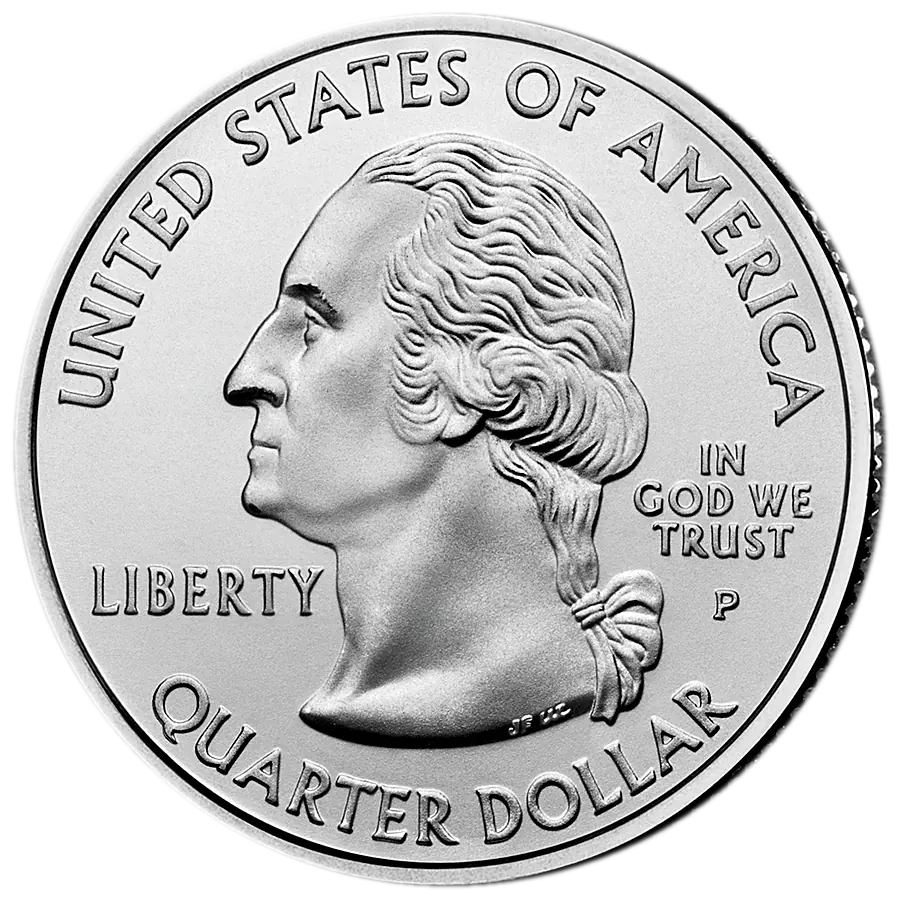
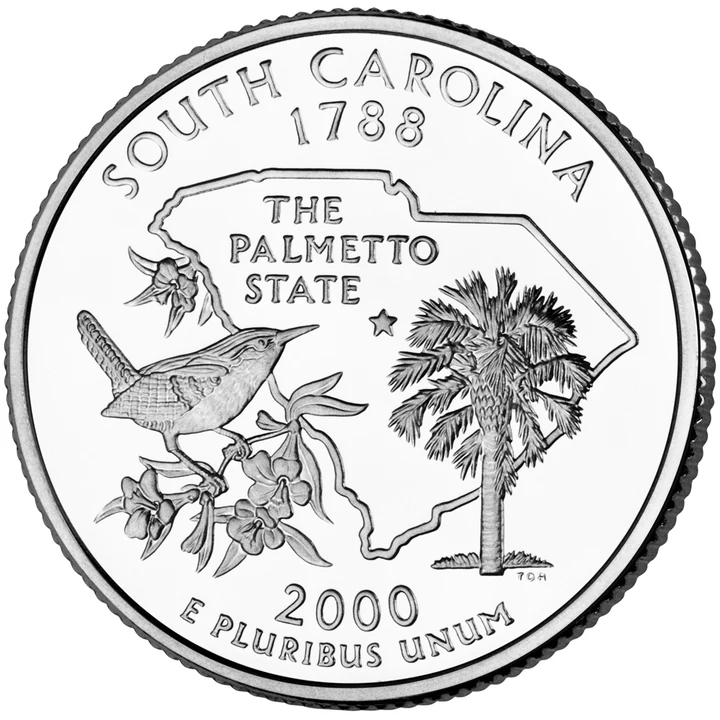
Exact South Carolina reverse from the U.S. Mint; shared program obverse.
8 / 50release order
4mint/finish issues
P · D · Smint marks
2000release year
Story in 30 Seconds
The reverse layers a Carolina wren, yellow jessamine, and palmetto tree over South Carolina’s outline. A star marks Columbia, and THE PALMETTO STATE names the identity binding the symbols together.
South Carolina gathered suggestions through its Department of Parks, Recreation and Tourism. Elementary students, tourism offices, and the South Carolina Numismatic Society contributed ideas; five concepts were narrowed to three through federal advisory review, and Governor Jim Hodges selected the final concept. The reviewed record documents participation, not a statewide public vote.
Collectors encounter P and D circulation strikes, an S copper-nickel clad proof, and an S 90% silver proof. World Coin Book asserts no recognized South Carolina variety; doubled-looking feathers, missing petals, extra branches, map distortions, and similar anomalies require mint-made evidence before being called errors.
Public Law 105-124 placed South Carolina eighth because it ratified the Constitution eighth, on May 23, 1788. One reverse could not represent Indigenous nations, colonization, slavery, Revolution and Civil War, agriculture, ports, textile and tourism economies, civil-rights history, mountains, Piedmont, and coast. The chosen design instead assembled official natural symbols around a palmetto whose state meaning reaches back to the defense of Charleston Harbor.
South Carolina stretches from the Blue Ridge through the Piedmont to the Atlantic coastal plain, yet the quarter shows no literal landscape. Columbia, the capital since 1786, appears only as a star inside the outline. The palmetto is the state tree, the Carolina wren the state bird, and yellow jessamine the state flower. Together they provide statewide identity, while their arrangement and nickname give the low-country palmetto the central historical role.
The palmetto’s political meaning comes from the Battle of Sullivan’s Island on June 28, 1776. Colonel William Moultrie’s unfinished fort used palmetto-log cribbing filled with sand. After a nine-hour attack, the British fleet withdrew and Charles Town avoided occupation. The event entered state memory, but the familiar claim that cannonballs simply bounced harmlessly from soft logs compresses a fortification system, sand fill, artillery, defenders, tides, and British operational failures into one slogan.
The other devices broaden the design beyond one battle. South Carolina designated the Sabal palmetto as state tree in 1939, the yellow jessamine as state flower in 1924, and the Carolina wren as state bird in 1948. Governor Hodges interpreted the tree as strength, the wren’s song as hospitality, and the flower as natural beauty. Those are official launch interpretations, not biological properties or timeless meanings shared by every resident.
World Coin Book interpretation: the palmetto forms the tallest axis, the wren adds a living diagonal at left, and the jessamine balances the lower right. The outline turns the three emblems into a map key, while the capital star supplies civic geography. The design emphasizes official symbols, Revolutionary endurance, and welcome; it omits the crescent from the state flag, Fort Moultrie itself, the state’s people, Indigenous and African American histories, labor, urban life, and regional landscapes.
Beginning in 1998, the South Carolina Department of Parks, Recreation and Tourism accepted quarter-design suggestions. The surviving Mint launch record says many ideas came from elementary students and thanks Dutch Fork Elementary School students for participation. A preserved account of the former Mint material also identifies tourism-department offices and the South Carolina Numismatic Society as contributors.
The tourism department narrowed the suggestions to five concepts. The federal Citizens Commemorative Coin Advisory Committee and Commission of Fine Arts narrowed those to three, after which Governor Jim Hodges made the final state selection. The Mint translated the selected concept into coinable art; the Treasury Secretary retained final federal approval under the program process.
This was a suggestion-and-review process, not a documented statewide vote. The reviewed official pages do not name the five concepts or three finalists, reproduce their artwork, identify the participating students, give panel scores or vote totals, or state exactly when Hodges selected the final composition.
Procedures varied by state and changed during the program; each researched state page must document its actual path.
Alternative Designs
The record establishes five state semifinal concepts and three federally reviewed finalists, but the reviewed official sources do not name or illustrate them. World Coin Book therefore does not invent an alternatives gallery or infer that individual symbols were separate finalists. The final combination itself is documented; the rejected subjects and their authors remain an evidence gap.
Use the complete text cards below as the keyboard and screen-reader equivalent of the image.
Palmetto tree and THE PALMETTO STATE
Official explanation: The Mint identifies the central tree as the state palmetto and connects the nickname to the palmetto-log fort that resisted the British fleet at Charleston Harbor.
Historical context: The first Fort Moultrie combined palmetto-log cribbing with sand; South Carolina designated Sabal palmetto as state tree in 1939.
World Coin Book interpretation: The tallest device fuses natural emblem, Revolutionary memory, nickname, and visual strength without literally depicting the battle.
Official explanation: The Mint identifies the bird as South Carolina’s state bird; Governor Hodges linked its song to the hospitality of the state’s people.
Historical context: The state adopted the Carolina wren in 1948. It is a small resident songbird recognizable by its curved bill, lifted tail, and pale eyebrow.
World Coin Book interpretation: Facing inward from the left, the bird adds voice, movement, and an implied human quality to an otherwise emblematic composition.
Official explanation: The Mint identifies the flowering vine as South Carolina’s state flower; Governor Hodges described it as part of the state’s natural beauty.
Historical context: Adopted in 1924, yellow jessamine is an evergreen woody vine with yellow trumpet-shaped flowers. It is poisonous and should not be confused with an edible jasmine.
World Coin Book interpretation: The low blossom cluster softens the map edge and balances the bird, adding seasonal renewal to the tree’s historical endurance.
Official explanation: The Mint says the background is South Carolina’s outline and the star marks Columbia, the state capital.
Historical context: The outline is a geographic locator, not a topographic map; it carries no county borders, rivers, mountain relief, or coastline labels.
World Coin Book interpretation: The map contains the natural emblems while the lone star joins official state identity to its governmental center.
SOUTH CAROLINA · 1788 · 2000 · E PLURIBUS UNUM · TDR
Official explanation: The inscriptions identify the state, constitutional-ratification year, issue year, national motto, and Thomas D. Rogers’s initials.
Historical context: South Carolina ratified the Constitution on May 23, 1788, becoming eighth in the program’s official sequence.
World Coin Book interpretation: The lower text band anchors a dense symbol collage in federal chronology and coin identity.
South Carolina’s state tree and central emblem, linked to the 1776 Charleston Harbor defense.
Carolina wren
State bird whose song Governor Hodges used as an official metaphor for hospitality.
Yellow jessamine
Poisonous native flowering vine adopted as state flower in 1924.
Fort Moultrie
Sullivan’s Island fort whose first palmetto-log-and-sand version underlies the nickname story.
Columbia
State capital marked by a star inside the outline.
Jim Hodges
Governor who made South Carolina’s final state design selection and explained the symbols at launch.
Thomas D. Rogers, Sr.
U.S. Mint sculptor-engraver officially credited as reverse designer and sculptor.
Focused Timeline
South Carolina defenders repel a British fleet at the palmetto-log-and-sand fort on Sullivan’s Island
South Carolina becomes the eighth state to ratify the U.S. Constitution
South Carolina adopts yellow jessamine as the state flower
South Carolina designates Sabal palmetto as the state tree
South Carolina designates the Carolina wren as the state bird
The tourism department begins accepting quarter-design suggestions
Five state concepts are narrowed to three through federal advisory review
The Mint releases South Carolina quarters to the Federal Reserve system
The state and Mint launch the quarter at Dutch Fork Elementary School
Official Explanation and Interpretation
Artists and relief
John Flanagan’s Washington portrait, adapted by William Cousins, appears on the shared obverse. South Carolina students and civic groups supplied ideas rather than a documented final drawing. The U.S. Mint credits Thomas D. Rogers, Sr. as reverse designer and sculptor. The reviewed record does not name the original authors of the five concepts, show the three finalists, or map particular student suggestions through Mint refinement to Rogers’s relief.
P and D are circulation issues. Both S issues were sold in proof products; the silver proof is a distinct 90% silver composition. Mintages are established catalog figures retained with an explicit source-audit limit.
Identification Guide
Identify the reverse by the state outline, capital star, tall palmetto, left-facing Carolina wren, yellow jessamine, and THE PALMETTO STATE. The P, D, or S mint mark is on the obverse to the right of Washington’s hair ribbon. P and D are circulation strikes; S coins are proofs. A clad proof shows a copper stripe at the reeded edge; the 90% silver proof lacks it and weighs about 6.25 g rather than 5.67 g.
Condition Guide
On circulated pieces, inspect the palmetto crown and upper trunk, wren’s head, back and wing, blossom centers and petals, and raised map edge for first smoothing. Confirm wear through broken luster across several high points. Flat feathers, merged fronds, weak petals, or a soft star can instead reflect strike pressure, die wear, or grease.
The fields around the bird and tree show contact marks readily; fine feathers, the wren’s eye and bill, palmetto frond tips, flower outlines, coastline, star, and small letters are vulnerable to weak definition. Proofs should be checked for hairlines, haze, spots, fingerprints, impaired mirrors, and diminished frost rather than cameo contrast alone.
Mint Errors vs. Damage
Recognized catalog varieties: none are listed in the current World Coin Book South Carolina issue records. This is an evidence boundary, not proof that no die varieties exist.
Genuine mint errors can include off-center strikes, broadstrikes, clips, wrong-planchet strikes, retained cuds, struck-through material, or substantial die cracks. Attribution requires mint-made metal flow, correct diagnostics, weight, geometry, and where applicable repeatable die evidence.
A doubled-looking wren, extra feather, missing flower petal, extra palmetto branch, doubled star, distorted coastline, or thick THE PALMETTO STATE is not a rare variety by appearance alone. Mechanical doubling, die deterioration, grease-filled recesses, glare, compression, and image sharpening can create those impressions. The coin marks Columbia with the star; it does not depict Fort Moultrie, and the flowers are poisonous yellow jessamine rather than an edible jasmine.
Scratches, gouges, flattened rims, dryer damage, corrosion, stains, glue, plating, polishing, and heat color are post-mint damage. A supposed extra branch or doubled bird needs raised, repeatable die evidence rather than displaced metal or a single photograph.
Why Collectors Care
Durable value tiers
Worn P and D examples usually occupy the face-value design-set tier. Better circulation coins can gain collector interest from full luster, clean fields, a sharp wren eye and feathers, separated palmetto fronds, complete blossoms, a crisp capital star and coastline, and readable inscriptions. Clad proofs form a collector-product tier; silver proofs add 90% silver content as a separate composition tier. World Coin Book gives no live price promise: compare dated references for the exact mint, finish, grade, strike, and surfaces.
Official law and U.S. Mint records establish program facts and image identity. World Coin Book separates official explanation, historical analysis, and editorial interpretation.
Official descriptions, historical context, and World Coin Book interpretation are labeled separately. No live prices are asserted. Last verified:
The tourism department’s complete submission file, the five semifinal concepts, the three federally reviewed finalists, panel deliberations, scores, vote totals, and finalist artwork were not located in the reviewed official record; no statewide public vote is asserted.
The surviving Mint launch credits elementary students collectively but does not name them or connect any student’s idea to a specific device in the final relief.
The complete concept-to-relief path does not establish who composed the combined state-symbol proposal before Thomas D. Rogers’s officially credited design and sculpture work.
The popular shorthand that British cannonballs simply bounced from soft palmetto logs omits the sand-filled fortification system and broader battle conditions; the page uses the NPS account rather than repeating that mechanism as settled fact.
The normalized mintages remain established catalog figures; a future source audit should attach direct U.S. Mint annual-production evidence to each number.