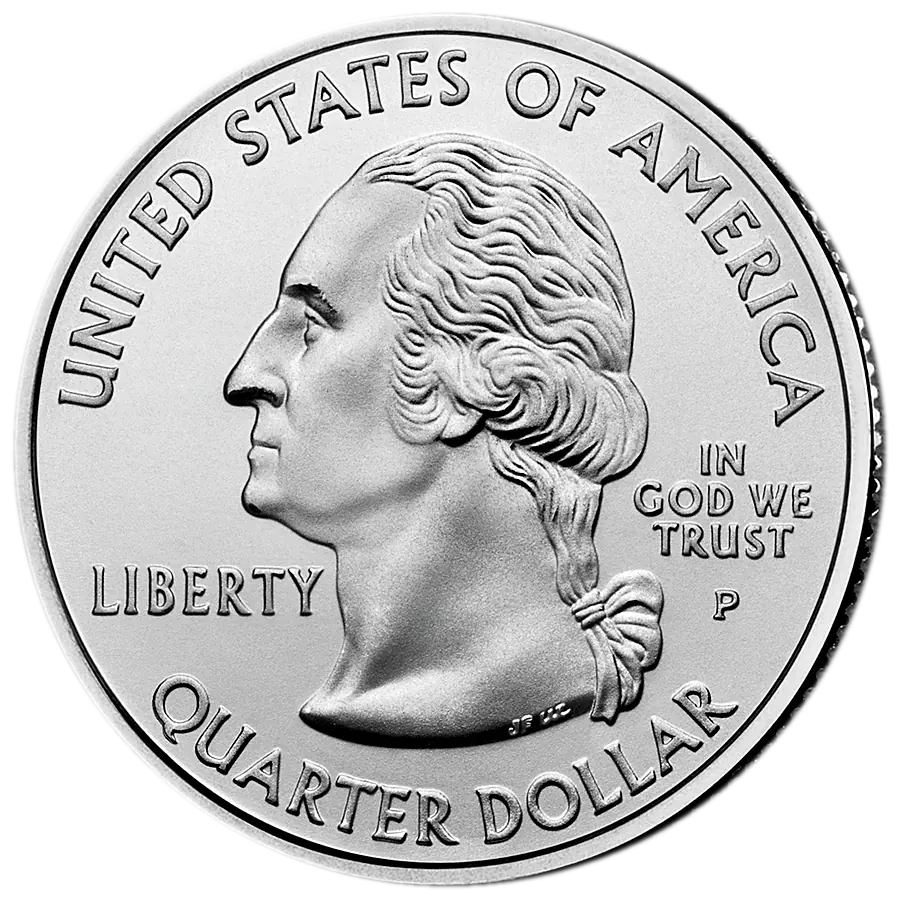
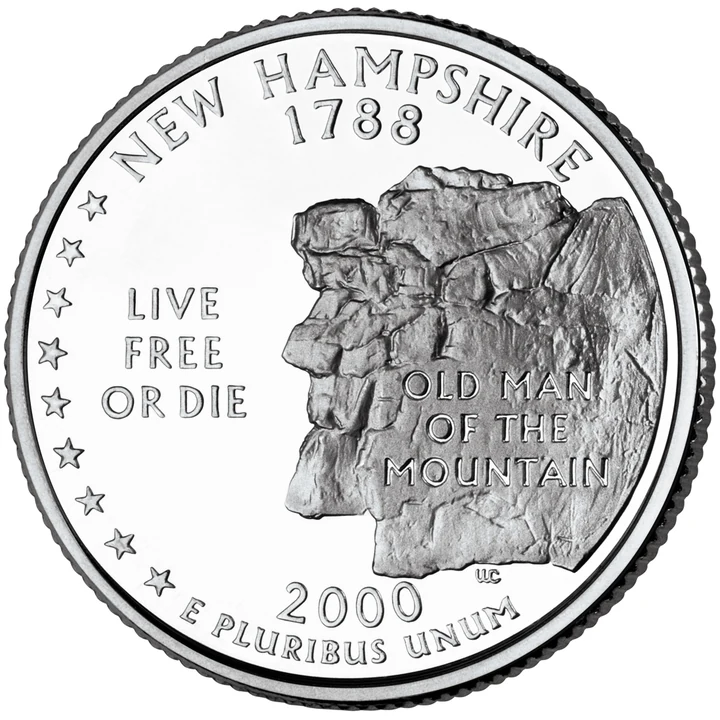
Exact New Hampshire reverse from the U.S. Mint; shared program obverse.
9 / 50release order
4mint/finish issues
P · D · Smint marks
2000release year
Story in 30 Seconds
The reverse places the Old Man of the Mountain’s profile at left, LIVE FREE OR DIE in the open field, and nine stars at right. The stars mark New Hampshire as the ninth state to ratify the Constitution.
Governor Jeanne Shaheen established the New Hampshire Commemorative Quarter Committee to moderate a statewide design contest. Suggestions went to the committee, the selected concept moved through Mint development and federal review, the governor made the state’s final selection, and the Treasury Secretary retained final approval. The reviewed official record does not document a statewide popular vote.
Collectors encounter P and D circulation strikes, an S copper-nickel clad proof, and an S 90% silver proof. World Coin Book asserts no recognized New Hampshire variety; supposed extra rocks, doubled stars, altered facial features, or a missing motto require mint-made evidence rather than appearance alone.
Public Law 105-124 placed New Hampshire ninth because it ratified the Constitution on June 21, 1788. One reverse could not represent Abenaki homelands, colonial and Revolutionary history, mills and industry, town government, seacoast, lakes, forests, and the White Mountains. The selected pairing instead joined the state’s best-known natural profile to a statutory motto about freedom and independence.
New Hampshire runs from a short Atlantic coast through lake country to the White Mountains. The quarter chooses one precise northern landmark: five naturally aligned granite ledges on Cannon Mountain’s eastern slope in Franconia Notch, seen as a human profile from a particular viewpoint. It pairs that fragile natural emblem with the durable words LIVE FREE OR DIE.
The Old Man was not a carved statue or a whole mountain shaped like a face. Five granite ledges aligned into forehead, nose, lips, and chin when viewed from below near Profile Lake. A survey party recorded the profile around 1805; later writers, artists, tourism promoters, engineers, and generations of visitors made it a statewide emblem. Stabilization began in 1916 and continued for decades.
LIVE FREE OR DIE comes from Revolutionary War general John Stark’s 1809 message for a veterans’ reunion he could not attend. New Hampshire law adopted those words as the official motto in 1945. The quarter does not print the rest of Stark’s sentence, and the motto was written after—not during—the Revolution.
World Coin Book interpretation: the crag’s face looks inward toward the motto, while nine stars form a measured counterweight in the right field. Rock, words, and federal sequence turn landscape into character: endurance, independence, and belonging. The design omits people, the White Mountains as a panorama, forests, lakes, seacoast, Indigenous history, industry, and the caretakers who prolonged the profile’s life.
The Old Man collapsed in the early morning of May 3, 2003, after water, freezing, thawing, and fractures had long weakened the ledges. That did not make the quarter an error or invalidate its design; it transformed the coin into a dated image of a landmark that physically survived when the coin was issued and now persists through memory and memorial profilers.
Governor Jeanne Shaheen established the New Hampshire Commemorative Quarter Committee to moderate a statewide design contest. The Mint’s contemporary release says the final design was based on suggestions given to that committee, establishing public submission of ideas without establishing a public ballot.
Under the program process, state concepts were sent to the Mint for coinable development and federal advisory review, then returned for state selection; the governor made the final state choice and the Treasury Secretary held final federal approval. The Mint credits William Cousins for the finished reverse design and sculpture.
The reviewed official sources do not provide the contest opening date, submission total, committee roster, number or names of semifinalists and finalists, images, scores, vote totals, or the identity of the person who first paired the Old Man, motto, and nine stars. Those details remain evidence gaps rather than invitations to reconstruct a contest from later anecdotes.
Procedures varied by state and changed during the program; each researched state page must document its actual path.
Alternative Designs
A statewide contest implies rejected suggestions, but the reviewed official record does not name or illustrate alternatives or establish how many reached federal review. World Coin Book therefore publishes no finalist gallery and does not promote covered bridges, loons, mountains, or other plausible New Hampshire subjects to finalist status without primary evidence.
Use the complete text cards below as the keyboard and screen-reader equivalent of the image.
Old Man of the Mountain profile
Official explanation: The Mint identifies the left device as the Old Man of the Mountain, a rock formation on Cannon Mountain in Franconia Notch and one of the state’s best-known natural attractions.
Historical context: Five granite ledges appeared as a face only from a particular viewpoint. Preservation work began in 1916; the formation collapsed on May 3, 2003.
World Coin Book interpretation: The isolated profile turns geology into a watchful state portrait and gives the motto a speaker without claiming the rock was human-made.
Official explanation: The Mint identifies the words as New Hampshire’s state motto and attributes them to Revolutionary War hero John Stark.
Historical context: Stark wrote the words in a July 31, 1809 message; state law adopted them as the official motto in 1945. The coin preserves the statutory short form.
World Coin Book interpretation: Large open lettering makes political character equal in weight to the landmark rather than merely labeling it.
Official explanation: The Mint says the nine stars signify New Hampshire’s status as the ninth state to ratify the U.S. Constitution.
Historical context: New Hampshire ratified on June 21, 1788; its approval supplied the ninth state required for the Constitution to take effect among ratifying states.
World Coin Book interpretation: The vertical star group balances the profile and translates release order into a countable visual device.
NEW HAMPSHIRE · 1788 · 2000 · E PLURIBUS UNUM · WC
Official explanation: The inscriptions identify the state, ratification year, issue year, national motto, and William Cousins’s initials.
Historical context: The state name crowns the design; dates and national motto place the local emblem inside federal chronology and the shared quarter program.
World Coin Book interpretation: Curved border text frames the stark central dialogue between face, motto, and stars without adding another pictorial subject.
Five-ledged granite profile on Cannon Mountain and the reverse’s central subject.
Cannon Mountain and Franconia Notch
White Mountains setting of the former profile and its viewing landscape.
John Stark
Revolutionary War general whose 1809 words became the state motto.
Jeanne Shaheen
Governor who established the quarter committee and made the state’s final design selection.
William Cousins
U.S. Mint sculptor-engraver officially credited as reverse designer and sculptor.
Focused Timeline
New Hampshire becomes the ninth state to ratify the U.S. Constitution
A survey party makes the first recorded sighting of the granite profile
John Stark writes the words Live free or die in a reunion message
Edward Geddes installs the first turnbuckles used to stabilize the profile
LIVE FREE OR DIE becomes New Hampshire’s official state motto
State law officially designates the formation as the Old Man of the Mountain
The governor’s committee moderates a statewide quarter-design contest and the concept moves through federal review
The Mint releases and launches the ninth State Quarter at the New Hampshire State House
The Old Man of the Mountain collapses; the coin becomes a record of the lost profile
New Hampshire establishes annual Old Man of the Mountain Day
Official Explanation and Interpretation
Artists and relief
John Flanagan’s Washington portrait, adapted by William Cousins, appears on the shared obverse. Public suggestions supplied concept material through the governor’s committee, but the reviewed record does not identify a named concept author or surviving final drawing. The U.S. Mint credits William Cousins as both reverse designer and sculptor, responsible for translating the approved profile, motto, and stars into coin relief.
P and D are circulation issues. Both S issues were sold in proof products; the silver proof is a distinct 90% silver composition. Mintages are established catalog figures retained with an explicit source-audit limit.
Identification Guide
Identify the reverse by the left-facing granite profile, LIVE FREE OR DIE, and nine stars. The P, D, or S mint mark is on the obverse to the right of Washington’s hair ribbon. P and D are circulation strikes; S coins are proofs. A clad proof shows a copper stripe at the reeded edge; the 90% silver proof lacks it and weighs about 6.25 g rather than 5.67 g.
Condition Guide
On circulated pieces, inspect the forehead, nose, lips, chin, ledge edges, and star points for first smoothing. Confirm wear through broken luster across several high points. A flat nose, merged ledges, soft stars, or weak motto letters can instead reflect strike pressure, die wear, or grease.
The broad fields around the face, motto, and stars reveal contact marks readily; the nose tip, lips, chin, fine rock texture, star points, and small border lettering are vulnerable. Proofs should be checked for hairlines, haze, spots, fingerprints, impaired mirrors, and diminished frost rather than cameo contrast alone.
Mint Errors vs. Damage
Recognized catalog varieties: none are listed in the current World Coin Book New Hampshire issue records. This is an evidence boundary, not proof that no die varieties exist.
Genuine mint errors can include off-center strikes, broadstrikes, clips, wrong-planchet strikes, retained cuds, struck-through material, or substantial die cracks. Attribution requires mint-made metal flow, correct diagnostics, weight, geometry, and where applicable repeatable die evidence.
A doubled star, extra rock, changed nose, missing mouth, filled motto letter, or apparent extra profile is not a rare variety by appearance alone. Mechanical doubling, die deterioration, grease-filled recesses, glare, compression, image sharpening, wear, and impacts can create those impressions. The formation collapsed in 2003; that event did not make 2000 quarters errors, recalls, or newly issued memorial coins.
Scratches, gouges, flattened rims, dryer damage, corrosion, stains, glue, plating, polishing, and heat color are post-mint damage. A supposed second face or extra ledge needs raised, repeatable die evidence rather than displaced metal or a single photograph.
Why Collectors Care
Durable value tiers
Worn P and D examples usually occupy the face-value design-set tier. Better circulation coins can gain collector interest from full luster, clean open fields, a complete profile, separated ledges, sharp star points, and crisp motto lettering. Clad proofs form a collector-product tier; silver proofs add 90% silver content as a separate composition tier. The landmark’s 2003 collapse adds historical resonance, not automatic rarity. World Coin Book gives no live price promise: compare dated references for the exact mint, finish, grade, strike, and surfaces.
Official law and U.S. Mint records establish program facts and image identity. World Coin Book separates official explanation, historical analysis, and editorial interpretation.
Official descriptions, historical context, and World Coin Book interpretation are labeled separately. No live prices are asserted. Last verified:
The committee’s full roster, contest rules, opening and closing dates, submission total, semifinal and finalist counts, rejected subjects, deliberations, scores, vote totals, and artwork were not located in the reviewed official record; no statewide public vote is asserted.
The surviving Mint record does not identify who first combined the Old Man, motto, and nine stars or connect a named entrant’s suggestion to William Cousins’s finished relief.
The exact overnight time of the Old Man’s collapse is unknown; official and institutional records place it between May 2 and the morning of May 3, 2003.
Accounts of an Indigenous origin story for the profile vary and were not adopted here without a reviewed Indigenous or primary institutional source.
The normalized mintages remain established catalog figures; a future source audit should attach direct U.S. Mint annual-production evidence to each number.