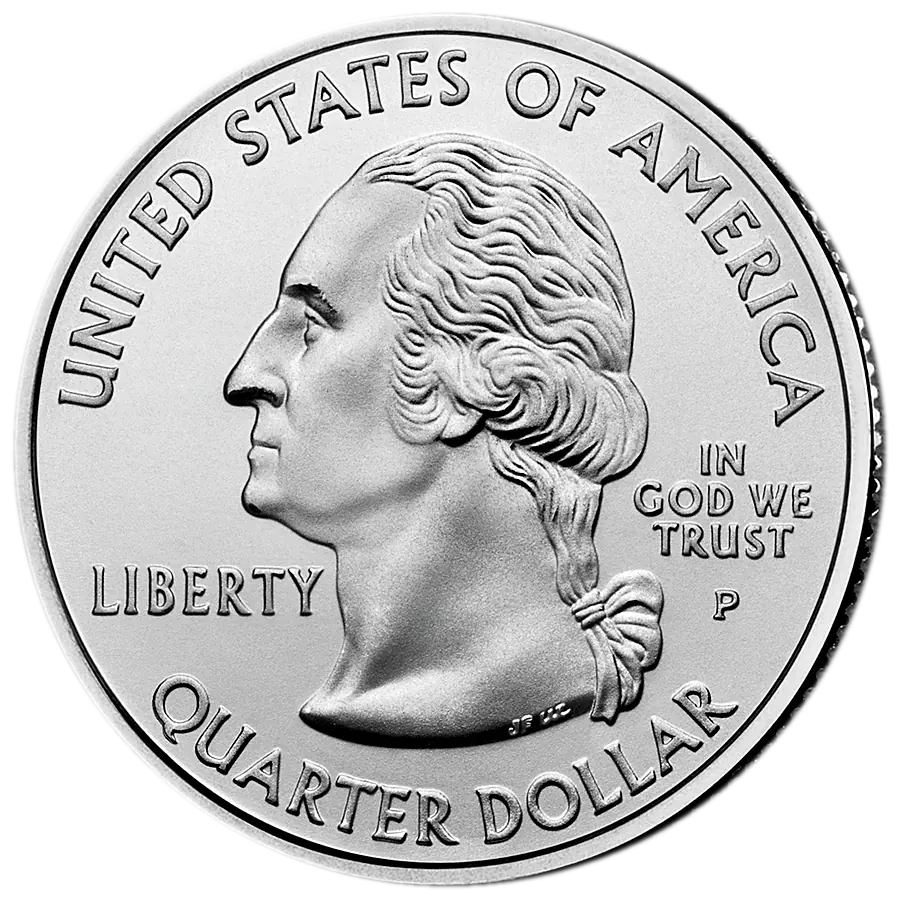
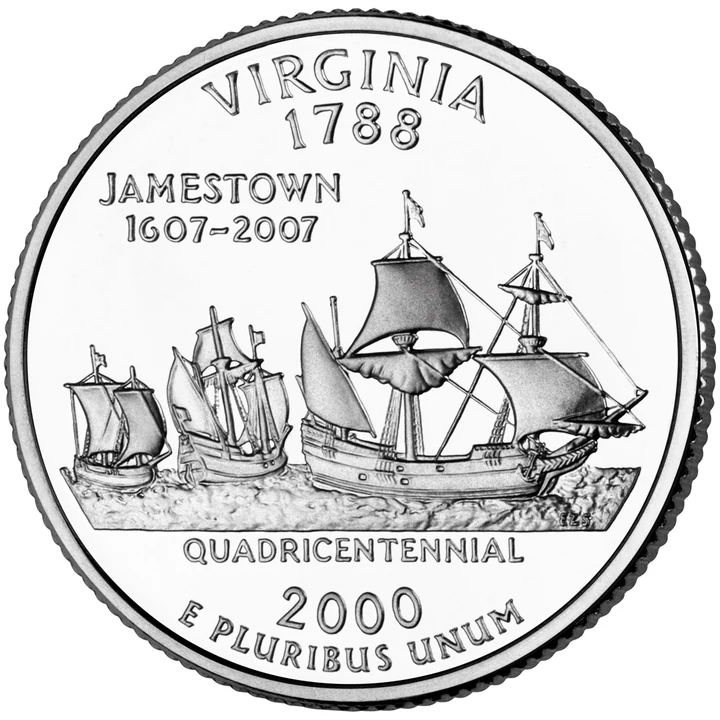
Exact Virginia reverse from the U.S. Mint; shared program obverse.
10 / 50release order
4mint/finish issues
P · D · Smint marks
2000release year
Story in 30 Seconds
The reverse shows Susan Constant, Godspeed, and Discovery, the three vessels that brought the 1607 English expedition to Jamestown. JAMESTOWN 1607–2007 and QUADRICENTENNIAL look forward from the coin’s 2000 issue date to the settlement’s 400th anniversary.
Virginia officials developed four history concepts. Governor James S. Gilmore III invited public comment on the finalists—Jamestown, the Colonial Williamsburg Capitol, Thomas Jefferson’s Virginia State Capitol, and Mount Vernon—and the official state report says thousands responded with an overwhelming preference for Jamestown. The governor selected it; Mint development and federal approval followed.
Collectors encounter P and D circulation strikes, an S copper-nickel clad proof, and an S 90% silver proof. World Coin Book asserts no recognized Virginia variety; supposed extra sails, doubled rigging, missing ropes, or a ‘fourth ship’ require mint-made evidence rather than appearance alone.
Public Law 105-124 placed Virginia tenth because it ratified the Constitution on June 25, 1788. One reverse could not represent Virginia’s Indigenous homelands, colonial expansion, slavery, Revolution, presidents, landscapes, agriculture, industry, and modern communities. The chosen design instead used the approaching 2007 Jamestown anniversary to frame Virginia as a point of English colonial arrival and national beginnings.
Virginia stretches from the Chesapeake and Tidewater through the Piedmont to the Blue Ridge and Appalachian highlands. The quarter narrows that breadth to Jamestown Island on the James River, where an English expedition funded by the Virginia Company established a settlement in 1607 amid an already inhabited Powhatan world. Jamestown endured and became Virginia’s first colonial capital, but its history is not a simple empty-land founding tale.
Susan Constant, Godspeed, and Discovery left England in December 1606 under the Virginia Company’s colonial venture. In May 1607 the expedition selected Jamestown Island, where deep water allowed ships near shore and an inland position offered defense. The settlement became the first permanent English settlement in North America, though hunger, disease, conflict, and dependence on Indigenous knowledge and trade shaped its precarious beginning.
The coin presents three vessels under sail, not scale ship portraits. Susan Constant was the largest, Godspeed smaller, and Discovery the smallest; the precise final histories of the vessels are uncertain. Discovery remained in Virginia when the other two sailed for England in June 1607. Claims that the exact original ships survive, or that today’s museum vessels are the originals, are wrong: surviving displays are reconstructions.
World Coin Book interpretation: the overlapping hulls and crossing rigging compress an ocean voyage into forward movement. Large sails dominate the field, while the anniversary legend turns the ships into a bridge between 1607 and 2007. The composition celebrates arrival and perseverance more than settlement life, archaeology, governance, or consequence.
That emphasis also omits essential people and outcomes: the Powhatan peoples whose homelands surrounded Jamestown, women, Africans arriving in Virginia in 1619, coercive labor and slavery, warfare, dispossession, mortality, and the settlement’s dependence on a commercial company. The NPS now interprets Jamestown through intertwined Virginia Indian, European, and African histories; the quarter preserves the narrower commemorative frame selected in the late 1990s.
The Mint says the concept was created collaboratively by the State Treasurer and representatives of the Library of Virginia, Department of Historic Resources, Virginia Tourism Corporation, and Department of General Services. The reviewed record does not identify one citizen concept author or document an open statewide submission contest.
Four finalists represented Jamestown’s quadricentennial, the Colonial Williamsburg Capitol, Thomas Jefferson’s design of the Virginia State Capitol, and Mount Vernon. Governor Gilmore invited Virginians to comment. The official Jamestown 2007 report says thousands responded and the Jamestown design was the overwhelming choice; it does not publish exact totals, ballot wording, demographic reach, or vote counts.
Gilmore selected Jamestown from the four. Under the federal program, the concept moved through Mint coinability development and advisory review before the Treasury Secretary’s final approval. The Mint credits Edgar Z. Steever as reverse designer and sculptor; the reviewed state report does not preserve the intermediate drawings or explain every refinement from agency concept to relief.
Procedures varied by state and changed during the program; each researched state page must document its actual path.
Alternative Designs
The official state report documents three rejected finalists: the reconstructed Capitol at Colonial Williamsburg, Thomas Jefferson’s Virginia State Capitol in Richmond, and George Washington’s Mount Vernon. They represent colonial government, republican architecture, and a founding president. No reviewed source supplies the candidate artwork, exact captions, public-response totals, or evidence that any additional concept reached finalist status, so World Coin Book does not fabricate a gallery.
Use the complete text cards below as the keyboard and screen-reader equivalent of the image.
Susan Constant, Godspeed, and Discovery
Official explanation: The Mint identifies the three sailing vessels as the ships that carried the 1607 English expedition to Jamestown.
Historical context: The vessels differed in size, and Discovery stayed in Virginia when Susan Constant and Godspeed returned to England. Their ultimate histories are incompletely documented.
World Coin Book interpretation: Overlapping hulls make the fleet read as one collective movement rather than three isolated ship portraits.
Official explanation: The official description identifies the three ships; it does not assign separate symbolic meanings to every sail, rope, wave, or hull.
Historical context: The actual transatlantic voyage began in December 1606 and reached the Chesapeake in 1607; the compact relief necessarily simplifies vessel scale and rigging.
World Coin Book interpretation: Diagonal masts and billowing sails fill the small field with motion, while the low waterline keeps attention on arrival rather than destination.
Official explanation: The Mint says these inscriptions honor Jamestown’s 400th anniversary.
Historical context: The quarter was released in 2000, seven years before the 2007 anniversary; 2007 is not the coin’s issue date.
World Coin Book interpretation: The paired dates make the reverse anticipatory: it advertises a future commemoration while anchoring the pictured voyage in 1607.
Official explanation: The inscriptions identify the state, ratification year, issue year, national motto, and Edgar Z. Steever’s initials.
Historical context: The border chronology distinguishes Virginia’s 1788 federal admission from Jamestown’s 1607 settlement and the coin’s 2000 release.
World Coin Book interpretation: Curved border text encloses the fleet, while the anniversary block at lower center gives the design a commemorative destination.
Three vessels of the 1606–1607 Virginia Company expedition and the reverse’s central subjects.
Jamestown Island
James River settlement site selected by the English expedition in May 1607.
Powhatan peoples
Indigenous communities and polities whose homelands surrounded the new settlement but are absent from the coin.
James S. Gilmore III
Governor who sought public comment and selected Jamestown from four finalists.
Edgar Z. Steever
U.S. Mint sculptor-engraver officially credited as reverse designer and sculptor.
Focused Timeline
Susan Constant, Godspeed, and Discovery leave England for Virginia
The expedition selects Jamestown Island for its settlement
Susan Constant and Godspeed depart for England while Discovery remains in Virginia
Representative government meets at Jamestown; Africans also arrive in Virginia
Virginia ratifies the U.S. Constitution and becomes the tenth state
State agencies develop four concepts and the governor invites public comment
The tenth State Quarter launches beside ship reconstructions at Jamestown Settlement
Jamestown’s quadricentennial broadens public interpretation of the site’s intertwined histories
Official Explanation and Interpretation
Artists and relief
John Flanagan’s Washington portrait, adapted by William Cousins, appears on the shared obverse. Virginia agencies jointly developed the selected concept, and the reviewed record names no single public submitter. The U.S. Mint credits sculptor-engraver Edgar Z. Steever as both reverse designer and sculptor, translating the three-ship and anniversary concept into layered hulls, sails, rigging, water, and inscriptions suitable for low relief.
P and D are circulation issues. Both S issues were sold in proof products; the silver proof is a distinct 90% silver composition. Mintages are established catalog figures retained with an explicit source-audit limit.
Identification Guide
Identify the reverse by three overlapping sailing ships and JAMESTOWN 1607–2007 above QUADRICENTENNIAL. The P, D, or S mint mark is on the obverse to the right of Washington’s hair ribbon. P and D are circulation strikes; S coins are proofs. A clad proof shows a copper stripe at the reeded edge; the 90% silver proof lacks it and weighs about 6.25 g rather than 5.67 g.
Condition Guide
On circulated pieces, inspect the sail centers and edges, mast and yard intersections, forward hulls, stern details, rigging crossings, and wave crests for first smoothing. Confirm wear through broken luster across several high points. Flat sails, merged rigging, weak ropes, or shallow anniversary letters can instead reflect strike pressure, die wear, or grease.
The open sky and water fields reveal contact marks readily; fine ropes, mast tips, ship rails, hull windows, wave lines, QUADRICENTENNIAL, and small border lettering are vulnerable. Proofs should be checked for hairlines, haze, spots, fingerprints, impaired mirrors, and diminished frost rather than cameo contrast alone.
Mint Errors vs. Damage
Recognized catalog varieties: none are listed in the current World Coin Book Virginia issue records. This is an evidence boundary, not proof that no die varieties exist.
Genuine mint errors can include off-center strikes, broadstrikes, clips, wrong-planchet strikes, retained cuds, struck-through material, or substantial die cracks. Attribution requires mint-made metal flow, correct diagnostics, weight, geometry, and where applicable repeatable die evidence.
An extra sail, fourth ship, doubled mast, floating rope, missing rigging, filled window, or doubled 1607–2007 is not a rare variety by appearance alone. Mechanical doubling, die deterioration, grease-filled recesses, glare, compression, image sharpening, wear, and impacts can create those impressions. The date 2007 marks the quadricentennial; it is not a wrong date, overdate, future-dated error, or second issue year.
Scratches across rigging, gouges, flattened rims, dryer damage, corrosion, stains, glue, plating, polishing, and heat color are post-mint damage. A supposed extra ship or sail needs raised, repeatable die evidence rather than displaced metal or a single photograph.
Why Collectors Care
Durable value tiers
Worn P and D examples usually occupy the face-value design-set tier. Better circulation coins can gain collector interest from full luster, clean sky and water fields, separated ships, sharp sail edges, distinct rigging, complete hull details, and crisp anniversary lettering. Clad proofs form a collector-product tier; silver proofs add 90% silver content as a separate composition tier. The Jamestown subject and 2007 anniversary add historical interest, not automatic rarity. World Coin Book gives no live price promise: compare dated references for the exact mint, finish, grade, strike, and surfaces.
Official law and U.S. Mint records establish program facts and image identity. World Coin Book separates official explanation, historical analysis, and editorial interpretation.
Official descriptions, historical context, and World Coin Book interpretation are labeled separately. No live prices are asserted. Last verified:
The reviewed official record does not provide the agency working group’s complete roster, meeting minutes, concept drafts, evaluation criteria, or the precise originator of each of the four finalist ideas.
The state report says thousands commented and Jamestown was the overwhelming choice but does not publish the exact response total, vote counts or percentages, ballot language, collection method, eligibility controls, or demographic reach; this page does not call it a binding statewide election.
Candidate artwork and the complete refinement trail from the joint state concept through Mint models, advisory review, governor recommendation, and Treasury approval were not located.
The relief does not label the three individual ships, and the reviewed official record does not map each engraved hull to Susan Constant, Godspeed, or Discovery; positional identifications are therefore not asserted.
The normalized mintages remain established catalog figures; a future source audit should attach direct U.S. Mint annual-production evidence to each number.