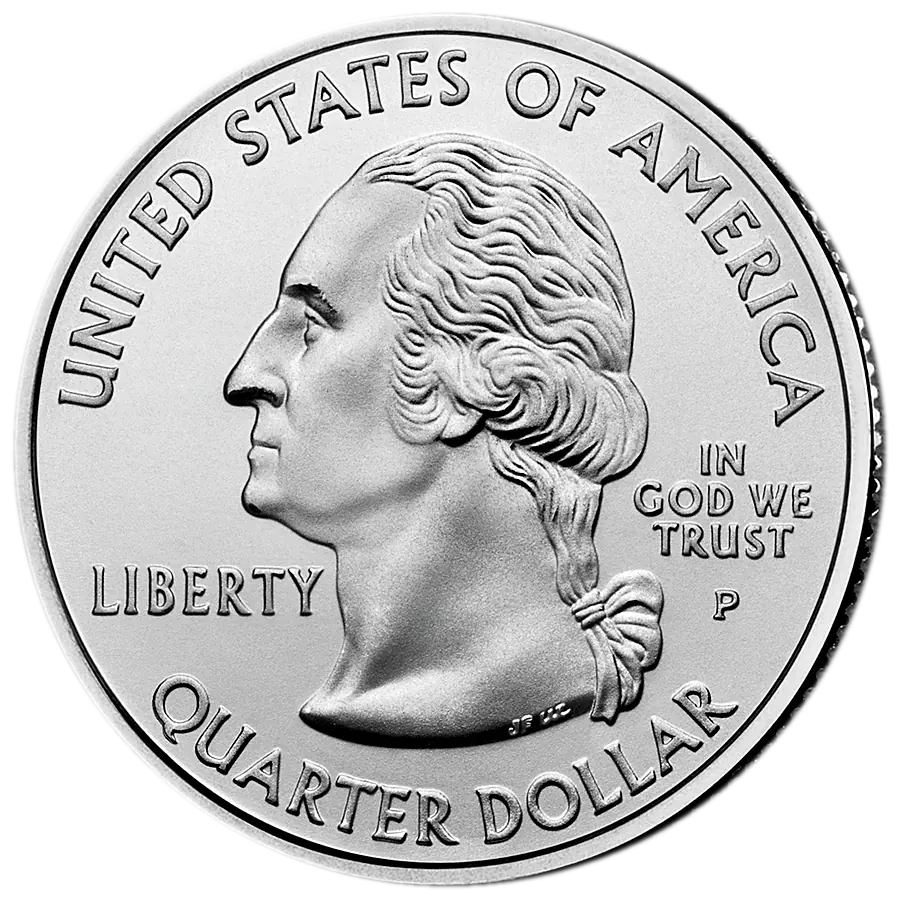
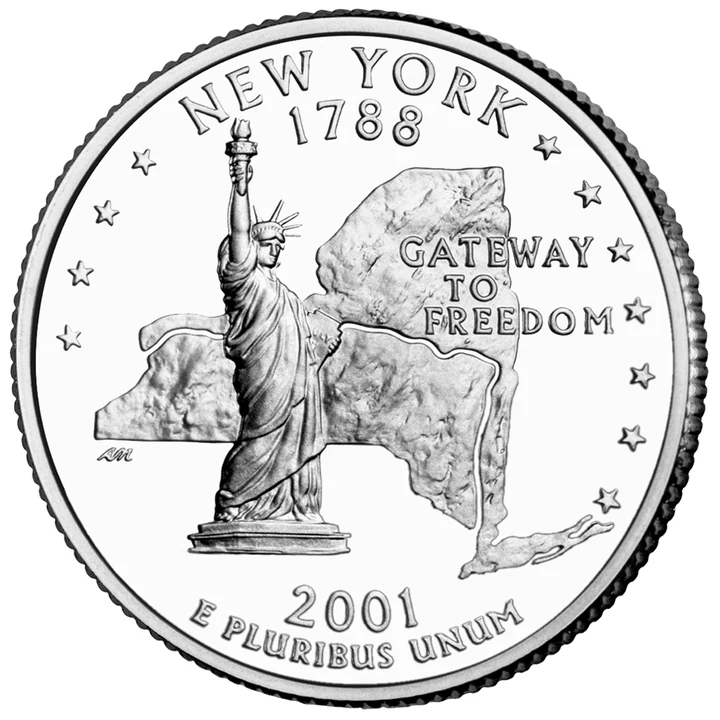
Exact New York reverse from the U.S. Mint; shared program obverse.
11 / 50release order
4mint/finish issues
P · D · Smint marks
2001release year
Story in 30 Seconds
The reverse places the Statue of Liberty over New York’s outline, with eleven stars for the eleventh state and GATEWAY TO FREEDOM. Lines inside the outline trace the Hudson River and Erie Canal.
The governor’s office orchestrated a two-year process and Governor George E. Pataki considered five finalist designs. The reviewed official record does not name the finalists or document a public vote. Pataki selected the Liberty concept and requested that the Hudson and Erie Canal lines be added before federal approval.
Collectors encounter P and D circulation strikes, an S copper-nickel clad proof, and an S 90% silver proof. No New York variety is asserted here; supposed doubled waterways, extra stars, missing torch rays, or a ‘map error’ need repeatable mint evidence.
Public Law 105-124 placed New York eleventh because it ratified the Constitution on July 26, 1788. One reverse could not represent the state’s Indigenous homelands, cities, farms, mountains, industry, reform movements, immigration, and many communities. The selected design framed New York through arrival and connection: harbor Liberty in front, statewide outline behind, and waterways linking coast and interior.
New York joins an Atlantic harbor to the Hudson valley, canal corridor, Great Lakes, Adirondacks, and western interior. The quarter selects two connected geographies: New York Harbor as a point of immigrant arrival and the Hudson–Erie route as an engine of movement, trade, settlement, and ideas. That lens is powerful but incomplete; New York existed before those routes and its migration history includes coercion, exclusion, displacement, and arrivals far beyond Ellis Island.
France gave Liberty Enlightening the World to the United States, and Frédéric-Auguste Bartholdi’s copper statue was dedicated in New York Harbor in 1886. Its torch originally expressed enlightenment and liberty. Passage by the monument and the opening of Ellis Island in 1892 gradually made it an emblem of immigrant arrival and welcome.
The official quarter story uses that later association: New York was a major port of entry, and millions encountered the harbor while seeking new lives. The eleven stars locate that story in federal sequence, while the state outline expands a harbor monument into an emblem for the whole state.
Governor Pataki requested two lines not present in the original design: the Hudson River and Erie Canal. The Hudson carries the eye north from the harbor; the Erie Canal historically joined the Hudson at Albany to Buffalo and the Great Lakes, helping make New York City a principal seaport and moving goods, people, and reform ideas across the state.
World Coin Book interpretation: Liberty is larger than the map, so ideals and arrival dominate geography. The waterways pull the eye inland and keep the design from reducing New York entirely to its largest city. What it omits is equally important: Lenape and Haudenosaunee homelands, enslavement and forced migration, exclusion laws, difficult inspections and settlement, and the many New Yorkers whose histories do not fit a triumphant gateway narrative.
The Mint’s contemporary launch release says the governor’s office orchestrated a two-year selection process and that Governor Pataki considered five finalist designs. It does not identify a commission, submission rules, finalist names, concept authors, scoring criteria, or a statewide public ballot.
Pataki chose the Statue of Liberty over the state outline and requested that the Hudson River and Erie Canal be added to honor their importance in New York’s development. The New York State Museum displayed the winner and five finalists at the January 2001 launch, but the reviewed online record does not preserve the candidate art.
Under the federal program, state concepts proceeded through Mint feasibility and artistic development, federal advisory review, a governor recommendation, and Treasury approval. The Mint credits Alfred Maletsky as reverse designer and sculptor. The complete model-by-model refinement and advisory record was not located.
Procedures varied by state and changed during the program; each researched state page must document its actual path.
Alternative Designs
The Mint documents five finalist designs considered by Governor Pataki but does not name their subjects; its wording distinguishes the winning design from those five, implying six displayed designs at the museum exhibit. Without official titles or artwork, World Coin Book does not invent candidates or reproduce unsourced lists.
Use the complete text cards below as the keyboard and screen-reader equivalent of the image.
Statue of Liberty
Official explanation: The Mint identifies Liberty as the central image and connects it with New York’s role as a major immigrant port of entry.
Historical context: Dedicated in 1886, the statue’s immigrant-welcome meaning grew after Ellis Island opened and through later public memory; it was not the monument’s only or original meaning.
World Coin Book interpretation: The oversized figure makes liberty and arrival the visual gateway through which the map is read.
Official explanation: The state outline identifies New York; eleven stars mark its position as the eleventh state admitted to the Union.
Historical context: New York ratified the Constitution on July 26, 1788. The outline includes Long Island but is a compact emblem, not a survey map.
World Coin Book interpretation: Stars arc around the upper map while Liberty breaks its boundary, joining federal sequence to an outward-facing harbor symbol.
Official explanation: The Mint says the etched lines trace the Hudson River and Erie Canal and were added at Governor Pataki’s request to honor their importance in state development.
Historical context: The Erie Canal opened in 1825, joining the Hudson corridor to Buffalo and the Great Lakes and reshaping trade, migration, settlement, and reform networks.
World Coin Book interpretation: The thin inland path balances the monumental figure and turns the state silhouette into a network rather than a static border.
GATEWAY TO FREEDOM · NEW YORK · 1788 · 2001 · E PLURIBUS UNUM · AM
Official explanation: The inscriptions state the theme, state, ratification year, issue year, national motto, and Alfred Maletsky’s initials.
Historical context: Gateway to Freedom is the quarter’s theme, not New York’s statutory state motto and not text engraved on the Statue of Liberty’s tablet.
World Coin Book interpretation: The lower banner names the argument explicitly while border inscriptions anchor the symbolic image in coin identity and chronology.
1886 harbor monument and the reverse’s dominant symbol of liberty and immigrant arrival.
Hudson River
Tidal river corridor connecting New York Harbor north toward Albany.
Erie Canal
Waterway opened in 1825 linking the Hudson corridor with Buffalo and the Great Lakes.
George E. Pataki
Governor who selected the concept and requested the Hudson and Erie Canal lines.
Alfred Maletsky
U.S. Mint sculptor-engraver credited as reverse designer and sculptor.
Focused Timeline
New York ratifies the Constitution as the eleventh state
The Erie Canal opens across New York
The Statue of Liberty is dedicated in New York Harbor
The federal immigration station opens on Ellis Island
The governor’s office conducts the documented two-year selection process
Governor Pataki selects Liberty and requests the two waterway lines
The New York quarter enters release as the program’s eleventh coin
The state and Mint unveil the quarter at the New York State Museum
Official Explanation and Interpretation
Artists and relief
John Flanagan’s Washington portrait, adapted by William Cousins, appears on the shared obverse. The reviewed official record does not name the winning concept’s original proposer or the five finalist authors. The U.S. Mint credits Alfred Maletsky as reverse designer and sculptor; he translated Liberty, map, stars, waterways, and inscriptions into low relief. Pataki’s documented request for the Hudson and Erie lines was a concept refinement, not an artist credit.
P and D are circulation issues. Both S issues were sold in proof products; the silver proof is a distinct 90% silver composition. Mintages are established catalog figures retained with an explicit source-audit limit.
Identification Guide
Identify the reverse by Liberty over the New York outline, eleven stars, internal waterway lines, and GATEWAY TO FREEDOM. The P, D, or S mint mark is on the obverse right of Washington’s hair ribbon. P and D are circulation strikes; S coins are proofs. A clad proof shows a copper edge stripe; the 90% silver proof lacks it and weighs about 6.25 g rather than 5.67 g.
Condition Guide
On circulated coins, inspect Liberty’s face, crown rays, torch and arm, robe folds, map boundary, Long Island, stars, and raised waterway lines for first smoothing. Confirm wear through broken luster across several high points; weak torch detail, incomplete routes, or soft stars can instead reflect strike, die wear, or grease.
The open field around Liberty and the map reveals contact marks. Crown rays, torch flame, fingers, fine waterways, coastline, star points, AM initials, and small letters are vulnerable. Proofs should be checked for hairlines, haze, spots, fingerprints, impaired mirrors, and reduced frost.
Mint Errors vs. Damage
Recognized catalog varieties: none are listed in the current World Coin Book New York issue records. This is an evidence boundary, not proof that no die varieties exist.
Genuine mint errors can include off-center strikes, broadstrikes, clips, wrong-planchet strikes, retained cuds, struck-through material, or substantial die cracks. Attribution requires mint-made metal flow, correct weight and geometry, and where applicable repeatable die evidence.
A doubled canal, extra river branch, twelfth star, missing star, broken crown ray, doubled torch, filled map, or ‘wrong coastline’ is not a rare variety by appearance alone. Mechanical doubling, die deterioration, grease, glare, compression, sharpening, wear, and impacts can create those impressions. The simplified outline and waterways are emblematic, not a survey error.
Scratches crossing the map, gouges beside Liberty, flattened rims, dryer damage, corrosion, stains, glue, plating, polishing, and heat color are post-mint damage. Gateway to Freedom is the coin theme, not a mistaken state motto or an inscription copied from Liberty’s tablet.
Why Collectors Care
Durable value tiers
Worn P and D examples usually occupy the face-value design-set tier. Better circulation coins attract interest through full luster, clean open fields, distinct crown rays and torch, complete stars, crisp map edges, visible waterways, and sharp lettering. Clad proofs form a collector-product tier; silver proofs add 90% silver as a separate composition tier. The famous subject adds demand, not automatic rarity. World Coin Book gives no live price promise: compare dated references for the exact mint, finish, grade, strike, and surfaces.
Official law and U.S. Mint records establish program facts and image identity. World Coin Book separates official explanation, historical analysis, and editorial interpretation.
Official descriptions, historical context, and World Coin Book interpretation are labeled separately. No live prices are asserted. Last verified:
The reviewed official record does not identify the state committee or staff roster, submission rules, evaluation criteria, meeting minutes, winning concept proposer, or authors and subjects of the five finalist designs.
No reviewed official source documents a public vote, response total, ballot, eligibility controls, or public ranking; this page therefore does not claim citizens selected the winner.
The New York State Museum exhibit and candidate artwork were not located online, and the complete Mint model, advisory-review, governor-recommendation, and Treasury-approval trail remains unresolved.
Official text says the lines trace the Hudson River and Erie Canal but does not define every bend or endpoint; the relief should not be read as a survey map or a complete state waterway network.
The normalized mintages remain established catalog figures; a future source audit should attach direct U.S. Mint annual-production and proof-sales evidence to each number.