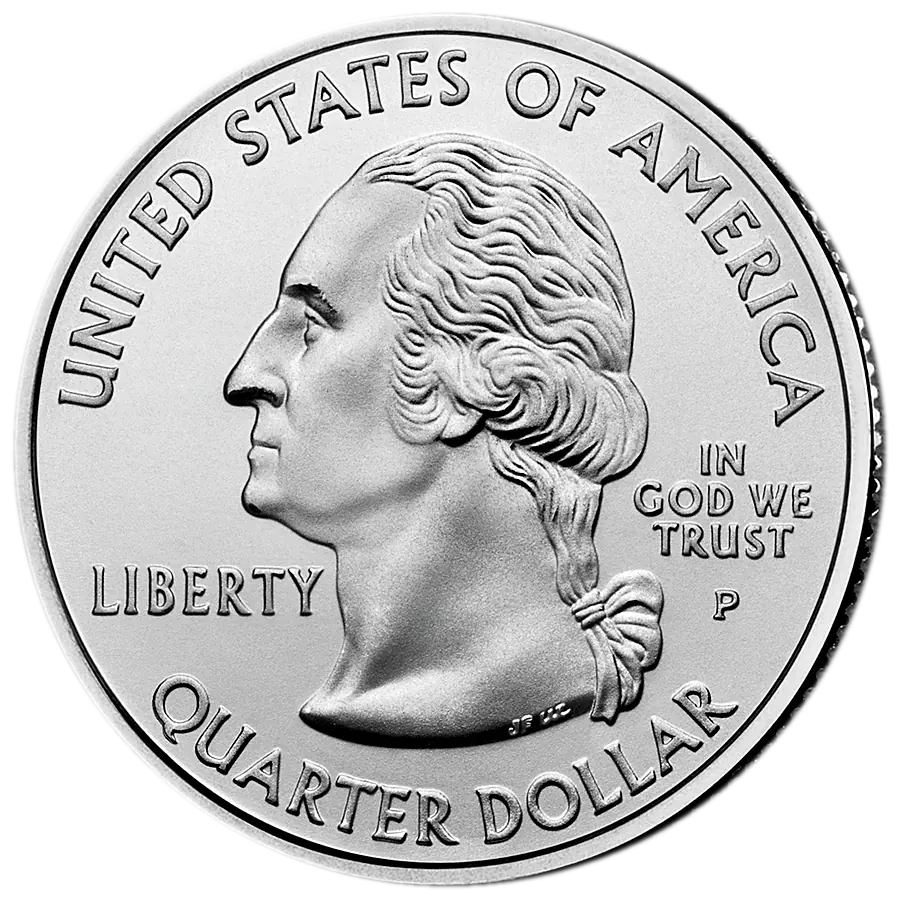
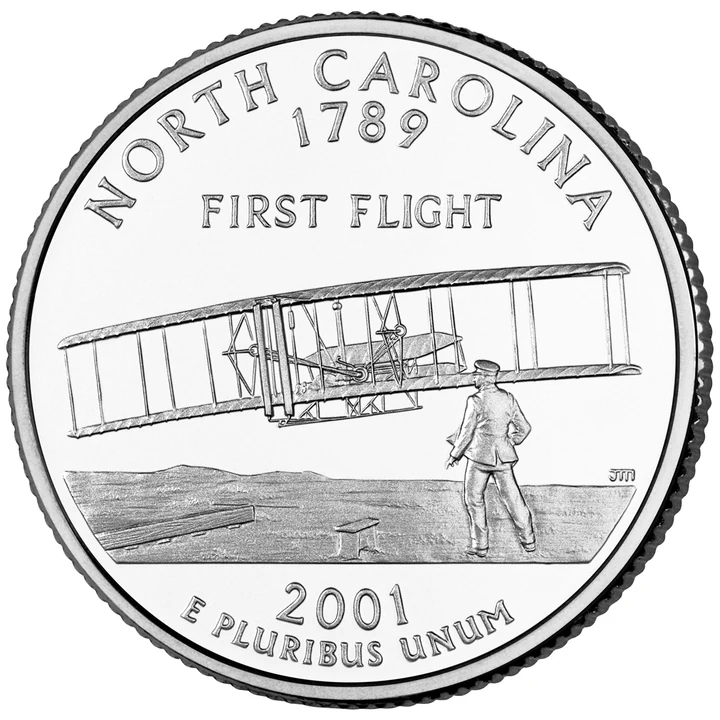
Exact North Carolina reverse from the U.S. Mint; shared program obverse.
12 / 50release order
4mint/finish issues
P · D · Smint marks
2001release year
Story in 30 Seconds
The reverse adapts the famous December 17, 1903 photograph: Orville Wright lies at the controls as the Flyer lifts from its rail, while Wilbur runs beside it across the Outer Banks sand.
North Carolina chose First Flight because the Wright brothers carried out their decisive glider experiments and first successful controlled, powered airplane flights at Kill Devil Hills, near Kitty Hawk. The image turns a specific place and event into a statewide aviation identity.
The reviewed official online record confirms the subject, release, inscriptions, and John Mercanti credit but does not preserve a complete state selection file. Public submissions, a committee, and alternatives are reported in later retellings, yet submission totals, finalist artwork, votes, and minutes remain unresolved here.
Collectors should distinguish the four 2001 issues: P and D circulation strikes, S clad proof, and S 90% silver proof. Fine Flyer wires, wing edges, Wilbur’s figure, rail, sand texture, and small lettering reveal strike quality, wear, and damage.
Public Law 105-124 scheduled one state reverse in constitutional-ratification or admission order. North Carolina ratified the Constitution on November 21, 1789, making this the program’s twelfth coin and second 2001 release. A quarter could not narrate four years of experiments, local assistance, engineering work, and later aviation development, so the state centered one instantly recognizable photographed instant.
The relevant North Carolina is the northeastern Outer Banks: open sand, steady wind, isolation, and local contacts drew the Ohio-based brothers to the Kitty Hawk area. The powered flights occurred at the camp and level track in present-day Kill Devil Hills, south of Kitty Hawk village. Saying ‘Kitty Hawk’ reflects the historic postal and regional label; saying ‘Kill Devil Hills’ locates the actual memorial site more precisely.
From 1900 through 1903, Wilbur and Orville Wright returned to the Outer Banks to test kites and gliders, measure lift, develop control, and build a powered machine. They chose the coast for wind, sand, open space, and isolation—not because the airplane was invented wholly in North Carolina. Their workshop, calculations, wind-tunnel work, engine, and much construction were rooted in Dayton, Ohio.
On December 17, 1903, Orville piloted the first flight from a level launch rail. It lasted about twelve seconds and traveled 120 feet. Wilbur ran beside the right wing; John T. Daniels operated the camera that preserved the instant adapted for the quarter. Three more flights followed that day, with the fourth reaching 852 feet in 59 seconds.
The coin freezes takeoff rather than explaining the experimental program. Its compact composition celebrates control, motion, teamwork, and place, but omits the witnesses, camp buildings, launch apparatus detail, years of failed and successful tests, local Outer Banks assistance, the brothers’ Dayton work, and other aviation pioneers.
First Flight became a durable North Carolina identity through memorialization, tourism, license-plate language, the approaching 2003 centennial, and the quarter itself. The claim should be read precisely: the National Park Service describes the achievement as the first successful controlled, powered, heavier-than-air airplane flight. Broader phrases such as ‘first flight ever’ erase earlier balloons, gliders, unmanned powered craft, and contested definitions.
The reviewed Mint pages say North Carolina themed the coin First Flight and that the final reverse renders the 1903 photograph. They do not identify who first submitted the concept, the state committee roster, rules, counts, judging criteria, public ballot, or the governor’s formal recommendation.
Later accounts describe Governor James B. Hunt assigning the Department of Cultural Resources to lead a commemorative-coin committee, inviting resident ideas, and considering Flyer and Cape Hatteras Lighthouse concepts. Because the underlying state file was not located in the reviewed official online record, World Coin Book treats those procedural details as leads, not settled claim-level facts.
Under the documented federal program framework, state concepts moved through Mint feasibility and artistic development, advisory review, gubernatorial recommendation, and Treasury approval. The Mint credits John Mercanti as reverse designer and sculptor. The surviving public pages do not expose model-by-model revisions or the advisory comments for North Carolina.
Procedures varied by state and changed during the program; each researched state page must document its actual path.
Alternative Designs
A Cape Hatteras Lighthouse concept and versions combining the Flyer or lighthouse with a state outline appear in later summaries, but the reviewed official Mint, state, and federal pages do not preserve a definitive finalist list or candidate artwork. This page therefore names no official finalist, winner of a public vote, or alternative artist.
Use the complete text cards below as the keyboard and screen-reader equivalent of the image.
1903 Wright Flyer and Orville Wright
Official explanation: The Mint identifies the Flyer lifting off with Orville piloting, adapted from the famous First Flight photograph.
Historical context: Orville lay prone on the lower wing and controlled pitch, roll, and yaw through the machine’s linked systems; the first flight covered 120 feet in about twelve seconds.
World Coin Book interpretation: The broad stacked wings dominate the center, making engineered structure—not a heroic portrait—the chief symbol.
Official explanation: The Mint says Wilbur watches in the foreground; the source photograph shows him running beside the right wing at takeoff.
Historical context: The brothers alternated as pilots during the four flights; Wilbur’s presence makes the scene one of collaboration rather than a solitary feat.
World Coin Book interpretation: His forward-leaning figure supplies scale and direction, visually pushing the Flyer toward the open right field.
Official explanation: The Mint calls the setting North Carolina’s Outer Banks; the photograph-based relief retains the low rail and sandy ground beneath the aircraft.
Historical context: The Flyer had no wheels. A rail supported takeoff, while steady wind, open terrain, soft sand, and isolation made the site useful for experiments.
World Coin Book interpretation: Dense machinery rises from a thin horizon into empty field, turning physical separation from the ground into the coin’s dramatic event.
FIRST FLIGHT · NORTH CAROLINA · 1789 · 2001 · E PLURIBUS UNUM · JM
Official explanation: The inscriptions identify the theme, state, ratification year, issue year, national motto, and John Mercanti’s initials.
Historical context: FIRST FLIGHT is the coin theme and echoes the state’s aviation identity; it is not a claim that every category of human flight began there.
World Coin Book interpretation: The phrase sits in the Flyer’s path, so image and text make one directional argument while border legends anchor state and time.
Pilot of the first December 17, 1903 flight and the prone figure aboard the Flyer.
Wilbur Wright
Co-inventor shown running beside the aircraft in the photographed takeoff.
1903 Wright Flyer
Controlled, powered, heavier-than-air machine represented at takeoff.
Kill Devil Hills
Present-day town and memorial site where the powered flights occurred, south of Kitty Hawk.
John T. Daniels
U.S. Life-Saving Service member who operated the camera for the famous first-flight photograph.
John Mercanti
U.S. Mint artist credited as reverse designer and sculptor.
Focused Timeline
North Carolina ratifies the Constitution as the twelfth state
Wilbur and Orville Wright begin Outer Banks flight experiments
Four powered flights occur at Kill Devil Hills; Orville pilots the first
Congress authorizes a memorial at Kill Devil Hills
Public Law 105-124 authorizes the 50 State Quarters program
North Carolina’s quarter enters release as the program’s twelfth coin
The centennial renews public interpretation of the Outer Banks achievement
Official Explanation and Interpretation
Artists and relief
John Flanagan’s Washington portrait, adapted by William Cousins, appears on the shared obverse. The famous scene derives from the photograph made when John T. Daniels operated the Wrights’ camera, but photographic authorship is not the same as coin-design credit. The U.S. Mint credits John Mercanti as reverse designer and sculptor; he condensed wings, struts, pilot, runner, rail, sand, open field, and inscriptions into durable low relief. The reviewed official record does not identify an original state concept artist or document production revisions.
P and D are circulation issues. Both S issues were sold in proof products; the silver proof is a distinct 90% silver composition. Mintages are established catalog figures retained with an explicit source-audit limit.
Identification Guide
Identify the reverse by the biplane lifting from a rail, Orville aboard, Wilbur running below, and FIRST FLIGHT. The P, D, or S mint mark is on the obverse right of Washington’s hair ribbon. P and D are circulation strikes; S coins are proofs. A clad proof shows a copper edge stripe; the 90% silver proof lacks it and weighs about 6.25 g rather than 5.67 g.
Condition Guide
On circulated coins, inspect the upper and lower wing edges, forward elevator, struts and wires, Orville’s body, Wilbur’s head and shoulders, rail, sand ridges, and lettering for smoothing. Confirm wear through luster breaks across several high points; incomplete wires, merged struts, a weak runner, or flat sand can instead reflect strike, die wear, or grease.
Broad fields above and ahead of the Flyer reveal contact marks. Wing tips, fine rigging, propeller area, Wilbur’s limbs, rail ends, JM initials, and small letters are vulnerable. Proofs should be checked for hairlines, haze, spots, fingerprints, impaired mirrors, and reduced frost.
Mint Errors vs. Damage
Recognized catalog varieties: none are listed in the current World Coin Book North Carolina issue records. This is an evidence boundary, not proof that no die varieties exist.
Genuine mint errors can include off-center strikes, broadstrikes, clips, wrong-planchet strikes, retained cuds, struck-through material, or substantial die cracks. Attribution requires mint-made metal flow, correct weight and geometry, and where applicable repeatable die evidence.
A ‘floating’ plane, missing or extra wing wire, doubled wing, detached propeller, extra rail, filled letters, missing Wilbur, or doubled FIRST FLIGHT is not a rare variety by appearance alone. Mechanical doubling, die deterioration, grease, glare, compression, sharpening, wear, and impacts commonly erase or duplicate this fine relief.
Scratches in the sky, gouges through wings, bent rims, dryer damage, corrosion, stains, glue, plating, polishing, and heat color are post-mint damage. The coin does not picture the later Wright Flyer III, and Kitty Hawk is a broad historic label: the actual powered-flight site is in present-day Kill Devil Hills. ‘First flight’ should not be expanded into a false claim about balloons, gliders, or every earlier aviation experiment.
Why Collectors Care
Durable value tiers
Worn P and D examples usually occupy the face-value design-set tier. Better circulation coins attract interest through full luster, clean open fields, separated wing edges and struts, visible fine rigging, a distinct runner and rail, and sharp lettering. Clad proofs form a collector-product tier; silver proofs add 90% silver as a separate composition tier. The celebrated subject adds demand, not automatic rarity. World Coin Book gives no live price promise: compare dated references for the exact mint, finish, grade, strike, and surfaces.
Official law and U.S. Mint records establish program facts and image identity. World Coin Book separates official explanation, historical analysis, and editorial interpretation.
Official descriptions, historical context, and World Coin Book interpretation are labeled separately. No live prices are asserted. Last verified:
The reviewed official online record does not identify the North Carolina committee roster, submission period and rules, number of entries, evaluation criteria, meeting minutes, original concept proposer, or the governor’s signed recommendation.
No reviewed official source documents a statewide public vote, ballot, response total, eligibility controls, or ranking; this page therefore does not claim citizens selected the winner.
Later summaries name Cape Hatteras Lighthouse and state-outline concepts, but the underlying official finalist list and candidate artwork were not located, so none is presented as a documented finalist.
The complete Mint model, federal advisory review, state feedback, Treasury approval, and any changes involving FIRST FLIGHT versus FIRST IN FLIGHT remain unresolved.
The normalized mintages remain established catalog figures; a future source audit should attach direct U.S. Mint annual-production and proof-sales evidence to each number.