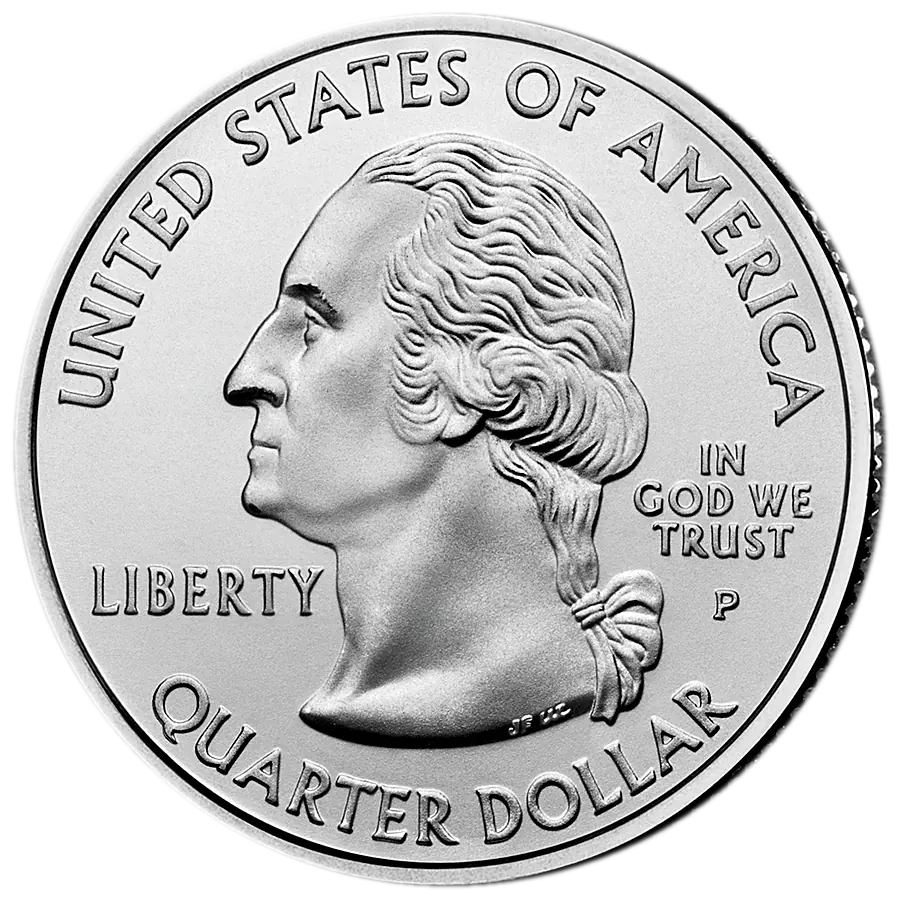
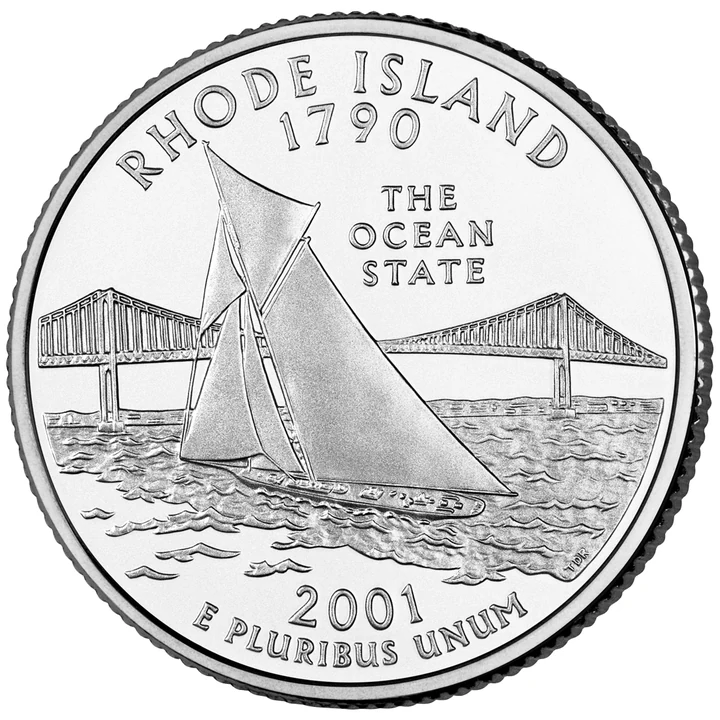
Exact Rhode Island reverse from the U.S. Mint; shared program obverse.
13 / 50release order
4mint/finish issues
P · D · Smint marks
2001release year
Story in 30 Seconds
The reverse shows a vintage sailboat under way on Narragansett Bay with the Claiborne Pell Bridge behind it; THE OCEAN STATE states the design’s argument directly.
Rhode Island selected the scene because sailing and the bay communicate the state’s coastal geography, recreation, maritime economy, and public identity while the bridge anchors the view to a recognizable modern place.
Governor Lincoln Almond authorized the Rhode Island State Council on the Arts to organize a Coin Concept Advisory Panel. More than 500 concepts produced three finalists; residents voted at libraries, the State House, and online, casting 34,566 votes. The sailboat won 57% and the governor accepted it.
Collectors should distinguish P and D circulation strikes, S clad proof, and S 90% silver proof. The sail, rigging, hull, bridge cables and towers, wave lines, and small inscriptions expose strike weakness, wear, and damage.
Public Law 105-124 arranged state reverses by constitutional ratification or admission. Rhode Island ratified the Constitution on May 29, 1790, making this the thirteenth program coin, the third 2001 release, and the last of the original thirteen states. One reverse could not represent the state’s Indigenous history, religious-liberty tradition, industry, cities, islands, fisheries, naval activity, and coast, so the selected scene made Narragansett Bay the organizing idea.
Narragansett Bay is an estuary where fresh and salt water mix and is central to Rhode Island’s geography, ecology, transportation, fisheries, tourism, and recreation. The coin looks across its East Passage near Newport and Jamestown. ‘Ocean State’ is a nickname, not a claim that Rhode Island is mostly open ocean; the bay and watershed extend beyond political boundaries and carry environmental pressures the celebratory reverse does not show.
Narragansett Bay long predates the state and has supported Indigenous communities and later fishing, trade, defense, shipbuilding, naval work, tourism, and recreation. The coin compresses that layered water history into a leisure sailboat, a deliberate but incomplete identity choice.
The foreground boat is described officially as vintage, not identified as a named yacht or exact class. Its filled sail and angled hull suggest wind and movement. Rhode Island’s launch ceremony reinforced the association with a parade of vintage yachts, and the Mint called sailing the state’s most popular sport.
Behind the boat, the Claiborne Pell Bridge crosses the East Passage between Jamestown and Newport. Opened in 1969 and named for Senator Claiborne Pell in 1992, its towers and cables supply a twentieth-century counterpoint to traditional sail. The bridge is not the boat’s destination and the coin does not document a specific voyage.
The design emphasizes scenic access, recreation, motion, and connection. It omits commercial fishing, ports, working vessels, industrial shorelines, Indigenous presence, coastal storms, pollution, habitat vulnerability, and the communities beyond Newport. Its meaning has broadened as the bay is increasingly discussed as both state identity and a shared, vulnerable estuary.
Governor Lincoln Almond issued an order authorizing the Rhode Island State Council on the Arts to organize a Coin Concept Advisory Panel. The official state account says the panel received more than 500 concepts and chose three finalists.
Residents could vote for two weeks at area libraries, the State House, and on the Internet. The official state and Mint accounts agree on 34,566 votes and a 57% win for the sailboat. Governor Almond accepted the result in July; RISCA executive director Randall Rosenbaum helped oversee the process.
Under the federal program framework, state concepts then passed through Mint feasibility and artistic development, advisory review, gubernatorial recommendation, and Treasury approval. The Mint credits Thomas D. Rogers as reverse designer and sculptor, but the reviewed public record does not preserve the panel roster, finalist names or art, vote breakdown for the other designs, models, advisory comments, or revision trail.
Procedures varied by state and changed during the program; each researched state page must document its actual path.
Alternative Designs
Three finalists are officially documented, but the reviewed official pages identify only the winning sailboat scene. Because the names, subjects, artwork, artists, and vote shares of the other two were not located, this page does not repeat secondary lists or display neighboring designs as substitutes.
Use the complete text cards below as the keyboard and screen-reader equivalent of the image.
Vintage sailboat
Official explanation: The Mint identifies a vintage sailboat gliding through Narragansett Bay and links it to Rhode Island sailing.
Historical context: The official record does not name a yacht or class; the generic vessel represents sailing rather than one documented voyage.
World Coin Book interpretation: The diagonal mast, filled sail, and heeling hull create the strongest movement and make lived use of the bay the foreground subject.
Official explanation: The Mint places the vessel on Rhode Island’s famous Narragansett Bay.
Historical context: The bay is a productive estuary central to ecology, fisheries, transport, tourism, and recreation, and vulnerable to watershed-wide pressures.
World Coin Book interpretation: Repeated low curves carry the eye beneath boat and bridge, making water the connective field rather than empty background.
Official explanation: The Mint identifies the Pell Bridge in the background and calls it New England’s longest suspension bridge.
Historical context: The 11,250-foot crossing opened in 1969 across the East Passage between Jamestown and Newport and received Claiborne Pell’s name in 1992.
World Coin Book interpretation: The thin horizontal deck steadies the boat’s diagonal motion; paired towers turn modern infrastructure into a distant frame for maritime tradition.
Estuary and central water landscape represented by the coin.
Claiborne Pell Bridge
Suspension bridge crossing the East Passage between Jamestown and Newport.
Claiborne Pell
Rhode Island senator for whom the bridge was named in 1992; he is not portrayed on the coin.
Lincoln Almond
Governor who authorized the state process and accepted the public-vote result.
Randall Rosenbaum
RISCA executive director identified by the Mint as helping oversee selection.
Thomas D. Rogers
U.S. Mint artist credited as reverse designer and sculptor.
Focused Timeline
Rhode Island ratifies the Constitution as the thirteenth state
The Newport Bridge opens across Narragansett Bay’s East Passage
The bridge is renamed for Senator Claiborne Pell
Public Law 105-124 authorizes the 50 State Quarters program
More than 500 concepts become three finalists and residents cast 34,566 votes
Governor Almond accepts the 57% sailboat winner
Rhode Island’s quarter debuts as the thirteenth program coin
Official Explanation and Interpretation
Artists and relief
John Flanagan’s Washington portrait, adapted by William Cousins, appears on the shared obverse. The state record documents public concept gathering and selection but does not identify the winning concept’s original proposer. The U.S. Mint credits Thomas D. Rogers as reverse designer and sculptor. He translated a broad civic concept into low relief by enlarging the sailboat, simplifying water, reducing the bridge to towers, deck, and cables, and fitting the nickname into open field. No reviewed official source exposes rejected models or production revisions.
P and D are circulation issues. Both S issues were sold in proof products; the silver proof is a distinct 90% silver composition. Mintages are established catalog figures retained with an explicit source-audit limit.
Identification Guide
Identify the reverse by one sailboat, wave lines, the distant twin-tower Pell Bridge, and THE OCEAN STATE. The P, D, or S mint mark is on the obverse right of Washington’s hair ribbon. P and D are circulation strikes; S coins are proofs. A clad proof has a copper edge stripe; the 90% silver proof lacks it and weighs about 6.25 g rather than 5.67 g.
Condition Guide
Check the sail’s broad surface and edges, mast and rigging, bow and stern, hull-water junction, wave crests, bridge towers, deck and fine cables, nickname, dates, and TDR initials. Confirm wear through luster breaks across multiple high points; missing cables, merged rigging, flat waves, or weak letters can instead result from strike, die wear, or grease.
The open fields around the sail and above the bridge reveal contact marks. Rigging intersections, sail tip, hull ends, bridge cables, tower tops, TDR, and small letters are vulnerable. Proofs require checks for hairlines, haze, spots, fingerprints, impaired mirrors, and reduced frost.
Mint Errors vs. Damage
Recognized catalog varieties: none are listed in the current World Coin Book Rhode Island issue records. This evidence boundary does not prove that no minor die varieties exist.
Genuine mint errors can include off-center strikes, broadstrikes, clips, wrong-planchet strikes, retained cuds, struck-through material, or substantial die cracks. Attribution requires mint-made metal flow, correct weight and geometry, and repeatable die evidence where applicable.
A missing bridge cable, extra mast or rigging line, doubled sail, detached hull, extra wave, filled letter, or ‘floating bridge’ is not a rare variety by appearance alone. Mechanical doubling, die deterioration, grease, glare, compression, sharpening, wear, and impacts commonly alter this fine relief.
Scratches across the sail, cuts in the water, bent rims, dryer damage, corrosion, stains, glue, plating, polishing, and heat color are post-mint damage. The boat is not officially identified as Courageous or another named yacht, the bridge is not the Jamestown Verrazzano Bridge, and ‘Ocean State’ does not mean the scene shows open Atlantic Ocean.
Why Collectors Care
Durable value tiers
Worn P and D examples usually occupy the face-value design-set tier. Better circulation coins attract interest through full luster, clean fields, a complete sail edge, separated mast and rigging, a crisp hull and waves, and visible bridge cables and letters. Clad proofs form a collector-product tier; silver proofs add 90% silver as a separate composition tier. A popular coastal subject adds demand, not automatic rarity. World Coin Book gives no live price promise: compare dated references for exact mint, finish, grade, strike, and surfaces.
Official law and U.S. Mint records establish program facts and image identity. World Coin Book separates official explanation, historical analysis, and editorial interpretation.
Official descriptions, historical context, and World Coin Book interpretation are labeled separately. No live prices are asserted. Last verified:
The reviewed official record does not identify all Coin Concept Advisory Panel members, the submission period and rules, evaluation criteria, meeting minutes, or the winning concept’s original proposer.
The names, subjects, artwork, artists, and vote shares of the two losing finalists were not located in reviewed official sources.
The vote total and winning percentage are official, but ballot-level data, geographic distribution, duplicate-vote controls, and channel-by-channel totals were not located.
The complete Mint model, advisory-review, state-feedback, Treasury-approval, and inscription-revision trail remains unresolved.
Normalized mintages remain established catalog figures; a future source audit should attach direct U.S. Mint annual-production and proof-sales evidence to each number.