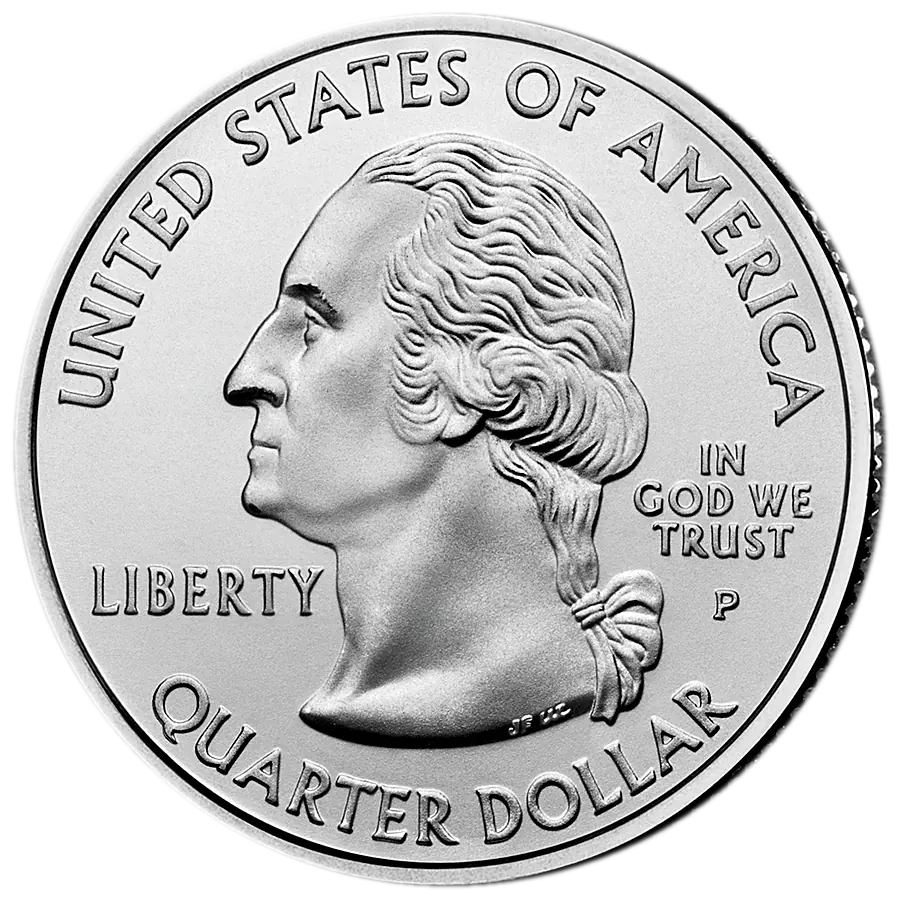
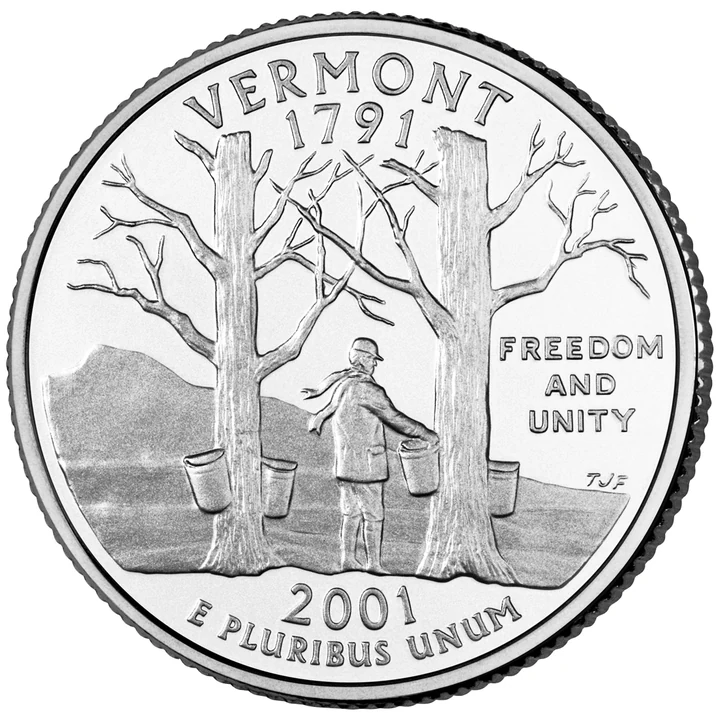
Exact Vermont reverse from the U.S. Mint; shared program obverse.
14 / 50release order
4mint/finish issues
P · D · Smint marks
2001release year
Story in 30 Seconds
The reverse shows two maple trees fitted with sap buckets in the foreground and Camel’s Hump’s distinctive profile behind them, with FREEDOM AND UNITY across the field.
Vermont chose maple sugaring because it joins rural heritage, seasonal work, forest stewardship, and an industry strongly identified with the state; Camel’s Hump supplies a recognizable preserved landscape.
Governor Howard Dean assigned the Vermont Arts Council to lead an 18-month process. The Council worked with the U.S. Mint to narrow proposals to three, and Dean sought opinions during public appearances before choosing the maple-sugaring favorite.
Collectors should distinguish P and D circulation strikes, S clad proof, and S 90% silver proof. Fine twigs, bucket handles, taps, sap lines, mountain contours, bark, and small inscriptions are sensitive to strike, wear, die state, and damage.
Public Law 105-124 arranged state reverses by constitutional ratification or admission. Vermont entered the Union on March 4, 1791 as the first state after the original thirteen, making this the fourteenth program coin and fourth 2001 release. One reverse could not represent Abenaki homelands and living communities, the republic and statehood era, farms, towns, industry, abolition, migration, mountains, forests, and modern Vermont. The selected scene instead made a working landscape its compact identity.
Vermont’s statutes name the sugar maple as the state tree and describe maple sugaring as both a cultural tradition and part of the agricultural and forest-products economy. Camel’s Hump is a protected Green Mountain landscape: the state’s trail guide traces its modern name, a 1911 gift of summit land intended to preserve its undeveloped character, and 1969 protection. The coin celebrates these identities but does not show the full ecology, labor, technology, climate risk, land history, or Indigenous knowledge associated with them.
Maple sugaring is not simply a bottle of syrup. The scene begins in a sugarbush when temperature conditions allow sap to move. Taps and buckets turn an ordinary-looking stand of trees into a seasonal workplace; collected sap must then be concentrated. The coin uses older bucket technology as a readable emblem, not as a claim that every 2001 producer worked that way.
The two trunks dominate the foreground. Their buckets make labor visible without depicting a worker, sugarhouse, fire, tubing, tank, evaporator, packaging, or market. That omission makes the woods appear quiet and timeless even though sugaring is skilled agricultural and forest work that changes with technology and climate.
Camel’s Hump rises behind the trees with the asymmetric double profile that makes it recognizable. State ownership began around the summit with Colonel Joseph Battell’s 1911 gift; later policy protected its primitive and undeveloped qualities. The mountain therefore contributes both scenery and a history of deliberate conservation.
The state motto FREEDOM AND UNITY bridges work and landscape. Vermont law preserves that wording; the coin does not define a single political meaning for it. World Coin Book reads the composition as a balance between individual trees and shared mountain horizon, private or family labor and public landscape, but that is editorial interpretation rather than Mint doctrine.
The design emphasizes rural continuity, maple identity, beauty, and stewardship. It omits Vermont’s cities, dairy and other farms, quarrying, manufacturing, immigration, social conflicts, Abenaki presence, and the difficult histories behind land ownership. Later viewers may also read the scene through changing winters, forest health, modern tubing systems, and debates over who and what the pastoral image leaves out.
Governor Howard Dean appointed the Vermont Arts Council to oversee the state process. The U.S. Mint’s contemporary account describes an extensive 18-month effort in which the Council worked with the Mint and narrowed the proposed designs to three.
Dean held the final state choice. Rather than documenting a formal statewide ballot, the Mint says he asked Vermonters for opinions during public appearances around the state; he reported that the maple-sugaring scene was the clear favorite and selected it for its rural heritage and landscape.
Under the federal framework, state concepts passed through Mint feasibility and artistic development, advisory review, gubernatorial recommendation, and Treasury approval. The Mint credits T. James Ferrell as reverse designer and sculptor. Reviewed official sources do not provide the original call, submission count, panel roster, three proposal images or subjects, opinion totals, models, advisory comments, or revision trail.
Procedures varied by state and changed during the program; each researched state page must document its actual path.
Alternative Designs
The U.S. Mint documents three proposed designs at the final state stage, but the reviewed official record identifies only the selected maple-sugaring scene. It does not establish whether every proposal showed Camel’s Hump, nor publish the other subjects, artists, images, or preference totals. This page therefore does not promote secondary-source finalist lists as established fact.
Use the complete text cards below as the keyboard and screen-reader equivalent of the image.
Two maple trees and sap buckets
Official explanation: The Mint identifies maple trees with sap buckets in the foreground and links them to Vermont’s maple-sugar and syrup production.
Historical context: The sugar maple is Vermont’s statutory state tree; state law describes sugaring as a cultural tradition, economic activity, and sustainable forest use.
World Coin Book interpretation: The paired trunks frame the mountain while buckets and taps convert scenic forest into working landscape; no worker is shown, so tools carry the human story.
Official explanation: The Mint identifies the mountain as Camel’s Hump, a significant Vermont landmark with a distinctive profile.
Historical context: The summit area entered state care through a 1911 preservation gift; later acquisitions and 1969 law protected a larger reserve and natural area.
World Coin Book interpretation: Its low, broad silhouette steadies the vertical trees and gives a local horizon to a practice that could otherwise appear generic.
Official explanation: The official description centers buckets in the foreground; it does not assign separate symbolic meanings to every incised line.
Historical context: Buckets are a historically legible collection method, while many modern operations also use tubing and vacuum systems not represented here.
World Coin Book interpretation: Curving ground lines lead from the lower inscriptions toward the mountain, while open field keeps fine branches and bucket silhouettes readable at quarter scale.
Protected Green Mountain landmark represented in the background.
Sugar maple
Vermont’s statutory state tree and the source of the sap represented by the buckets.
Maple sugaring
Seasonal forest and agricultural work represented through taps and buckets.
Howard Dean
Governor who assigned the Arts Council process, consulted Vermonters, and selected the state concept.
Vermont Arts Council
State arts organization that led the documented 18-month proposal process.
T. James Ferrell
U.S. Mint artist credited as reverse designer and sculptor.
Focused Timeline
Vermont enters the Union as the fourteenth state
Joseph Battell gives 1,000 summit acres for preservation
Vermont law creates the Camel’s Hump Forest Reserve framework
Public Law 105-124 authorizes the 50 State Quarters program
The Vermont Arts Council leads an 18-month process and narrows proposals to three
Governor Dean chooses the publicly favored maple-sugaring scene
The Vermont quarter enters circulation as the fourteenth program coin
The national launch at the Vermont State House honors the maple industry
Official Explanation and Interpretation
Artists and relief
John Flanagan’s Washington portrait, adapted by William Cousins, appears on the shared obverse. The state-level record describes concepts rather than naming the original proposer of the winning scene. The U.S. Mint credits T. James Ferrell as reverse designer and sculptor. In low relief he separated two strong tree trunks, tiny collection equipment, and a distant asymmetric mountain while reserving open sky for the motto. Reviewed official sources do not expose concept drawings, rejected models, advisory comments, or documented production revisions.
P and D are circulation issues. Both S issues were sold in proof products; the silver proof is a distinct 90% silver composition. Mintages are established catalog figures retained with an explicit source-audit limit.
Identification Guide
Identify the reverse by two tapped maple trees with hanging buckets, Camel’s Hump behind them, and FREEDOM AND UNITY. The P, D, or S mint mark is on the obverse right of Washington’s hair ribbon. P and D are circulation strikes; S coins are proofs. A clad proof has a copper edge stripe; the 90% silver proof lacks it and weighs about 6.25 g rather than 5.67 g.
Condition Guide
Check upper branches and twig tips, bark ridges, taps and bucket handles, bucket rims and bodies, thin sap lines, mountain summits and slopes, ground lines, motto, dates, and TJF initials. Confirm wear through luster breaks across several high points; flat bark, merged twigs, faint equipment, or a soft mountain can instead reflect strike, die wear, or grease.
Open sky around the motto and mountain shows contact marks readily. Branch tips, trunk edges, bucket handles, tap junctions, mountain crest, small letters, and TJF are vulnerable. Proofs require checks for hairlines, haze, spots, fingerprints, impaired mirrors, and reduced frost.
Mint Errors vs. Damage
Recognized catalog varieties: none are listed in the current World Coin Book Vermont issue records. This evidence boundary does not prove that no minor die varieties exist.
Genuine mint errors can include off-center strikes, broadstrikes, clips, wrong-planchet strikes, retained cuds, struck-through material, or substantial die cracks. Attribution requires mint-made metal flow, correct weight and geometry, and repeatable die evidence where applicable.
An ‘extra bucket,’ missing bucket handle, doubled tree, extra branch, flowing-sap line, filled motto, or altered mountain peak is not a rare variety by appearance alone. Mechanical doubling, die deterioration, grease, glare, compression, sharpening, wear, and impacts commonly alter this fine relief.
Scratches that resemble tubing, cuts in trunks, dents on buckets, bent rims, dryer damage, corrosion, stains, glue, plating, polishing, and heat color are post-mint damage. The trees are maples, not the Green Mountain Boys’ pines; no person is visible; the mountain is Camel’s Hump, not Mount Mansfield; and the buckets do not depict syrup already finished.
Why Collectors Care
Durable value tiers
Worn P and D examples usually occupy the face-value design-set tier. Better circulation coins attract interest through full luster, clean sky, separated branches, textured bark, complete bucket handles and taps, and a crisp mountain profile and lettering. Clad proofs form a collector-product tier; silver proofs add 90% silver as a separate composition tier. A popular maple subject adds demand, not automatic rarity. World Coin Book gives no live price promise: compare dated references for exact mint, finish, grade, strike, and surfaces.
Official law and U.S. Mint records establish program facts and image identity. World Coin Book separates official explanation, historical analysis, and editorial interpretation.
Official descriptions, historical context, and World Coin Book interpretation are labeled separately. No live prices are asserted. Last verified:
The reviewed official record does not provide the original call for ideas, eligibility and submission dates, number of submissions, Vermont Arts Council panel or staff roster, evaluation criteria, meeting minutes, or winning concept’s original proposer.
Three proposed designs are official, but their subjects, artwork, artists, ordering, and survival were not located. The claim that all showed Camel’s Hump remains unverified in primary sources.
Governor Dean reported broad preference gathered at public appearances, but no formal ballot, sample method, locations, question wording, response count, demographic or geographic distribution, or design-by-design totals were located.
The complete Mint model, advisory-review, state-feedback, Treasury-approval, and inscription-revision trail remains unresolved.
Normalized mintages remain established catalog figures; a future source audit should attach direct U.S. Mint annual-production and proof-sales evidence to each number.