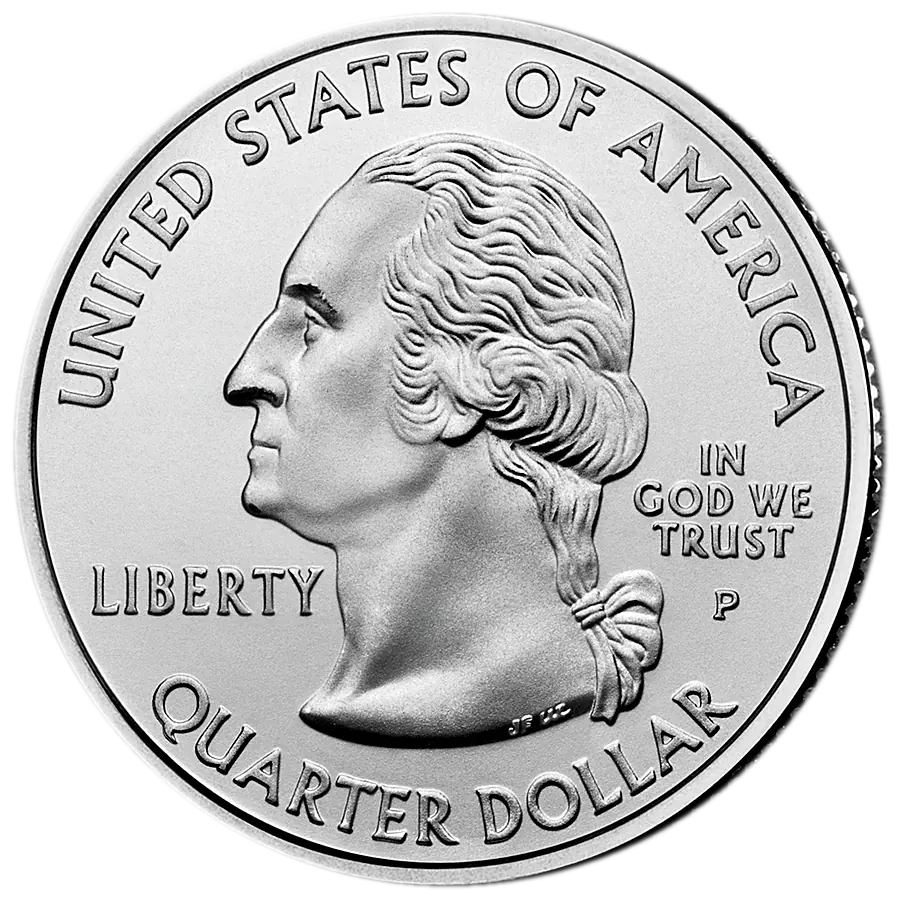
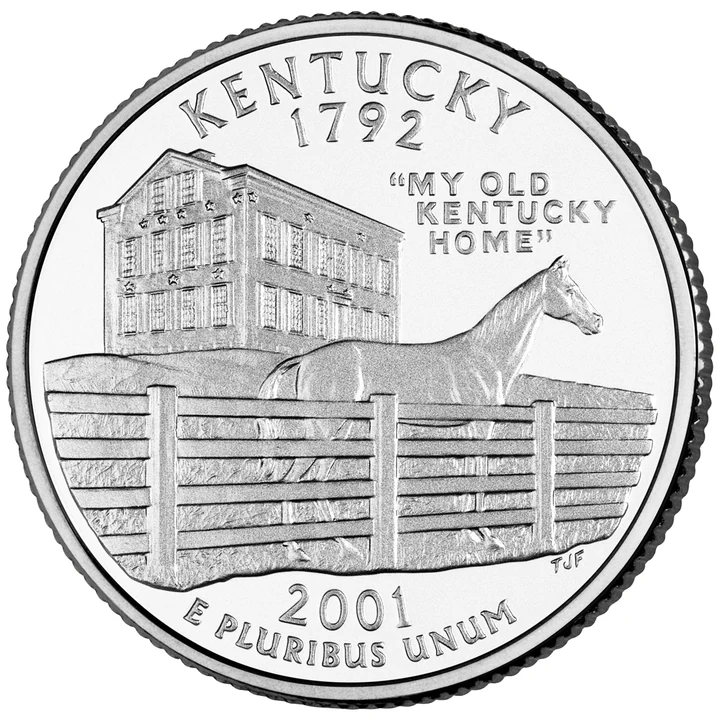
Exact Kentucky reverse from the U.S. Mint; shared program obverse.
15 / 50release order
4mint/finish issues
P · D · Smint marks
2001release year
Story in 30 Seconds
The reverse shows a thoroughbred standing behind a plank fence in the foreground and the side elevation of Federal Hill near Bardstown behind it, beneath MY OLD KENTUCKY HOME.
Kentucky paired two widely recognized identities: the Commonwealth’s thoroughbred breeding and racing landscape and the house long promoted as My Old Kentucky Home.
The surviving official federal record establishes the program-wide Mint, advisory, governor, and Treasury framework, but the reviewed Kentucky primary record does not preserve the state committee’s call, submissions, finalists, public-vote totals, or governor recommendation; those details remain evidence gaps.
Collectors should separate P and D circulation strikes, S clad proof, and S 90% silver proof. Horse anatomy, fence rails, mansion windows and roofline, trees, lettering, and open fields are sensitive to strike, wear, die state, and damage.
Public Law 105-124 ordered reverses by constitutional ratification or admission. Kentucky entered the Union on June 1, 1792 as the fifteenth state, making this the fifteenth program coin and fifth 2001 release. One reverse could not represent Indigenous homelands, frontier settlement, slavery and emancipation, Appalachian and western regions, agriculture, extraction, cities, music, civil rights, industry, waterways, or modern Kentucky. The selected scene instead joined two marketable Bluegrass images.
Federal Hill was the Rowan family’s plantation home near Bardstown, built in phases around 1795–1818 and later acquired by Kentucky. State and federal records preserve its architectural, political, and literary associations. Kentucky law names Stephen Foster’s ‘My Old Kentucky Home’ the state song, while official state history now qualifies the familiar claim that this specific house inspired it. The thoroughbred represents a powerful breeding and racing identity, but not every Kentucky horse or region.
The horse is not named and is not shown racing. Standing behind a fence, it evokes the Bluegrass breeding farm more than a particular Derby winner. That choice broadens the symbol from one animal or race to an industry and cultivated landscape, while omitting grooms, riders, stable labor, gambling, injury, ownership, and the industry’s racial and economic history.
Federal Hill supplies a second identity. Built for lawyer, legislator, and slaveholder John Rowan’s family, it became a state-owned shrine and was promoted as the setting or inspiration for Foster’s song. The mansion’s serene facade does not disclose the enslaved people whose labor sustained the plantation or the difference between documented association and popular legend.
MY OLD KENTUCKY HOME binds house, horse, and landscape. The phrase names both state song and historic site in public memory. Kentucky’s legislature notes that the official modern lyric replaced a racist term in 1986. The coin appeared fifteen years later without signaling the song’s Black dialect, slavery-era context, changing performance, or continuing debate.
World Coin Book reads the horse’s long horizontal body and fence as a visual base, with trees framing the lighter mansion and the title occupying open sky. This makes an elite pastoral estate appear continuous with modern horse country. That is editorial interpretation, not an official Mint claim.
The design emphasizes beauty, pedigree, heritage, and hospitality. It omits Kentucky’s Native nations, enslaved labor, emancipation, Appalachia, coal, bourbon labor, urban life, other agriculture and horse breeds, and social conflict. Its meaning has therefore shifted from uncomplicated celebration toward a prompt to ask who built the landscape and whose stories the pastoral image excludes.
The federal process announced by Treasury asked each governor to establish a state procedure and submit concepts. The Mint checked legal and technical suitability, prepared candidate designs, consulted the Commission of Fine Arts and Citizens Commemorative Coin Advisory Committee, obtained Treasury approval, and returned approved choices for the governor’s recommendation.
For Kentucky, reviewed official Mint pages identify the chosen subject and final artist but do not document the state-specific committee, solicitation, proposal count, finalist subjects, display, voting channels, vote total, or Governor Paul Patton’s recommendation. Secondary accounts repeat precise committee and voting numbers, but without a located primary record this page does not present them as established fact.
The U.S. Mint credits T. James Ferrell as reverse designer and sculptor. The surviving official sources reviewed here do not name the citizen concept proposer, publish candidate art, or expose Mint model changes, advisory comments, state feedback, inscription revisions, or the Secretary’s approval memorandum.
Procedures varied by state and changed during the program; each researched state page must document its actual path.
Alternative Designs
No Kentucky finalist list or candidate artwork was located in the reviewed official federal, state, or institutional sources. Secondary pages describe twelve displayed finalists and a public vote, but their underlying state record was not recovered. Alternative subjects, artists, rankings, and totals therefore remain unverified and are not reproduced here.
Use the complete text cards below as the keyboard and screen-reader equivalent of the image.
Thoroughbred behind a plank fence
Official explanation: The Mint identifies a thoroughbred racehorse behind a fence and links Kentucky with the Derby and celebrated racehorses.
Historical context: The standing, unnamed animal evokes breeding pasture rather than a specific race or horse; Kentucky’s wider equine population includes many other breeds.
World Coin Book interpretation: Horse and fence form the dark horizontal foreground, making managed land and pedigree the first reading while people and labor remain absent.
Official explanation: The Mint identifies the side view of Federal Hill, the Bardstown home known as My Old Kentucky Home.
Historical context: The Rowan plantation house was built in phases and later acquired and restored by Kentucky; official sources qualify the traditional Foster-inspiration story.
World Coin Book interpretation: Trees turn the facade into a distant framed memory, visually separating the historic house from the modern horse pasture while implying continuity.
Official explanation: The official description locates the horse behind a fence in the foreground; it gives no separate symbolism to every rail, tree, or ground line.
Historical context: The pastoral arrangement represents a selected Bluegrass identity, not a literal map of Federal Hill or a claim that this horse stood at the mansion.
World Coin Book interpretation: Overlapping rails create depth and hold the horse at the picture plane; open ground keeps the small mansion readable at quarter scale.
MY OLD KENTUCKY HOME · KENTUCKY · 1792 · 2001 · E PLURIBUS UNUM · TJF
Official explanation: The inscriptions state the theme, state, admission year, issue year, national motto, and T. James Ferrell initials.
Historical context: Kentucky law designates Foster’s song and records the 1986 lyric substitution; official history treats the mansion-inspiration claim as alleged or one of several inspirations.
World Coin Book interpretation: The title dominates the sky and instructs viewers to read the separate horse and mansion as one nostalgic statewide home image.
Rowan family plantation house represented behind the horse and now preserved as a Kentucky historic site.
Thoroughbred
Unnamed horse representing Kentucky’s prominent breeding and racing identity.
My Old Kentucky Home
Stephen Foster song, state-song title, historic-site name, and inscription carrying changing public meanings.
John Rowan
Lawyer, legislator, slaveholder, and owner associated with Federal Hill.
Stephen Foster
Songwriter associated by tradition with Federal Hill and author of My Old Kentucky Home.
T. James Ferrell
U.S. Mint artist credited as reverse designer and sculptor.
Focused Timeline
Kentucky enters the Union as the fifteenth state
The Rowan family builds Federal Hill in phases
Stephen Foster publishes the song later known as My Old Kentucky Home
Kentucky acquires Federal Hill and opens the historic shrine
Kentucky adopts My Old Kentucky Home as state song
The legislature adopts the modern lyric substituting ‘people’ for a racist term
Public Law 105-124 authorizes the 50 State Quarters program
The Kentucky quarter enters circulation as the fifteenth program coin
Official Explanation and Interpretation
Artists and relief
John Flanagan’s Washington portrait, adapted by William Cousins, appears on the shared obverse. The reviewed official record does not identify the original Kentucky concept proposer. The U.S. Mint credits T. James Ferrell as reverse designer and sculptor. He translated horse, fence, mature trees, long mansion facade, landscape, and six inscription groups into shallow relief with strong foreground/background separation. Candidate drawings, advisory comments, rejected models, and documented production revisions were not located.
P and D are circulation issues. Both S issues were sold in proof products; the silver proof is a distinct 90% silver composition. Mintages are established catalog figures retained with an explicit source-audit limit.
Identification Guide
Identify the reverse by a left-facing thoroughbred behind a plank fence, Federal Hill in the background, and MY OLD KENTUCKY HOME. The P, D, or S mint mark is on the obverse right of Washington’s hair ribbon. P and D are circulation strikes; S coins are proofs. A clad proof has a copper edge stripe; the 90% silver proof lacks it and weighs about 6.25 g rather than 5.67 g.
Condition Guide
Check the horse’s ear, face, shoulder, back, hip, legs, tail and interior modeling; fence rails and posts; mansion roof, pediment, chimneys, windows and columns; tree crowns and trunks; ground lines; lettering, dates, and TJF. Confirm wear through luster breaks across several high points; flat anatomy, weak legs, merged rails, soft windows, or faint initials may instead reflect strike, die wear, or grease.
Open fields above the horse and around the mansion show contact marks readily. The horse’s face, back and legs, fence edges, roofline, chimneys, tree tips, small windows and TJF are vulnerable. Proofs require checks for hairlines, haze, spots, fingerprints, impaired mirrors, and reduced frost.
Mint Errors vs. Damage
Recognized catalog varieties: none are listed in the current World Coin Book Kentucky issue records. This evidence boundary does not prove that no minor die varieties exist.
Genuine mint errors can include off-center strikes, broadstrikes, clips, wrong-planchet strikes, retained cuds, struck-through material, or substantial die cracks. Attribution requires mint-made metal flow, correct weight and geometry, and repeatable die evidence where applicable.
An ‘extra horse leg,’ doubled fence, floating rail, extra window, missing chimney, doubled tree, roofline break, or filled lettering is not a rare variety by appearance alone. Mechanical doubling, die deterioration, grease, glare, compression, sharpening, wear, and impacts commonly alter the crowded fine relief.
Scratches resembling reins or fence wire, cuts across the horse, dents on rails, bent rims, dryer damage, corrosion, stains, glue, plating, polishing, and heat color are post-mint damage. The horse is unnamed—not Secretariat or a documented Derby winner; the house is Federal Hill, not Churchill Downs; the horse is behind a fence, not jumping it; and official Kentucky history does not prove Foster wrote the song inside the mansion.
Why Collectors Care
Durable value tiers
Worn P and D examples usually occupy the face-value design-set tier. Better circulation coins attract interest through full luster, clean open fields, complete horse anatomy, separated fence rails, crisp mansion windows and roofline, textured trees, and sharp lettering. Clad proofs form a collector-product tier; silver proofs add 90% silver as a separate composition tier. A familiar horse subject adds demand, not automatic rarity. World Coin Book gives no live price promise: compare dated references for exact mint, finish, grade, strike, and surfaces.
Official law and U.S. Mint records establish program facts and image identity. World Coin Book separates official explanation, historical analysis, and editorial interpretation.
Official descriptions, historical context, and World Coin Book interpretation are labeled separately. No live prices are asserted. Last verified:
The reviewed official record does not provide Kentucky’s original call, eligibility and submission dates, proposal count, Kentucky Quarter Project Committee authority or roster, evaluation criteria, meeting minutes, or winning concept proposer.
No official finalist list, artwork, artists, display record, ranking, or survival information was located. Secondary claims of twelve finalists remain unverified here.
No primary record was located for voting dates, channels, eligibility, totals, design-by-design results, geographic distribution, duplicate-vote controls, or Governor Paul Patton’s recommendation.
The complete Mint feasibility, model, advisory-review, state-feedback, Treasury-approval, and inscription-revision trail remains unresolved.
Official state sources differ in confidence about Federal Hill as Foster’s inspiration; none reviewed proves that he wrote the song there. The site’s enslaved community and plantation operations need a stronger official interpretive source.
Normalized mintages remain established catalog figures; a future source audit should attach direct U.S. Mint annual-production and proof-sales evidence to each number.