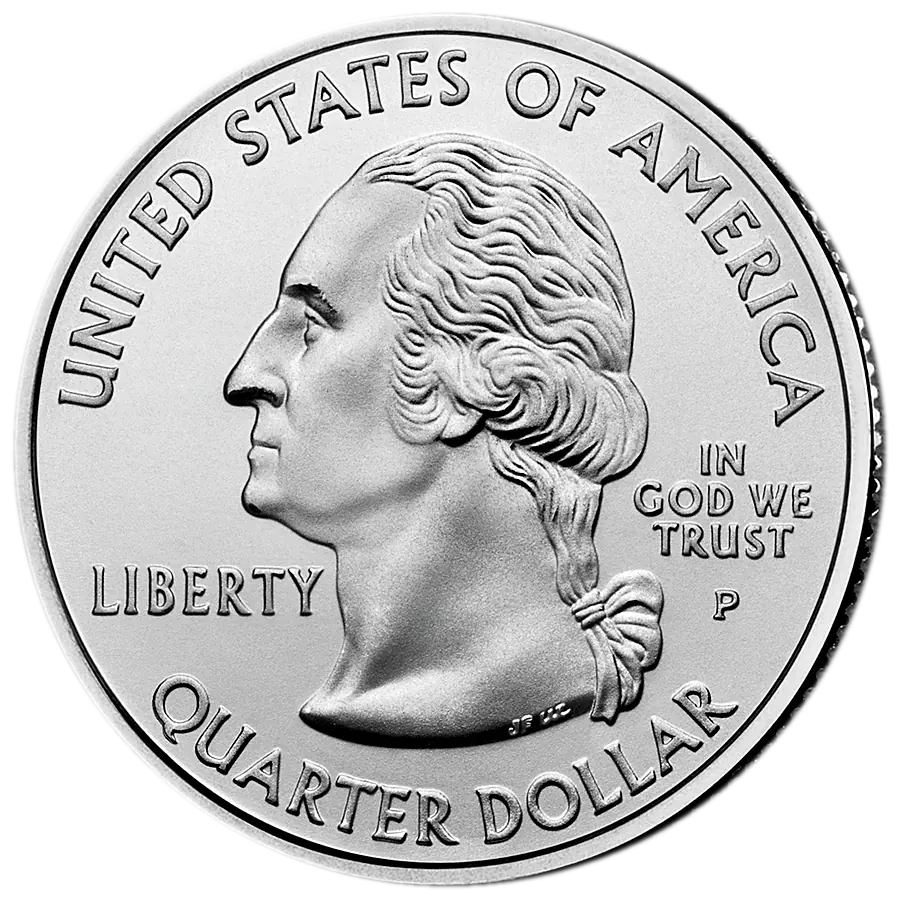
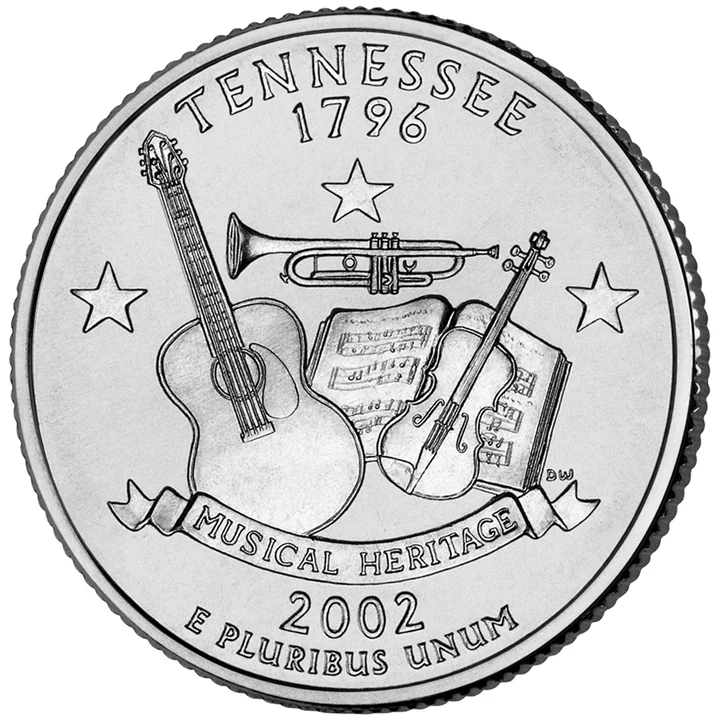
Exact Tennessee reverse from the U.S. Mint; shared program obverse.
16 / 50release order
4mint/finish issues
P · D · Smint marks
2002release year
Story in 30 Seconds
The reverse shows a fiddle, trumpet, guitar, musical score, MUSICAL HERITAGE banner, and three stars.
The Mint maps the fiddle to Appalachian music in East Tennessee, the guitar to Nashville country music in Middle Tennessee, and the trumpet to West Tennessee blues; the stars represent the three Grand Divisions.
The federal selection framework is documented, but reviewed official Tennessee sources do not preserve the state commission’s authority, call, submissions, finalists, public role, or Governor Don Sundquist’s recommendation.
Collectors should separate P and D circulation strikes, S clad proof, and S 90% silver proof. Strings, valves, instrument edges, score lines, notes, stars, banner, and initials are sensitive to strike, wear, die state, and damage.
Public Law 105-124 ordered reverses by constitutional ratification or admission. Tennessee entered the Union on June 1, 1796 as the sixteenth state, making this the sixteenth program coin and first 2002 release. One reverse could not encompass Cherokee and other Indigenous histories, slavery and emancipation, agriculture, mountains, rivers, cities, industry, civil rights, or every musical community. The selected concept used music to connect three strongly differentiated Grand Divisions.
Tennessee is formally divided into Eastern, Middle, and Western Grand Divisions. The coin turns that civic geography into a musical shorthand: Appalachian traditions in the east, Nashville’s recording and country-music identity in the middle, and blues associated with Memphis and the west. Those traditions overlap, migrate, and mix; no instrument belongs exclusively to one region or genre.
The fiddle, guitar, and trumpet are not portraits of named instruments or performers. They are category symbols. The Mint’s east-middle-west explanation makes the coin readable as a regional map without drawing Tennessee’s outline.
The fiddle points toward Appalachian old-time and related string traditions, but Appalachian music was never culturally isolated: African, Indigenous, British Isles, commercial radio, religious, and popular influences crossed communities and borders. A lone fiddle cannot carry that full history.
The guitar invokes Nashville country music and recording, although Nashville studios also made pop, gospel, rock, rhythm and blues, and other music. The trumpet points toward Memphis and West Tennessee blues, an African American form whose history cannot be reduced to one brass instrument; guitars, voices, pianos, harmonicas, and bands were also central.
The five-line score and notes unify instruments that would not normally form this exact trio. World Coin Book reads the rising diagonal—from trumpet through score to fiddle and guitar—as visual movement across the coin, while the banner names the intended interpretation. This is editorial analysis, not an official Mint statement.
The design emphasizes regional unity, creativity, performance, and Tennessee’s national influence. It omits musicians’ names and bodies, Black creators and labor, Indigenous music, sacred music, audiences, dance, radio, studios, migration, segregation, ownership, and genres that resist the neat three-region formula. Its continuing value is therefore both celebratory and diagnostic: it invites readers to ask who made the heritage behind the symbols.
Treasury’s federal process asked each governor to establish a state procedure and submit concepts. The Mint screened legal and technical suitability, prepared candidate designs, consulted the Commission of Fine Arts and Citizens Commemorative Coin Advisory Committee, obtained Treasury approval, and returned approved choices for a governor’s recommendation.
For Tennessee, reviewed official Mint and state sources establish the selected subject, symbolism, final artist, release date, and Governor Don Sundquist’s administration, but do not document the Tennessee commission’s legal authority or roster, solicitation dates and rules, submission count, evaluation criteria, meeting minutes, finalists, public display or vote, or governor recommendation.
Secondary accounts attribute an original concept to teacher Shawn Stookey and describe roughly 1,000 submissions and three finalists. Because the underlying state records were not located, this page preserves those claims as unresolved instead of treating them as fact. The U.S. Mint credits Donna Weaver as reverse designer and sculptor; no reviewed primary source explains how any citizen concept changed into her relief.
Procedures varied by state and changed during the program; each researched state page must document its actual path.
Alternative Designs
No official Tennessee finalist list, artwork, artists, rankings, vote totals, or preservation record was located. Secondary descriptions of three finalists are not enough to identify or reproduce alternatives. Their subjects and relationship to the final relief remain explicit evidence gaps.
Use the complete text cards below as the keyboard and screen-reader equivalent of the image.
Fiddle and bow
Official explanation: The Mint says the fiddle represents Appalachian music in East Tennessee.
Historical context: Fiddling participates in varied old-time, dance, sacred, commercial, Black, white, and Indigenous musical histories rather than one sealed regional tradition.
World Coin Book interpretation: The largest instrument spans the upper field; bow and neck create a long diagonal that makes East Tennessee the visual canopy.
Official explanation: The Mint says the trumpet represents blues in West Tennessee.
Historical context: Blues emerged from African American life in the South and used many voices and instruments; Memphis is important, but the form is not exclusively Tennessean or trumpet-led.
World Coin Book interpretation: The bell opens toward the rim while valves point inward, beginning the composition’s left-to-right musical sweep.
Official explanation: The Mint identifies a musical score and says the three stars represent Tennessee’s three geographical regions.
Historical context: State sources formally identify Eastern, Middle, and Western Grand Divisions; the score is symbolic and is not officially identified as a named composition.
World Coin Book interpretation: Staff lines bridge the instruments while the triangular stars turn regional difference into balance; neither the notes nor stars label one performer.
MUSICAL HERITAGE · TENNESSEE · 1796 · 2002 · E PLURIBUS UNUM · DW
Official explanation: The inscriptions state the theme, state, admission year, issue year, national motto, and Donna Weaver initials.
Historical context: MUSICAL HERITAGE is a broad civic claim, not the title of the unidentified notes or proof that the instruments depict one performance.
World Coin Book interpretation: The banner acts as a caption across the center; dates and motto form the statutory rim frame while DW quietly credits the final artist.
Official symbol for Appalachian music in East Tennessee; not a named historic instrument.
Guitar
Official symbol for Nashville country music and Middle Tennessee; also used across many genres.
Trumpet
Official symbol for West Tennessee blues, while blues history extends beyond one instrument.
Three Grand Divisions
Eastern, Middle, and Western Tennessee, represented by the three stars.
Donna Weaver
U.S. Mint sculptor-engraver credited as reverse designer and sculptor.
Focused Timeline
Tennessee enters the Union as the sixteenth state
Tennessee adopts a flag whose three stars represent the Grand Divisions
The Nashville radio program that became the Grand Ole Opry begins
RCA Studio B helps define Nashville’s recording industry and Nashville Sound
Public Law 105-124 authorizes the 50 State Quarters program
The Tennessee quarter enters circulation as the sixteenth program coin
Official Explanation and Interpretation
Artists and relief
John Flanagan’s Washington portrait, adapted by William Cousins, appears on the shared obverse. Secondary accounts name Shawn Stookey as a citizen concept proposer, but no reviewed primary state record confirms that attribution. The U.S. Mint credits Donna Weaver as reverse designer and sculptor. She organized three differently scaled instruments, score, stars, banner, dates, motto, and initials in shallow relief. Candidate drawings, concept transfer, advisory comments, rejected models, and production revisions were not located.
P and D are circulation issues. Both S issues were sold in proof products; the silver proof is a distinct 90% silver composition. Mintages are established catalog figures retained with an explicit source-audit limit.
Identification Guide
Identify the reverse by the fiddle across the top, trumpet at lower left, guitar at lower right, central MUSICAL HERITAGE banner, score, and three stars. The P, D, or S mint mark is on the obverse right of Washington’s hair ribbon. P and D are circulation strikes; S coins are proofs. A clad proof has a copper edge stripe; the 90% silver proof lacks it and weighs about 6.25 g rather than 5.67 g.
Condition Guide
Check fiddle scroll, pegs, strings, bridge, body edges and bow; trumpet mouthpiece, valves, tubing and bell; guitar headstock, strings, sound hole, bridge and rim; staff lines, notes, stars, banner folds, lettering and DW. Confirm wear through luster breaks across several high points; missing strings, merged valves, flat rims, broken staff lines, or faint initials may instead reflect strike, die wear, grease, or scale.
Open fields between instruments show contact marks readily. Instrument rims, fiddle scroll, trumpet valves and bell, guitar strings and sound hole, note heads, stars, banner edges, small lettering, and DW are vulnerable. Proofs require checks for hairlines, haze, spots, fingerprints, impaired mirrors, and reduced frost.
Mint Errors vs. Damage
Recognized catalog varieties: none are listed in the current World Coin Book Tennessee issue records. This evidence boundary does not prove that no minor die varieties exist.
Genuine mint errors can include off-center strikes, broadstrikes, clips, wrong-planchet strikes, retained cuds, struck-through material, or substantial die cracks. Attribution requires mint-made metal flow, correct weight and geometry, and repeatable die evidence where applicable.
An ‘extra string,’ doubled note, extra star, missing valve, closed guitar sound hole, broken score, doubled banner, or filled letter is not a rare variety by appearance alone. Mechanical doubling, die deterioration, grease, glare, compression, sharpening, wear, and impacts commonly alter this fine linear relief.
Scratches resembling strings or staff lines, cuts through instruments, dents, bent rims, dryer damage, corrosion, stains, glue, plating, polishing, and heat color are post-mint damage. The score is not officially identified as Tennessee Waltz, Rocky Top, or any named song; the stars represent regions, not three music stars; and the instruments do not prove a specific trio or performance.
Why Collectors Care
Durable value tiers
Worn P and D examples usually occupy the face-value design-set tier. Better circulation coins attract interest through full luster, clean fields, separated strings and staff lines, distinct valves and tubing, complete instrument rims, clear notes and stars, and sharp banner lettering. Clad proofs form a collector-product tier; silver proofs add 90% silver as a separate composition tier. A popular music theme adds demand, not automatic rarity. World Coin Book gives no live price promise: compare dated references for exact mint, finish, grade, strike, and surfaces.
Official law and U.S. Mint records establish program facts and image identity. World Coin Book separates official explanation, historical analysis, and editorial interpretation.
Official descriptions, historical context, and World Coin Book interpretation are labeled separately. No live prices are asserted. Last verified:
The reviewed official record does not provide Tennessee’s original call, eligibility and submission dates, Tennessee quarter commission authority or roster, proposal count, evaluation criteria, meeting minutes, or public-participation rules.
No official finalist list, artwork, artists, display record, ranking, vote record, or preservation information was located. Secondary claims of roughly 1,000 submissions and three finalists remain unverified here.
No reviewed primary record confirms Shawn Stookey as concept proposer or documents Governor Don Sundquist’s recommendation, its date, rationale, or any public input.
The complete Mint feasibility, model, advisory-review, state-feedback, Treasury-approval, note-and-banner revision, and production-change trail remains unresolved.
The musical score is unidentified. No reviewed official source names its tune, explains the exact notes, or assigns individual stars to specific divisions.
Normalized mintages remain established catalog figures; a future source audit should attach direct U.S. Mint annual-production and proof-sales evidence to each number.