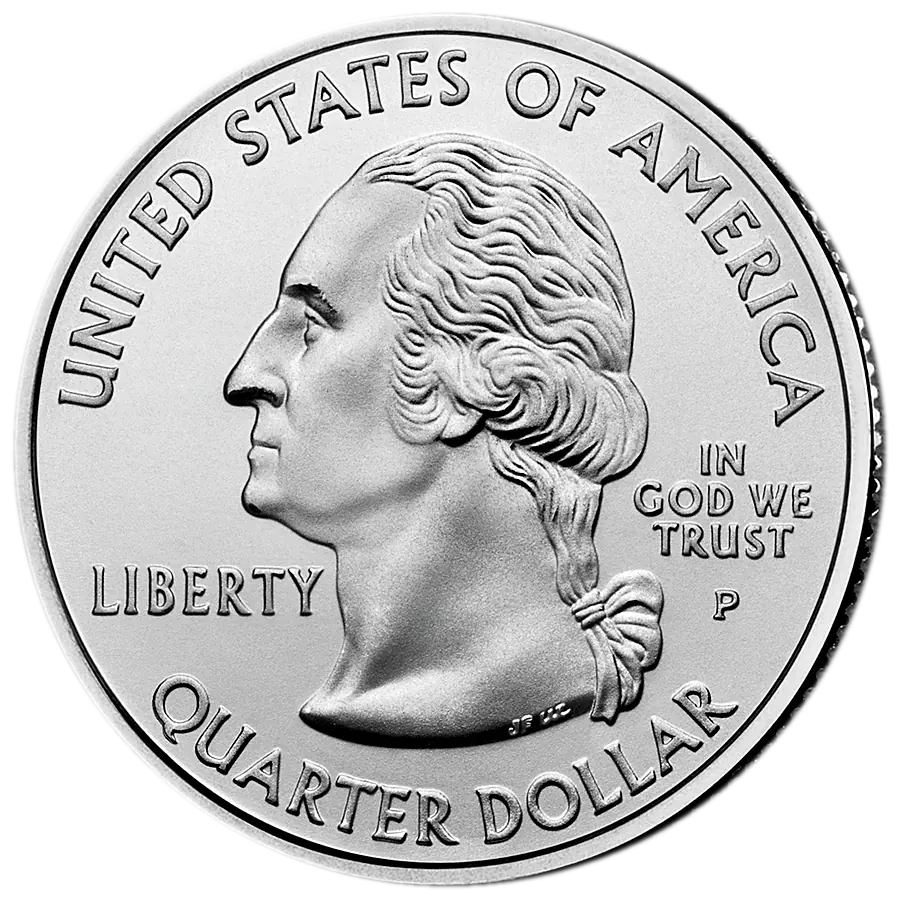
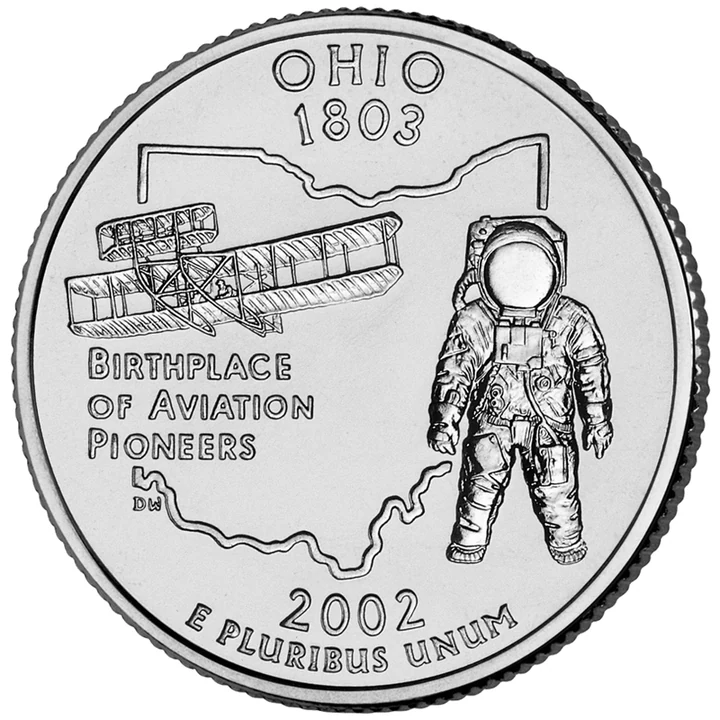
Exact Ohio reverse from the U.S. Mint; shared program obverse.
17 / 50release order
4mint/finish issues
P · D · Smint marks
2002release year
Story in 30 Seconds
The reverse shows a 1905 Wright Flyer, an astronaut, Ohio’s outline, and stars beneath BIRTHPLACE OF AVIATION PIONEERS.
The design joins aircraft development by Dayton’s Wright brothers with Ohio-born astronauts. The Mint specifically names Orville Wright, Neil Armstrong, and John Glenn while presenting the astronaut figure as a general symbol rather than an identified portrait.
The federal selection framework is documented, but reviewed official sources do not preserve Ohio’s state call, committee authority or roster, submissions, finalists, public role, or Governor Bob Taft’s recommendation.
Collectors should separate P and D circulation strikes, S clad proof, and S 90% silver proof. Flyer struts and wings, astronaut contours, state border, stars, lettering, and Donna Weaver initials are sensitive to strike, wear, die state, and damage.
Public Law 105-124 ordered reverses by constitutional ratification or admission. Ohio entered the Union on March 1, 1803 as the seventeenth state, making this the seventeenth program coin and second 2002 release. One reverse could not represent Indigenous homelands, the Northwest Territory, canals and rivers, agriculture, industrial labor, migration, cities, civil rights, education, music, or every Ohio innovation. The selected concept made aviation and spaceflight the state’s portable identity.
Dayton was the Wright brothers’ home and workshop base. Their first powered flights occurred near Kitty Hawk, North Carolina, in 1903; at Huffman Prairie near Dayton they developed and tested the controllable, practical 1905 Flyer III. Ohio also produced many astronauts, including Neil Armstrong of Wapakoneta, first person to step on the Moon, and John Glenn of Cambridge, first American to orbit Earth. The coin’s slogan celebrates people born or working in Ohio, not one exclusive geographic claim to every aviation milestone.
The aircraft is the 1905 Flyer, not the 1903 machine shown on North Carolina’s quarter. After the Kitty Hawk flights, Wilbur and Orville Wright used Huffman Prairie outside Dayton to master turns, circles, figure-eights, endurance, repeated takeoffs, and landings. The 1905 Flyer III became a practical airplane; that Ohio development story explains why a second consecutive state-quarter year returned to the Wrights without repeating North Carolina’s scene.
The astronaut extends the narrative from wood, wire, and fabric into spaceflight. The Mint’s background names Ohio-born Neil Armstrong and John Glenn, but its design description does not identify the silhouette as either man. Treating the figure as Armstrong, Glenn, or a composite portrait goes beyond the official record. Its anonymity lets one body represent a much larger Ohio astronaut community, while also erasing individual identity and difference.
Ohio’s outline binds the two technologies to place. The Flyer crosses the upper half and the astronaut rises through the lower center, so flight appears to move from airplane to space. World Coin Book reads this vertical progression and the surrounding stars as a compressed technological ascent. That is editorial interpretation; the Mint separately identifies the aircraft, astronaut, state outline, and stars but does not publish this compositional reading.
BIRTHPLACE OF AVIATION PIONEERS is carefully plural. Orville Wright was born in Dayton, while Wilbur was born in Indiana but developed the airplane with him in Ohio and North Carolina. Armstrong and Glenn were Ohio-born. The slogan is therefore defensible as a claim about pioneers, but it should not be simplified into ‘the airplane first flew in Ohio’: the 1903 powered flights occurred in North Carolina, and Ohio’s strongest distinct claim is development of the practical 1905 Flyer.
The design emphasizes invention, courage, technological continuity, and national achievement. It omits Katharine Wright, mechanics, engineers, NASA teams, women and minority aviators, military and industrial systems, risk and deaths, public investment, environmental costs, and the many Ohio astronauts beyond two famous names. Its meaning has broadened as Ohio’s astronaut roster and aerospace institutions became more visible.
Treasury’s federal process asked each governor to establish a state procedure and submit concepts. The Mint screened legal and technical suitability, prepared candidate designs, consulted the Commission of Fine Arts and Citizens Commemorative Coin Advisory Committee, obtained Treasury approval, and returned approved choices for a governor’s recommendation.
For Ohio, reviewed official Mint, state, NASA, and federal institutional sources establish the final subject, symbolism, artist, release, and Governor Bob Taft’s contemporary interpretation. They do not preserve the Ohio committee’s authority or roster, call and rules, submission count, evaluation criteria, meeting minutes, candidate subjects, public display or vote, or Taft’s final recommendation and rationale.
The U.S. Mint credits Donna Weaver as reverse designer and sculptor. No reviewed primary record identifies a citizen concept proposer or documents how a state concept became the final arrangement of Flyer, astronaut, outline, stars, slogan, dates, motto, and initials.
Procedures varied by state and changed during the program; each researched state page must document its actual path.
Alternative Designs
No official Ohio finalist list, candidate artwork, artists, rankings, vote totals, or preservation record was located in the reviewed sources. Secondary lists cannot establish which concepts reached each state and federal stage, so alternative subjects are not reproduced as fact.
Use the complete text cards below as the keyboard and screen-reader equivalent of the image.
1905 Wright Flyer
Official explanation: The Mint identifies the aircraft as the 1905 Flyer, developed and tested by the Wright brothers in Ohio.
Historical context: At Huffman Prairie, the improved Flyer III demonstrated controlled turns, circles, figure-eights, endurance, and repeated practical operation after the 1903 North Carolina flights.
World Coin Book interpretation: The broad wings span the upper state outline like a mechanical horizon, making early flight the design’s visual foundation rather than a reenactment of one flight.
Official explanation: The Mint identifies an astronaut and names Ohio-born Neil Armstrong and John Glenn in explaining the aviation-pioneer theme; it does not name the depicted figure.
Historical context: Armstrong first stepped on the Moon; Glenn became the first American to orbit Earth. NASA records many additional Ohio astronauts, so the silhouette can support a collective reading without becoming a portrait.
World Coin Book interpretation: The upright figure overlaps aircraft and state, turning a single anonymous body into the bridge between atmospheric and space flight.
Official explanation: The Mint describes the aircraft and astronaut superimposed on Ohio’s outline and separately notes stars; it assigns no individual star to a named person.
Historical context: The outline anchors achievements spread across Dayton, Wapakoneta, Cambridge, Cleveland, and other Ohio communities without mapping exact locations.
World Coin Book interpretation: The border contains the overlapping machines and body while stars open the field outward, balancing state ownership with achievements beyond the state.
BIRTHPLACE OF AVIATION PIONEERS · OHIO · 1803 · 2002 · E PLURIBUS UNUM · DW
Official explanation: The inscriptions state the theme, state, admission year, issue year, national motto, and Donna Weaver initials.
Historical context: The plural slogan accommodates Orville Wright, Armstrong, Glenn, and a larger pioneer community; it does not relocate the 1903 North Carolina flights.
World Coin Book interpretation: The long upper inscription caps the technological montage; dates and motto complete the statutory rim while DW marks the final Mint artist.
Practical airplane developed and tested by Wilbur and Orville Wright at Huffman Prairie near Dayton.
Astronaut
Anonymous space-suited figure representing Ohio’s astronaut legacy; not officially identified as a portrait.
Neil Armstrong
Wapakoneta-born astronaut and first person to step on the Moon, named by the Mint as an Ohio aviation pioneer.
John Glenn
Cambridge-born aviator and first American to orbit Earth, named by the Mint as an Ohio aviation pioneer.
Donna Weaver
U.S. Mint sculptor-engraver credited as reverse designer and sculptor.
Focused Timeline
Ohio enters the Union as the seventeenth state
Orville Wright is born in Dayton, Ohio
The Wright brothers make powered flights near Kitty Hawk, North Carolina
The 1905 Flyer III demonstrates practical controlled flight at Huffman Prairie, Ohio
John Glenn is born in Cambridge, Ohio
Neil Armstrong is born in Wapakoneta, Ohio
Glenn becomes the first American to orbit Earth
Armstrong becomes the first person to step on the Moon
Public Law 105-124 authorizes the 50 State Quarters program
The Ohio quarter enters circulation as the seventeenth program coin
Official Explanation and Interpretation
Artists and relief
John Flanagan’s Washington portrait, adapted by William Cousins, appears on the shared obverse. The U.S. Mint credits Donna Weaver as reverse designer and sculptor. She compressed the skeletal 1905 Flyer, a space-suited human figure, Ohio’s border, stars, long slogan, dates, motto, and initials into shallow relief. No reviewed primary source identifies a separate citizen proposer or preserves candidate drawings, model transfer, advisory comments, rejected reliefs, inscription revisions, or production changes.
P and D are circulation issues. Both S issues were sold in proof products; the silver proof is a distinct 90% silver composition. Mintages are established catalog figures retained with an explicit source-audit limit.
Identification Guide
Identify the reverse by Ohio’s outline containing a biplane-like 1905 Flyer and upright astronaut beneath BIRTHPLACE OF AVIATION PIONEERS. P, D, or S appears on the obverse to the right of Washington’s hair ribbon. P and D are circulation strikes; S coins are proofs. A clad proof usually shows a copper-colored core at the reeded edge and weighs 5.67 g; the 90% silver proof lacks that stripe and weighs about 6.25 g.
Condition Guide
On circulation coins, inspect the astronaut’s helmet, shoulders, backpack and forward contours; the Flyer’s wing edges, central structure, struts and skids; and the highest border and lettering. First wear dulls these points and breaks luster. Fine struts, fingers, suit lines, stars, state edge, and DW initials may be weak yet lustrous from strike or die state rather than wear.
The open fields around the outline and stars reveal contact marks, scrapes, residue, and cleaning. The dense overlap of Flyer, astronaut, and border can hide hits or lose separation. Check proofs for hairlines, haze, spots, fingerprints, carbon specks, frost breaks, and reduced cameo contrast. Compare normal coins before calling a missing strut, star, finger, or outline segment a filled die or struck-through error.
Mint Errors vs. Damage
Recognized catalog varieties: none are listed in the current World Coin Book Ohio issue records. This evidence boundary does not prove that no minor die varieties exist.
Genuine mint errors can include off-center strikes, broadstrikes, clips, wrong-planchet strikes, struck-through material, retained cuds, substantial die cracks, or other mint-made failures. Attribution requires correct metal flow, weight, geometry, and repeatable die evidence where applicable.
An ‘extra wing,’ doubled astronaut, extra star, missing finger, broken strut, doubled state outline, or filled letter is not a rare variety by appearance alone. Mechanical doubling, die deterioration, grease, weak strike, glare, compression, sharpening, wear, and impacts commonly alter the thin overlapping relief.
Scratches that resemble struts or rays, cuts through the outline, dents, bent or flattened rims, dryer damage, corrosion, glue, plating, polishing, and heat color are post-mint damage. The astronaut is not officially identified as Neil Armstrong or John Glenn; the aircraft is the 1905 Flyer, not proof that the 1903 first flights occurred in Ohio; and stars are not officially assigned to named astronauts.
Why Collectors Care
Durable value tiers
Worn P and D examples usually occupy the face-value design-set tier. Better circulation coins attract interest through full luster, clean open fields, a complete state border, separated Flyer struts and wing edges, a distinct astronaut, full stars, sharp slogan, and visible DW initials. Clad proofs form a collector-product tier; silver proofs add 90% silver as a separate composition tier. Aviation popularity adds demand, not automatic rarity. World Coin Book gives no live price promise: compare dated references for exact mint, finish, grade, strike, and surfaces.
Official law and U.S. Mint records establish program facts and image identity. World Coin Book separates official explanation, historical analysis, and editorial interpretation.
Official descriptions, historical context, and World Coin Book interpretation are labeled separately. No live prices are asserted. Last verified:
The reviewed official record does not provide Ohio’s original call, eligibility and submission dates, state committee authority or roster, proposal count, evaluation criteria, meeting minutes, or public-participation rules.
No official finalist list, candidate artwork, artists, display record, ranking, vote record, or preservation information was located.
No reviewed primary record identifies the citizen concept proposer or documents Governor Bob Taft’s recommendation, its date, rationale, or any public input.
The complete Mint feasibility, model, advisory-review, state-feedback, Treasury-approval, inscription-revision, and production-change trail remains unresolved.
The astronaut silhouette is unidentified; no reviewed official source says it portrays Armstrong, Glenn, or a composite. The stars have no published person-by-person assignment.
Normalized mintages remain established catalog figures; a future source audit should attach direct U.S. Mint annual-production and proof-sales evidence to each number.