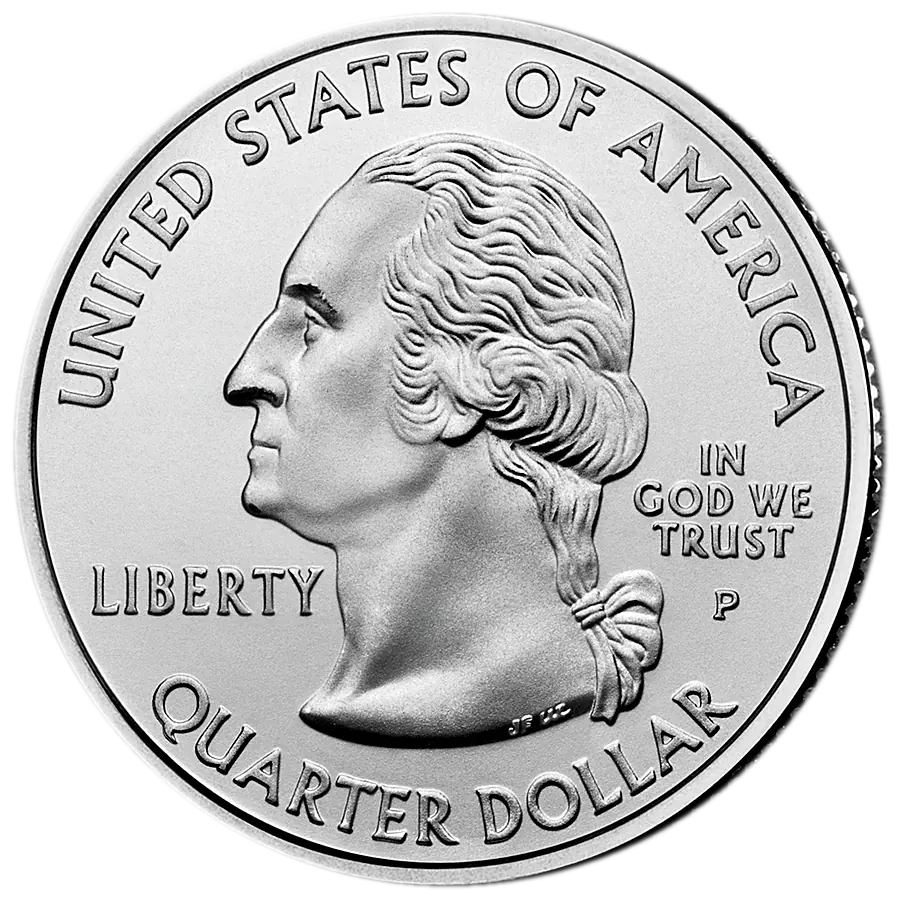
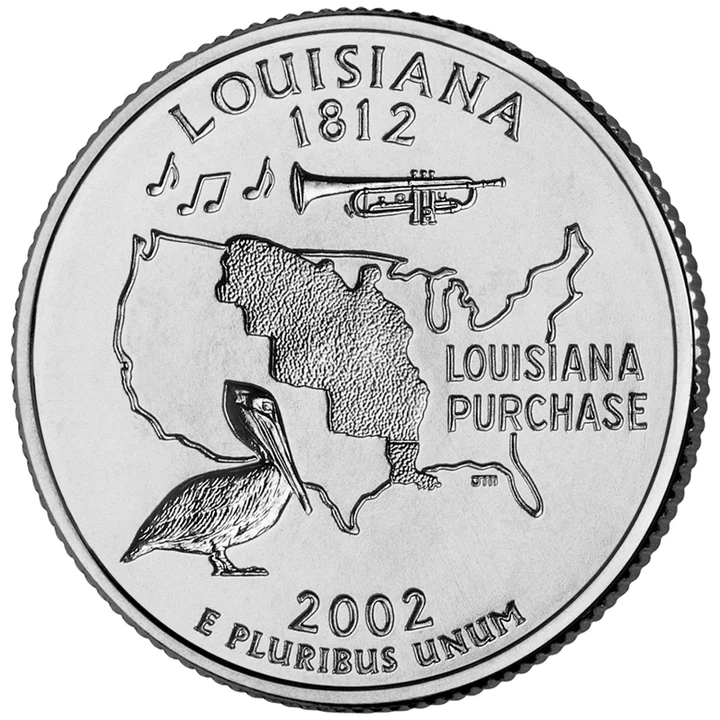
Exact Louisiana reverse from the U.S. Mint; shared program obverse.
18 / 50release order
4mint/finish issues
P · D · Smint marks
2002release year
Story in 30 Seconds
The reverse shows a brown pelican, a trumpet with musical notes, and an outline marking the Louisiana Purchase territory beneath LOUISIANA PURCHASE.
The Mint says the pelican represents the Pelican State and its state bird, the trumpet and notes represent jazz’s birth in New Orleans, and the map recalls the 1803 acquisition that roughly doubled the United States.
Governor M. J. ‘Mike’ Foster Jr. created the Louisiana Commemorative Coin Advisory Commission. It invited all Louisiana residents, especially schoolchildren, received 1,193 submissions, and helped Foster send five concepts to the Mint; Treasury Secretary Paul O’Neill approved the final design.
Collectors should separate P and D circulation strikes, S clad proof, and S 90% silver proof. Pelican feathers and bill, music notes, map boundary, lettering, and John Mercanti initials are vulnerable to weak strike, wear, die state, and damage.
Public Law 105-124 ordered reverses by constitutional ratification or admission. Louisiana entered the Union on April 30, 1812 as the eighteenth state, making this the eighteenth program coin and third 2002 release. One reverse could not represent Indigenous nations, French and Spanish colonial histories, slavery, emancipation, ports and river commerce, wetlands, hurricanes, foodways, languages, faiths, every music tradition, or every Louisiana community. The chosen montage foregrounded wildlife, jazz, and a national territorial event.
Louisiana’s identity is inseparable from the Mississippi River delta, Gulf wetlands, New Orleans, and layered Indigenous, African, Caribbean, French, Spanish, and American histories. The brown pelican became a durable state emblem; New Orleans is recognized as jazz’s birthplace; and the city was the strategic port at the center of American negotiations that expanded into the 1803 purchase. The transaction’s map extends far beyond modern Louisiana and covered homelands already occupied by many Indigenous nations.
The pelican gives the montage a living Louisiana emblem. The Mint identifies it as the indigenous brown pelican and explains the Pelican State nickname through the state bird. Its coastal identity also makes conservation an unavoidable modern reading, but the coin does not narrate habitat loss, pesticide-era decline, restoration, storms, or continuing wetland risk.
The trumpet and floating notes stand for jazz’s birth in New Orleans. They reduce a collective, multicultural history of performers, neighborhoods, venues, rhythms, and instruments to one portable brass symbol. The Mint does not identify a melody, player, or specific trumpet; claims that the notes quote a named song or the instrument belongs to Louis Armstrong exceed the official evidence.
The map invokes the 1803 Louisiana Purchase, not the present state boundary. The treaty transferred France’s claimed sovereignty over a vast territory to the United States for $15 million and roughly doubled the nation. National Archives and Library of Congress records also make the celebratory shorthand incomplete: Indigenous nations already occupied the land, and expansion brought dispossession, conflict, coerced removal, slavery disputes, and political transformation.
World Coin Book reads the three separated emblems as a deliberate identity triad: pelican for environment, trumpet for culture, and map for history and national scale. This is editorial interpretation. The Mint officially explains each element but does not publish that three-part analytical formula.
The design emphasizes recognizability and national contribution. It omits the Mississippi itself, Native nations, colonial power changes, enslaved and free Black communities, Creole and Cajun complexity, other music traditions, coastal loss, and the distinction between France’s territorial claim and Indigenous possession. Later ecological and historical awareness makes those silences more visible.
Treasury’s federal process asked each governor to establish a state procedure and submit concepts. The Mint screened legal and technical suitability, prepared candidate designs, consulted federal advisory bodies, obtained Treasury approval, and returned approved choices for a governor’s recommendation.
Governor Foster established the Louisiana Commemorative Coin Advisory Commission. Its rules required a design easily understood by young people, and it solicited concepts from every Louisiana resident while encouraging schoolchildren. Of 1,193 submissions, the Mint reported that a large majority came from schoolchildren.
After consulting the commission, Foster sent five concepts to the Mint. The launch record names among them a brown pelican, the Louisiana Purchase territory, a riverboat, and the Cabildo, but does not identify the fifth concept or preserve a final ranked slate. Louisiana Music Commission reporting says a trumpet was added to represent the state’s role in music. John Mercanti designed and sculpted the final reverse, and Treasury Secretary Paul O’Neill approved it.
Procedures varied by state and changed during the program; each researched state page must document its actual path.
Alternative Designs
The contemporary Mint launch identifies four of the five concepts sent by Governor Foster: a brown pelican, the Louisiana Purchase territory, a riverboat, and the Cabildo. It does not say whether these were separate designs or ingredients, name the fifth concept, show candidate artwork, identify citizen proposers, record rankings or votes, or explain which federal model combined the winning elements. No unsupported finalist gallery is presented.
Use the complete text cards below as the keyboard and screen-reader equivalent of the image.
Brown pelican
Official explanation: The Mint identifies Louisiana’s state bird, the brown pelican, and connects it to the Pelican State nickname.
Historical context: A coastal bird became a longstanding emblem of Louisiana; its modern story also includes conservation recovery and continuing habitat vulnerability that the coin does not depict.
World Coin Book interpretation: Facing inward from the left, the bird supplies an organic counterweight to the geometric map and metal instrument.
Official explanation: The Mint says the trumpet and notes represent the birth of jazz in New Orleans.
Historical context: Jazz emerged through Black musical creativity and the city’s layered cultural life; no official source reviewed identifies a player, instrument, melody, or song on the coin.
World Coin Book interpretation: The bell points toward the map while notes rise into open space, visually carrying Louisiana culture beyond the state.
Official explanation: The Mint identifies the outline as the Louisiana Purchase territory, the 1803 acquisition that roughly doubled the United States.
Historical context: The United States paid France $15 million for claims covering about 828,000 square miles; Indigenous nations already lived throughout the represented lands.
World Coin Book interpretation: The map’s continental scale makes the smallest state-specific object on the coin—the trumpet—appear nationally consequential.
Louisiana state bird and Pelican State emblem; a coastal species with a conservation history larger than the coin.
Jazz
Musical form born in New Orleans through Black creativity and the city’s multicultural communities.
Louisiana Purchase
1803 treaty transaction transferring France’s territorial claims to the United States over Indigenous homelands.
M. J. ‘Mike’ Foster Jr.
Governor who created the advisory commission and submitted five concepts after consultation.
John Mercanti
U.S. Mint sculptor-engraver credited as reverse designer and sculptor.
Focused Timeline
United States and France sign the Louisiana Purchase Treaty
Territorial transfer ceremony occurs in New Orleans
Louisiana enters the Union as the eighteenth state
Jazz develops in New Orleans through Black and multicultural musical traditions
Public Law 105-124 authorizes the 50 State Quarters program
Louisiana commission receives 1,193 resident concepts and Foster sends five concepts to the Mint
Louisiana quarter enters circulation as the eighteenth program coin
State and Mint hold the launch at the Old U.S. Mint in New Orleans
Official Explanation and Interpretation
Artists and relief
John Flanagan’s Washington portrait, adapted by William Cousins, appears on the shared obverse. The U.S. Mint credits John Mercanti as reverse designer and sculptor. He organized three unlike emblems, musical notes, a long theme inscription, dates, motto, and initials in shallow relief. The reviewed record says a trumpet was added to represent music but does not preserve the five Mint concepts, candidate drawings, advisory comments, state feedback, model revisions, or production changes.
P and D are circulation issues. Both S issues were sold in proof products; the silver proof is a distinct 90% silver composition. Mintages are established catalog figures retained with an explicit source-audit limit.
Identification Guide
Identify the reverse by the left-facing pelican, central trumpet and notes, and Louisiana Purchase territory outline beneath LOUISIANA PURCHASE. P, D, or S appears on the obverse to the right of Washington’s hair ribbon. P and D are circulation strikes; S coins are proofs. A clad proof usually shows a copper-colored edge core and weighs 5.67 g; the 90% silver proof lacks that stripe and weighs about 6.25 g.
Condition Guide
On circulation coins, inspect the pelican’s head, bill, neck, wing and feather ridges; trumpet bell, tubing and valves; musical notes; map boundary; and highest lettering. First wear dulls these points and breaks luster. Thin notes, feathers, map lines, letters, and JM initials may be weak yet lustrous from strike, grease, or die state rather than wear.
Open fields around the pelican and map reveal contact marks, scrapes, residue, and cleaning; the dense central trumpet can hide hits. Check proofs for hairlines, haze, spots, fingerprints, frost breaks, and reduced cameo contrast. Compare normal examples before calling a missing note, feather, map segment, or letter a filled die or struck-through error.
Mint Errors vs. Damage
Recognized catalog varieties: none are listed in the current World Coin Book Louisiana issue records. This evidence boundary does not prove that no minor die varieties exist.
Genuine mint errors can include off-center strikes, broadstrikes, clips, wrong-planchet strikes, struck-through material, retained cuds, substantial die cracks, or other mint-made failures. Attribution requires correct metal flow, weight, geometry, and repeatable die evidence where applicable.
An ‘extra note,’ doubled trumpet, extra feather, doubled pelican, broken map, or filled LOUISIANA PURCHASE letter is not a rare variety by appearance alone. Mechanical doubling, die deterioration, grease, weak strike, glare, image compression, sharpening, wear, and impacts commonly alter the fine relief.
Scratches mistaken for notes or map lines, cuts, dents, bent or flattened rims, dryer damage, corrosion, glue, plating, polishing, and heat color are post-mint damage. The trumpet is not officially Louis Armstrong’s, its notes are not an identified song, the pelican does not prove the species was always secure, and the map is not modern Louisiana or empty land acquired without Indigenous peoples.
Why Collectors Care
Durable value tiers
Worn P and D examples usually occupy the face-value design-set tier. Better circulation coins attract interest through full luster, clean fields, a complete map, separated pelican feathers, crisp trumpet valves and notes, sharp inscriptions, and visible JM initials. Clad proofs form a collector-product tier; silver proofs add 90% silver as a separate composition tier. A popular theme adds demand, not automatic rarity. World Coin Book gives no live price promise: compare dated references for exact mint, finish, grade, strike, and surfaces.
Official law and U.S. Mint records establish program facts and image identity. World Coin Book separates official explanation, historical analysis, and editorial interpretation.
Official descriptions, historical context, and World Coin Book interpretation are labeled separately. No live prices are asserted. Last verified:
The reviewed official record does not provide the commission’s legal instrument, complete roster, exact call and eligibility dates, judging criteria beyond youth comprehension, meeting minutes, or the distribution of 1,193 submissions.
The fifth concept sent to the Mint is unnamed. No complete finalist list, candidate artwork, citizen proposer identities, rankings, vote totals, public display, or preservation record was located.
The record does not establish whether pelican, Purchase map, riverboat, and Cabildo were separate designs or modular concepts, or exactly when and by whom the final three-element combination was recommended to Governor Foster.
The complete Mint feasibility, candidate-model, CFA/CCCAC review, state-feedback, governor-recommendation, Treasury-approval, inscription-revision, and production-change trail remains unresolved.
No reviewed official source identifies a melody, song, musician, trumpet model, exact pelican pose source, or the cartographic source and boundary conventions used for the map.
Normalized mintages remain established catalog figures; a future source audit should attach direct U.S. Mint annual-production and proof-sales evidence to each number.