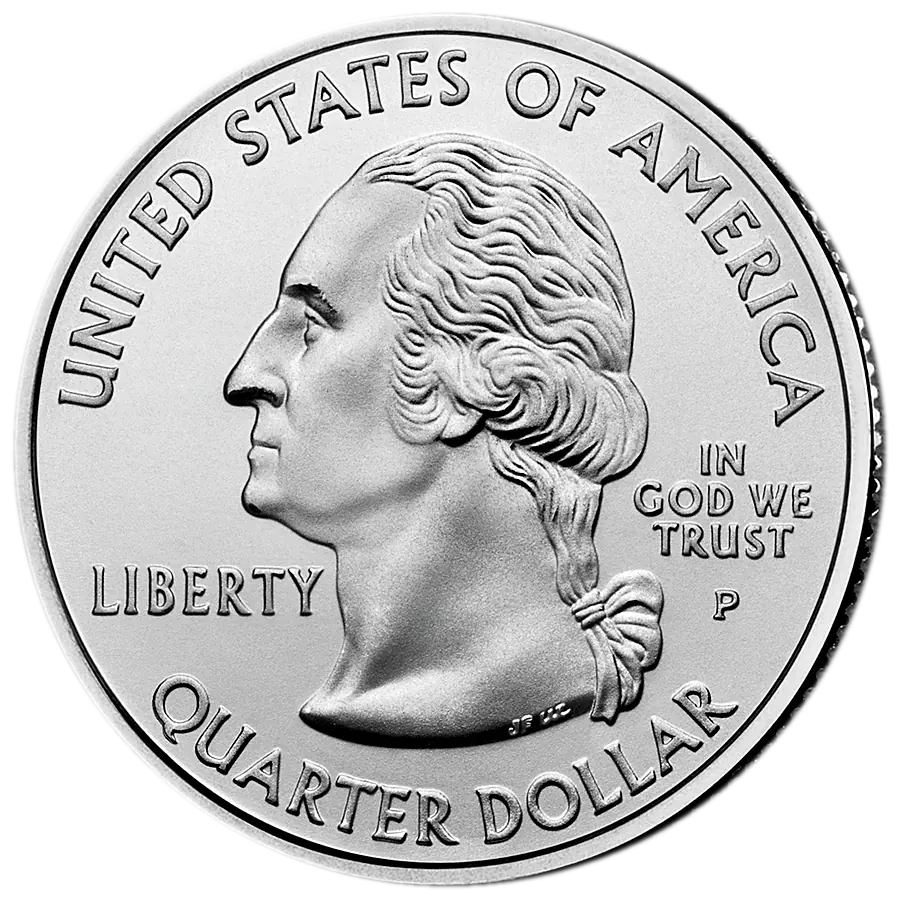
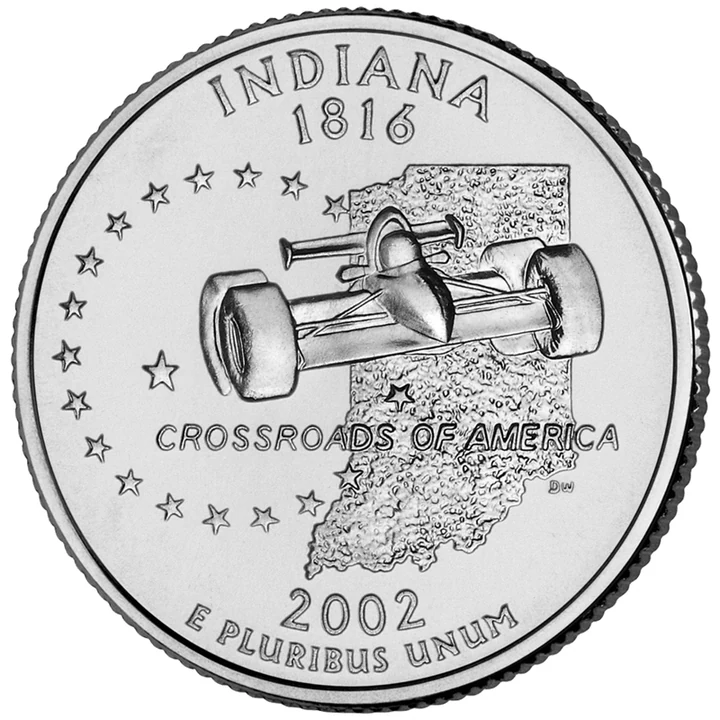
Exact Indiana reverse from the U.S. Mint; shared program obverse.
19 / 50release order
4mint/finish issues
P · D · Smint marks
2002release year
Story in 30 Seconds
The reverse shows an open-wheel ‘Indy’ race car superimposed on Indiana’s outline, nineteen stars, and the inscription CROSSROADS OF AMERICA.
The U.S. Mint says the car recognizes the famous Indianapolis 500, the stars mark Indiana as the nineteenth state, and the motto expresses a transportation identity built through waterways, canals, railroads, roads, and highways.
At Governor Frank O’Bannon’s request, the Indiana Arts Commission led a statewide process that drew more than 3,000 entries. A committee of artists, educators, historians, coin collectors, and graphic designers selected 17 semifinalists; nearly 160,000 online votes were recorded in two weeks.
Collectors should distinguish P and D circulation strikes, S clad proof, and S 90% silver proof. The car’s wheels, suspension, cockpit, nose, state border, stars, lettering, and Donna Weaver initials are vulnerable to weak strike, wear, die state, and damage.
Public Law 105-124 ordered reverses by constitutional ratification or admission. Indiana entered the Union on December 11, 1816 as the nineteenth state, making this the nineteenth program coin and fourth 2002 release. One reverse could not encompass Indigenous homelands, settlement and removal, agriculture, industry, labor, education, military history, arts, basketball, every form of transportation, or every Indiana community. The selected design foregrounded auto racing and a crossroads identity.
Indiana sits between the Great Lakes and Ohio River and became a national connector through waterways, canals, railroads, roads, and highways. The General Assembly adopted The Crossroads of America as the state motto in 1937. Indianapolis Motor Speedway opened in 1909, was paved with more than three million bricks after dangerous early races, and hosted the first Indianapolis 500 in 1911. The coin joins that internationally visible race to a longer transportation history without claiming that racing alone created the crossroads.
The race car is the design’s moving subject. The Mint calls it an ‘Indy’ car and says it recognizes the Indianapolis 500. It is a generic open-wheel racing image, not an officially identified winning car, driver, year, make, or team. That restraint turns a particular event into a broad symbol of speed, engineering, competition, and Indiana’s public identity.
The state outline makes the race statewide even though the Indianapolis Motor Speedway is one site near the capital. With the car crossing the silhouette, the composition links motorsport to Indiana rather than drawing the speedway, its oval, pagoda, yard of bricks, spectators, or a checkered flag. It emphasizes motion and recognition over architectural or race-specific detail.
CROSSROADS OF AMERICA expands the meaning beyond motorsport. Indiana Historical Society evidence traces the identity through rivers, canals, railroads, and highways. World Coin Book reads the car moving over the map as a modern continuation of that transport story; this is editorial interpretation, not a separate explanation published by the Mint.
Nineteen stars make admission order visible. They echo a broader Indiana star tradition, including the statutory state flag, but the Mint’s official quarter explanation only assigns them collectively to Indiana’s nineteenth-state status. Claims that individual stars name counties, drivers, races, roads, or specific earlier states exceed the evidence.
The design emphasizes a nationally recognized event, geographic silhouette, movement, and admission order. It omits Native nations, the consequences of settlement and transport expansion, farming, manufacturing and labor, other sports and arts, and the communities whose histories do not fit a speed-and-road identity.
Treasury’s federal process asked each governor to establish a state procedure and submit three to five concepts. The Mint screened legal and technical suitability, prepared candidate designs, consulted federal advisory bodies, obtained Treasury approval, and returned approved choices for a governor’s recommendation.
Governor Frank O’Bannon’s office asked the Indiana Arts Commission to organize and facilitate the state selection process. The commission collected more than 3,000 entries. Its design committee included artists, arts educators, historians, coin collectors, and graphic designers, establishing both broad participation and multidisciplinary review.
The committee selected 17 semifinalist designs. The commission and Access Indiana then opened a two-week online vote, the state service’s first such voting system, and recorded nearly 160,000 votes. The surviving official summary proves substantial public involvement but does not publish the 17 designs, vote totals by design, the final ranking, or the exact concepts O’Bannon forwarded.
Donna Weaver designed and sculpted the issued reverse for the U.S. Mint. The reviewed record does not identify the citizen concept proposer, show how the race car, outline, stars, and motto were combined or refined, document the governor’s final recommendation, or preserve the complete federal advisory and Treasury approval trail.
Procedures varied by state and changed during the program; each researched state page must document its actual path.
Alternative Designs
The Indiana Arts Commission confirms 17 semifinalist designs selected from more than 3,000 entries and a nearly 160,000-vote public poll. The reviewed official record does not name or show those semifinalists, publish design-by-design totals, identify the final three to five state concepts, or preserve the Mint’s candidate models. No reconstructed finalist gallery or unsupported alternative list is presented.
Use the complete text cards below as the keyboard and screen-reader equivalent of the image.
Open-wheel ‘Indy’ race car
Official explanation: The Mint says the car recognizes Indiana’s famous Indianapolis 500 race.
Historical context: Indianapolis Motor Speedway opened in 1909 and the first 500-mile race followed in 1911; the coin does not identify a driver, car, year, make, or team.
World Coin Book interpretation: The low, rightward car supplies speed and direction, turning the static map into terrain crossed rather than merely displayed.
Official explanation: The Mint says the nineteen stars symbolize Indiana as the nineteenth state admitted to the Union.
Historical context: Indiana entered the Union on December 11, 1816; its state flag also uses nineteen stars under a separately defined statutory arrangement.
World Coin Book interpretation: The stars arc around the upper and right edge, framing the car’s forward movement while turning constitutional sequence into a countable border.
CROSSROADS OF AMERICA · INDIANA · 1816 · 2002 · E PLURIBUS UNUM · DW
Official explanation: The inscriptions give the state motto, state, admission year, issue year, national motto, and Donna Weaver initials.
Historical context: Indiana adopted The Crossroads of America as its motto in 1937 after generations of waterway, canal, railroad, road, and highway development.
World Coin Book interpretation: The motto crowns the map and broadens the fast car from a race emblem into a transport metaphor; the lower inscriptions anchor the motion.
Annual 500-mile open-wheel race first held in 1911 at Indianapolis Motor Speedway.
The Crossroads of America
Indiana state motto connecting the coin to a layered history of waterways, canals, railroads, roads, and highways.
Frank O’Bannon
Governor whose office asked the Indiana Arts Commission to organize the state design process.
Indiana Arts Commission
State agency that collected entries, convened multidisciplinary review, and partnered on the online public vote.
Donna Weaver
U.S. Mint sculptor-engraver credited as reverse designer and sculptor.
Focused Timeline
Indiana enters the Union as the nineteenth state
Indianapolis Motor Speedway opens
First Indianapolis 500-mile race is held
Indiana adopts The Crossroads of America as state motto
Public Law 105-124 authorizes the 50 State Quarters program
Indiana Arts Commission receives more than 3,000 entries and records nearly 160,000 votes on 17 semifinalists
Indiana quarter enters circulation as the nineteenth program coin
Official Explanation and Interpretation
Artists and relief
John Flanagan’s Washington portrait, adapted by William Cousins, appears on the shared obverse. The U.S. Mint credits Donna Weaver as reverse designer and sculptor. She translated a car, state silhouette, nineteen stars, long motto, dates, national motto, and initials into shallow relief with enough open field to keep the overlapping forms legible. The reviewed record does not preserve the citizen concept credit, candidate drawings, advisory comments, state feedback, model revisions, inscription changes, or production changes.
P and D are circulation issues. Both S issues were sold in proof products; the silver proof is a distinct 90% silver composition. Mintages are established catalog figures retained with an explicit source-audit limit.
Identification Guide
Identify the reverse by the right-facing open-wheel race car crossing Indiana’s outline, nineteen stars, and CROSSROADS OF AMERICA. P, D, or S appears on the obverse to the right of Washington’s hair ribbon. P and D are circulation strikes; S coins are proofs. A clad proof usually shows a copper-colored edge core and weighs 5.67 g; the 90% silver proof lacks that stripe and weighs about 6.25 g.
Condition Guide
On circulation coins, inspect the car’s cockpit rim, driver area, nose, wheel rims and tires, suspension arms, rear wing, state boundary, star points, motto, and DW initials. First wear dulls the highest car and lettering relief and interrupts luster. Thin suspension lines, star points, border segments, and initials may be weak yet lustrous from strike, grease, or die state rather than wear.
Open fields above and below the car reveal contact marks, scrapes, residue, and cleaning; the overlapping car and map can conceal hits. Check proofs for hairlines, haze, spots, fingerprints, frost breaks, and reduced cameo contrast. Compare normal examples before calling a missing spoke, suspension line, star point, border, or letter a filled die or struck-through error.
Mint Errors vs. Damage
Recognized catalog varieties: none are listed in the current World Coin Book Indiana issue records. This evidence boundary does not prove that no minor die varieties exist.
Genuine mint errors can include off-center strikes, broadstrikes, clips, wrong-planchet strikes, struck-through material, retained cuds, substantial die cracks, or other mint-made failures. Attribution requires correct metal flow, weight, geometry, and repeatable die evidence where applicable.
An ‘extra wheel,’ doubled car, extra star, missing star, broken state line, doubled motto, or filled letter is not a rare variety by appearance alone. Mechanical doubling, die deterioration, grease, weak strike, glare, image compression, sharpening, wear, and impacts commonly alter the fine overlapping relief.
Scratches mistaken for suspension or border lines, cuts, dents, bent or flattened rims, dryer damage, corrosion, glue, plating, polishing, and heat color are post-mint damage. The car is not officially the Marmon Wasp or any named winner, no driver is identified, nineteen stars do not represent nineteen Indianapolis 500 victories or counties, and the motto does not mean the race itself created Indiana’s crossroads identity.
Why Collectors Care
Durable value tiers
Worn P and D examples usually occupy the face-value design-set tier. Better circulation coins attract interest through full luster, clean fields, complete wheel and suspension detail, a continuous state border, full star points, sharp motto, and visible DW initials. Clad proofs form a collector-product tier; silver proofs add 90% silver as a separate composition tier. Racing popularity adds demand, not automatic rarity. World Coin Book gives no live price promise: compare dated references for exact mint, finish, grade, strike, and surfaces.
Official law and U.S. Mint records establish program facts and image identity. World Coin Book separates official explanation, historical analysis, and editorial interpretation.
Official descriptions, historical context, and World Coin Book interpretation are labeled separately. No live prices are asserted. Last verified:
The reviewed official record does not provide the original call, eligibility and submission dates, complete design-committee roster, detailed judging criteria, meeting minutes, or geographic and age distribution of more than 3,000 entries.
The 17 semifinalists are not named or shown in the reviewed official record. Design-by-design vote totals, final rankings, and preservation locations were not located.
The exact three to five concepts sent to the Mint, Governor O’Bannon’s recommendation and rationale, the winning citizen concept proposer, and the relationship between public voting and final selection remain unresolved.
The complete Mint feasibility, candidate-model, CFA/CCCAC review, state-feedback, governor-recommendation, Treasury-approval, inscription-revision, and production-change trail remains unresolved.
No reviewed official source identifies a driver, car, model, team, race year, track feature, exact map source, or individual meaning for any one star.
Normalized mintages remain established catalog figures; a future source audit should attach direct U.S. Mint annual-production and proof-sales evidence to each number.