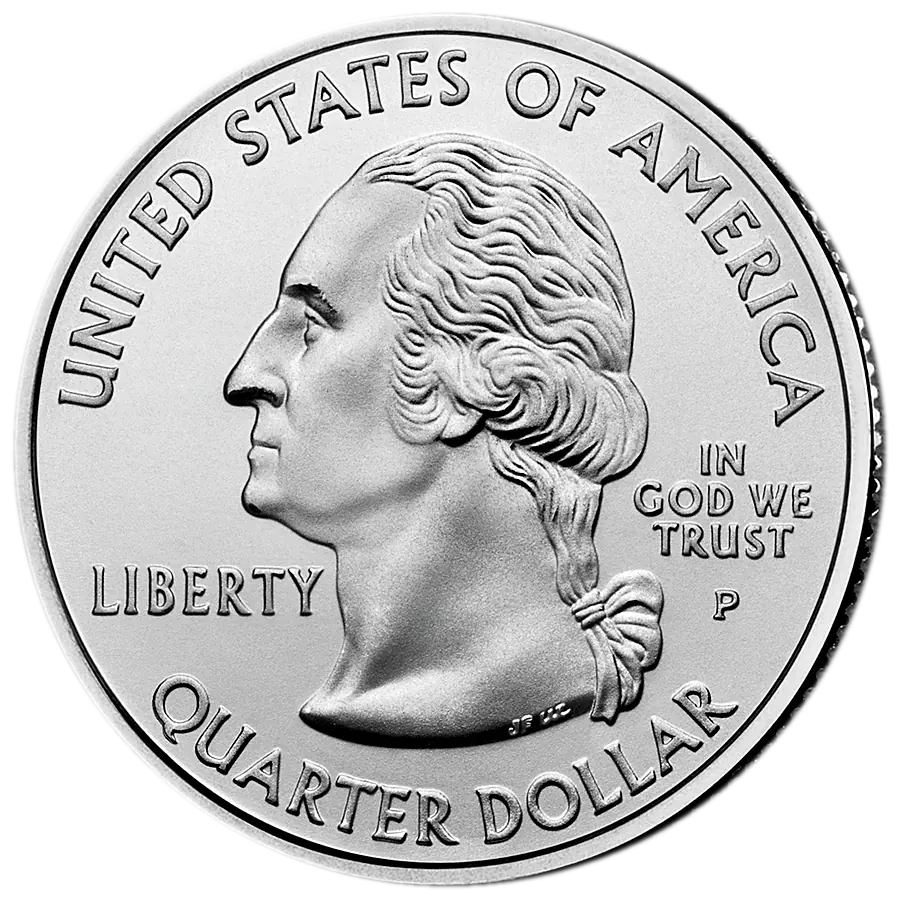
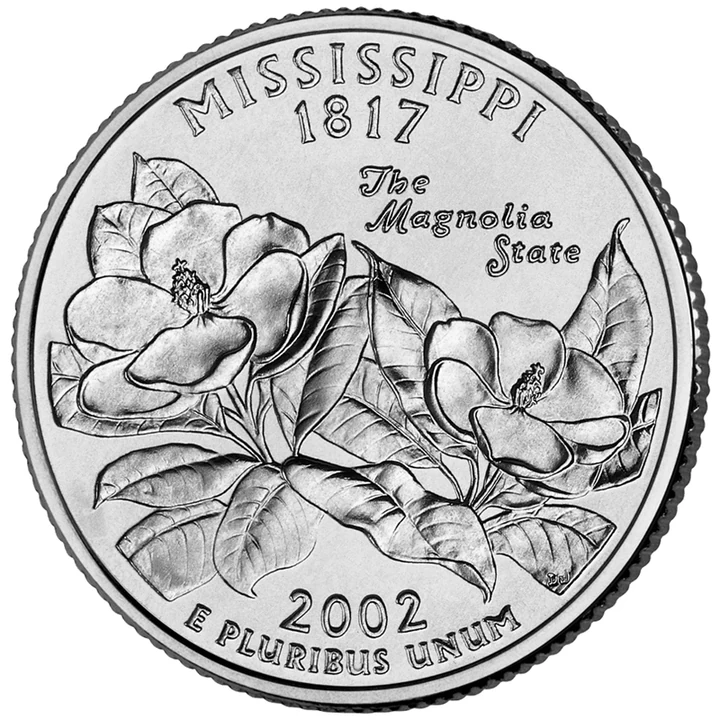
Exact Mississippi reverse from the U.S. Mint; shared program obverse.
20 / 50release order
4mint/finish issues
P · D · Smint marks
2002release year
Story in 30 Seconds
The reverse combines the blossoms and leaves of two magnolias beneath THE MAGNOLIA STATE; it does not depict a whole tree, a river scene, cotton, or a named place.
The U.S. Mint presents the composition as the beauty and elegance of Mississippi’s state flower. In a 1900 election, 23,278 schoolchildren voted on a state flower and the magnolia led with 12,745 votes; the Legislature formally designated it in 1952.
The federal program required a state process and gubernatorial concepts before Mint design and Treasury approval. The reviewed official Mississippi record does not disclose the state committee, submissions, finalists, public design vote, governor’s recommendation, or alternatives, so none is reconstructed here.
Collectors should distinguish P and D circulation strikes, S clad proof, and S 90% silver proof. Petal folds, stamens, leaf veins, lettering, and Donna Weaver’s DW initials are the principal areas for strike, wear, contact, and damage checks.
Public Law 105-124 ordered reverses by constitutional ratification or admission. Mississippi entered the Union on December 10, 1817 as the twentieth state, making this the twentieth program coin and fifth and final 2002 release. One reverse could not encompass Indigenous homelands, removal, slavery and emancipation, the Mississippi River and Delta, Gulf Coast, agriculture, civil rights, literature, music, industry, or every community. The selected design used one long-established natural emblem instead.
Mississippi’s name comes from the river, but the quarter chooses a flower rather than geography. Magnolia imagery had a long public life in the state before 2002. Schoolchildren selected it over other flowers in 1900; the Legislature made magnolia the state tree in 1938 and state flower in 1952. That democratic symbol history helps explain the design’s broad recognition, while the flower’s association with the South cannot stand for the state’s full Indigenous, African American, Delta, coastal, and modern history.
Two open blossoms dominate the reverse. The Mint calls them the blossoms and leaves of two magnolias and emphasizes beauty and elegance. The botanical subject is Magnolia grandiflora, commonly called southern magnolia, but the coin simplifies living plants into an emblem rather than providing a scientific specimen.
The 1900 schoolchildren’s election is the strongest documented reason the magnolia carries public legitimacy. Of 23,278 votes, magnolia received 12,745, ahead of cotton blossom and cape jasmine. That election chose a state-flower preference; it was not the 2000-era quarter-design vote and should not be retold as one.
The Legislature’s later designations made the symbol durable: magnolia became state tree in 1938 and state flower in 1952. THE MAGNOLIA STATE inscription names the identity the flowers are meant to carry, while the uncluttered composition makes recognition more important than a particular tree, garden, county, or historical scene.
World Coin Book reads the paired blossoms—one higher and more open, one lower and partially overlapping—as a study in repetition and depth. Curving leaves fill the center while open field separates the floral mass from the inscriptions. This is compositional interpretation, not a separate symbolic key published by the Mint.
The design emphasizes natural beauty, continuity, hospitality-associated public imagery, and a symbol once chosen by children. It omits the river that gives the state its name, Native nations, slavery and civil rights, Delta agriculture and labor, Gulf ecology, cities, music, literature, and the contested meanings that any single Southern emblem can acquire. The magnolia’s reuse on Mississippi’s 2020 state flag shows that the symbol continued to evolve after the coin.
Treasury’s federal process asked each governor to establish a state procedure and submit three to five concepts. The Mint screened legal and technical suitability, prepared candidate designs, consulted federal advisory bodies, obtained Treasury approval, and returned approved choices for a governor’s recommendation.
The reviewed U.S. Mint and Mississippi records confirm the issued magnolia concept and Governor Ronnie Musgrove’s support at the October 22 unveiling. They do not identify the state body that solicited or reviewed quarter concepts, the dates or rules of any call, a submission total, judging criteria, or a citizen concept proposer.
Official launch material says many Mississippi schoolchildren and citizens participated in the unveiling. Separately, the Secretary of State documents the 1900 schoolchildren’s state-flower election. Neither statement proves a public vote on quarter designs; this page keeps ceremony participation, symbol selection, and coin selection distinct.
Donna Weaver designed and sculpted the issued reverse for the U.S. Mint. The reviewed record does not preserve the exact concepts sent by Mississippi, candidate models, advisory recommendations, state feedback, Musgrove’s final recommendation, Treasury’s design-specific approval, or documented production revisions.
Procedures varied by state and changed during the program; each researched state page must document its actual path.
Alternative Designs
No official finalist or alternative-design list was located in the reviewed U.S. Mint, Mississippi Secretary of State, governor-archive, or Mississippi Department of Archives and History material. The federal process indicates that three to five state concepts normally entered review, but their identities cannot be inferred from the issued flowers. No river, mockingbird, cotton, music, civil-rights, flag, or other candidate is presented without documentation.
Use the complete text cards below as the keyboard and screen-reader equivalent of the image.
Two magnolia blossoms
Official explanation: The Mint says the reverse combines the blossoms of two magnolias and showcases the beauty and elegance of Mississippi’s state flower.
Historical context: Mississippi schoolchildren preferred magnolia in 1900; the Legislature formally designated it the state flower in 1952.
World Coin Book interpretation: The paired, overlapping blooms create depth and make a repeated natural form—not a person or place—the visual hierarchy’s center.
Official explanation: The Mint includes leaves with the two blossoms but publishes no leaf-by-leaf symbolic key.
Historical context: Magnolia was also designated Mississippi’s state tree in 1938, connecting flower and foliage to one established state emblem.
World Coin Book interpretation: Curving leaves knit the blossoms into one central mass and provide darker-shaped relief around the lighter petal folds; no individual leaf represents a region or event.
Official explanation: The inscription states Mississippi’s quarter theme and names the identity carried by the floral design.
Historical context: Magnolia imagery long predates the quarter and remains a recurring Mississippi public symbol.
World Coin Book interpretation: The arcing nickname acts as a caption: it resolves the compact floral relief immediately and balances the lower state and date inscriptions.
Official explanation: The inscriptions give the state, admission year, issue year, national motto, and Donna Weaver’s initials.
Historical context: Mississippi entered the Union on December 10, 1817 as the twentieth state; the coin was the twentieth program release.
World Coin Book interpretation: The lower inscriptions create a firm baseline beneath the organic forms, while the small DW preserves artist identity without competing with the flowers.
Evergreen tree whose blossoms and leaves form the reverse; Mississippi’s state tree and state flower.
Mississippi schoolchildren
23,278 pupils whose 1900 flower election gave magnolia a documented public mandate decades before formal designation.
Ronnie Musgrove
Governor who supported the issued magnolia design at the 2002 unveiling; the reviewed record does not preserve his final design recommendation.
Donna Weaver
U.S. Mint sculptor-engraver credited as reverse designer and sculptor.
The Magnolia State
Quarter theme and longstanding Mississippi identity named directly above the flowers.
Focused Timeline
Mississippi enters the Union as the twentieth state
23,278 schoolchildren vote on a state flower; magnolia leads with 12,745 votes
Mississippi designates magnolia as the state tree
Mississippi formally designates magnolia as the state flower
Public Law 105-124 authorizes the 50 State Quarters program
Mississippi quarter enters circulation as the twentieth program coin
State and Mint officials unveil the quarter in Jackson
Magnolia becomes the central emblem of Mississippi’s new state flag
Official Explanation and Interpretation
Artists and relief
John Flanagan’s Washington portrait, adapted by William Cousins, appears on the shared obverse. The U.S. Mint credits Donna Weaver as reverse designer and sculptor. She translated layered petals, stamens, leaves, stems, a long arcing nickname, state and date inscriptions, the national motto, and initials into shallow relief. The reviewed record does not preserve a citizen concept credit, candidate drawings, advisory comments, state feedback, model revisions, inscription changes, or production changes.
P and D are circulation issues. Both S issues were sold in proof products; the silver proof is a distinct 90% silver composition. Mintages are established catalog figures retained with an explicit source-audit limit.
Identification Guide
Identify the reverse by two overlapping magnolia blossoms and leaves beneath THE MAGNOLIA STATE. P, D, or S appears on the obverse to the right of Washington’s hair ribbon. P and D are circulation strikes; S coins are proofs. A clad proof usually shows a copper-colored edge core and weighs 5.67 g; the 90% silver proof lacks that stripe and weighs about 6.25 g.
Condition Guide
On circulation coins, inspect the upper blossom’s central folds and stamens, the lower blossom’s projecting petals, leaf tips and veins, the nickname, lower inscriptions, and DW initials. First wear dulls the highest petal ridges and interrupts luster. Soft inner petals, faint veins, or weak initials may remain lustrous from strike, grease, or die state rather than wear.
The open field around the floral cluster reveals contact marks, scrapes, residue, and cleaning, while overlapping petals can conceal hits. Check proofs for hairlines, haze, spots, fingerprints, frost breaks, and reduced cameo contrast. Compare normal examples before calling a missing stamen, vein, petal line, letter, or initial a filled die or struck-through error.
Mint Errors vs. Damage
Recognized catalog varieties: none are listed in the current World Coin Book Mississippi issue records. This evidence boundary does not prove that no minor die varieties exist.
Genuine mint errors can include off-center strikes, broadstrikes, clips, wrong-planchet strikes, struck-through material, retained cuds, substantial die cracks, or other mint-made failures. Attribution requires correct metal flow, weight, geometry, and repeatable die evidence where applicable.
An ‘extra petal,’ doubled flower, extra stamen, missing leaf, doubled nickname, filled letter, or apparent leaf-vein doubling is not a rare variety by appearance alone. Mechanical doubling, die deterioration, grease, weak strike, glare, image compression, sharpening, wear, and impacts readily alter the dense floral relief.
Scratches mistaken for veins or stems, cuts, dents, bent or flattened rims, dryer damage, corrosion, glue, plating, polishing, and heat color are post-mint damage. The blossoms are not cotton, gardenia, lotus, or two named historic trees. The 1900 schoolchildren’s flower election was not a quarter-design vote, and the two blossoms are not officially assigned to two regions, people, or historical eras.
Why Collectors Care
Durable value tiers
Worn P and D examples usually occupy the face-value design-set tier. Better circulation coins attract interest through full luster, clean fields, complete petal folds and stamens, strong leaf veins, sharp lettering, and visible DW initials. Clad proofs form a collector-product tier; silver proofs add 90% silver as a separate composition tier. A familiar state symbol adds thematic appeal, not automatic rarity. World Coin Book gives no live price promise: compare dated references for exact mint, finish, grade, strike, and surfaces.
Official law and U.S. Mint records establish program facts and image identity. World Coin Book separates official explanation, historical analysis, and editorial interpretation.
Official descriptions, historical context, and World Coin Book interpretation are labeled separately. No live prices are asserted. Last verified:
The reviewed official record does not identify Mississippi’s quarter committee or other state selection body, its membership, original call, eligibility and submission dates, submission total, judging criteria, or minutes.
No official finalist or alternative-design list, images, rankings, vote totals, or preservation locations were located. The identities of Mississippi’s three to five concepts sent into federal review remain unresolved.
No reviewed source establishes a public quarter-design vote. Schoolchildren’s participation at the 2002 launch and their documented 1900 state-flower election must not be combined into that claim.
Governor Ronnie Musgrove’s exact recommendation and rationale, any citizen concept proposer, Mint candidate models, CFA/CCCAC reviews, state feedback, Treasury approval detail, inscription revisions, and production changes remain unresolved.
The Mint identifies two magnolias but does not assign separate meanings to the two blossoms, particular petals, stamens, leaves, stems, or their placement; no named tree or location is documented.
Normalized mintages remain established catalog figures; a future source audit should attach direct U.S. Mint annual-production and proof-sales evidence to each number.