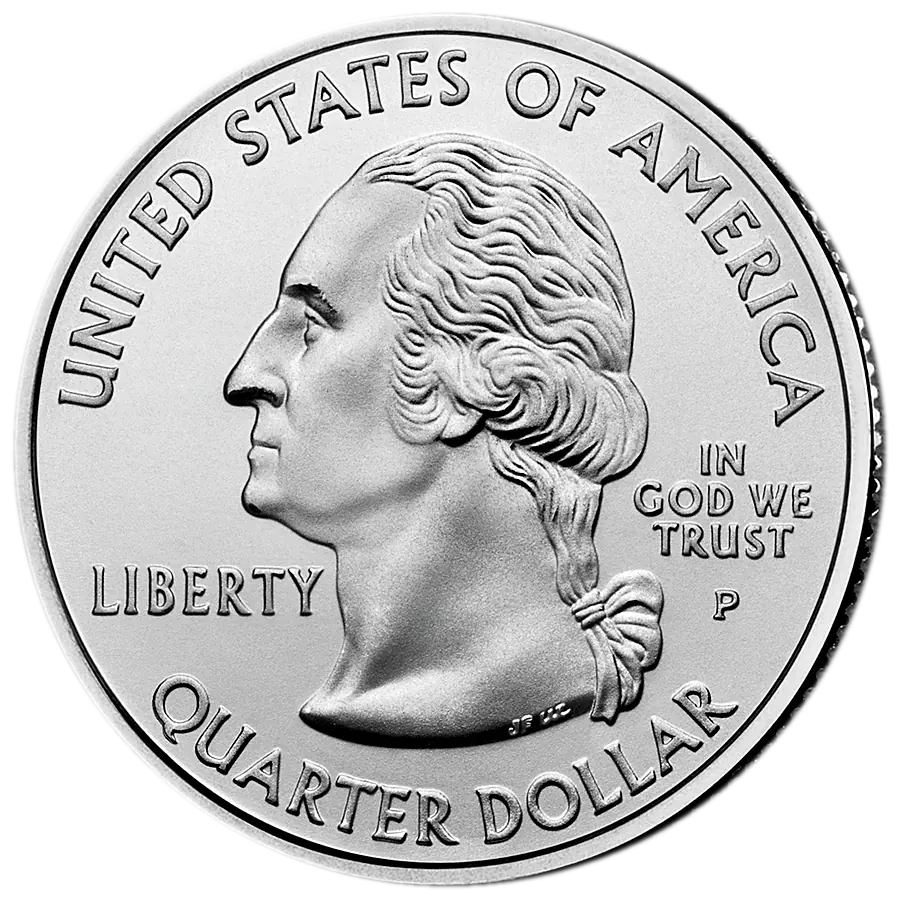
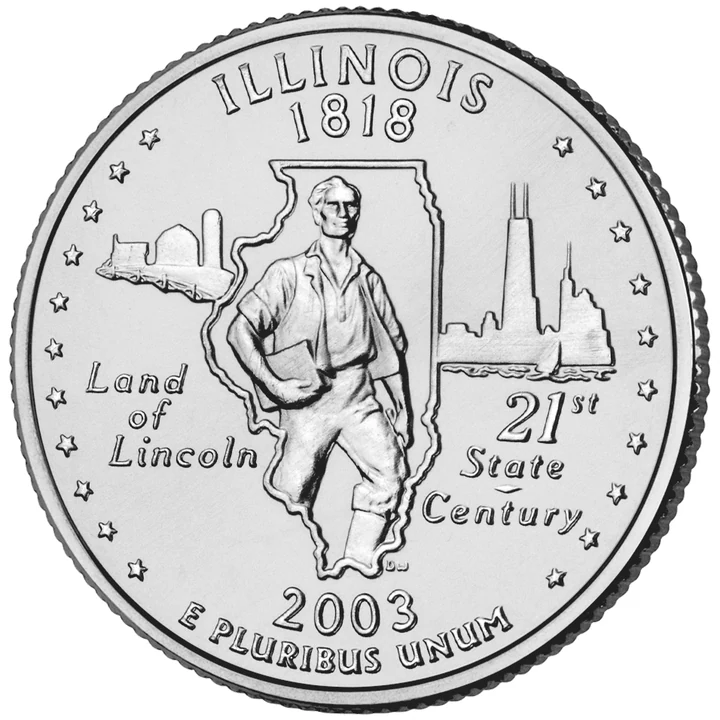
Exact Illinois reverse from the U.S. Mint; shared program obverse.
21 / 50release order
4mint/finish issues
P · D · Smint marks
2003release year
Story in 30 Seconds
The reverse places a young Abraham Lincoln inside Illinois’s outline, with a farm scene at left, Chicago skyline at right, 21 border stars, and LAND OF LINCOLN and 21ST STATE/CENTURY inscriptions.
The Mint says agriculture and the state’s business and financial climate rest on Lincoln’s legacy of integrity and hard work. Lincoln moved to Illinois at age 21 and built his adult legal and political career there; the farm is a state-sector symbol, not his Kentucky birthplace.
Governor George Ryan’s Classroom Contest brought more than 6,000 ideas, nearly 5,700 from students. A 14-member committee reviewed submissions and suggested three to five concepts for the Mint; the reviewed record does not identify its roster, finalists, votes, or Ryan’s final recommendation.
Collectors should distinguish P and D circulation strikes, S clad proof, and S 90% silver proof. Lincoln’s face and coat, state border, farm furrows, skyline, stars, inscriptions, and DW initials need careful strike, wear, contact, and damage checks.
Public Law 105-124 ordered reverses by constitutional ratification or admission. Illinois entered the Union on December 3, 1818 as the twenty-first state, making this the twenty-first program coin and first 2003 release. One reverse could not encompass Native nations, French and U.S. settlement, slavery and Black freedom, prairie ecology, rivers, agriculture, industry, labor, migration, Chicago, downstate communities, or every part of Lincoln’s contested national legacy. The selected composition instead makes Lincoln the bridge between rural and urban Illinois.
Illinois joined the Union in 1818. Abraham Lincoln was born in Kentucky and raised largely in Indiana, then moved to Illinois at age 21 in 1830. He farmed and worked before settling in New Salem and Springfield, serving in the state legislature, practicing law, debating slavery’s expansion, and becoming president. The quarter’s farm and Chicago skyline compress a much broader state into agricultural and metropolitan poles; neither represents every landscape, community, worker, or economy.
The Mint’s central figure is specifically a young Lincoln. Contemporary launch material says it was based on Avard Fairbanks’s sculpture The Resolute Lincoln and calls this the first U.S. coin to show Lincoln as a young man. The outline locates his adult formation in Illinois rather than claiming his birth there.
Lincoln arrived in Illinois at 21, worked in farming and other occupations, settled in New Salem, entered the legislature, studied law, and moved to Springfield. That trajectory explains why the state could present effort and public life as a bridge from field to city, although Lincoln’s history also includes Civil War, emancipation, race, constitutional power, and political conflict that a celebratory silhouette cannot resolve.
The farm and Chicago skyline do not depict identified properties or a single historical moment. The Mint treats them as agricultural tradition and business-financial climate. World Coin Book reads their placement on opposite sides as a rural-metropolitan contrast held together by the state outline and Lincoln; this compositional reading is editorial, not a separate official symbolic key.
Twenty-one stars turn admission order into a border. The split inscription 21ST STATE/CENTURY makes Illinois’s 1818 rank rhyme with a coin launched in the twenty-first century. It does not mean Illinois entered the Union in the twenty-first century, and the stars do not represent counties, cities, presidents, or committee members.
The design emphasizes aspiration, integrity, work, agriculture, commerce, and a nationally recognizable Illinois association. It omits Indigenous dispossession, slavery and exclusion within Illinois, Black migration and culture, labor conflict, waterways, prairie ecology, other cities and rural communities, and debate over using one exceptional man to stand for a diverse state. Those omissions matter when reading the coin as evidence of 2003 civic identity rather than a complete state history.
Treasury’s federal process asked each governor to establish a procedure and submit three to five concepts. The Mint screened legal and technical suitability, made candidate designs, consulted federal advisory bodies, obtained Treasury approval, and returned approved choices for a governor’s recommendation.
Governor George Ryan created a Governor’s Classroom Contest to solicit design ideas from schoolchildren. The governor’s office received more than 6,000 submissions, nearly 5,700 from students. A 14-member committee reviewed them and suggested three to five concepts for the Mint. This is documented public idea participation, not evidence that the public voted on final Mint designs.
The reviewed launch record does not name the committee, state its appointment dates, eligibility details, judging criteria, meetings, or selected concepts. It also does not name student winners or identify which submitted idea, if any, originated the final combination. No official finalist art, ranking, public vote total, or preservation location was located.
The Mint credits Donna Weaver with designing and sculpting the issued reverse and identifies Fairbanks’s The Resolute Lincoln as the model for the young figure. The reviewed sources do not preserve Mint candidate models, CFA/CCCAC comments, state feedback, Governor Ryan’s exact recommendation, Treasury’s design-specific decision, inscription revisions, or production changes.
Procedures varied by state and changed during the program; each researched state page must document its actual path.
Alternative Designs
Official evidence establishes that a 14-member committee suggested three to five concepts after reviewing more than 6,000 submissions, but the reviewed U.S. Mint and Illinois records do not identify or show those concepts. No candidate may be reconstructed from common Illinois symbols. The 6,000-plus classroom ideas were submissions, not 6,000 finalist coin designs, and no official public final-design vote was located.
Use the complete text cards below as the keyboard and screen-reader equivalent of the image.
Young Abraham Lincoln
Official explanation: The Mint places young Lincoln inside Illinois and says the image was based on Avard Fairbanks’s The Resolute Lincoln.
Historical context: Lincoln moved to Illinois at 21 and built his legal and political career there; he was born in Kentucky and raised largely in Indiana.
World Coin Book interpretation: The upright full-length figure is the visual hinge between farm and skyline; it presents work and civic ambition as the composition’s human scale.
Official explanation: The Mint identifies the state outline surrounding Lincoln.
Historical context: The outline locates Lincoln’s adult story and separates the central state identity from the two flanking economic scenes.
World Coin Book interpretation: Its narrow vertical shape acts as a frame within the round coin; it is geographic shorthand, not a detailed map with rivers or counties.
Official explanation: The Mint says the farm represents Illinois agricultural traditions.
Historical context: Lincoln did farm labor, but the scene is not identified as his birthplace, Illinois homestead, or a named property.
World Coin Book interpretation: Low horizontal furrows and buildings counter the vertical skyline; the scene represents an economic sector, not a nostalgic claim that all Illinois is rural.
Official explanation: The Mint identifies the Chicago skyline and connects the design to business, finance, and international commerce.
Historical context: The official record does not name individual buildings or fix the silhouette to one date or viewpoint.
World Coin Book interpretation: The dense vertical cluster supplies a modern metropolitan pole opposite the open farm; no tower should be attributed by resemblance alone.
Official explanation: The Mint says 21 stars signify Illinois as the twenty-first state; inscriptions include LAND OF LINCOLN and 21ST STATE/CENTURY.
Historical context: Illinois entered the Union in 1818; the century wording links admission rank to the coin’s 2003 issue era.
World Coin Book interpretation: Stars form an outer civic frame while the split wordplay compresses rank and present time; individual stars have no documented separate identities.
Official explanation: The inscriptions give the state, admission year, issue year, national motto, and Donna Weaver’s initials.
Historical context: Donna Weaver is officially credited as reverse designer and sculptor.
World Coin Book interpretation: The statutory rim text anchors the crowded center; DW records final artistic authorship without identifying any classroom concept proposer.
Kentucky-born sixteenth president whose adult Illinois years, work, law, and politics anchor the design.
Avard Fairbanks
Sculptor whose The Resolute Lincoln supplied the model identified for the quarter’s young Lincoln.
Illinois agriculture
State economic tradition represented by a generic farm scene, not a named Lincoln farm.
Chicago
Metropolitan skyline used for Illinois business, finance, and international-commerce identity; no buildings are officially named.
George Ryan
Governor who created the classroom contest; the reviewed record does not preserve his exact final design recommendation.
Donna Weaver
U.S. Mint medallic artist credited as reverse designer and sculptor.
Focused Timeline
Abraham Lincoln is born in Kentucky
Illinois enters the Union as the twenty-first state
Lincoln moves to Illinois at age 21
Lincoln wins election to the Illinois legislature
Lincoln qualifies as an attorney and moves to Springfield
Illinois career carries Lincoln to election as president
Public Law 105-124 authorizes the 50 State Quarters program
Governor’s Classroom Contest receives more than 6,000 ideas
Illinois quarter enters Federal Reserve distribution
Mint and state officials unveil the quarter in Chicago
Official Explanation and Interpretation
Artists and relief
John Flanagan’s Washington portrait, adapted by William Cousins, appears on the shared obverse. The Mint credits Donna Weaver as reverse designer and sculptor. She translated the Fairbanks-based young Lincoln, narrow state outline, farm, skyline, 21 stars, wordplay, dates, motto, and initials into shallow relief. A classroom idea is not automatically an artistic credit: the reviewed record does not identify a winning student, concept author, candidate drawings, advisory comments, state feedback, model revisions, inscription changes, or production changes.
P and D are circulation issues. Both S issues were sold in proof products; the silver proof is a distinct 90% silver composition. Mintages are established catalog figures retained with an explicit source-audit limit.
Identification Guide
Identify the reverse by young Lincoln inside Illinois, farm at left, Chicago skyline at right, 21 stars, and LAND OF LINCOLN. P, D, or S appears on the obverse right of Washington’s hair ribbon. P and D are circulation strikes; S coins are proofs. A clad proof usually shows a copper-colored edge core and weighs 5.67 g; the 90% silver proof lacks that stripe and weighs about 6.25 g.
Condition Guide
On circulation coins inspect Lincoln’s forehead, cheek, hair, coat, hands and book-like object, the state border, farm roofs and furrows, skyline tops, star points, inscriptions, and DW. First wear dulls the highest figure and building relief and interrupts luster. Soft skyline windows, shallow furrows, incomplete stars, or faint initials may remain lustrous from strike, grease, or die state rather than wear.
The open fields beside the state outline reveal marks, scrapes, residue, and cleaning, while the crowded farm and skyline can hide impacts. Check proofs for hairlines, haze, spots, fingerprints, frost breaks, and reduced cameo contrast. Compare normal coins before calling a missing star point, building, furrow, border segment, letter, or initial a filled die or struck-through error.
Mint Errors vs. Damage
Recognized catalog varieties: none are listed in the current World Coin Book Illinois issue records. This evidence boundary does not prove that no minor die varieties exist.
Genuine mint errors can include off-center strikes, broadstrikes, clips, wrong-planchet strikes, struck-through material, retained cuds, substantial die cracks, or other mint-made failures. Attribution requires correct metal flow, weight, geometry, and repeatable die evidence where applicable.
An ‘extra building,’ doubled Lincoln, extra star, missing star, doubled skyline, floating roof, extra farm line, broken state outline, or filled 21ST is not a rare variety by appearance alone. Mechanical doubling, die deterioration, grease, weak strike, glare, image compression, wear, and impacts readily alter the fine relief.
Scratches mistaken for farm furrows or skyline lines, cuts, dents, flattened rims, dryer damage, corrosion, glue, plating, polishing, and heat color are post-mint damage. Lincoln was not born in Illinois; the farm is not his Kentucky birthplace; the skyline has no officially named buildings; 21ST STATE/CENTURY does not date admission to the twenty-first century; and individual stars do not represent counties or cities.
Why Collectors Care
Durable value tiers
Worn P and D examples usually occupy the face-value design-set tier. Better circulation coins attract interest through full luster, clean fields, a complete state border, distinct Lincoln features, clear farm and skyline detail, full stars, sharp inscriptions, and visible DW initials. Clad proofs form a collector-product tier; silver proofs add 90% silver as a separate composition tier. Lincoln and Chicago themes add broad interest, not automatic rarity. World Coin Book gives no live price promise: compare dated references for exact mint, finish, grade, strike, and surfaces.
Official law and U.S. Mint records establish program facts and image identity. World Coin Book separates official explanation, historical analysis, and editorial interpretation.
Official descriptions, historical context, and World Coin Book interpretation are labeled separately. No live prices are asserted. Last verified:
The reviewed official record gives a 14-member committee but not its name, roster, appointment authority, appointment dates, eligibility and contest dates, detailed criteria, meeting minutes, or handling of nonstudent submissions.
The three to five concepts suggested to the Mint are not identified or shown. No official finalist art, artists, rankings, vote totals, public final-design vote, or preservation locations were located.
No reviewed source identifies a winning student or other citizen concept proposer, maps any submission to the final combination, or preserves Governor George Ryan’s exact recommendation and rationale.
The complete Mint feasibility, candidate-model, CFA/CCCAC review, state-feedback, governor-recommendation, Treasury-approval, inscription-revision, and production-change trail remains unresolved.
The Mint does not name farm buildings, crops, a property, skyline buildings, viewpoint, or date; it gives no individual meaning to any star and does not publish a line-by-line symbolic key for Lincoln’s clothing or held object.
Normalized mintages remain established catalog figures; a future source audit should attach direct U.S. Mint annual-production and proof-sales evidence to each number.