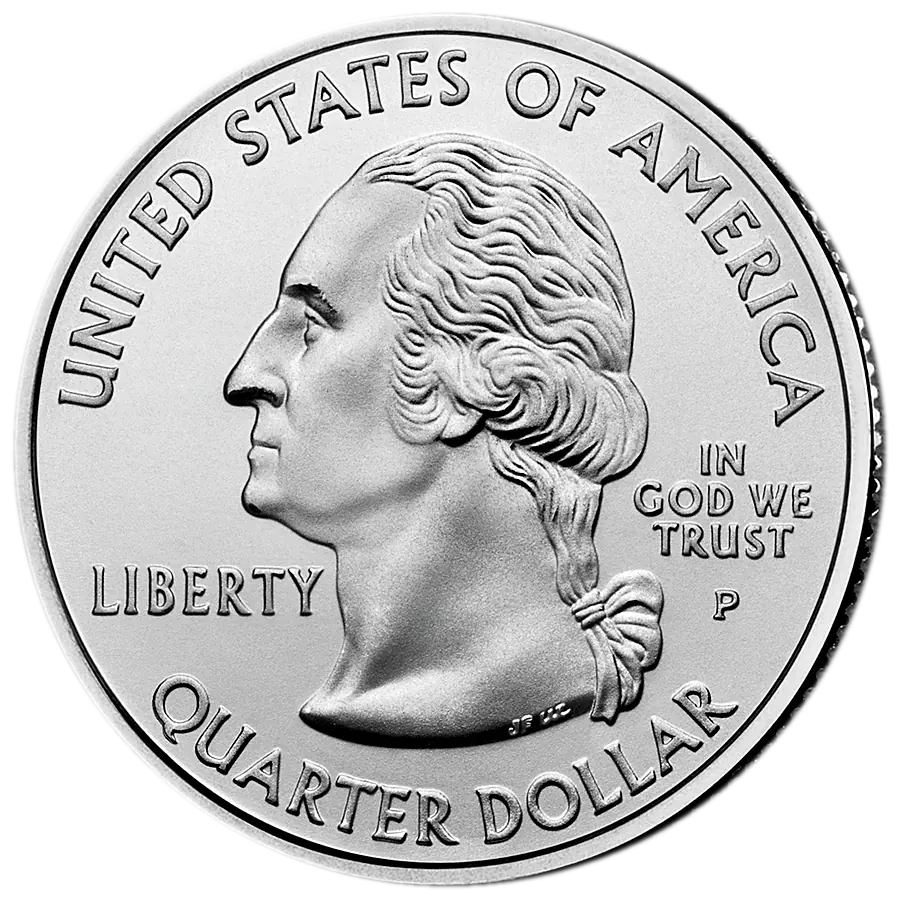
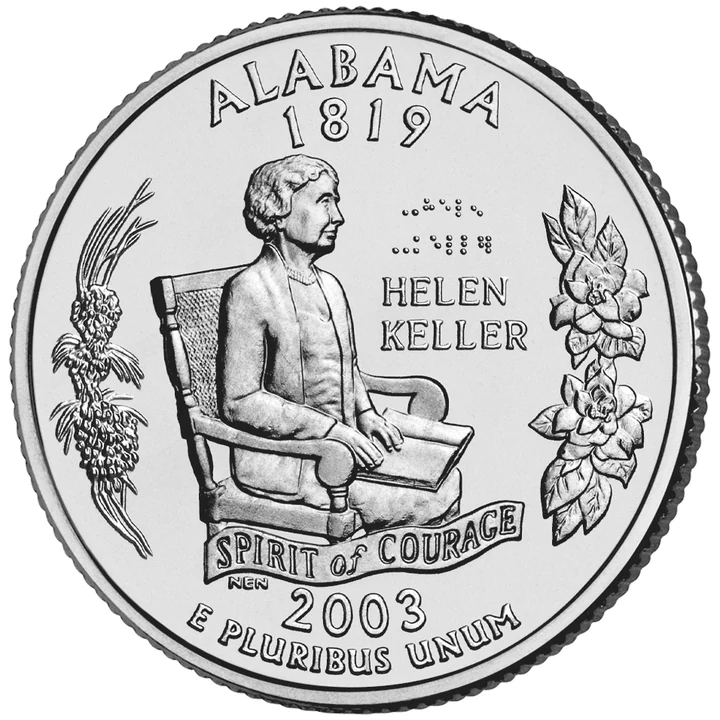
Exact Alabama reverse from the U.S. Mint; shared program obverse.
22 / 50release order
4mint/finish issues
P · D · Smint marks
2003release year
Story in 30 Seconds
The reverse shows Helen Keller seated with a book, her name in print and reduced-size simulated Braille, a longleaf-pine branch, magnolia blossoms, and a SPIRIT OF COURAGE banner.
The Mint calls it the first U.S. circulating coin to feature Braille. The dots are a visual representation at reduced size, not tactile, readable Braille; Keller was an author and wide-ranging activist, not only the child in the water-pump story.
Former Governor Don Siegelman opened a statewide school competition in January 2001. From thousands of concepts, his administration sent the Mint three themes—Keller, Alabama’s role in social movements, and the state’s social and economic history; the Mint returned five candidate designs and the governor’s office selected Spirit of Courage.
Collectors should distinguish P and D circulation strikes, S clad proof, and S 90% silver proof. Keller’s face, hands, book and chair, the dot cells, flower centers, pine needles, banner, inscriptions, and NE initials require careful strike, wear, contact, and damage checks.
Public Law 105-124 ordered reverses by constitutional ratification or admission. Alabama entered the Union on December 14, 1819 as the twenty-second state, making this the twenty-second program coin and second 2003 release. One reverse could not encompass Indigenous homelands, removal, slavery and emancipation, civil rights, labor, agriculture, forests, industry, music, cities, the Gulf Coast, or every Alabama community. The selected design instead joined a globally known Alabama-born advocate to two natural emblems.
Alabama became a state in 1819. Helen Adams Keller was born at Ivy Green in Tuscumbia in 1880 and became deafblind after illness at 19 months. With Anne Sullivan and many forms of communication, she pursued formal education, graduated from Radcliffe in 1904, wrote extensively, and advocated for disability access, workers, women’s suffrage, peace, and other social causes. Longleaf pine recalls a once-vast southern forest and Alabama’s natural and economic history; the magnolias are decorative regional flora, not Alabama’s official state flower, which is the camellia.
The central portrait presents Keller as an adult reader and thinker. Her book, composed posture, and printed name resist reducing her to diagnosis alone, although the official Spirit of Courage framing still favors an overcoming narrative over the full complexity of her ideas.
Keller’s Alabama origin made her a powerful state representative, but her public life was national and international. She identified as a writer and worked for decades with the American Foundation for the Blind while also supporting suffrage, workers’ rights, civil liberties, pacifism, and socialism—commitments mostly absent from the coin’s inspirational summary.
The name appears in ordinary letters and a reduced-size field of raised-looking dots. The Mint’s ‘first circulating coin to feature braille’ claim describes the depicted writing system, not an accessible tactile inscription: circulating relief, spacing, scale, and wear do not make these dots readable Braille by touch.
Longleaf-pine needles and magnolia blossoms flank the portrait as natural beauty and place markers. The Mint calls them Alabama longleaf pine and magnolias but gives no species for the flowers or separate symbolic code for each blossom. Magnolias must not be mislabeled as the current state flower.
The design emphasizes education, persistence, disability visibility, natural beauty, and one internationally famous native daughter. It omits Keller’s teacher and collaborators, her mature political positions, Alabama’s Black civil-rights history, Indigenous histories, slavery, industrial and agricultural labor, other landscapes, and disability perspectives that critique heroic-overcoming narratives. Those omissions make the coin a 2003 civic selection, not a complete biography or state history.
Treasury’s federal process asked each governor to establish a procedure and submit three to five concepts. The Mint screened legal and technical suitability, developed candidate designs, consulted federal advisory bodies, obtained Treasury approval, and returned approved choices for a governor’s recommendation.
In January 2001 Governor Don Siegelman announced a statewide competition for Alabama schools. The Mint says thousands of concepts were submitted. The reviewed official record does not give a total, grade eligibility, deadlines, judging panel, rubric, school distribution, or named student winners.
Siegelman forwarded three concepts: Helen Keller; Alabama’s role in social movements; and Alabama’s social and economic history. These were themes, not necessarily finished coin drawings. The Mint returned five candidate designs to the governor’s office, where Spirit of Courage featuring Keller was selected. The record documents student idea participation but no public vote on the final five.
The Mint credits Norman E. Nemeth as reverse designer and sculptor. The reviewed sources do not reproduce the five candidate designs, identify which state submission shaped each, name the final decision-makers beyond the governor’s office, or preserve advisory comments, state feedback, Treasury’s design-specific approval, inscription revisions, or production changes.
Procedures varied by state and changed during the program; each researched state page must document its actual path.
Alternative Designs
The official Mint record names three state concepts—Helen Keller, Alabama’s role in social movements, and Alabama’s social and economic history—and says the Mint returned five candidate designs. It does not show or describe those five, so they cannot be equated one-for-one with the three themes. No official finalist art, artist list, ranking, vote total, or public final-design vote was located.
Use the complete text cards below as the keyboard and screen-reader equivalent of the image.
Helen Keller with book and chair
Official explanation: The Mint identifies the seated figure as Alabama-born Helen Keller and frames her achievements as a Spirit of Courage.
Historical context: Keller graduated from Radcliffe, wrote books and hundreds of speeches and essays, and pursued disability, labor, suffrage, civil-liberties, peace, and international advocacy.
World Coin Book interpretation: The book and seated adult portrait center literacy and authorship; the coin’s calm profile leaves her voice, politics, collaborators, and travel outside the frame.
Official explanation: The Mint gives Keller’s name in English and reduced-size Braille and calls this the first U.S. circulating coin to feature Braille.
Historical context: Braille is a tactile writing system; the coin’s reduced dots visually reference it but are not spaced and sized as a practical touch-readable label.
World Coin Book interpretation: Print and dots place two reading systems beside the portrait, making communication the visual hinge; accessibility should not be inferred from symbolism alone.
Official explanation: The Mint identifies an Alabama longleaf-pine branch as one of the natural elements flanking Keller.
Historical context: Longleaf pine once dominated broad southern landscapes and carries ecological, timber, and restoration history in Alabama.
World Coin Book interpretation: Fine radiating needles create motion and texture opposite the rounded flowers; the branch evokes a landscape rather than a named tree or site.
Official explanation: The Mint says magnolias grace the design and celebrate Alabama’s natural beauty.
Historical context: The source does not identify a species or call magnolia Alabama’s state flower; Alabama law names Camellia japonica as the state flower.
World Coin Book interpretation: Broad petals soften and balance the pine needles while framing the portrait; flower count and placement have no documented separate meanings.
Official explanation: The Mint says the banner underlines Keller’s central image and names the selected design.
Historical context: The phrase celebrates persistence but is not documented as a quotation by Keller or Alabama’s official motto.
World Coin Book interpretation: The curved banner forms a base for the portrait and turns a complex public life into a concise civic virtue; that compression is inspirational and selective.
Official explanation: The inscriptions give the state, admission year, issue year, national motto, and Norman E. Nemeth’s initials.
Historical context: The Mint credits Nemeth as reverse designer and sculptor; Alabama was admitted in 1819 and the coin was released in 2003.
World Coin Book interpretation: Rim inscriptions establish time and nation around the portrait; NE records final artistic authorship, not a named school-concept winner.
Alabama-born author and activist whose adult portrait, name, and disability advocacy anchor the reverse.
Anne Sullivan
Teacher and collaborator central to Keller’s education, though absent from the coin.
Ivy Green
Keller’s Tuscumbia birthplace and site of the official 2003 unveiling.
Braille
Tactile writing system represented visually in reduced form beside Keller’s printed name.
Longleaf pine
Southern tree and Alabama landscape emblem represented by a needle-bearing branch.
Norman E. Nemeth
U.S. Mint sculptor-engraver credited as reverse designer and sculptor.
Focused Timeline
Alabama enters the Union as the twenty-second state
Helen Keller is born at Ivy Green in Tuscumbia
Anne Sullivan arrives and begins teaching Keller
Keller graduates cum laude from Radcliffe College
Keller begins forty-four years of work with AFB
Keller dies after a lifetime of writing and advocacy
Public Law 105-124 authorizes the 50 State Quarters program
Siegelman announces the statewide school concept competition
Alabama quarter enters Federal Reserve distribution
Mint and state unveil the quarter at Ivy Green
Official Explanation and Interpretation
Artists and relief
John Flanagan’s Washington portrait, adapted by William Cousins, appears on the shared obverse. The Mint credits Norman E. Nemeth as reverse designer and sculptor. He organized Keller’s seated profile, book, chair, print and dot inscriptions, pine needles, magnolia petals, banner, dates, motto, and initials in shallow relief. The reviewed record does not identify a winning student artist, reproduce the five Mint candidates, or preserve advisory comments, state feedback, model revisions, inscription changes, or production changes.
P and D are circulation issues. Both S issues were sold in proof products; the silver proof is a distinct 90% silver composition. Mintages are established catalog figures retained with an explicit source-audit limit.
Identification Guide
Identify the reverse by seated Helen Keller with a book, HELEN KELLER in print and simulated Braille, pine needles, magnolia blossoms, and SPIRIT OF COURAGE. P, D, or S appears on the obverse right of Washington’s hair ribbon. P and D are circulation strikes; S coins are proofs. A clad proof usually shows a copper-colored edge core and weighs 5.67 g; the 90% silver proof lacks that stripe and weighs about 6.25 g.
Condition Guide
On circulation coins inspect Keller’s forehead, cheek, hair, shoulder, hands, book edge and chair; the Braille-like dots; flower centers and petal folds; pine needles; banner; lettering; and NE. First wear dulls the highest portrait and floral relief and interrupts luster. Weak dots, needles, letters, or initials may remain lustrous from strike, grease, or die state rather than wear.
Open fields around the portrait and banner reveal contact marks, scrapes, residue, and cleaning, while dense flowers and needles can hide impacts. Check proofs for hairlines, haze, spots, fingerprints, frost breaks, and reduced cameo contrast. Compare normal examples before calling a missing dot, needle, petal line, letter, or initial a filled die or struck-through error.
Mint Errors vs. Damage
Recognized catalog varieties: none are listed in the current World Coin Book Alabama issue records. This evidence boundary does not prove that no minor die varieties exist.
Genuine mint errors can include off-center strikes, broadstrikes, clips, wrong-planchet strikes, struck-through material, retained cuds, substantial die cracks, or other mint-made failures. Attribution requires correct metal flow, weight, geometry, and repeatable die evidence where applicable.
An ‘extra Braille dot,’ missing dot, doubled Keller, extra pine needle, extra petal, filled SPIRIT, doubled book, or broken banner is not a rare variety by appearance alone. Mechanical doubling, die deterioration, grease, weak strike, glare, image compression, wear, and impacts readily alter fine relief.
Scratches mistaken for pine needles or letters, dents mistaken for dots, cuts, flattened rims, dryer damage, corrosion, glue, plating, polishing, and heat color are post-mint damage. The dots are not tactile readable Braille; magnolia is not Alabama’s state flower; SPIRIT OF COURAGE is not documented as Keller’s quotation or the state motto; and the coin does not depict Anne Sullivan, the water pump, or a named magnolia tree.
Why Collectors Care
Durable value tiers
Worn P and D examples usually occupy the face-value design-set tier. Better circulation coins attract interest through full luster, clean fields, distinct Keller features, separated fingers and book edge, complete dots, crisp flowers and pine needles, sharp banner and inscriptions, and visible NE initials. Clad proofs form a collector-product tier; silver proofs add 90% silver as a separate composition tier. Keller and the Braille milestone add thematic interest, not automatic rarity. World Coin Book gives no live price promise: compare dated references for exact mint, finish, grade, strike, and surfaces.
Official law and U.S. Mint records establish program facts and image identity. World Coin Book separates official explanation, historical analysis, and editorial interpretation.
Official descriptions, historical context, and World Coin Book interpretation are labeled separately. No live prices are asserted. Last verified:
The reviewed official record says thousands of school concepts were submitted but gives no exact total, complete rules, grade eligibility, dates beyond the January 2001 announcement, school distribution, judging body, roster, rubric, minutes, or named winners.
The three themes sent to the Mint are named, but the five returned candidate designs are not shown or described. Their artists, relationship to student submissions, rankings, and preservation locations remain unresolved.
No reviewed official source establishes a public vote on the five candidates or names every person in the governor’s office who made the final selection. Governor Siegelman’s complete written recommendation and rationale were not located.
The complete Mint feasibility, candidate-model, CFA/CCCAC review, state-feedback, Treasury-approval, inscription-revision, and production-change trail remains unresolved.
The Mint does not identify the portrait or book model, chair type, magnolia species, flower count meaning, exact pine specimen, or source of the phrase SPIRIT OF COURAGE; it does not claim the reduced dots are touch-readable.
Normalized mintages remain established catalog figures; a future source audit should attach direct U.S. Mint annual-production and proof-sales evidence to each number.