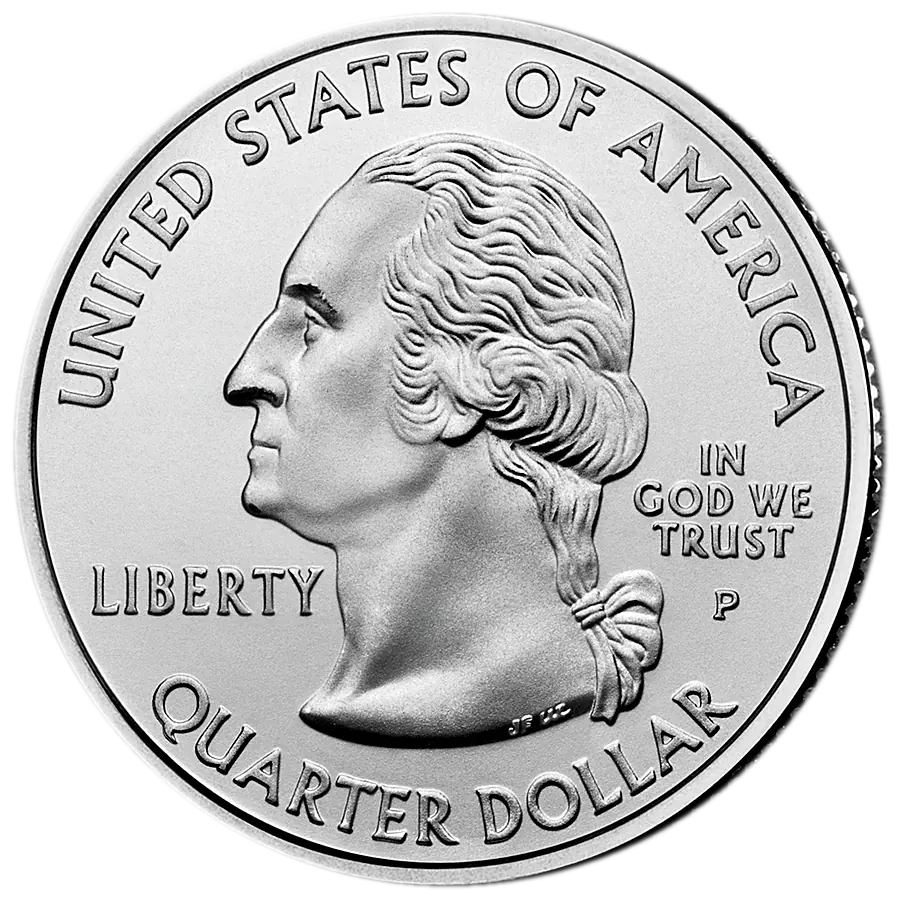
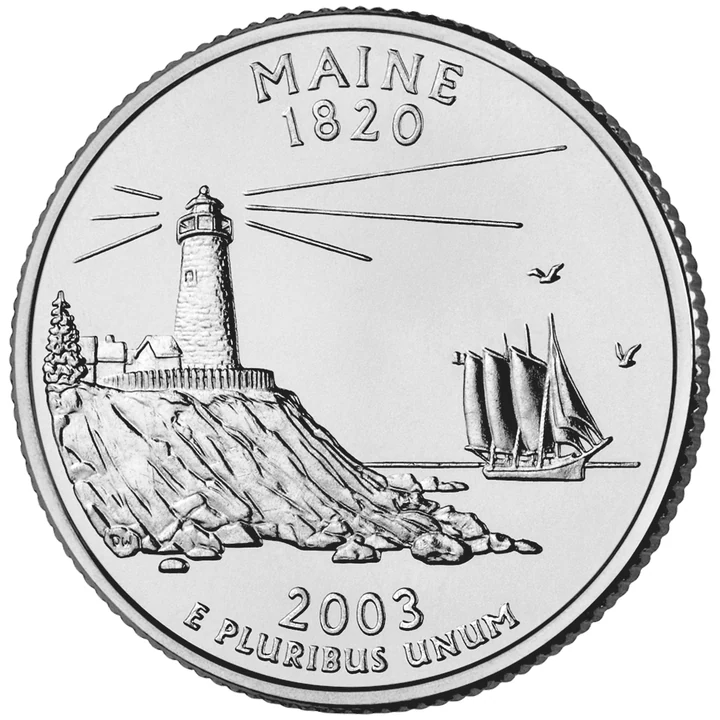
Exact Maine reverse from the U.S. Mint; shared program obverse.
23 / 50release order
4mint/finish issues
P · D · Smint marks
2003release year
Story in 30 Seconds
The reverse shows Pemaquid Point Light above a granite coast with a schooner at sea; the Mint says the vessel resembles Victory Chimes rather than identifying it as an exact portrait.
The lighthouse represents navigation, hazard, public safety, preservation, and a familiar Maine coast, while the schooner evokes working sail and the state’s windjammer tradition.
Governor Angus King created the Commission on the Maine State Quarter Design in March 2001. The Mint reports that the Pemaquid design won a popular vote in which more than 100,000 Maine residents participated; the surviving official summary does not disclose the ballot count or every alternative.
Collectors should distinguish P and D circulation strikes, S clad proof, and S 90% silver proof. The lantern, tower, rooflines, rocks, hull, rigging, sails, horizon, inscriptions, and DW initials reward close strike, wear, contact, and damage checks.
Public Law 105-124 ordered reverses by constitutional ratification or admission. Maine entered the Union on March 15, 1820 as the twenty-third state, making this the twenty-third program coin and third 2003 release. One reverse could not encompass Wabanaki homelands, forests, farms, fisheries, shipbuilding, labor, inland waters, mountains, cities, islands, or every coastal community. Voters instead selected a compact maritime scene that joined a navigational landmark to a vessel under sail.
Maine became a state in 1820. Pemaquid Point Light stands at New Harbor in Bristol, near the entrances to Muscongus Bay and Johns Bay. Congress funded an initial light in 1826; the Mint says the original building was replaced in 1835, while the National Register record identifies 1827 and 1857 as significant years. This difference likely reflects distinctions among authorization, first construction, tower replacement, and later rebuilding, so the page does not collapse them into one date. The coast and sailing economy are only one part of Maine’s history and identity.
The tower rises at left from layered granite, its lantern and attached keeper structures forming the design’s most stable vertical mass. The Mint presents the light as a response to hazardous shoals and shipwrecks as maritime trade increased, tying a picturesque landmark to practical navigation and public safety.
At right, a schooner heels slightly beneath filled sails. The Mint carefully says it resembles Victory Chimes, the last three-masted schooner of the Windjammer Fleet, and that the vessel became synonymous with Maine windjamming. Resemblance is not proof that every spar, sail, or hull detail is a literal ship portrait.
Water and the low horizon connect lighthouse and ship: one fixed on shore, the other moving through the route the light helps mark. Granite textures counter the thin rigging and curved sails, creating a visual exchange between endurance and motion.
The design emphasizes a recognizable coast, maritime skill, navigational infrastructure, tourism, preservation, and sailing memory. It can evoke the Pine Tree State indirectly through landscape and identity, but THE PINE TREE STATE is not an inscription on the coin and no pine tree is the central device.
The scene omits Wabanaki presence and place histories, fisheries and working waterfronts beyond sail, shipyard and lighthouse labor, inland Maine, forests, farms, industry, cities, ecological change, and the human cost of maritime hazards. It is a popular 2001–2003 civic image, not a complete account of Maine.
Treasury’s federal process asked each governor to establish a procedure and submit three to five concepts. The Mint screened legal and technical suitability, developed candidate designs, consulted federal advisory bodies, obtained Treasury approval, and returned approved choices for a governor’s recommendation.
The Mint says Governor Angus King established the Commission on the Maine State Quarter Design in March 2001. The reviewed official summary does not provide the commission’s legal instrument, roster, meetings, submission rules, concept authors, judging criteria, or the route by which ideas became Mint art.
The Pemaquid Point Light design was chosen by popular vote with more than 100,000 Maine residents participating. That establishes unusually broad public participation, but participation is not the same as votes cast for the winner; the official summary supplies neither exact turnout nor candidate totals.
The Mint credits Donna Weaver as reverse designer and sculptor. The reviewed record does not reproduce the ballot, identify every finalist, connect a citizen proposal to Weaver’s relief, record Governor King’s recommendation, or preserve Mint feasibility notes, advisory comments, state feedback, Treasury’s design-specific approval, or production revisions.
Procedures varied by state and changed during the program; each researched state page must document its actual path.
Alternative Designs
The reviewed official sources establish that a popular vote occurred, but they do not name or show every choice on the ballot, provide candidate descriptions, artists, rankings, vote totals, or preservation locations. Accordingly, World Coin Book publishes only the documented winning Pemaquid concept and does not reconstruct a finalist list from secondary retellings.
Use the complete text cards below as the keyboard and screen-reader equivalent of the image.
Pemaquid Point Light and keeper buildings
Official explanation: The Mint identifies Pemaquid Point Light in New Harbor and says it marks the entrance to Muscongus Bay and Johns Bay.
Historical context: Congress funded a light in 1826 in response to hazardous navigation; successive construction and rebuilding dates require distinction.
World Coin Book interpretation: The tall fixed beacon anchors the left side and makes public infrastructure, warning, and safe passage the scene’s organizing idea.
Official explanation: The Mint says the schooner resembles Victory Chimes and associates that vessel with Maine windjamming.
Historical context: The wording documents resemblance, not an exact vessel portrait or a claim that Victory Chimes sailed past the lighthouse in this depicted moment.
World Coin Book interpretation: The diagonal hull, rigging, and filled sails supply movement opposite the lighthouse’s vertical stillness.
Official explanation: The inscriptions give the state, admission year, issue year, national motto, and Donna Weaver’s initials.
Historical context: The Mint credits Weaver as reverse designer and sculptor; Maine entered the Union in 1820 and the coin was released in 2003.
World Coin Book interpretation: The rim text frames place and time while DW records artistic authorship; THE PINE TREE STATE does not appear on the coin.
Historic navigational light and the fixed landmark anchoring the reverse.
Victory Chimes
Three-masted schooner that the Mint says the coin’s vessel resembles; not an officially claimed exact portrait.
Muscongus Bay and Johns Bay
Waters whose entrances the Mint says Pemaquid Point Light marks.
Commission on the Maine State Quarter Design
Governor Angus King’s 2001 body associated with developing the state’s design choices.
Donna Weaver
U.S. Mint medallic artist credited as reverse designer and sculptor.
Focused Timeline
Maine enters the Union as the twenty-third state
Congress appropriates funds for a light at Pemaquid Point
National Register record identifies an early significant year for the light
Mint history says the original building is replaced
National Register record identifies another significant rebuilding-era year
Pemaquid Point Light is documented in the National Register collection
Public Law 105-124 authorizes the 50 State Quarters program
Governor Angus King establishes the state quarter design commission
Maine quarter is released to the Federal Reserve Bank
Mint and state launch the quarter at Pemaquid Point Light
Official Explanation and Interpretation
Artists and relief
John Flanagan’s Washington portrait, adapted by William Cousins, appears on the shared obverse. The Mint credits medallic artist Donna Weaver as both reverse designer and sculptor. She translated a selected lighthouse-and-schooner concept into shallow relief, balancing the tower and granite at left against hull, rigging, sails, and open water at right. The reviewed record does not identify a citizen concept author, reproduce ballot art, or preserve model revisions, advisory comments, inscription changes, or production changes.
P and D are circulation issues. Both S issues were sold in proof products; the silver proof is a distinct 90% silver composition. Mintages are established catalog figures retained with an explicit source-audit limit.
Identification Guide
Identify the reverse by Pemaquid Point Light on granite at left and a schooner under sail at right. P, D, or S appears on the obverse right of Washington’s hair ribbon. P and D are circulation strikes; S coins are proofs. A clad proof usually shows a copper-colored edge core and weighs 5.67 g; the 90% silver proof lacks that stripe and weighs about 6.25 g.
Condition Guide
On circulation coins inspect the lantern and tower edges, keeper-house roofs, highest rock ridges, schooner bow and hull, sail centers and edges, mastheads, rigging junctions, horizon, lettering, and DW. First wear dulls exposed tower, rock, hull, and sail relief and interrupts luster. Thin rigging or rooflines may be weak yet lustrous from strike or die state rather than wear.
Open sky and water fields reveal contact marks, scrapes, residue, and cleaning; rocks and rigging can hide impacts. Check proofs for hairlines, haze, spots, fingerprints, frost breaks, and reduced cameo contrast. Compare normal examples before calling a missing line, mast, rope, window, rock edge, letter, or initial a filled die or struck-through error.
Mint Errors vs. Damage
Recognized catalog varieties: none are listed in the current World Coin Book Maine issue records. This evidence boundary does not prove that no minor die varieties exist.
Genuine mint errors can include off-center strikes, broadstrikes, clips, wrong-planchet strikes, struck-through material, retained cuds, substantial die cracks, or other mint-made failures. Attribution requires correct metal flow, weight, geometry, and repeatable die evidence where applicable.
An ‘extra mast,’ extra sail, doubled lighthouse, floating roof, missing window, broken rigging, extra rock, wave, bird, or doubled date is not a rare variety by appearance alone. Mechanical doubling, die deterioration, grease, weak strike, glare, image compression, wear, and impacts readily alter thin relief.
Scratches mistaken for rigging, dents mistaken for windows or rocks, cuts, flattened rims, dryer damage, corrosion, glue, plating, polishing, and heat color are post-mint damage. The schooner only resembles Victory Chimes; the coin does not document a specific voyage, shipwreck, keeper, crew, storm, pine tree, or THE PINE TREE STATE inscription.
Why Collectors Care
Durable value tiers
Worn P and D examples usually occupy the face-value design-set tier. Better circulation coins attract interest through full luster, clean sky and water, a sharp lantern and tower, separated rooflines and rocks, a complete hull, distinct masts and rigging, full sail contours, clear inscriptions, and visible DW initials. Clad proofs form a collector-product tier; silver proofs add 90% silver as a separate composition tier. Lighthouse and maritime themes add collector interest, not automatic rarity. World Coin Book gives no live price promise: compare dated references for exact mint, finish, grade, strike, and surfaces.
Official law and U.S. Mint records establish program facts and image identity. World Coin Book separates official explanation, historical analysis, and editorial interpretation.
Official descriptions, historical context, and World Coin Book interpretation are labeled separately. No live prices are asserted. Last verified:
The reviewed official record does not provide the commission’s establishing instrument, complete name history, roster, appointment dates, meetings, minutes, submission rules, eligibility, deadlines, judging criteria, or concept authors.
The popular-vote ballot, exact participation total, candidate list and images, individual totals, voting dates and channels, eligibility controls, audit method, rankings, and preservation locations were not located in reviewed official sources.
No reviewed source maps a public submission to Donna Weaver’s relief or preserves Governor Angus King’s exact recommendation and rationale.
The complete Mint feasibility, candidate-model, CFA/CCCAC review, state-feedback, Treasury-approval, inscription-revision, and production-change trail remains unresolved.
The Mint says the schooner resembles Victory Chimes but does not identify a voyage, date, crew, viewpoint, exact waters, weather, tide, or literal vessel details; no individual rock, building, window, sail, or wave has a documented separate symbolic meaning.
Official summaries differ in construction chronology: the Mint cites 1826 funding and an 1835 replacement, while the National Register metadata highlights 1827 and 1857. A fuller Coast Guard or historic-structure record is needed to reconcile authorization, first lighting, tower replacement, and rebuilding.
Normalized mintages remain established catalog figures; a future source audit should attach direct U.S. Mint annual-production and proof-sales evidence to each number.