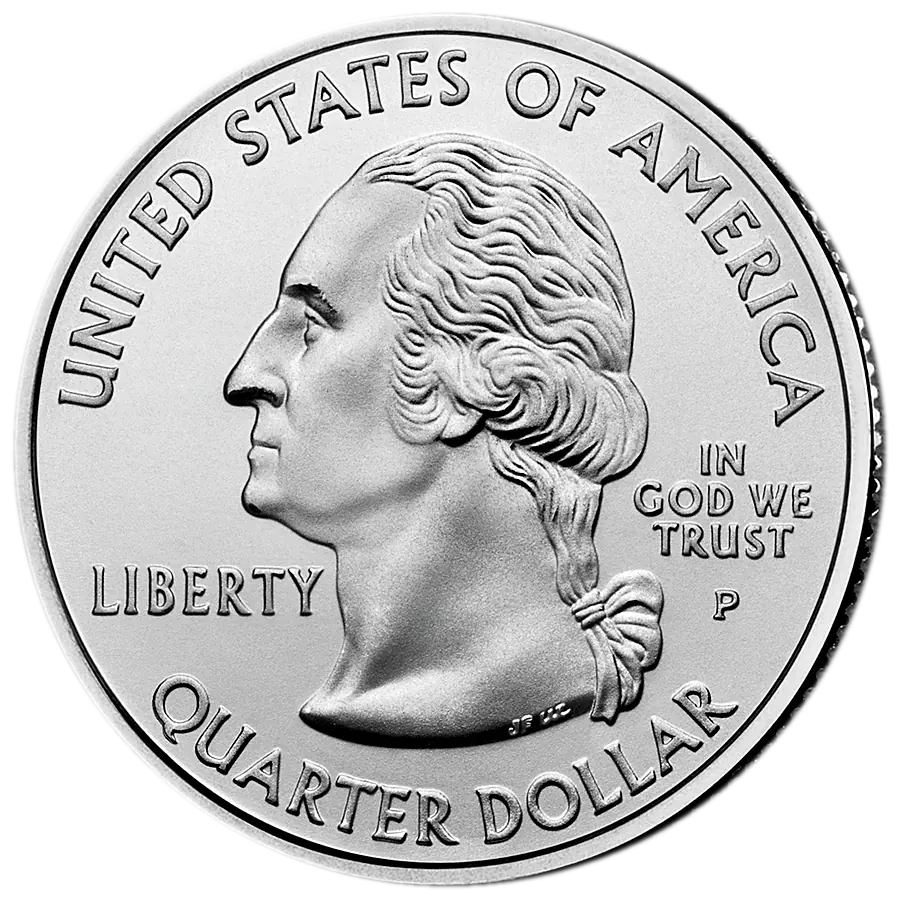
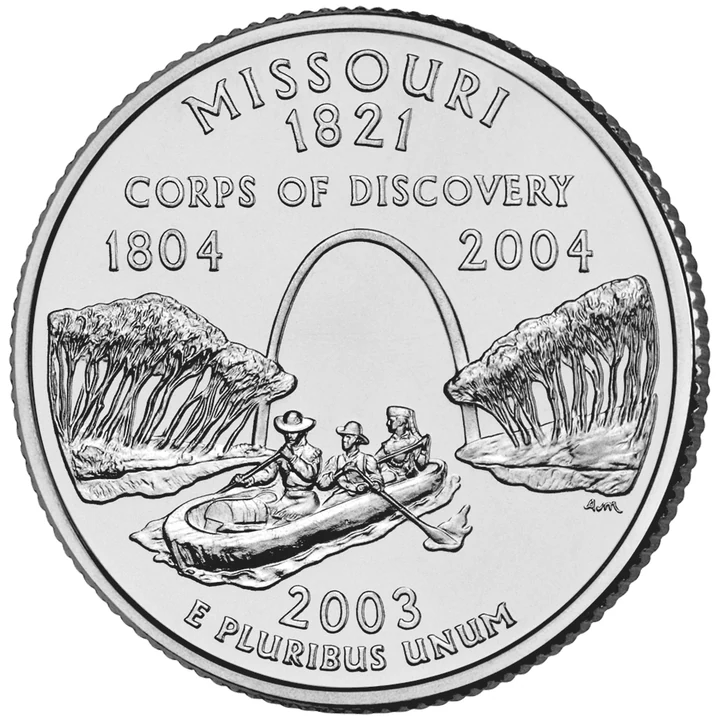
Exact Missouri reverse from the U.S. Mint; shared program obverse.
24 / 50release order
4mint/finish issues
P · D · Smint marks
2003release year
Story in 30 Seconds
The reverse shows Meriwether Lewis and William Clark returning to St. Louis down the Missouri River in 1806, with the Gateway Arch behind them and CORPS OF DISCOVERY 1804–2004 above.
Missouri chose the expedition because its preparation, departure from the St. Louis area, river route, and homecoming tie national exploration memory to the state; the Arch adds a twentieth-century St. Louis symbol.
Governor Bob Holden appointed a design committee and requested statewide submissions. More than 3,000 concepts became twelve committee finalists, five public-selected concepts, five Mint redraws, and an online-vote winner based on Paul Jackson’s entry.
Collectors should distinguish P and D circulation strikes, S clad proof, and S 90% silver proof. Faces, canoe, paddles, water lines, Arch edges, inscriptions, and AM initials require careful checks.
Public Law 105-124 ordered reverses by constitutional ratification or admission. Missouri entered the Union on August 10, 1821 as the twenty-fourth state, making this the twenty-fourth program coin and fourth 2003 release. One reverse could not encompass Indigenous nations, colonial histories, slavery and freedom, the Missouri Compromise, rivers, farms, cities, migration, civil rights, industry, music, or every community. The selected scene instead made the state a departure-and-return threshold in a national expansion story.
Missouri’s position around the Missouri–Mississippi confluence made the St. Louis area a preparation, supply, departure, and return point for the Corps of Discovery. Clark established Camp River Dubois near the confluence in 1803; the party moved up the Missouri in 1804 and returned to St. Louis on September 23, 1806. The expedition depended on a larger, changing Corps and on knowledge, food, horses, shelter, translation, and assistance from many Indigenous nations. The coin’s two named captains and later Arch do not represent that full history.
Two seated figures occupy a canoe in the foreground. The Mint identifies them as Lewis and Clark returning down the Missouri River to St. Louis. Their diagonal boat and paddles turn a long expedition into one readable homecoming instant.
The Gateway Arch rises behind them even though it did not exist in 1806. That deliberate time-layer joins the expedition to later public memory: St. Louis as a Gateway to the West, expressed through a monument completed more than a century and a half after the return.
CORPS OF DISCOVERY 1804–2004 frames the bicentennial period, not the expedition’s complete dates. The journey began in 1804 and returned in 1806; 2004 points to commemoration rather than a historical endpoint.
The Missouri River acts as route and visual ground, while the Arch creates the tallest, simplest silhouette. The compact heroic image omits most Corps members, Sacagawea, York, interpreters and boatmen, Indigenous homelands and aid, diplomacy and conflict, scientific labor, expansion and dispossession. It is a 2001–2003 civic choice, not a complete history.
In February 2001 Governor Bob Holden announced the Missouri Commemorative Quarter Design Committee and requested statewide submissions. The Mint reports more than 3,000 March submissions; the State Archives says First Lady Lori Hauser Holden headed the initiative and many submissions came from schoolchildren.
The committee selected twelve named finalists. A first public vote narrowed them to entries by Barton Burnell, Albert Fields, Paul Jackson, Marybeth Logsdon, and Natasha Zerjav; Missouri sent those five to the Mint on April 20, 2001.
About a year later the Mint returned redrawn versions. The state archive says some changes were radical and one redraw misspelled Bicentennial. The candidates represented westward expansion, a riverboat, Pony Express, and Lewis and Clark; an online public vote selected CORPS OF DISCOVERY 1804–2004.
The State Archives identifies Paul Jackson as the winning concept artist and documents negotiations that restored some original elements. The Mint credits Alfred Maletsky as reverse designer and sculptor, separating Jackson’s citizen concept from Maletsky’s coin relief.
Reviewed summaries do not preserve vote totals, rules, the committee roster and deliberations, every candidate image, Mint feasibility notes, advisory comments, the governor’s formal recommendation, Treasury’s design-specific approval, or a complete change log.
Procedures varied by state and changed during the program; each researched state page must document its actual path.
Alternative Designs
Official records name twelve first-round finalists: Marvin Brown, Barton Burnell, Danielle Renee Critten, Howard D. Franklin, Albert Fields, Charles W. Galli, Paul Jackson, Lauren Keller, Marybeth Logsdon, Stanze Sneller, Sarah Wilson, and Natasha Zerjav. The public advanced Burnell, Fields, Jackson, Logsdon, and Zerjav. The Mint describes broad subjects—westward expansion, riverboat, Pony Express, and Lewis and Clark—but reviewed summaries do not reliably map each name to each subject or reproduce every design, so World Coin Book does not invent that mapping.
Larger expedition compressed into two figures on the coin.
Missouri River and St. Louis
Return route and city tying the scene to Missouri.
Gateway Arch
Later memorial used symbolically, not an 1806 structure.
Paul Jackson and Alfred Maletsky
Jackson created the winning concept; Maletsky designed and sculpted the issued relief.
Focused Timeline
Clark establishes Camp River Dubois near the river confluence
Corps leaves Camp River Dubois and joins Lewis at St. Charles
Corps returns to St. Louis
Missouri enters the Union as the twenty-fourth state
Public Law 105-124 authorizes the program
Governor Holden announces committee and submissions
Missouri sends five concepts to the Mint
Mint redraws return for online public vote
Quarter is released to the Federal Reserve Bank
Quarter launches at the Missouri State Fair
Official Explanation and Interpretation
Artists and relief
John Flanagan’s Washington portrait, adapted by William Cousins, appears on the shared obverse. The Missouri State Archives identifies watercolorist Paul Jackson as creator of the winning citizen concept and documents negotiation over the Mint redraw. The Mint credits Alfred Maletsky as reverse designer and sculptor. Maletsky converted the concept into shallow relief, simplifying figures, canoe, water, inscriptions, and Arch for production. Reviewed summaries do not preserve every model, advisory comment, inscription revision, die change, or complete before-and-after record.
P and D are circulation issues. Both S issues were sold in proof products; the silver proof is a distinct 90% silver composition. Mintages are established catalog figures retained with an explicit source-audit limit.
Identification Guide
Identify the reverse by two explorers in a canoe beneath the Gateway Arch and CORPS OF DISCOVERY 1804–2004. P, D, or S appears on the obverse right of Washington’s hair ribbon. P and D are circulation strikes; S coins are proofs. A clad proof usually shows a copper-colored edge core and weighs 5.67 g; the 90% silver proof lacks that stripe and weighs about 6.25 g.
Condition Guide
Inspect heads and shoulders, canoe rim and ends, paddle blades, water lines, Arch curves, inscriptions, and AM. First wear dulls exposed figures, boat, and Arch and interrupts luster. Thin lines or faces may be weak yet lustrous from strike or die state rather than wear.
Open fields around the Arch reveal contact, scrapes, residue, and cleaning; dense water and figure relief can hide impacts. Check proofs for hairlines, haze, spots, fingerprints, frost breaks, and reduced cameo. Compare normal examples before calling missing detail a filled die or struck-through error.
Mint Errors vs. Damage
Recognized catalog varieties: none are listed in current World Coin Book Missouri issue records. This evidence boundary does not prove no minor die varieties exist.
Genuine mint errors can include off-center strikes, broadstrikes, clips, wrong planchets, struck-through material, retained cuds, or substantial die cracks. Attribution requires correct metal flow, weight, geometry, and repeatable evidence.
An extra paddle, person, water line, doubled Arch or date, floating canoe, missing face, broken boat, or altered AM is not rare by appearance alone. Mechanical doubling, die deterioration, grease, weak strike, glare, compression, wear, and impacts alter shallow details.
Scratches mistaken for paddles or water, dents mistaken for people, cuts, flattened rims, dryer damage, corrosion, glue, plating, polishing, and heat color are post-mint damage. The Arch was not present in 1806; 1804–2004 is a bicentennial inscription, not the journey’s full dates; two figures do not mean only Lewis and Clark traveled.
Why Collectors Care
Durable value tiers
Worn P and D examples usually occupy the face-value design-set tier. Better circulation coins attract interest through full luster, clean Arch fields, distinct faces, complete canoe and paddles, separated water lines, sharp Arch edges, clear inscriptions, and visible AM. Clad proofs form a collector-product tier; silver proofs add 90% silver as a separate composition tier. Themes add interest, not automatic rarity. World Coin Book gives no live price promise: compare dated references for exact mint, finish, grade, strike, and surfaces.
Official law and U.S. Mint records establish program facts and image identity. World Coin Book separates official explanation, historical analysis, and editorial interpretation.
Official descriptions, historical context, and World Coin Book interpretation are labeled separately. No live prices are asserted. Last verified:
Reviewed summaries do not provide the committee’s complete roster, appointments, meetings, minutes, judging criteria, submission rules, eligibility, or an exact count beyond more than 3,000; the State Archives identifies boxes for future research.
Neither public vote’s dates, eligibility controls, audit method, turnout, candidate totals, rankings, or complete ballot images were located in reviewed online official records.
Official summaries do not reliably map each five-finalist name to the broad alternative subjects or identify every original concept’s details.
The full Mint feasibility, candidate-model, CFA/CCCAC review, state-feedback, governor-recommendation, Treasury-approval, inscription-revision, negotiation, and production-change trail remains unresolved.
Reviewed online records do not establish which Jackson elements were removed, restored, or changed; preserved watercolors and files require archival inspection.
No official source assigns separate meaning to each paddle, water line, canoe detail, pose, or spacing, or identifies a literal viewpoint and exact river reach.
Normalized mintages remain established catalog figures; future work should attach direct Mint annual-production and proof-sales evidence.