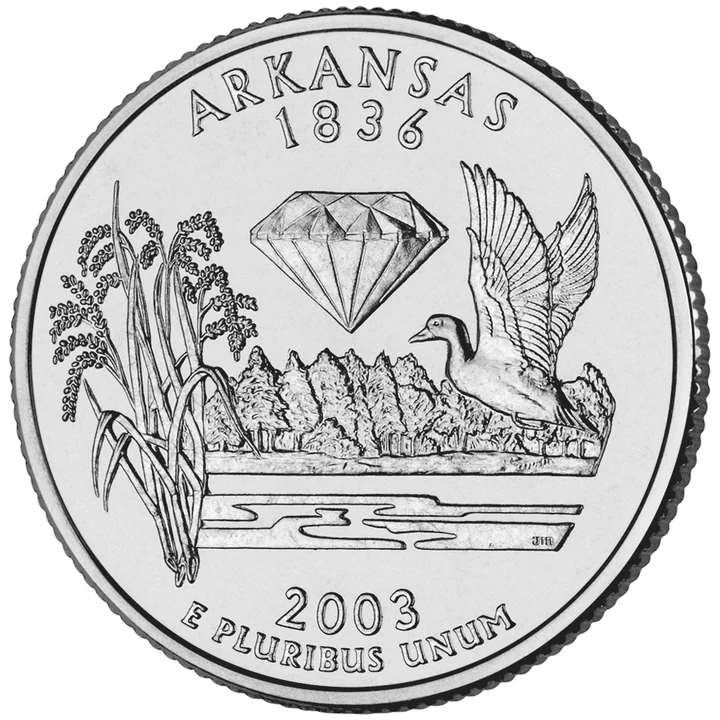
A diamond anchors a layered wetland landscape where rice and a flying mallard turn “The Natural State” into a compact story of geology, agriculture, water, and outdoor culture.
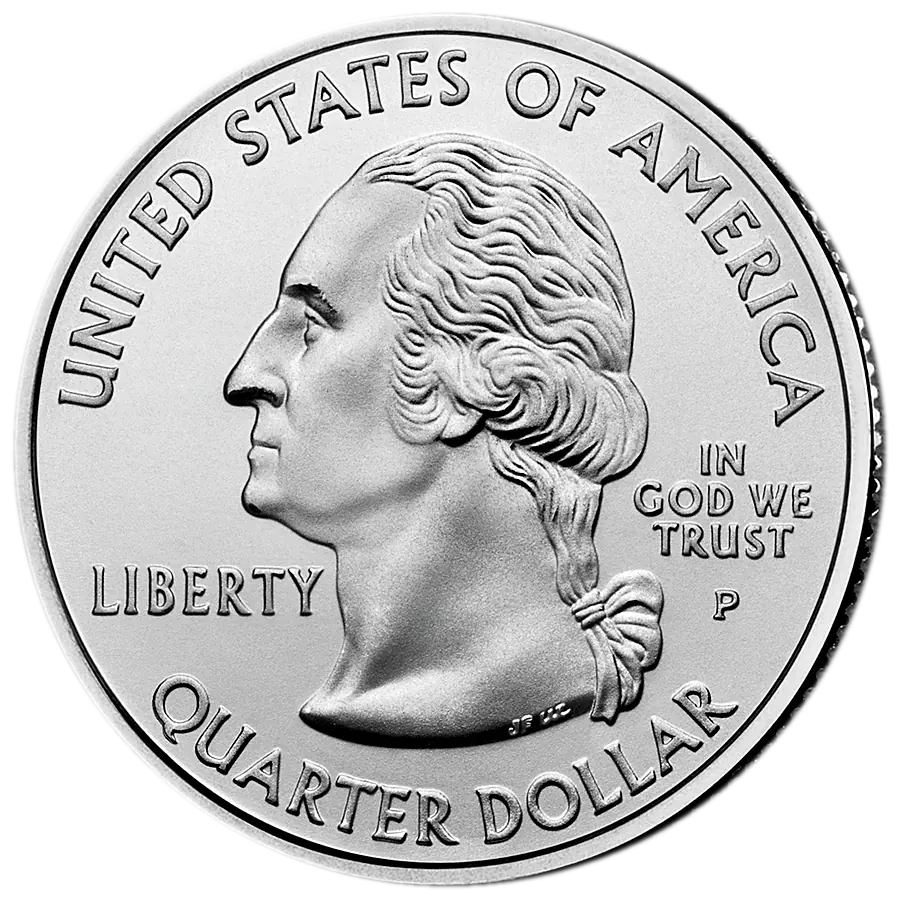
Exact Arkansas reverse from the U.S. Mint; shared program obverse.
25 / 50release order
4mint/finish issues
P · D · Smint marks
2003release year
Story in 30 Seconds
The reverse shows a large cut diamond, rice stalks, and a mallard flying over a tree-lined lake. The official theme is The Natural State; that phrase explains the concept but is not inscribed on the coin.
The diamond points to Crater of Diamonds State Park, rice to a nationally important Arkansas crop, and the mallard, water, and woods to the state’s waterways, wintering-waterfowl habitat, and outdoor identity.
Governor Mike Huckabee opened the Arkansas Quarter Challenge statewide in January 2001. From 9,320 entries, reviewers produced 100, then 12, then three named concepts; the Mint returned four candidates and the governor selected the natural-resources design derived from Dortha Scott’s entry.
Collectors should distinguish P and D circulation strikes, S clad proof, and S 90% silver proof. The diamond facets, rice grains and awns, mallard, tree line, water lines, inscriptions, and JM initials are the main diagnostic zones.
Public Law 105-124 ordered state reverses by constitutional ratification or admission. Arkansas entered the Union on June 15, 1836 as the twenty-fifth state, so its quarter became the program’s twenty-fifth coin, fifth 2003 release, and halfway point. One reverse could not represent Indigenous nations, removal and survival, French and Spanish colonial histories, slavery and emancipation, agriculture and labor, the Delta, Ozarks and Ouachitas, cities, civil rights, music, industry, or every community. The selected design instead defines Arkansas through a curated natural-resources landscape.
Arkansas joins several distinct landscapes. Diamond-bearing ground near Murfreesboro became Crater of Diamonds State Park, where the public can search for natural diamonds. Eastern Arkansas rice production and the Mississippi Flyway connect agriculture with wintering-waterfowl habitat; flooded timber, wetlands, reservoirs, and rice fields support mallards and an influential hunting culture. The coin merges these places into one symbolic scene rather than depicting a single literal lake or viewpoint.
A faceted diamond dominates the lower center. It is not a claim that diamonds characterize every part of Arkansas: it selects one unusual geological and public-park identity and makes it the design’s visual anchor.
Rice stalks rise at left, bringing managed land and agricultural work into a scene often described simply as natural beauty. Their placement beside the diamond links renewable annual production with ancient geology without explaining the people, water systems, markets, or labor behind the crop.
A mallard crosses above the lake and tree line. Official accounts connect it to abundant natural resources and outdoor sporting reputation; current state wildlife information also links mallards to Mississippi Flyway habitat, flooded timber, and rice fields. The bird therefore joins ecology and hunting culture, not wilderness alone.
The lake, horizontal water lines, and woods unify elements from different Arkansas regions. World Coin Book reads the upward stalks, central diamond, and flying bird as a three-level composition—ground resource, cultivated resource, and mobile wildlife—but this visual reading is editorial, not an official symbolic formula.
The compact Natural State story omits communities, contested land histories, environmental costs, agricultural labor, and much of Arkansas’s cultural and political history. Its meaning lies partly in that 2001–2002 choice to present geology, production, water, and wildlife as a shared statewide identity.
Under Mint guidelines, Governor Mike Huckabee announced the Arkansas Quarter Challenge in January 2001 and invited Arkansans to submit concepts by March 31. Permitted subjects included landmarks, landscapes, historic buildings, state outline, resources, flowers, and trees; flags, seals, and people were excluded.
The state received 9,320 entries. A committee narrowed them to 100 displayed at the State Capitol. An eleven-judge panel selected by Huckabee chose twelve, and the governor selected three finalists: Kathy Basler, Ariston Jacks, and Dortha Scott. Each received a $1,000 prize.
Basler combined the state outline, pine, apple blossoms, flying ducks, mountains, and NATURAL STATE; Jacks showed the State Capitol with a mockingbird and pine branches; Scott combined a diamond, ducks, lakes, mountains, and rice. Huckabee sent those three concepts to the Mint.
The Mint translated the submissions into four coin candidates and returned them to the governor. Huckabee announced Scott’s natural-resources concept as winner on October 7, 2002. The Mint credits John Mercanti as designer and sculptor of the issued relief, distinguishing Scott’s citizen concept from the final coin execution.
The reviewed official and institutional summaries do not identify the initial committee, all eleven judges, the twelve semifinalists, why three concepts became four Mint candidates, advisory review, state revisions, the formal Treasury approval, or a complete concept-to-relief change log.
Procedures varied by state and changed during the program; each researched state page must document its actual path.
Alternative Designs
Three state finalists are documented. Kathy Basler proposed a state outline with pine, apple blossoms, flying ducks, mountains, and a NATURAL STATE banner. Ariston Jacks proposed the State Capitol with a mockingbird and pine branches. Dortha Scott proposed diamond, ducks, lakes, mountains, and rice. The Mint returned four modified candidates, including natural-resources and State Capitol treatments, but reviewed records do not reproduce or fully describe all four; World Coin Book therefore does not invent their exact layouts.
Mint releases Arkansas quarter to the Federal Reserve
Official launch at Crater of Diamonds State Park
Official Explanation and Interpretation
Artists and relief
John Flanagan’s Washington portrait, adapted by William Cousins, appears on the shared obverse. Dortha Scott, a self-taught artist from Mount Ida, created the winning citizen concept from Arkansas’s statewide contest. The Mint credits John Mercanti as reverse designer and sculptor; he translated the concept into shallow relief and organized diamond facets, rice, mallard, water, woods, inscriptions, and initials for mass production. Reviewed records do not preserve all four candidate models, advisory comments, the exact Scott-to-Mercanti change sequence, or production revisions.
P and D are circulation issues. Both S issues were sold in proof products; the silver proof is a distinct 90% silver composition. Mintages are established catalog figures retained with an explicit source-audit limit.
Identification Guide
Identify the reverse by a large diamond below a mallard, rice stalks at left, and a lake and tree line behind. P, D, or S appears on the obverse right of Washington’s hair ribbon. P and D are circulation strikes; S coins are proofs. A clad proof usually shows a copper-colored edge core and weighs 5.67 g; the 90% silver proof lacks that stripe and weighs about 6.25 g.
Condition Guide
Inspect the diamond’s upper facets and points, mallard’s head, breast and wings, rice grains and awns, tree line, water bands, inscriptions, and JM. First wear dulls exposed diamond and bird relief and breaks luster. Fine rice, trees, feathers, or water may be weak yet lustrous from strike or die state rather than wear.
Broad fields around the bird and diamond reveal contact, scrapes, residue, and cleaning; dense rice and tree texture can hide marks. Check proofs for hairlines, haze, spots, fingerprints, frost breaks, and reduced cameo. Compare normal examples before attributing a missing grain, feather, facet, tree, or water line to a filled die or struck-through error.
Mint Errors vs. Damage
Recognized catalog varieties: none are listed in current World Coin Book Arkansas issue records. This evidence boundary does not prove no minor die varieties exist.
Genuine mint errors can include off-center strikes, broadstrikes, clips, wrong planchets, struck-through material, retained cuds, or substantial die cracks. Attribution requires correct metal flow, weight, geometry, and repeatable evidence.
An extra diamond facet, rice grain, stalk, feather, tree, shoreline, water line, doubled mallard or date, missing wing, floating diamond, or altered JM is not rare by appearance alone. Mechanical doubling, die deterioration, grease, weak strike, glare, compression, wear, and impacts alter shallow details.
Scratches mistaken for rice or water, dents mistaken for diamonds, cuts, flattened rims, dryer damage, corrosion, glue, plating, polishing, and heat color are post-mint damage. The coin does not say THE NATURAL STATE, the diamond is not the state-flag diamond, and reviewed sources do not identify a literal lake or exact duck-hunting site.
Why Collectors Care
Durable value tiers
Worn P and D examples usually occupy the face-value design-set tier. Better circulation coins attract interest through full luster, clean fields, crisp diamond facets, complete rice grains and awns, distinct mallard feathers, separated trees and water lines, clear inscriptions, and visible JM. Clad proofs form a collector-product tier; silver proofs add 90% silver as a separate composition tier. The program-midpoint and Natural State story add interest, not automatic rarity. World Coin Book gives no live price promise: compare dated references for exact mint, finish, grade, strike, and surfaces.
Official law and U.S. Mint records establish program facts and image identity. World Coin Book separates official explanation, historical analysis, and editorial interpretation.
Official descriptions, historical context, and World Coin Book interpretation are labeled separately. No live prices are asserted. Last verified:
Reviewed online records do not name the initial committee, all eleven judges, the twelve semifinalists, their scores, judging criteria, meetings, minutes, or conflict controls.
The exact 100 displayed concepts, all twelve semifinalist images, submission demographics, eligibility enforcement, and preservation location were not found in reviewed online records.
Three state concepts became four Mint candidates, but reviewed sources do not explain the split or reproduce and fully describe all four candidate layouts.
The complete Mint feasibility, candidate-model, CFA/CCCAC review, state-feedback, governor-recommendation, Treasury-approval, inscription, die, and production-change trail remains unresolved.
Reviewed records do not establish every element removed, retained, or added between Scott’s drawing and Mercanti’s issued relief, or whether Scott reviewed the final model.
No official source names the exact lake, shoreline, tree species, number of rice stalks or grains, mallard sex, flight direction, diamond cut, or a separate symbolic meaning for each facet and water line.
Normalized mintages remain established catalog figures; future work should attach direct Mint annual-production and proof-sales evidence.