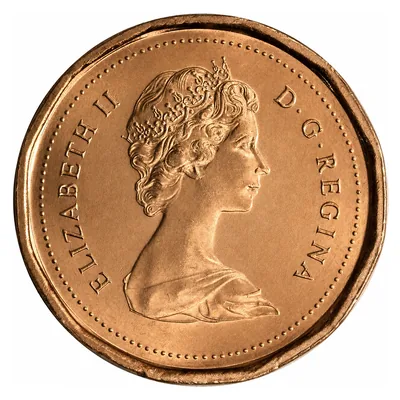
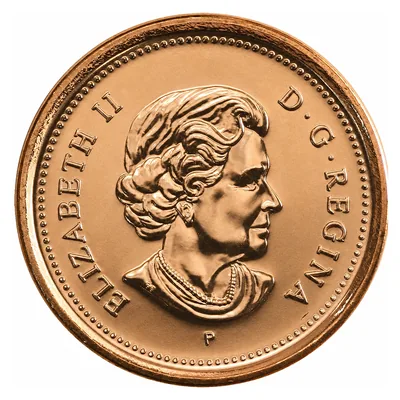
Canada's smallest denomination · 1858–2012
Denomination overview
Canada's one-cent coin began before Confederation, changed size in 1920, adopted its enduring maple-leaf twig in 1937, and moved from bronze to plated zinc and steel before production ended in 2012. This page connects the three verified design-family routes with official technical standards, annual Mint figures, collector landmarks, and the rules that followed withdrawal.
Scope: principal federal design families, official Mint specifications, and annual mintages from 1908 through 2012. Earlier annual rows, prices, population estimates, and unverified varieties are not invented.
One denomination, four major types, eight technical standards
The useful way to study Canada's cent is to separate design identity from size, shape, composition, portrait, and annual production. Those layers do not always change at the same time.
- Identify the reverse family first — The large-cent vine, Fred Lewis two-leaf small cent, Kruger-Gray twig, and 1967 Centennial dove form four stable type-page branches.
- Read production in context — The Mint's annual table begins in 1908. Its 105 rows sum to 35.26 billion pieces, but mintage alone does not measure survival, condition, or scarcity.
- Collect by a declared boundary — A four-coin reverse set, a metal-generation set, or a complete date run are different projects. Define the boundary before buying varieties or high-grade examples.
A small coin carried 154 years of monetary change
The Province of Canada issued decimal one-cent pieces in 1858 and 1859, before Confederation. The Royal Mint in London made ten million of them, more than the market needed while older copper tokens still circulated, so the new Dominion did not issue another cent until 1876. The official denomination is the cent; “penny” is the durable Canadian nickname rather than the legal unit.
Canadian production began at the Ottawa branch of the Royal Mint in 1908, with the first Ottawa one-cent piece struck at the branch opening on January 2. The facility became the Royal Canadian Mint in 1931. Rising copper costs drove the most visible physical break in 1920: a large 5.67-gram format gave way to a 3.24-gram small cent, and both sizes belong to that transition year.
Design modernisation in 1937 made G.E. Kruger-Gray's two-leaf twig the denomination's enduring symbol. Alex Colville's rock dove replaced it for the 1967 Centennial. The familiar twig later moved onto a 12-sided coin in 1982, returned to a round form with a copper-plated zinc core in 1997, and continued through the plated-steel era introduced in 2000.
Economics ended production. The Mint stopped making circulation cents in May 2012; the ceremonial final coin was struck in Winnipeg on May 4. Distribution ended on February 4, 2013. Existing cents retained their value, electronic payments continued to settle to the exact cent, and only the final total of a cash transaction became subject to five-cent rounding.
- 1858 · First decimal cent — The Province of Canada introduced the one-cent denomination before Confederation.
- 1876 · Dominion issue resumes — After the oversized 1858–1859 supply, federal cent production returned.
- 1908 · Ottawa begins — Canada's first locally made cent was struck when the Ottawa branch opened.
- 1920 · Large and small in one year — Copper economics produced a reduced 19.05 mm, 3.24 g format.
- 1936 · Dot emergency coin — A small dot marked coins prepared in 1937 with the old date; the cent examples were not issued.
- 1937 · Maple-leaf twig — Kruger-Gray's reverse established the design identity carried to the end.
- 1967 · Centennial dove — Alex Colville's rock dove became the only issued break in the twig reverse.
- 1982 · Dodecagonal form — Twelve sides improved tactile distinction for visually impaired users.
- 1997–2000 · Plated-metal transition — A round zinc-core cent arrived in 1997; steel-based production followed from 2000, with zinc also noted.
- 2012–2013 · Production and distribution end — Minting ended in 2012 and cash rounding began when distribution ceased in 2013.
The visual catalog is broader than a single maple-leaf cent
Portraits changed with the reigning monarch, but the reverse supplies the clearest first division. Each card links to an existing verified type page when the catalog has one.
- Large cent · maple-leaf vine · 1858–1911 · L.C. Wyon — ONE CENT and the date sit within a beaded circle, surrounded by maple leaves carried on a winding vine.
- Large cent · revised vine · 1911–1920 · W.H.J. Blakemore — The large-cent reverse retained the vine framework while adding CANADA and adapting the tooling for the George V era.
- Small cent · two maple leaves · 1920–1936 · Fred Lewis — The reduced-diameter coin places ONE CENT between two separate maple leaves with CANADA above and the date below.
- Small cent · maple-leaf twig · 1937–1966, 1968–1981, 1997–2012 · G.E. Kruger-Gray — Two naturalistic maple leaves share a twig; K·G appears to the right. The same reverse identity continued through later round plated-metal generations.
- Centennial cent · rock dove · 1967 · Alex Colville — For Canada's Centennial, a rock dove in flight temporarily replaced the maple-leaf twig and the dates read 1867–1967.
- Maple-leaf twig · 12-sided form · 1982–1996 · G.E. Kruger-Gray — The familiar twig was retained while the edge became subtly dodecagonal to improve tactile distinction for blind and partially sighted users.
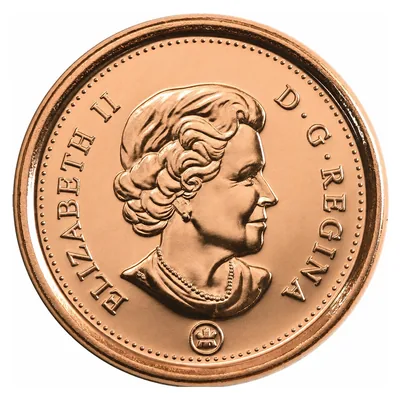
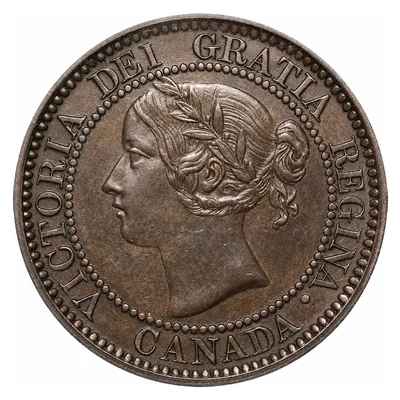
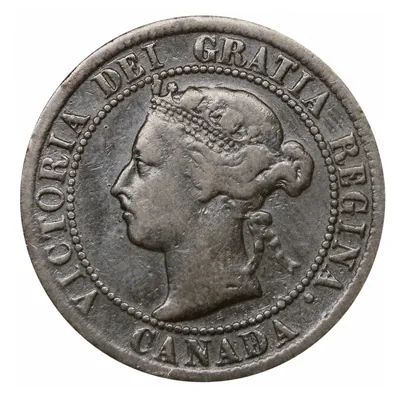
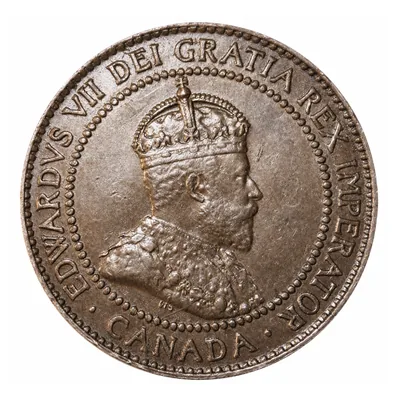
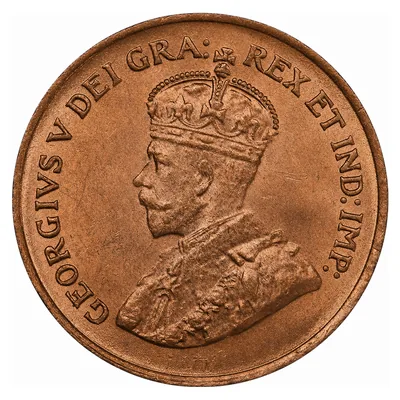
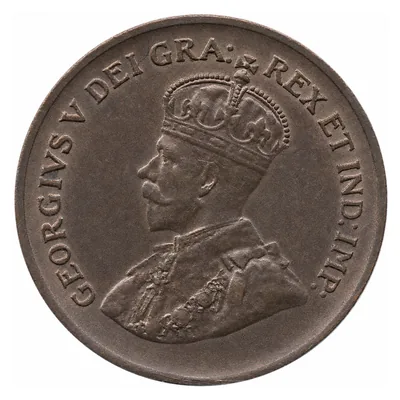
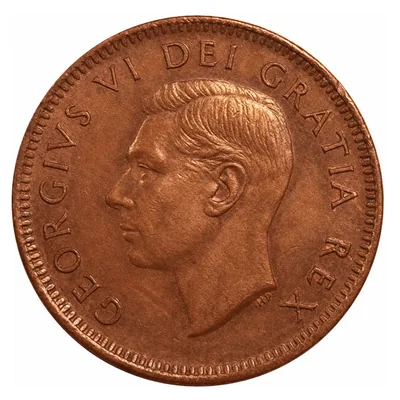
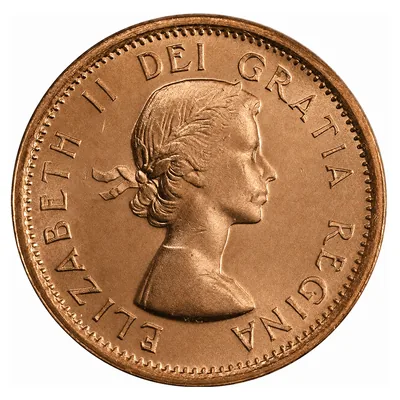
Use the hero only to understand the sequence. For attribution, inspect the actual coin's date, portrait, diameter, shape, edge, weight, metal response, lettering, and designer initials under neutral light.
Production expanded from millions to billion-piece years
The official table provides 105 annual totals from 1908 through 2012. Summed without rounding, those rows equal 35,257,341,680 cents; the Bank of Canada Museum describes the same span as 35 billion.
The 1920 total covers a transition year in which both large and small cents were issued; the Mint table does not split that annual figure by size. No earlier annual row is inferred here.
Dates that change what the coin is—or how carefully it must be verified
These entries represent beginnings, design transitions, unusual production context, and authentication risk. A low annual mintage is not automatically the rarest surviving coin.
- 1858 · First Canadian cent — A pre-Confederation Province of Canada issue and the logical starting point for the denomination's story.
- 1920 · Two physical formats — Both the final large cent and first small cent carry this date; diameter is the immediate dividing test.
- 1936 dot · Three known examples — The Bank of Canada Museum reports that the dot cents were never issued and that three examples are known. Expert authentication is essential.
- 1937 · First maple-leaf twig — The K·G-signed reverse began the design family that lasted, with interruptions and format changes, through 2012.
- 1967 · Centennial rock dove — Alex Colville's bird and dual dates distinguish this national commemorative issue at a glance.
- 1982 · First 12-sided cent — The dodecagonal outline is a functional accessibility change, not a separate denomination.
- 1997 and 2000 · Plated cores — Round zinc-core and later steel-based standards can react differently to magnets and environmental damage.
- 2012 · Last production year — The final strike closed production; February 2013 ended distribution, not the cent's legal value.
The 1936 dot is an emergency-production marker, not a casual “tiny dot” claim
Following George V's death and Edward VIII's abdication, some 1936-dated denominations were prepared in 1937 with a small dot below the date. The one-cent pieces were not released for circulation, and the Museum reports three known examples.
- Confirm the host coin — It must be a genuine 1936 George V small cent of the correct design, size, weight, and metal.
- Locate—not imagine—the marker — The documented dot sits below the centre of the date; corrosion, contact marks, and displaced metal are not enough.
- Require expert authentication — Because the known population is exceptionally small, photographs or seller descriptions alone cannot establish attribution.
Annual one-cent mintages, 1908–2012
Each row reproduces the Royal Canadian Mint's annual total and adds a design/technical context label. Rows do not create unsupported issue pages or grade-value tables.
Mintage is production, not survival. Wear, melting, hoarding, set retention, quality distribution, and authentication determine what collectors encounter.
| Year | Design context | Technical context | Mintage |
|---|---|---|---|
| 1908 | Large bronze cent | 25.4 mm · 5.67 g | 2,401,506 |
| 1909 | Large bronze cent | 25.4 mm · 5.67 g | 3,973,339 |
| 1910 | Large bronze cent | 25.4 mm · 5.67 g | 5,146,487 |
| 1911 | Large bronze cent | 25.4 mm · 5.67 g | 4,663,486 |
| 1912 | Large bronze cent | 25.4 mm · 5.67 g | 5,107,642 |
| 1913 | Large bronze cent | 25.4 mm · 5.67 g | 5,735,405 |
| 1914 | Large bronze cent | 25.4 mm · 5.67 g | 3,405,958 |
| 1915 | Large bronze cent | 25.4 mm · 5.67 g | 4,932,134 |
| 1916 | Large bronze cent | 25.4 mm · 5.67 g | 11,022,367 |
| 1917 | Large bronze cent | 25.4 mm · 5.67 g | 11,899,254 |
| 1918 | Large bronze cent | 25.4 mm · 5.67 g | 12,970,798 |
| 1919 | Large bronze cent | 25.4 mm · 5.67 g | 11,279,634 |
| 1920 | Large bronze cent / Two-maple-leaf small cent | 25.4 mm · 5.67 g / 19.05 mm · 3.24 g | 22,246,170 |
| 1921 | Two-maple-leaf small cent | 19.05 mm · 3.24 g | 7,601,627 |
| 1922 | Two-maple-leaf small cent | 19.05 mm · 3.24 g | 1,243,635 |
| 1923 | Two-maple-leaf small cent | 19.05 mm · 3.24 g | 1,019,022 |
| 1924 | Two-maple-leaf small cent | 19.05 mm · 3.24 g | 1,593,195 |
| 1925 | Two-maple-leaf small cent | 19.05 mm · 3.24 g | 1,000,622 |
| 1926 | Two-maple-leaf small cent | 19.05 mm · 3.24 g | 2,143,372 |
| 1927 | Two-maple-leaf small cent | 19.05 mm · 3.24 g | 3,553,928 |
| 1928 | Two-maple-leaf small cent | 19.05 mm · 3.24 g | 9,144,860 |
| 1929 | Two-maple-leaf small cent | 19.05 mm · 3.24 g | 12,159,840 |
| 1930 | Two-maple-leaf small cent | 19.05 mm · 3.24 g | 2,538,613 |
| 1931 | Two-maple-leaf small cent | 19.05 mm · 3.24 g | 3,842,776 |
| 1932 | Two-maple-leaf small cent | 19.05 mm · 3.24 g | 21,316,190 |
| 1933 | Two-maple-leaf small cent | 19.05 mm · 3.24 g | 12,079,310 |
| 1934 | Two-maple-leaf small cent | 19.05 mm · 3.24 g | 7,042,358 |
| 1935 | Two-maple-leaf small cent | 19.05 mm · 3.24 g | 7,526,400 |
| 1936 | Two-maple-leaf small cent | 19.05 mm · 3.24 g | 8,768,769 |
| 1937 | Maple-leaf-twig small cent | 19.05 mm · 3.24 g | 10,090,231 |
| 1938 | Maple-leaf-twig small cent | 19.05 mm · 3.24 g | 18,365,608 |
| 1939 | Maple-leaf-twig small cent | 19.05 mm · 3.24 g | 21,600,319 |
| 1940 | Maple-leaf-twig small cent | 19.05 mm · 3.24 g | 85,740,532 |
| 1941 | Maple-leaf-twig small cent | 19.05 mm · 3.24 g | 56,336,011 |
| 1942 | Maple-leaf-twig small cent | 19.05 mm · 3.24 g | 76,113,708 |
| 1943 | Maple-leaf-twig small cent | 19.05 mm · 3.24 g | 89,111,969 |
| 1944 | Maple-leaf-twig small cent | 19.05 mm · 3.24 g | 44,131,216 |
| 1945 | Maple-leaf-twig small cent | 19.05 mm · 3.24 g | 77,268,591 |
| 1946 | Maple-leaf-twig small cent | 19.05 mm · 3.24 g | 56,662,071 |
| 1947 | Maple-leaf-twig small cent | 19.05 mm · 3.24 g | 74,949,349 |
| 1948 | Maple-leaf-twig small cent | 19.05 mm · 3.24 g | 25,767,779 |
| 1949 | Maple-leaf-twig small cent | 19.05 mm · 3.24 g | 33,128,933 |
| 1950 | Maple-leaf-twig small cent | 19.05 mm · 3.24 g | 60,444,992 |
| 1951 | Maple-leaf-twig small cent | 19.05 mm · 3.24 g | 80,430,379 |
| 1952 | Maple-leaf-twig small cent | 19.05 mm · 3.24 g | 67,631,736 |
| 1953 | Maple-leaf-twig small cent | 19.05 mm · 3.24 g | 67,806,016 |
| 1954 | Maple-leaf-twig small cent | 19.05 mm · 3.24 g | 22,181,760 |
| 1955 | Maple-leaf-twig small cent | 19.05 mm · 3.24 g | 56,403,193 |
| 1956 | Maple-leaf-twig small cent | 19.05 mm · 3.24 g | 78,685,535 |
| 1957 | Maple-leaf-twig small cent | 19.05 mm · 3.24 g | 100,601,792 |
| 1958 | Maple-leaf-twig small cent | 19.05 mm · 3.24 g | 59,385,679 |
| 1959 | Maple-leaf-twig small cent | 19.05 mm · 3.24 g | 83,615,343 |
| 1960 | Maple-leaf-twig small cent | 19.05 mm · 3.24 g | 75,772,775 |
| 1961 | Maple-leaf-twig small cent | 19.05 mm · 3.24 g | 139,598,404 |
| 1962 | Maple-leaf-twig small cent | 19.05 mm · 3.24 g | 227,244,069 |
| 1963 | Maple-leaf-twig small cent | 19.05 mm · 3.24 g | 279,076,334 |
| 1964 | Maple-leaf-twig small cent | 19.05 mm · 3.24 g | 484,655,322 |
| 1965 | Maple-leaf-twig small cent | 19.05 mm · 3.24 g | 304,441,082 |
| 1966 | Maple-leaf-twig small cent | 19.05 mm · 3.24 g | 183,644,388 |
| 1967 | Centennial rock-dove cent | 19.05 mm · 3.24 g | 345,140,645 |
| 1968 | Maple-leaf-twig small cent | 19.05 mm · 3.24 g | 329,695,772 |
| 1969 | Maple-leaf-twig small cent | 19.05 mm · 3.24 g | 335,240,929 |
| 1970 | Maple-leaf-twig small cent | 19.05 mm · 3.24 g | 344,145,010 |
| 1971 | Maple-leaf-twig small cent | 19.05 mm · 3.24 g | 298,228,936 |
| 1972 | Maple-leaf-twig small cent | 19.05 mm · 3.24 g | 451,304,591 |
| 1973 | Maple-leaf-twig small cent | 19.05 mm · 3.24 g | 457,058,489 |
| 1974 | Maple-leaf-twig small cent | 19.05 mm · 3.24 g | 692,058,489 |
| 1975 | Maple-leaf-twig small cent | 19.05 mm · 3.24 g | 642,618,000 |
| 1976 | Maple-leaf-twig small cent | 19.05 mm · 3.24 g | 701,122,890 |
| 1977 | Maple-leaf-twig small cent | 19.05 mm · 3.24 g | 453,050,666 |
| 1978 | Maple-leaf-twig small cent | 19.05 mm · 3.24 g | 911,170,647 |
| 1979 | Maple-leaf-twig small cent | 19.05 mm · 3.24 g | 753,942,953 |
| 1980 | Maple-leaf-twig small cent | 19 mm · 2.8 g | 911,800,000 |
| 1981 | Maple-leaf-twig small cent | 19 mm · 2.8 g | 1,209,468,500 |
| 1982 | Maple-leaf-twig small cent | 19.1 mm · 2.5 g | 876,036,898 |
| 1983 | Maple-leaf-twig small cent | 19.1 mm · 2.5 g | 975,510,000 |
| 1984 | Maple-leaf-twig small cent | 19.1 mm · 2.5 g | 838,225,000 |
| 1985 | Maple-leaf-twig small cent | 19.1 mm · 2.5 g | 771,772,500 |
| 1986 | Maple-leaf-twig small cent | 19.1 mm · 2.5 g | 788,285,000 |
| 1987 | Maple-leaf-twig small cent | 19.1 mm · 2.5 g | 774,549,000 |
| 1988 | Maple-leaf-twig small cent | 19.1 mm · 2.5 g | 482,676,752 |
| 1989 | Maple-leaf-twig small cent | 19.1 mm · 2.5 g | 1,066,628,200 |
| 1990 | Maple-leaf-twig small cent | 19.1 mm · 2.5 g | 218,035,000 |
| 1991 | Maple-leaf-twig small cent | 19.1 mm · 2.5 g | 831,001,000 |
| 1992 | Maple-leaf-twig small cent | 19.1 mm · 2.5 g | 673,512,000 |
| 1993 | Maple-leaf-twig small cent | 19.1 mm · 2.5 g | 808,585,000 |
| 1994 | Maple-leaf-twig small cent | 19.1 mm · 2.5 g | 639,516,000 |
| 1995 | Maple-leaf-twig small cent | 19.1 mm · 2.5 g | 624,983,000 |
| 1996 | Maple-leaf-twig small cent | 19.1 mm · 2.5 g | 445,746,000 |
| 1997 | Maple-leaf-twig small cent | 19.05 mm · 2.25 g | 549,868,000 |
| 1998 | Maple-leaf-twig small cent | 19.05 mm · 2.25 g | 999,578,000 |
| 1999 | Maple-leaf-twig small cent | 19.05 mm · 2.25 g | 1,089,625,000 |
| 2000 | Maple-leaf-twig small cent | 19.05 mm · 2.35 g | 902,506,000 |
| 2001 | Maple-leaf-twig small cent | 19.05 mm · 2.35 g | 928,434,000 |
| 2002 | Maple-leaf-twig small cent | 19.05 mm · 2.35 g | 830,040,000 |
| 2003 | Maple-leaf-twig small cent | 19.05 mm · 2.35 g | 748,123,000 |
| 2004 | Maple-leaf-twig small cent | 19.05 mm · 2.35 g | 842,486,000 |
| 2005 | Maple-leaf-twig small cent | 19.05 mm · 2.35 g | 767,425,000 |
| 2006 | Maple-leaf-twig small cent | 19.05 mm · 2.35 g | 1,261,883,000 |
| 2007 | Maple-leaf-twig small cent | 19.05 mm · 2.35 g | 846,420,000 |
| 2008 | Maple-leaf-twig small cent | 19.05 mm · 2.35 g | 787,625,000 |
| 2009 | Maple-leaf-twig small cent | 19.05 mm · 2.35 g | 455,680,000 |
| 2010 | Maple-leaf-twig small cent | 19.05 mm · 2.35 g | 486,200,000 |
| 2011 | Maple-leaf-twig small cent | 19.05 mm · 2.35 g | 662,750,000 |
| 2012 | Maple-leaf-twig small cent | 19.05 mm · 2.35 g | 199,347,000 |
Size, weight, shape, and metal changed on different schedules
The Royal Canadian Mint table begins at 1908. Its overlapping 1920 ranges reflect the large-to-small transition. All circulation cents in this series use a plain edge.
1908–1920 · Round
- Composition
- 95.5% copper, 3% tin, 1.5% zinc
- Weight
- 5.67 g
- Diameter
- 25.4 mm
- Thickness
- Not stated
1920–1941 · Round
- Composition
- 95.5% copper, 3% tin, 1.5% zinc
- Weight
- 3.24 g
- Diameter
- 19.05 mm
- Thickness
- 1.65 mm
1942–1977 · Round
- Composition
- 98% copper, 0.5% tin, 1.5% zinc
- Weight
- 3.24 g
- Diameter
- 19.05 mm
- Thickness
- 1.65 mm
1978–1979 · Round
- Composition
- 98% copper, 1.75% tin, 0.25% zinc
- Weight
- 3.24 g
- Diameter
- 19.05 mm
- Thickness
- 1.52 mm
1980–1981 · Round
- Composition
- 98% copper, 1.75% tin, 0.25% zinc
- Weight
- 2.8 g
- Diameter
- 19 mm
- Thickness
- 1.45 mm
1982–1996 · 12-sided
- Composition
- 98% copper, 1.75% tin, 0.25% zinc
- Weight
- 2.5 g
- Diameter
- 19.1 mm
- Thickness
- 1.45 mm
1997–1999 · Round
- Composition
- 98.4% zinc core with 1.6% copper plating
- Weight
- 2.25 g
- Diameter
- 19.05 mm
- Thickness
- 1.45 mm
2000–2012 · Round
- Composition
- 94% steel, 1.5% nickel, 4.5% copper plating; the Mint notes copper-plated zinc was also used
- Weight
- 2.35 g
- Diameter
- 19.05 mm
- Thickness
- 1.45 mm
Five collecting paths from a four-coin sampler to a full date study
Start with stable design and technical transitions before pursuing scarce varieties. Condition and surface originality matter more than bright colour produced by cleaning.
- Four reverse landmarks — Select one large-cent vine, one Fred Lewis two-leaf small cent, one Kruger-Gray twig, and one 1967 dove.
- 1920 transition pair — Place the last large cent beside the first small cent to make the economic redesign immediately visible.
- Eight-standard set — Choose one example for each Mint specification row, including the 12-sided, zinc-core, and steel-based generations.
- Date run by design family — Build within one verified type route first, recording portrait changes and major subtypes separately.
- Documented varieties — Use specialist references and professional authentication; never infer rarity from a dot, die chip, colour, or low mintage alone.
Collector checklist
- Confirm the date, reverse family, monarch portrait, diameter, shape, and plain edge before attribution.
- Weigh and measure a candidate with calibrated tools when a transition year or plated core matters.
- Do not clean copper or plated cents; altered colour and hairlines can permanently reduce numismatic usefulness.
- Treat magnetic response as one clue for later plated-metal generations, not a complete authentication test.
- For 1936 dot claims or other high-risk pieces, require recognized third-party or specialist authentication.
- Use mintage as production context only; compare condition, surfaces, strike, and verified subtype before value references.
Two source conflicts remain visible
The Royal Canadian Mint technical table gives 25.4 mm for 1908–1920 large cents, while the Bank of Canada Museum narrative says the pre-1920 coin shrank from 24.4 mm. This page uses 25.4 mm in the specification table because it is the Mint's explicit technical value and does not silently merge the discrepancy. The Mint denomination page and 2012 report spell the 1911–1920 contributor “Blackmore”; the Royal Mint Museum and another Mint product record identify the resident engraver as W.H.J. Blakemore, the spelling used here.
Primary institutions first
Design, specification, mintage, production, withdrawal, and spelling decisions are tied to the sources below. The visual-reference index supports only the generated hero's identity grounding.
- 1 centRoyal Canadian Mint
One-cent reverse designs, designers, technical generations, annual mintages from 1908 through 2012, and the end of production in 2012.
- Whatever happened to the penny? A history of our one-cent coinBank of Canada Museum
The 1858 introduction, Ottawa production, 1920 size change, 1936 dot coins, design transitions, metal changes, final 2012 strike, withdrawal, and rounded historical production total.
- Australian pattern florinRoyal Mint Museum
W.H.J. Blakemore's name spelling and role as a resident engraver at the Royal Mint.
- One cent coins of CanadaWikimedia Commons
High-resolution, license-documented visual references for the 1858, 1920, 1937, and 1967 reverse identities used to ground the project-owned editorial hero composite.
- Government of Canada and Royal Canadian Mint bid farewell to the Canadian pennyGovernment of Canada
Penny phase-out chronology and final distribution in February 2013.
- A History of the Canadian DollarBank of Canada
Decimal adoption, 1858 coinage, 1870 Dominion coinage, provincial issues, Newfoundland, and mint history.