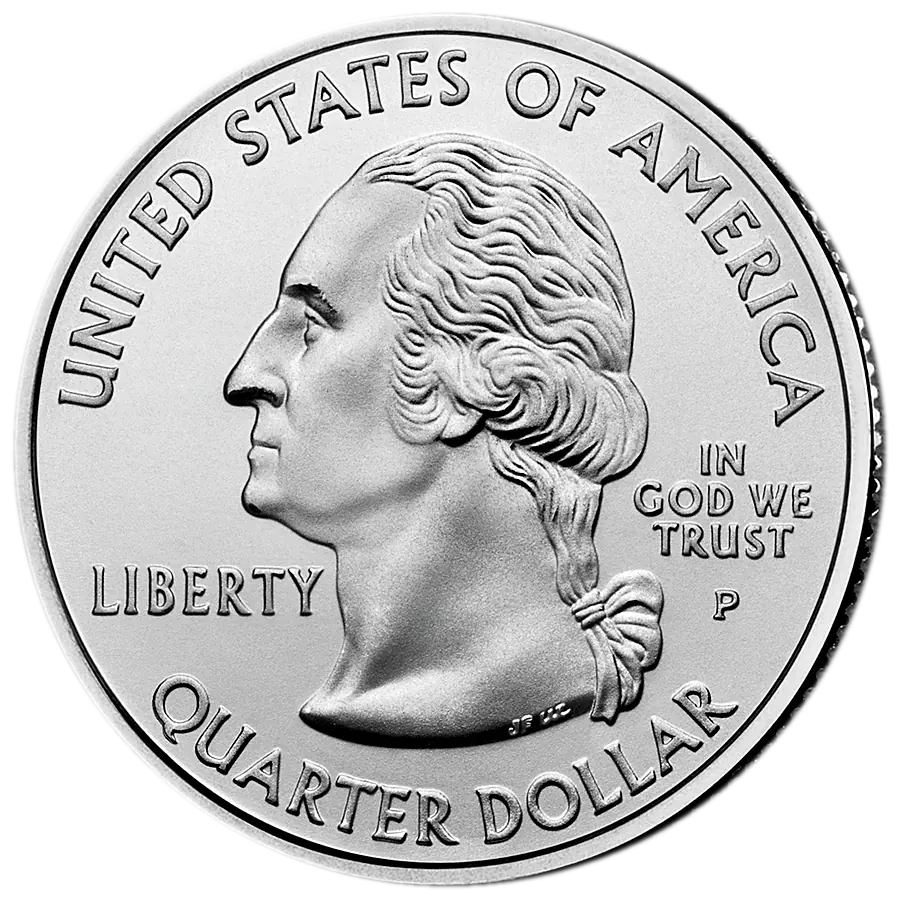
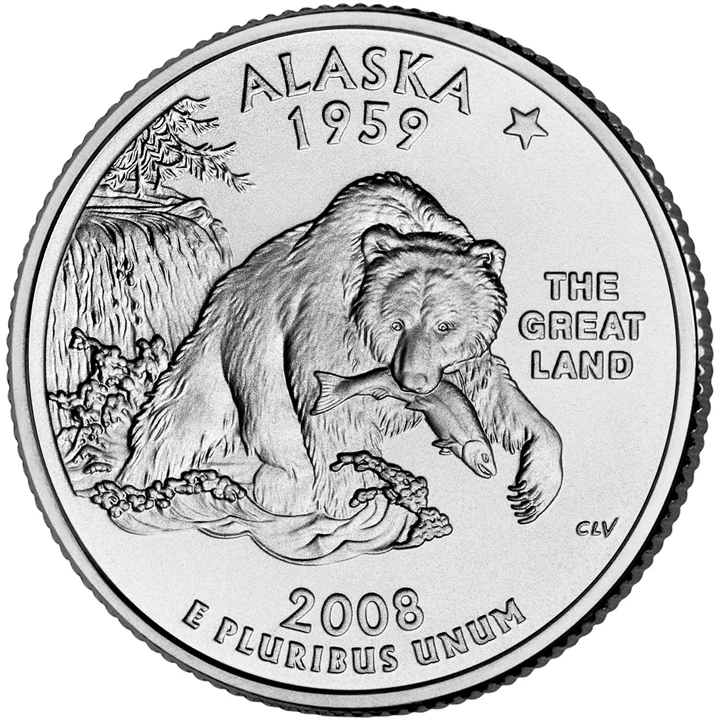
Exact Alaska reverse from the U.S. Mint; shared program obverse.
49 / 50release order
4mint/finish issues
P · D · Smint marks
2008release year
Story in 30 Seconds
The reverse shows a grizzly bear emerging from water with a salmon in its jaw. A North Star stands above THE GREAT LAND; ALASKA, 1959, 2008, and E PLURIBUS UNUM complete the state reverse.
An eleven-member Alaska Commemorative Coin Commission solicited hundreds of public narratives and sent four concepts for Mint artwork. Thousands of comments, including student input, informed Governor Sarah Palin's choice of bear-and-salmon design AK-3.
The Mint says the scene symbolizes Alaska's natural beauty and abundant wildlife. Brown bears and spawning salmon form a real ecological relationship, while the North Star draws on a durable northern and state-flag symbol.
Collectors distinguish P and D circulation strikes from S clad and 90% silver proofs. No Alaska-specific major variety is modeled; extra-claw, extra-water, doubled-star, or hidden-image labels require repeatable die evidence.
Public Law 105-124 ordered state reverses by ratification or admission. Alaska entered the Union on January 3, 1959 as the forty-ninth state, making this the program's forty-ninth design and fourth 2008 release. One reverse cannot encompass Alaska Native nations and cultures, vast coasts and interiors, fisheries, subsistence, oil, mining, military history, cities, villages, climate change, or statehood debates. Bear, salmon, star, and inscription form a selective wildlife-centered identity.
Alaska brown bears and grizzlies are the same species, Ursus arctos; coastal animals with access to spawning salmon are commonly called brown bears, while northern and interior animals are often called grizzlies. Salmon runs concentrate food and move marine nutrients inland. The North Star also appears on Alaska's flag, where designer Benny Benson described it as the future state of Alaska, the Union's northernmost territory.
The bear dominates the relief: its head, shoulder hump, forelegs, and claws break above rippling water while a salmon crosses its jaw. The Mint interprets this encounter as natural beauty and abundant wildlife, not a portrait of one named bear, fish, stream, or waterfall.
The salmon makes abundance active rather than decorative. It links water, seasonal migration, bear feeding, fisheries, and food webs, but the coin does not identify a salmon species or distinguish wild, hatchery, subsistence, sport, or commercial contexts.
The North Star supplies a second scale of meaning. It turns the wildlife scene into a northern emblem and echoes Alaska's flag history; it is symbolic rather than a plotted sky, and the remaining Big Dipper stars are not shown.
World Coin Book interpretation: the bear's diagonal movement and horizontal fish concentrate force at center, radiating water lines imply emergence, and the isolated star opens the upper field. THE GREAT LAND bridges animal action and state identity.
The design emphasizes wildlife abundance, strength, water, and northern scale. It omits Alaska Native stewardship and cultures, human communities, working fisheries, ecological limits, habitat conflict, climate change, resource extraction, and the political complexity of territorial purchase and statehood.
The federal process asked governors for three to five narrative concepts. The Mint screened legality and coinability, created candidate art through staff and Artistic Infusion Program artists, consulted CFA and CCAC, returned approved choices for state recommendation, and the Treasury Secretary retained final approval.
Alaska's 2004 HB 467 established an eleven-member Alaska Commemorative Coin Commission to develop concepts and recommend a final design. Its membership mixed six governor-appointed public members, an arts nominee, a secondary student, and legislative representation; the commission invited public narrative submissions.
Hundreds of submissions produced four Mint candidates: AK-1 polar bear with midnight sun; AK-2 Denali, dog musher, Big Dipper and North Star; AK-3 brown bear with salmon beside a waterfall; and AK-4 gold panner with Denali. The state collected thousands of comments and specifically sought student participation.
CFA recommended AK-1 but asked to replace LAND OF THE MIDNIGHT SUN with THE LAST FRONTIER. CCAC also recommended AK-1, scoring the four designs 22, 15, 8, and 6 of 27 respectively. These federal advisory preferences did not bind the governor or Treasury.
Sarah Palin announced AK-3 on April 26, 2007 after considering statewide comments. A contemporaneous governor letter records Treasury approval on May 25, 2007. The issued design changed the candidate's brown-bear wording to the Mint's grizzly description and retained THE GREAT LAND, North Star, salmon, water, and waterfall setting.
Procedures varied by state and changed during the program; each researched state page must document its actual path.
Alternative Designs
Four documented candidates offered a polar bear under the midnight sun; Denali with a dog musher and Alaska-flag stars; the issued bear, salmon, and waterfall; or a gold panner before Denali. CFA and CCAC preferred the polar-bear design, while statewide comments informed the governor's choice of AK-3. Candidate-art rights, individual artist assignments, full comment totals, rankings, and revision files are incomplete, so no reconstructed gallery is published.
Use the complete text cards below as the keyboard and screen-reader equivalent of the image.
Grizzly bear
Official explanation: The Mint identifies a grizzly emerging from water and says the design symbolizes Alaska's natural beauty and abundant wildlife.
Historical context: Brown bears and grizzlies are the same species; naming varies with geography and ecology, so the relief should not be treated as a diagnosed subspecies or individual.
World Coin Book interpretation: World Coin Book interpretation: the high shoulder, forward head, and raised forelegs make strength and emergence the visual center.
Official explanation: The Mint identifies a salmon clutched in the bear's jaw; candidate records place the animal beside a waterfall.
Historical context: Spawning salmon are a seasonally abundant food for many Alaska brown bears, but the relief names no species, run, or watershed.
World Coin Book interpretation: World Coin Book interpretation: the fish forms a bright horizontal bar across the bear's motion while ripples and falling water establish habitat.
Official explanation: The Mint identifies the North Star above the inscription THE GREAT LAND.
Historical context: The North Star echoes Alaska's flag, where Benny Benson associated it with the future state and the far north; the coin does not reproduce the full flag.
World Coin Book interpretation: World Coin Book interpretation: one isolated star balances the dense bear scene and turns the phrase below into a geographic and aspirational caption.
Official explanation: The reverse bears ALASKA, 1959, 2008, E PLURIBUS UNUM, THE GREAT LAND, SG, and CLV.
Historical context: 1959 records statehood; 2008 is issue year. SG credits designer Susan Gamble and CLV credits sculptor Charles L. Vickers.
World Coin Book interpretation: World Coin Book interpretation: perimeter legends contain the moving scene while the internal phrase and star create a compact state emblem.
Ursus arctos, represented feeding in salmon water rather than as one named animal.
Salmon
A migrating fish and important ecological, cultural, subsistence, and economic presence not identified to species on the coin.
North Star
Northern symbol echoed from Alaska's flag, but shown without the full Big Dipper.
The Great Land
The issued design's state-identity inscription; the page does not claim one settled Indigenous-language derivation.
Alaska Commemorative Coin Commission
Eleven-member statutory body that solicited concepts and advised the governor.
Sarah Palin
Governor who selected AK-3 after statewide comments.
Susan Gamble and Charles L. Vickers
Artistic Infusion Program designer and U.S. Mint sculptor credited for the issued reverse.
Focused Timeline
Flag adopted
Statehood
Program authorization
State commission
CFA review
CCAC review
State choice
Treasury approval
Federal release
Official Explanation and Interpretation
Artists and relief
John Flanagan's Washington portrait, adapted and sculpted for the program by William Cousins, appears on the shared obverse. Public narratives became four Mint candidates reviewed by CFA, CCAC, Alaska, and Treasury. The Mint's Susan Gamble profile credits her with the Alaska reverse design; Charles L. Vickers translated it into coinage relief and his CLV appears with Gamble's SG. Candidate-by-candidate assignments and the complete model-to-die revision record were not recovered.
P and D are circulation issues. Both S issues were sold in proof products; the silver proof is a distinct 90% silver composition. Mintages are established catalog figures retained with an explicit source-audit limit.
Identification Guide
Identify the reverse by the grizzly with salmon, North Star, and THE GREAT LAND. P, D, or S appears on the obverse near Washington's hair ribbon. P and D are circulation strikes; S coins are proofs. The clad proof has a copper-colored edge core and weighs 5.67 g; the 90% silver proof lacks that stripe and weighs about 6.25 g.
Condition Guide
Inspect the bear's brow, muzzle, shoulder, forelegs and claws; the salmon's body and fins; waterfall, water lines, star points, inscriptions, SG, and CLV. First wear or friction dulls the bear's high shoulder and face, forelegs, fish, and strong water ridges. Weak strike or grease can soften fur, claws, fish details, star, initials, or letters while nearby luster remains.
The open upper field and spaces around the bear reveal contact marks, scuffs, residue, cleaning, and wheel marks; dense fur and water can hide hits. Proofs require checks for hairlines, haze, milk spots, fingerprints, frost breaks, and impaired mirrors. Judge wear, strike weakness, machine doubling, die deterioration, die cracks, and post-mint damage separately.
Mint Errors vs. Damage
The canonical Alaska catalog models no recognized major variety beyond the four normal issues. Seller labels such as extra claw, extra salmon fin, extra water, doubled star, missing star, doubled THE GREAT LAND, hidden face, or hidden animal are not catalog attributions without repeatable die markers and specialist documentation.
Genuine mint errors can include off-center strikes, broadstrikes, clips, wrong planchets, struck-through material, retained cuds, or substantial die cracks. Authentication requires mint-made geometry, metal flow, weight, and repeatable evidence rather than accidental shapes in fur or water.
Weak strike or grease may soften claws, salmon, water, star points, dates, SG, CLV, or letters. Machine doubling and die deterioration can create flat shelf-like outlines; these are not automatically doubled dies. Raised lines may be die cracks, while incuse lines crossing relief are usually scratches.
Scratches, gouges, dents, flattened rims, dryer damage, glue, corrosion, plating disturbance, polishing, paint, heat color, and carving are post-mint damage. A contact mark near a claw does not create a biological extra claw; aftermarket color is not a Mint issue, and pareidolia is not a variety.
Why Collectors Care
Durable value tiers
Ordinary worn P and D examples generally occupy the face-value design-set tier. Better circulation coins attract interest through full luster, clean open fields, crisp bear fur and claws, complete salmon and star, sharp inscriptions, and legible SG and CLV. Clad proofs form a collector-product tier; silver proofs add 90% silver as a separate composition tier. Unsupported extra-claw, doubled-star, or hidden-image labels and aftermarket color do not create a reliable premium. Compare dated completed transactions for the exact mint, finish, grade, surfaces, and authenticated error status.
Official law and U.S. Mint records establish program facts and image identity. World Coin Book separates official explanation, historical analysis, and editorial interpretation.
Official descriptions, historical context, and World Coin Book interpretation are labeled separately. No live prices are asserted. Last verified:
The commission's complete appointment record, meetings, minutes, attendance, screening rubric, intermediate shortlist, scores, and preserved submission corpus were not recovered.
The state record says hundreds of submissions and thousands of comments; exact accepted totals, candidate-by-candidate rankings, eligibility, duplicate controls, geographic distribution, and legal weight were not recovered from a primary tabulation.
The signed commission recommendation, governor approval instrument, Treasury approval instrument, and complete state-to-Mint correspondence remain unavailable; May 25, 2007 comes from the governor's contemporaneous release letter.
Candidate-by-candidate artist assignments, intermediate models, inscription changes, and the complete design-to-die revision record were not recovered.
The reviewed record does not establish consultation with Alaska Native nations or organizations about the finalist concepts or THE GREAT LAND wording.
The relief does not identify a bear population, salmon species, waterfall, stream, watershed, season, North Star orientation, or exact source image.
The Mint calls the animal a grizzly, candidate minutes call it a brown bear, and Alaska wildlife guidance explains both are Ursus arctos; the coin itself cannot settle regional naming or subspecies.
No Alaska-specific variety is normalized. Future extra-claw, doubled-star, missing-star, added-water, or hidden-image attribution requires stable die markers and specialist documentation.
Normalized mintages remain established catalog figures; direct annual-production and proof-product evidence should be attached in a future issue-level source audit.