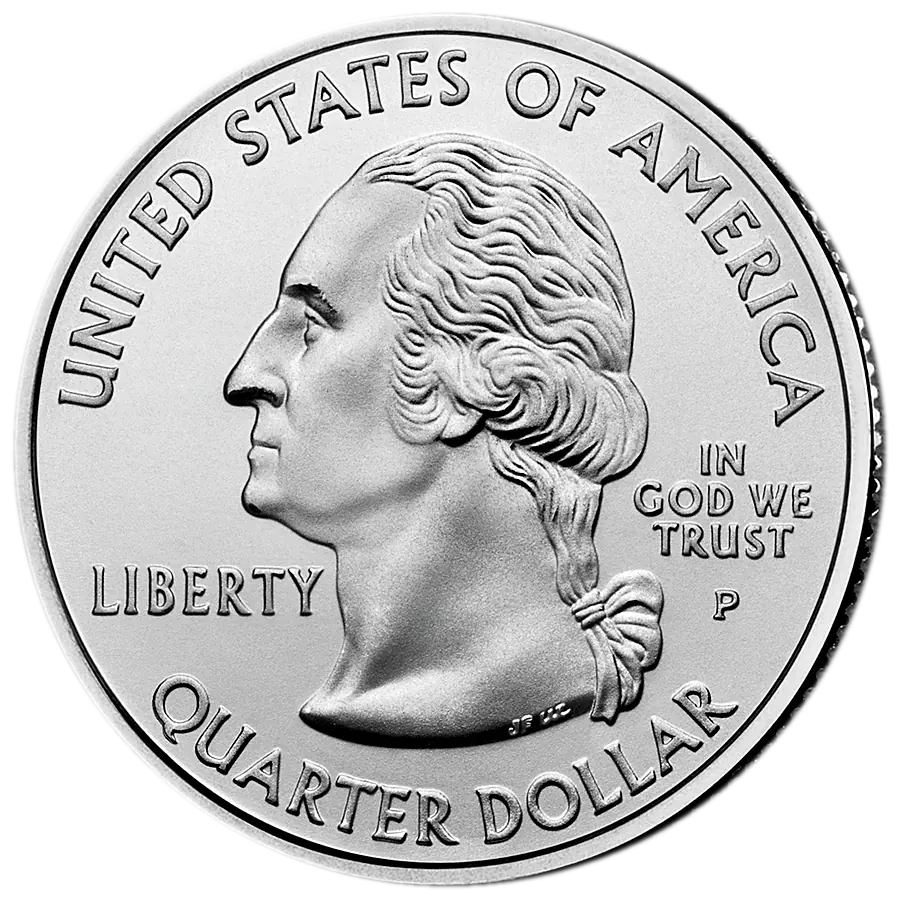
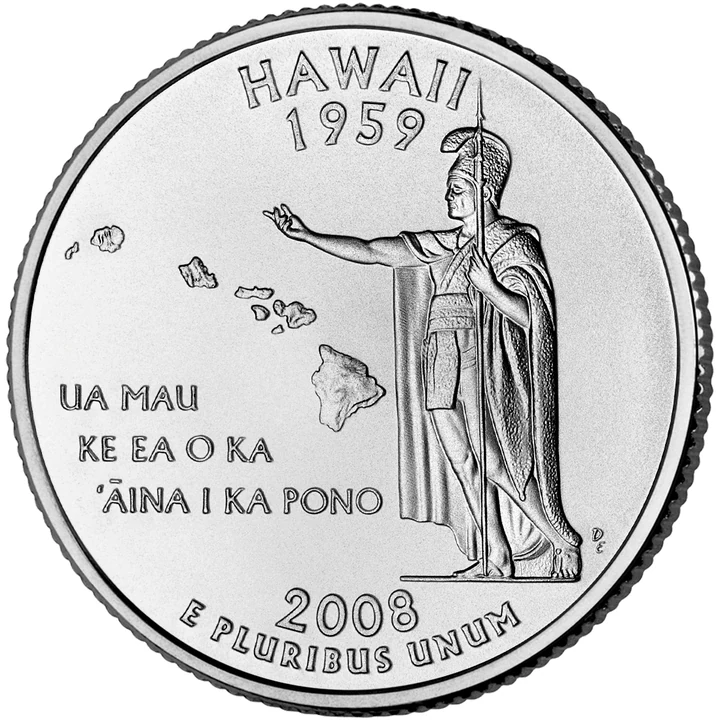
Kamehameha I extends a hand toward the island chain above a motto whose ideas of life, land, sovereignty, and right conduct resist a one-line translation.
Exact Hawaii reverse from the U.S. Mint; shared program obverse.
50 / 50release order
4mint/finish issues
P · D · Smint marks
2008release year
Story in 30 Seconds
The reverse shows King Kamehameha I extending his right hand toward an outline of the eight major Hawaiian Islands. UA MAU KE EA O KA ʻĀINA I KA PONO, HAWAII, 1959, 2008, and E PLURIBUS UNUM complete the design.
A 36-member Hawaiʻi Commemorative Quarter Advisory Commission developed concepts and ranked Mint art. More than 26,000 public votes informed its recommendation, and Governor Linda Lingle unveiled the selected Kamehameha, islands, and motto design on April 23, 2007.
Kamehameha represents the ruler who unified the islands under one kingdom; the map gives geographic form to that political story. The motto originated with Kamehameha III after restoration of the Hawaiian Kingdom government in 1843, not with Kamehameha I.
Collectors distinguish P and D circulation strikes from S clad and 90% silver proofs. No Hawaii-specific major variety is modeled; alleged extra fingers, doubled islands, missing islands, or hidden images need repeatable die evidence.
Public Law 105-124 ordered reverses by ratification or admission. Hawaii entered the Union on August 21, 1959 as the fiftieth state, making this the program's fiftieth and final design and fifth 2008 release. One reverse cannot encompass Native Hawaiian history and sovereignty, every island and community, migration, plantation labor, military occupation, overthrow, annexation, statehood debate, tourism, ecology, or contemporary life. Monarch, map, and motto form a selective political-cultural emblem.
Kamehameha I consolidated rule through warfare and diplomacy, completing unification in 1810 when Kauaʻi's ruler acknowledged his authority. His reign founded the Kingdom of Hawaiʻi amid profound Indigenous political change and growing foreign contact. The motto was proclaimed by Kamehameha III after Britain restored his government on July 31, 1843; ea can carry meanings of life, breath, rule, sovereignty, and independence, while ʻāina is land that feeds. The Mint supplies the conventional English translation, but it is not exhaustive.
Kamehameha's standing figure is based on the familiar heroic statue tradition: feathered cloak and helmet, spear in his left hand, right arm extended. The Mint identifies him as the Hawaiian monarch who unified governance of the islands in the early nineteenth century; the coin is an emblem, not a literal scene of one treaty or battle.
The eight-island outline turns the gesture into a geographic relationship. It recognizes Hawaiʻi, Maui, Kahoʻolawe, Lānaʻi, Molokaʻi, Oʻahu, Kauaʻi, and Niʻihau at coin scale, but cannot represent the full archipelago, island size, spacing, communities, or distinct histories with map precision.
UA MAU KE EA O KA ʻĀINA I KA PONO links the state coin to the Hawaiian Kingdom's Restoration Day history. The Mint translates it as THE LIFE OF THE LAND IS PERPETUATED IN RIGHTEOUSNESS; World Coin Book retains the Hawaiian and notes that ea also carries political meanings obscured by a single English gloss.
World Coin Book interpretation: the king's vertical body anchors the left, his arm and spear create opposing diagonals, and the islands rise through the open right field. The motto forms a dense base, making words—not scenery—the design's visual foundation.
The design emphasizes Native Hawaiian monarchy, political unity, geography, Hawaiian language, and a statehood date. It omits the violence and diplomacy of unification, the overthrow and annexation of the Kingdom, contested meanings of statehood and sovereignty, women and other leaders, the smaller Northwestern Hawaiian Islands, and present-day Native Hawaiian life.
The federal process asked governors to develop three to five concepts. The Mint screened legality and coinability, made candidate art, consulted CFA and CCAC, returned approved choices for state recommendation, and the Treasury Secretary retained final approval.
The Hawaiʻi Commemorative Quarter Advisory Commission included 36 leaders and students from across the state and was chaired by Jonathan Johnson of the State Foundation on Culture and the Arts. Its earlier plan was to submit concepts to the Mint, rank Mint-approved designs, and advise Governor Linda Lingle.
Five federal alternatives followed: surfer with Diamond Head and ALOHA; hula dancer, islands, and ALOHA; Diamond Head with Thomas Gould's Kamehameha statue and ALOHA; and two configurations of Kamehameha, islands, and the state motto.
CFA found none strong and recommended simplifying HI-3 to Diamond Head alone, removing Kamehameha and palms. CCAC instead recommended HI-3 with Kamehameha and Diamond Head, giving it 25 of 27 points; HI-4 received 10, while HI-1, HI-2, and HI-5 received 0, 1, and 1.
The state commission and more than 26,000 public votes supported the Kamehameha, eight islands, and motto concept. Lingle unveiled the final choice on April 23, 2007. The reviewed records establish public participation and the governor's choice, but not a complete certified candidate-by-candidate vote table or Treasury approval date.
Procedures varied by state and changed during the program; each researched state page must document its actual path.
Alternative Designs
Five documented candidates offered a surfer and Diamond Head; a hula dancer and islands; Kamehameha with Diamond Head; or two arrangements of Kamehameha, islands, and motto. CFA recommended Diamond Head alone, CCAC preferred the Kamehameha-and-Diamond Head design, and Hawaii's commission and public process supported the issued monarch-map-motto concept. Candidate-art rights, individual assignments, exact public totals by design, and full revisions remain incomplete, so no reconstructed gallery is published.
Use the complete text cards below as the keyboard and screen-reader equivalent of the image.
King Kamehameha I
Official explanation: The Mint identifies the Hawaiian monarch extending his hand toward the eight major islands and credits him with unifying governance of the islands.
Historical context: Unification was achieved through warfare and diplomacy by 1810; the statue-like image should not turn that complex history into a bloodless legend.
World Coin Book interpretation: World Coin Book interpretation: the extended hand directs attention from one ruler toward the island chain, visually joining person, government, and geography.
Official explanation: The Mint identifies the outline as the eight major Hawaiian Islands toward which Kamehameha reaches.
Historical context: The compact map is symbolic: it excludes the Northwestern Hawaiian Islands and cannot preserve true area, distance, orientation, or each island's distinct history.
World Coin Book interpretation: World Coin Book interpretation: the ascending chain balances the king's mass and turns empty field into connected territory.
Official explanation: The Mint identifies the inscription as the state motto and translates it as “The life of the land is perpetuated in righteousness.”
Historical context: Kamehameha III proclaimed the words after restoration of his government in 1843. Ea can include sovereignty or rule as well as life; the motto is not a quotation from Kamehameha I.
World Coin Book interpretation: World Coin Book interpretation: the long Hawaiian inscription anchors the image and asks readers to interpret land, governance, and pono together.
Founder and first ruler of the unified Kingdom of Hawaiʻi; represented through a familiar statue-like image.
Eight major Hawaiian Islands
Hawaiʻi, Maui, Kahoʻolawe, Lānaʻi, Molokaʻi, Oʻahu, Kauaʻi, and Niʻihau, compressed into a symbolic outline.
Ua Mau ke Ea o ka ʻĀina i ka Pono
Kingdom-era proclamation and state motto whose ea includes life and political sovereignty beyond the Mint's concise translation.
Hawaiʻi Commemorative Quarter Advisory Commission
Thirty-six-member body of leaders and students that developed concepts and advised the governor.
Linda Lingle
Governor who selected and unveiled the issued concept after commission advice and public voting.
Don Everhart
U.S. Mint sculptor-engraver credited as designer and sculptor of the issued reverse.
Focused Timeline
Kingdom unified
Government restored
Statehood
Program authorization
State development
CFA review
CCAC review
State choice
Federal release
Official Explanation and Interpretation
Artists and relief
John Flanagan's Washington portrait, adapted and sculpted for the program by William Cousins, appears on the shared obverse. State concepts became five Mint alternatives reviewed by CFA, CCAC, Hawaii's commission, the public, the governor, and Treasury. The Mint credits Don Everhart as both designer and sculptor of the issued reverse; his DE appears at the king's feet. Candidate-by-candidate assignments and the full model-to-die revision record were not recovered.
P and D are circulation issues. Both S issues were sold in proof products; the silver proof is a distinct 90% silver composition. Mintages are established catalog figures retained with an explicit source-audit limit.
Identification Guide
Identify the reverse by Kamehameha, the eight-island outline, and the Hawaiian motto. P, D, or S appears on the obverse near Washington's hair ribbon. P and D are circulation strikes; S coins are proofs. The clad proof has a copper-colored edge core and weighs 5.67 g; the 90% silver proof lacks that stripe and weighs about 6.25 g.
Condition Guide
Inspect Kamehameha's face, helmet crest, shoulder and cloak folds, extended hand and fingers, spear, island edges, motto, dates, and DE. First wear or friction dulls the face, shoulder, forearm, hand, cloak ridges, and broad island relief. Weak strike or grease can soften fingers, spear, small islands, diacritics, DE, or letters while nearby luster remains.
The open field around the islands and king reveals contact marks, scuffs, residue, cleaning, and wheel marks; cloak texture and lettering can hide hits. Proofs require checks for hairlines, haze, milk spots, fingerprints, frost breaks, and impaired mirrors. Judge wear, strike weakness, machine doubling, die deterioration, die cracks, and post-mint damage separately.
Mint Errors vs. Damage
The canonical Hawaii catalog models no recognized major variety beyond the four normal issues. Seller labels such as extra finger, doubled hand, doubled spear, extra island, doubled island, missing island, doubled motto, missing ʻokina, hidden face, or hidden animal are not catalog attributions without repeatable die markers and specialist documentation.
Genuine mint errors can include off-center strikes, broadstrikes, clips, wrong planchets, struck-through material, retained cuds, or substantial die cracks. Authentication requires mint-made geometry, metal flow, weight, and repeatable evidence.
Weak strike or grease may soften fingers, spear, small islands, motto letters, ʻokina, dates, or DE. Machine doubling and die deterioration create flat shelf-like outlines; these are not automatically doubled dies. Raised lines may be die cracks; incuse lines are usually scratches.
Scratches, dents, flattened rims, dryer damage, glue, corrosion, plating disturbance, polishing, paint, heat color, and carving are damage. The small islands and dense motto are intentional design challenges; added color is aftermarket, and pareidolia is not a variety.
Why Collectors Care
Durable value tiers
Ordinary worn P and D examples generally occupy the face-value design-set tier. Better circulation coins attract interest through full luster, clean open fields, a crisp face, hand, spear and cloak, complete small islands, and a legible motto and DE. Clad proofs form a collector-product tier; silver proofs add 90% silver as a separate composition tier. Unsupported error labels or aftermarket color do not create a reliable premium. Compare dated completed transactions for the exact mint, finish, grade, surfaces, and authenticated error status.
Official law and U.S. Mint records establish program facts and image identity. World Coin Book separates official explanation, historical analysis, and editorial interpretation.
Official descriptions, historical context, and World Coin Book interpretation are labeled separately. No live prices are asserted. Last verified:
The commission's complete appointment record, meetings, minutes, attendance, screening rubric, original concept corpus, intermediate shortlist, and scores were not recovered.
The official state report says more than 26,000 public votes informed the selection, but a certified candidate-by-candidate tally, eligibility rules, duplicate controls, geographic distribution, and legal weight were not recovered.
The signed commission recommendation, governor approval instrument, Treasury approval instrument, approval date, and complete state-to-Mint correspondence remain unavailable.
The reviewed record does not establish consultation with Native Hawaiian governing, cultural, or language organizations about Kamehameha, the map, or motto treatment.
Candidate-by-candidate artist assignments, intermediate models, changes between HI-4 or HI-5 and the issued relief, and the complete model-to-die revision record were not recovered.
The Mint calls the shape the eight major islands, but the relief does not label individual islands, preserve map scale, or represent the Northwestern Hawaiian Islands.
The Mint's English motto translation is retained as official wording, while ea, ʻāina, and pono carry broader linguistic, historical, and political meanings; no single gloss is presented as exhaustive.
No Hawaii-specific variety is normalized. Future extra-finger, doubled-island, missing-island, altered-motto, or hidden-image attribution requires stable die markers and specialist documentation.
Normalized mintages remain established catalog figures; direct annual-production and proof-product evidence should be attached in a future issue-level source audit.