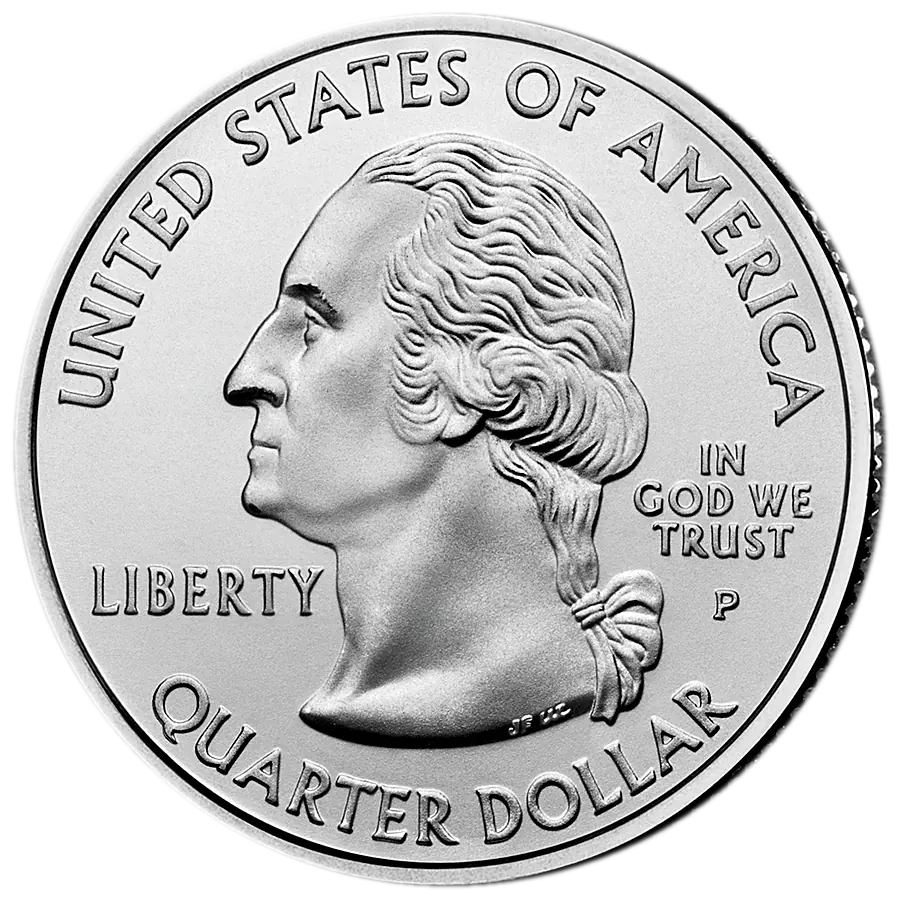
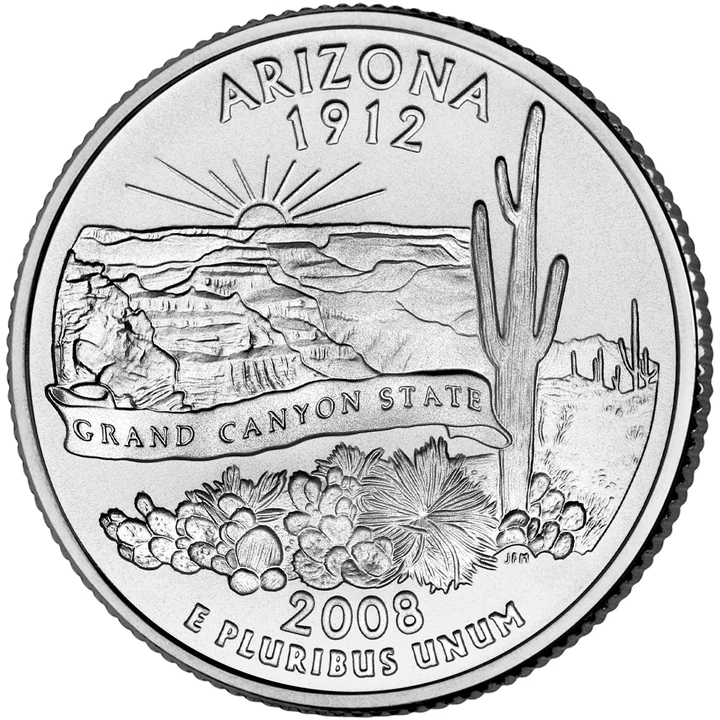
Exact Arizona reverse from the U.S. Mint; shared program obverse.
48 / 50release order
4mint/finish issues
P · D · Smint marks
2008release year
Story in 30 Seconds
The reverse shows a sunrise over the layered Grand Canyon, a large saguaro and smaller desert plants in the foreground, and a GRAND CANYON STATE banner between them. The Mint says the banner separates the scenes because saguaros do not grow in the Grand Canyon.
Governor Janet Napolitano's Arizona Quarter Commission considered more than 4,200 ideas from 79 communities. Five concepts became Mint designs, and roughly 112,000 online rankings favored the combined canyon-and-saguaro design; the governor selected the public's top-ranked choice.
The design joins Arizona's best-known nickname and northern canyon landscape with a Sonoran Desert plant whose blossom is the state flower. It communicates geographic breadth through juxtaposition, not one literal viewpoint.
Collectors distinguish P and D circulation strikes from S clad and 90% silver proofs. No Arizona-specific major variety is modeled; alleged extra cactus arms, doubled banners, added rocks, or hidden figures need repeatable die evidence.
Public Law 105-124 ordered reverses by ratification or admission. Arizona entered the Union on February 14, 1912 as the forty-eighth state, making this the program's forty-eighth design and third 2008 release. One reverse cannot encompass sovereign Tribal nations, canyon country, Sonoran deserts, plateaus, rivers, borderlands, mines, ranches, farms, cities, migration, or modern communities. Canyon, cactus, and banner form a recognizable but deliberately compressed identity.
Grand Canyon lies in northern Arizona, where the Colorado River and tributaries cut through uplifted Colorado Plateau rock; the modern canyon-and-river system developed over millions of years. Saguaros belong to the Sonoran Desert farther south and at lower elevations, and their white blossoms are Arizona's state flower. Eleven contemporary tribes have cultural links to Grand Canyon. The coin's two-scene emblem is therefore neither one habitat nor an empty wilderness.
The Grand Canyon supplies monumental scale through stacked cliffs, a distant sun, and a deep central opening. It carries the official nickname and the state's most internationally recognizable landscape, but the relief is a generalized panorama rather than an identified overlook, rim, butte, or river mile.
The saguaro supplies a different Arizona: a long-lived Sonoran Desert cactus with an unmistakable column and arms. Its prominence makes desert ecology legible at coin scale, while smaller cacti and vegetation suggest habitat without naming one park or locality.
The banner solves an ecological problem created by combining icons. The Mint explicitly says GRAND CANYON STATE separates the two because saguaros do not grow in Grand Canyon. It is therefore a geographic disclaimer, state nickname, and strong horizontal divider at once.
World Coin Book interpretation: canyon strata and sun create depth above; the dark cactus rises vertically below; the diagonal banner arrests that rise and prevents the eye from reading the foreground as part of the canyon. Large natural forms dominate while perimeter inscriptions contain the scene.
The design emphasizes scenic grandeur, desert distinctiveness, state nickname, and geographic variety. It omits the Colorado River as a clearly readable subject, Grand Canyon's associated Tribes and living communities, the border, water conflict, cities, mining, agriculture, labor, migration, and the ecological limits facing both landscapes.
The federal process asked governors to develop three to five concepts. The Mint screened legality and coinability, made candidate art, consulted CFA and CCAC, returned approved choices for state recommendation, and the Treasury Secretary retained final approval.
Governor Janet Napolitano's Executive Order 2005-27 created a commission including legislators, history and arts representatives, a teacher, a K–12 student, and at least twelve geographically, demographically, and artistically diverse public members. It required procedures for soliciting and reviewing narratives, school participation where possible, public comment on Mint renderings, and a recorded recommendation to the governor.
The governor reported more than 4,200 ideas from 79 communities. The commission narrowed them to five concepts: Grand Canyon; Grand Canyon with saguaro; saguaro and desert; John Wesley Powell's Grand Canyon expedition; and Navajo Code Talkers. Mint artists translated these into five federal candidates.
On January 18, 2007, CFA favored design 1's canyon view and rejected the misleading combination of a non-canyon cactus with GRAND CANYON STATE. On January 23, CCAC also recommended design 1, awarding it 23 of 27 points; the combined design 2 received 9, while designs 3, 4, and 5 received 3, 2, and 1.
Arizona then invited online ranking. The governor's contemporaneous account says roughly 112,000 Arizonans participated and ranked design 2 first. Napolitano selected that public favorite; Treasury approved it, and the issued relief retained the separating banner that answers the advisory boards' geographic concern.
Procedures varied by state and changed during the program; each researched state page must document its actual path.
Alternative Designs
Five documented candidates framed Arizona through a canyon panorama; the issued canyon-and-saguaro composite; a saguaro-centered desert; John Wesley Powell's Colorado River expedition; or Navajo Code Talkers. CFA and CCAC preferred the canyon-only design, while the public ranking favored the composite. Candidate-art rights, individual artist assignments, exact ranking totals by design, commission minutes, and the full revision record remain incomplete, so no reconstructed gallery is published.
Use the complete text cards below as the keyboard and screen-reader equivalent of the image.
Grand Canyon and sun
Official explanation: The Mint identifies the Grand Canyon with the sun above its layered walls.
Historical context: The Colorado River carved through uplifted Colorado Plateau rocks; the relief does not identify one overlook or show the river clearly.
World Coin Book interpretation: World Coin Book interpretation: receding horizontal layers and a small sun create the design's deepest space.
Official explanation: The Mint identifies a saguaro cactus in the foreground with smaller desert vegetation.
Historical context: Saguaros belong to the Sonoran Desert and bear Arizona's state flower; the coin does not identify one plant, age, or locality.
World Coin Book interpretation: World Coin Book interpretation: the large branching silhouette gives the lower field an immediate Arizona signature and vertical counterweight.
Official explanation: The Mint says the banner separates the canyon and cactus to signify that saguaros do not grow in Grand Canyon.
Historical context: The words are Arizona's official nickname and also prevent two separate ecosystems from becoming one false scene.
World Coin Book interpretation: World Coin Book interpretation: the diagonal strip is both caption and compositional hinge, dividing depth above from emblem below.
Official explanation: The reverse bears ARIZONA, 1912, 2008, E PLURIBUS UNUM, GRAND CANYON STATE, and Joseph Menna's JM initials.
Historical context: 1912 records statehood; 2008 is issue year. JM credits the reverse designer and sculptor.
World Coin Book interpretation: World Coin Book interpretation: perimeter legends frame the landscape while the banner carries the strongest internal text.
Northern Arizona canyon landscape carved by the Colorado River and culturally connected to eleven contemporary tribes.
Saguaro cactus
A Sonoran Desert cactus whose white blossom is Arizona's state flower.
Grand Canyon State
Arizona's official nickname and the banner that separates the coin's two ecosystems.
Arizona Quarter Commission
The governor-created body that reviewed public concepts and recommended among Mint designs.
Janet Napolitano
Governor who created the commission and selected the public's top-ranked design.
Joseph Menna
U.S. Mint sculptor-engraver credited with designing and sculpting the issued reverse.
Focused Timeline
Statehood
State flower
Program authorization
State commission
CFA review
CCAC review
State choice
Federal release
Official Explanation and Interpretation
Artists and relief
John Flanagan's Washington portrait, adapted and sculpted for the program by William Cousins, appears on the shared obverse. Public narratives became five Mint candidates reviewed by CFA, CCAC, Arizona, and Treasury. The Mint credits sculptor-engraver Joseph Menna with both designing and sculpting the issued reverse; JM appears in relief. Candidate-by-candidate assignments, intermediate models, and the complete response to geographic criticism were not recovered.
P and D are circulation issues. Both S issues were sold in proof products; the silver proof is a distinct 90% silver composition. Mintages are established catalog figures retained with an explicit source-audit limit.
Identification Guide
Identify the reverse by the Grand Canyon above, large saguaro below, and GRAND CANYON STATE banner between them. P, D, or S appears on the obverse near Washington's hair ribbon. P and D are circulation strikes; S coins are proofs. The clad proof has a copper-colored edge core and weighs 5.67 g; the 90% silver proof lacks that stripe and weighs about 6.25 g.
Condition Guide
Inspect the sun, canyon rims and fine strata, banner folds and letters, saguaro crown and arm tips, smaller plants, dates, E PLURIBUS UNUM, and JM. First wear or friction dulls the cactus high points, banner ridges, and upper canyon edges. Weak strike or grease can soften fine canyon lines, cactus spines and edges, initials, or letters while nearby luster remains.
The open sky and fields around the cactus reveal contact marks, scuffs, residue, cleaning, and wheel marks; dense canyon texture can hide hits. Proofs require checks for hairlines, haze, milk spots, fingerprints, frost breaks, and impaired mirrors. Judge wear, strike weakness, machine doubling, die deterioration, die cracks, and post-mint damage separately.
Mint Errors vs. Damage
The canonical Arizona catalog models no recognized major variety beyond the four normal issues. Seller labels such as extra cactus arm, doubled cactus, doubled banner, extra rock, missing sun, hidden face, hidden animal, or hidden person are not catalog attributions without repeatable die markers and specialist documentation.
Genuine mint errors can include off-center strikes, broadstrikes, clips, wrong planchets, struck-through material, retained cuds, or substantial die cracks. Authentication requires mint-made geometry, metal flow, weight, and repeatable evidence rather than accidental shapes in canyon texture.
Weak strike or grease may soften canyon strata, cactus tips, banner letters, dates, or JM. Machine doubling and die deterioration can create flat shelf-like outlines; these are not automatically doubled dies. Raised lines may be die cracks, while incuse lines crossing relief are usually scratches.
Scratches, gouges, dents, flattened rims, dryer damage, glue, corrosion, plating disturbance, polishing, paint, heat color, and carving are post-mint damage. The banner intentionally crosses the cactus, the two landscapes are intentionally separate, aftermarket color is not a Mint issue, and pareidolia is not a variety.
Why Collectors Care
Durable value tiers
Ordinary worn P and D examples generally occupy the face-value design-set tier. Better circulation coins attract interest through full luster, clean open fields, crisp canyon strata, complete cactus arms and tips, a sharp banner, and legible JM. Clad proofs form a collector-product tier; silver proofs add 90% silver as a separate composition tier. Unsupported cactus, banner, rock, or hidden-image labels and aftermarket color do not create a reliable premium. Compare dated completed transactions for the exact mint, finish, grade, surfaces, and authenticated error status.
Official law and U.S. Mint records establish program facts and image identity. World Coin Book separates official explanation, historical analysis, and editorial interpretation.
Official descriptions, historical context, and World Coin Book interpretation are labeled separately. No live prices are asserted. Last verified:
The commission's complete member roster, appointment record, meetings, minutes, attendance, screening rubric, intermediate shortlist, scores, and preserved 4,200-plus submission corpus were not recovered.
The contemporaneous governor account reports roughly 112,000 online rankings, but a certified result by candidate, percentages, eligibility, duplicate controls, geographic distribution, and legal weight were not recovered.
The signed commission recommendation, governor approval instrument, Treasury final-approval instrument and date, and state-to-Mint correspondence remain unavailable.
Candidate-by-candidate artist assignments, intermediate models, inscription changes, and the complete design-to-die revision record were not recovered.
The reviewed record does not establish consultation with the eleven Grand Canyon-associated Tribes or Navajo Code Talkers concerning the finalist concepts.
The canyon relief does not identify an overlook, named formation, sunrise or sunset direction, specific Colorado River reach, season, or exact source image; the saguaro is also not a named specimen or locality.
The banner resolves the cactus-range problem stated by the Mint, but the full state and Treasury deliberation explaining why the public preference outweighed CFA and CCAC recommendations is unavailable.
No Arizona-specific variety is normalized. Future extra-arm, doubled-banner, missing-sun, added-rock, or hidden-image attribution requires stable die markers and specialist documentation.
Normalized mintages remain established catalog figures; direct annual-production and proof-product evidence should be attached in a future issue-level source audit.