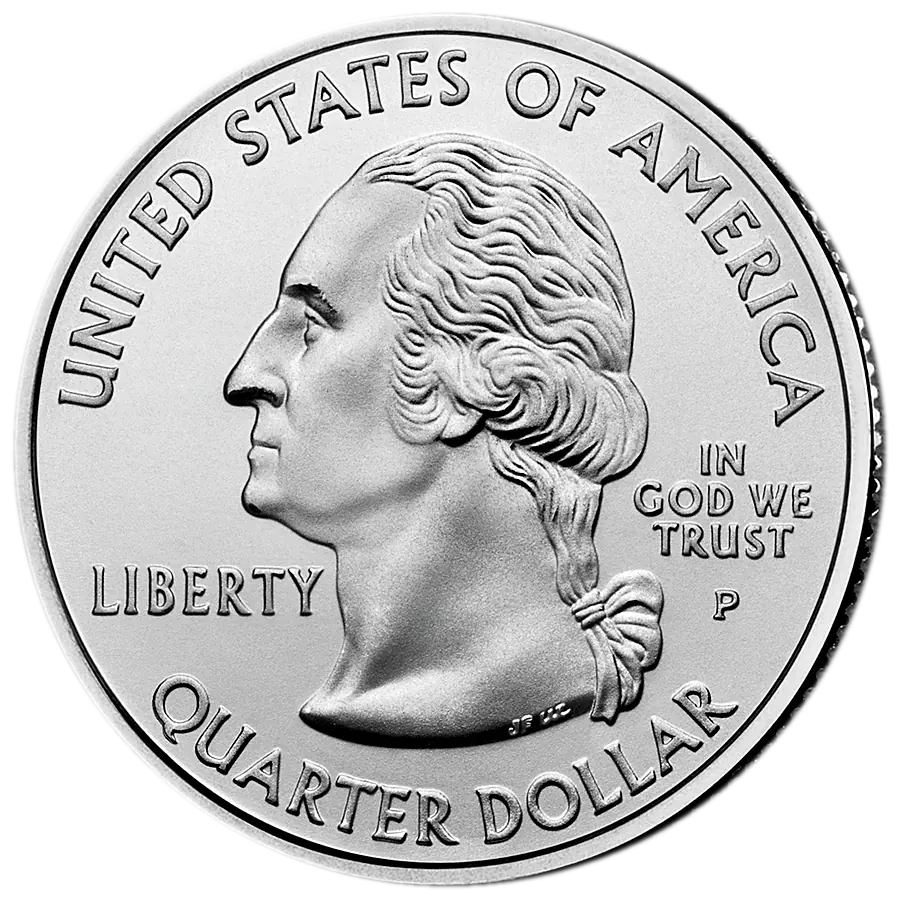
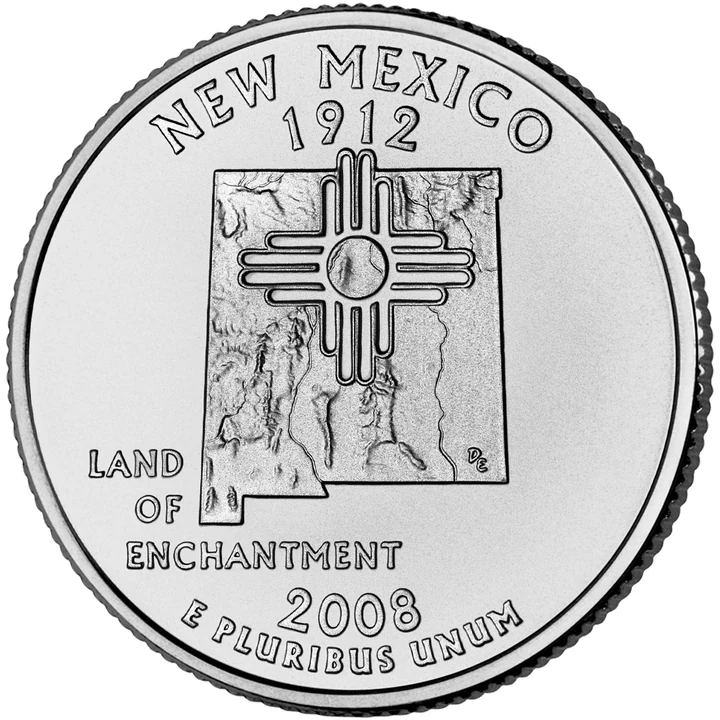
A sacred Zia Pueblo sun symbol crosses a topographical state outline, turning New Mexico's most familiar emblem into a compact—and ethically complex—state portrait.
◆
Zia sun symbol over a topographical outline of New Mexico
Exact New Mexico reverse from the U.S. Mint; shared program obverse.
47 / 50release order
4mint/finish issues
P · D · Smint marks
2008release year
Story in 30 Seconds
The reverse places a sixteen-ray Zia sun symbol over a topographical outline of New Mexico. LAND OF ENCHANTMENT crosses the lower map; NEW MEXICO, 1912, 2008, and E PLURIBUS UNUM frame it.
All four documented Mint alternatives combined the Zia symbol and state outline, showing that the state had already settled on one theme. CFA recommended design 1; CCAC recommended design 3; the issued layout corresponds to design 2's symbol, outline, and nickname.
The symbol comes from Zia Pueblo and carries sacred fourfold meanings. It became New Mexico's dominant public emblem through the 1925 state flag, but broad state and commercial use has also prompted acknowledgment, permission, respect, and reconciliation.
Collectors distinguish P and D circulation strikes from S clad and 90% silver proofs. No New Mexico-specific major variety is modeled; extra rays, doubled maps, missing letters, and alleged hidden images need repeatable die evidence.
Public Law 105-124 ordered reverses by ratification or admission. New Mexico entered the Union on January 6, 1912 as the forty-seventh state, making this the program's forty-seventh design and second 2008 release. A single reverse cannot encompass Zia Pueblo's sovereignty, New Mexico's other Pueblos and Tribal nations, Indigenous and Hispano histories, Spanish and Mexican rule, territorial government, land and water, science, arts, landscapes, or living communities. It chooses one extraordinarily legible emblem and map.
New Mexico's official nickname, Land of Enchantment, appears on the coin. The Secretary of State traces the state flag to a 1923 competition won by physician and archaeologist Harry Mera; Reba Mera made the design, and the legislature adopted it in 1925. Its red Zia sun on yellow adapted a sacred Zia Pueblo symbol into a state emblem. The quarter renders that emblem in metal without the flag's colors.
The issued design is radically spare: symbol, map, nickname. That economy lets the reverse read instantly at 24.3 millimeters and makes it unlike inventory-style quarters crowded with several industries, plants, or events.
Official state explanations connect four groups of four rays with directions, seasons, parts of the day, and stages of life, held together by a circle. Those summaries are public explanations, not permission to detach the symbol from the Zia people or reduce a living sacred tradition to decorative geometry.
The New Mexico Legislature formally acknowledged in 2012 that the symbol is ancient and sacred to the Zia people, recognized its long commercialization by others, and called for collaboration, reconciliation, and mutual respect. The Indian Pueblo Cultural Center's Zia Pueblo-collaborative account likewise stresses origin, knowledge, respectful use, and permission.
World Coin Book interpretation: the upright state shape acts as a quiet field while the horizontal rays cross its narrow waist. LAND OF ENCHANTMENT forms a low band; the circular center becomes the strongest focal point. The design's symmetry and open fields favor recognition over narrative movement.
The reverse communicates state identity through a symbol already ubiquitous on the flag, plates, buildings, and civic design. It omits color, Zia Pueblo as a named sovereign community, the symbol's contested path into state use, every other Indigenous nation, Hispano culture, landscape, people, events, and the state's social and environmental complexity.
The federal process asked governors to develop three to five concepts. The Mint screened legality and coinability, developed art, consulted CFA and CCAC, returned approved choices for a state recommendation, and the Treasury Secretary retained final approval.
The reviewed federal records present four New Mexico designs, all using the Zia sun and state outline. That unanimity showed a clear state preference, but the available official record does not identify a state commission, public-submission program, vote, poll totals, governor's finalist decision, or signed recommendation.
Design 1 centered the largest Zia symbol on a lightly textured raised state. Design 2 placed a textured symbol over the outline and added LAND OF ENCHANTMENT. Designs 3 and 4 used the symbol to mark Santa Fe; design 3 gave the map topographical relief, while design 4 used a textured outline.
On January 18, 2007, CFA recommended design 1 for its large central symbol. On January 23, CCAC recommended design 3 with 16 of 27 points; design 1 received 13, design 4 received 3, and design 2 received 1. Members saw the shared theme as evidence of state preference and liked design 3's topography.
The issued reverse combines the design-2 description with a topographical outline and was designed and sculpted by Don Everhart. The reviewed records do not establish who proposed the original concept, whether Zia Pueblo was consulted or consented, how advisory comments shaped the final model, or the dates and instruments of governor and Treasury approval.
Procedures varied by state and changed during the program; each researched state page must document its actual path.
Alternative Designs
Four documented alternatives stayed within one state-selected theme. Design 1 emphasized the largest centered sacred symbol; design 2 added the nickname; designs 3 and 4 used the symbol as a Santa Fe locator, with different map treatments. CFA and CCAC chose different candidates, and the issued result was neither committee's recommendation as described. They are concept alternatives, not coin varieties; no gallery is reconstructed without cleared candidate-image rights.
Use the complete text cards below as the keyboard and screen-reader equivalent of the image.
Zia sun symbol
Official explanation: The Mint identifies a Zia sun symbol over the state; the Secretary of State explains four groups of four rays around a circle.
Historical context: The symbol is ancient and sacred to the Zia people. State adoption and widespread civic use do not erase that origin or the need for respect and permission.
World Coin Book interpretation: World Coin Book interpretation: crossing rays make the sacred symbol visually dominant while the map becomes its supporting field.
Official explanation: The Mint calls the map a topographical outline of New Mexico.
Historical context: The relief texture suggests terrain but names no mountain, river, Pueblo, city, or region; it is not a precise elevation map.
World Coin Book interpretation: World Coin Book interpretation: the nearly rectangular silhouette anchors the circular symbol and makes state recognition secondary but immediate.
Official explanation: LAND OF ENCHANTMENT is the nickname inscription crossing the lower state outline.
Historical context: It supplies verbal state identity where the colorless relief cannot reproduce the red-and-yellow flag.
World Coin Book interpretation: World Coin Book interpretation: the straight inscription ties the map's sides together and balances the horizontal rays above.
The sovereign Pueblo whose people created and hold the sacred Zia sun symbol.
Zia sun symbol
A circle with four groups of four rays and living sacred meaning, not a generic Southwestern decoration.
New Mexico
The forty-seventh state, represented by a textured topographical outline.
Harry and Reba Mera
Harry's competition design and Reba's made flag helped move the Zia symbol into official state use.
Don Everhart
U.S. Mint sculptor-engraver who designed and sculpted the issued reverse.
CFA and CCAC
Federal advisory bodies that preferred different New Mexico candidates in January 2007.
Focused Timeline
Documented vessel
Flag competition
State flag
Program authorization
CFA review
CCAC review
Federal release
State acknowledgment
Official Explanation and Interpretation
Artists and relief
John Flanagan's Washington portrait, adapted and sculpted by William Cousins, appears on the shared obverse. Mint artists translated the state's single Zia-and-map theme into four relief proposals. The Mint credits sculptor-engraver Don Everhart with both designing and sculpting the issued reverse; DE appears in relief. Candidate artist assignments, intermediate models, Zia Pueblo consultation, and the complete revision path were not recovered.
P and D are circulation issues. Both S issues were sold in proof products; the silver proof is a distinct 90% silver composition. Mintages are established catalog figures retained with an explicit source-audit limit.
Identification Guide
Identify the reverse by the sixteen-ray Zia sun crossing a textured New Mexico outline and LAND OF ENCHANTMENT. P, D, or S appears on the obverse. P and D are circulation strikes; S coins are proofs. The clad proof has a copper-colored edge core and weighs 5.67 g; the 90% silver proof lacks that stripe and weighs about 6.25 g.
Condition Guide
Inspect the central circle, ray ends, map rim and texture, LAND OF ENCHANTMENT, NEW MEXICO, dates, E PLURIBUS UNUM, and DE. First wear dulls the central symbol and highest map texture. Weak strike or grease can soften ray tips, relief texture, initials, or letters while luster survives nearby.
Broad open fields and flat geometry readily show contact marks, scuffs, residue, cleaning, and wheel marks. Proofs require checks for hairlines, haze, milk spots, fingerprints, frost breaks, and impaired mirrors. Separate wear from weak strike, die polishing, machine doubling, die deterioration, cracks, and post-mint damage.
Mint Errors vs. Damage
The canonical New Mexico catalog models no recognized major variety beyond the four normal issues. Seller labels such as extra ray, doubled ray, doubled Zia, doubled map, missing letter, extra mountain, hidden face, or hidden alien are not catalog attributions without repeatable die evidence.
Genuine mint errors can include off-center strikes, broadstrikes, clips, wrong planchets, struck-through material, retained cuds, or substantial die cracks. Authentication requires mint-made geometry, metal flow, weight, and repeatable evidence.
Weak strike or grease may soften ray ends, map texture, LAND OF ENCHANTMENT, DE, or perimeter letters. Machine doubling and die deterioration create flat shelf-like outlines; these are not automatically doubled dies. Raised lines may be die cracks; incuse lines are usually scratches.
Scratches, dents, flattened rims, dryer damage, glue, corrosion, plating disturbance, polishing, paint, heat color, and carving are damage. Sixteen rays and uneven topographical texture are intentional; added color is aftermarket, and pareidolia is not a variety.
Why Collectors Care
Durable value tiers
Ordinary worn P and D examples generally occupy the face-value design-set tier. Better circulation coins attract interest through full luster, clean open fields, complete ray ends, crisp map texture, and legible nickname and DE. Clad proofs form a collector-product tier; silver proofs add 90% silver as a separate composition tier. Unsupported error labels or aftermarket color do not create a reliable premium. Compare dated completed transactions for the exact mint, finish, grade, surfaces, and authenticated error status.
Official law and U.S. Mint records establish program facts and image identity. World Coin Book separates official explanation, historical analysis, and editorial interpretation.
Official descriptions, historical context, and World Coin Book interpretation are labeled separately. No live prices are asserted. Last verified:
The complete state submission corpus, eligibility rules, selection body, meetings, scoring, public outreach, and concept authors were not recovered.
No reviewed official record establishes a New Mexico public vote, poll result, turnout, certification, or legal weight; none is claimed.
The signed governor recommendation, Treasury approval instrument, approval dates, and state-to-Mint correspondence were not recovered.
The four federal candidates share one theme, but the record does not explain who fixed that theme or how it was selected before Mint art development.
The reviewed record does not establish whether Zia Pueblo was consulted, consented, or received acknowledgment during the 2006–2008 coin process.
The issued design resembles design 2 but uses a topographical outline; the complete response to CFA and CCAC comments and intermediate model history remain unavailable.
Candidate-by-candidate artist assignments and revision credits are unavailable; only Don Everhart's issued design-and-sculpt credit is established.
No New Mexico-specific variety is normalized. Future extra-ray, doubled-map, missing-letter, or hidden-image attribution requires stable die markers and specialist documentation.
Normalized mintages remain established catalog figures; direct annual-production and proof-product evidence should be attached in a future issue-level source audit.