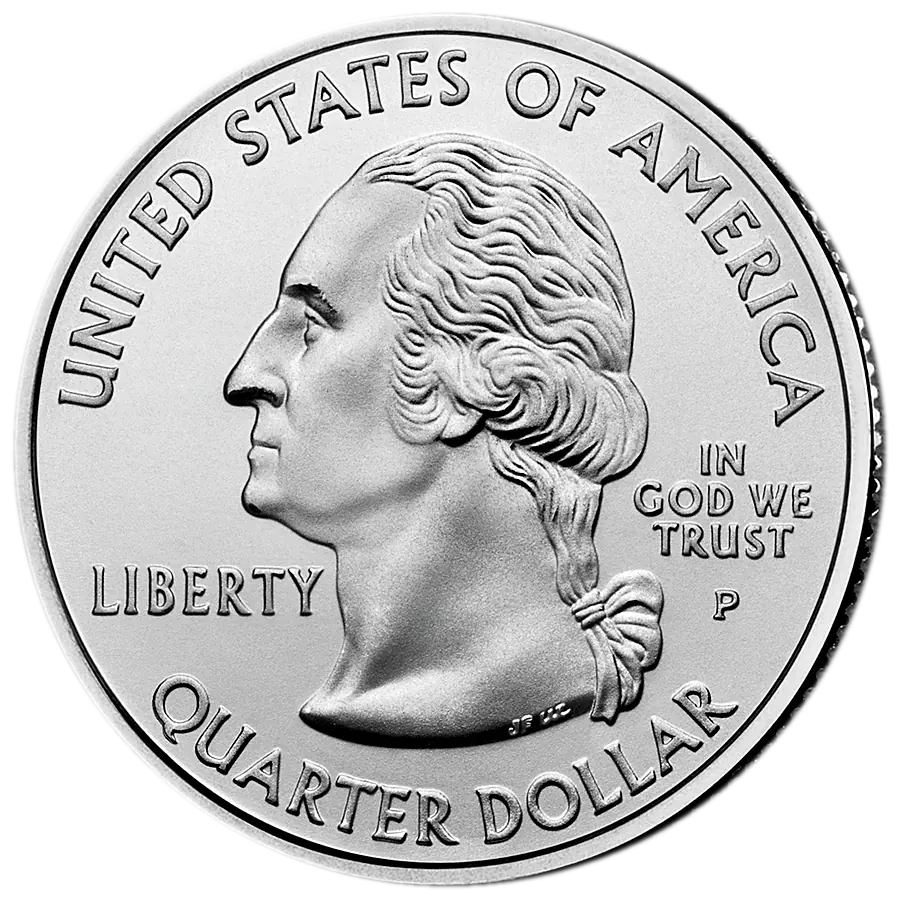
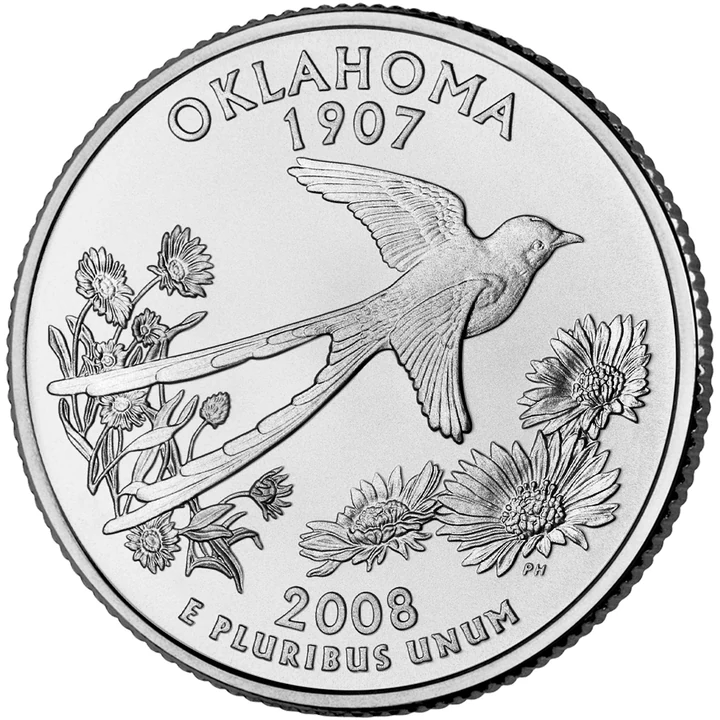
Exact Oklahoma reverse from the U.S. Mint; shared program obverse.
46 / 50release order
4mint/finish issues
P · D · Smint marks
2008release year
Story in 30 Seconds
The reverse shows Oklahoma's state bird, a scissor-tailed flycatcher, in flight above the state wildflower, Indian blanket, with more blossoms filling a prairie-like field. OKLAHOMA, 1907, 2008, and E PLURIBUS UNUM frame the scene.
Oklahoma citizens submitted more than 1,000 concepts. The state reduced them to ten narratives, a citizen vote narrowed those to five, Mint artists developed five designs, and a second statewide vote strongly favored the bird and flowers. Governor Brad Henry recommended that design; Treasury approved it.
CFA also recommended the bird-and-flower design for its beauty and Oklahoma meaning. CCAC found several designs cluttered and instead recommended a state-outline, calumet, and Pioneer Woman composition, so the issued coin was not the unanimous federal-advisory favorite.
Collectors distinguish P and D circulation strikes from S clad and 90% silver proofs. No Oklahoma-specific major variety is modeled; alleged extra tail feathers, doubled flowers, hidden faces, or missing petals require stable die evidence rather than image pareidolia.
Public Law 105-124 ordered reverses by ratification or admission. Oklahoma entered the Union on November 16, 1907 as the forty-sixth state, making this the program's forty-sixth design and first 2008 release. One reverse cannot represent sovereign Tribal nations, Indian Territory and Oklahoma Territory, removals and allotment, Black towns, land runs, agriculture, oil, Dust Bowl migration, cities, arts, or contemporary communities. The natural-emblem design is welcoming but deliberately partial.
The scissor-tailed flycatcher became Oklahoma's state bird in 1951; its long forked tail and summer presence make it a conspicuous plains bird. Indian blanket (Gaillardia pulchella), red with yellow-tipped petals, became the state wildflower in 1986. The Oklahoma Historical Society distinguishes it from the Oklahoma rose, the state flower. 'Sooner State' is contextual identity, not an inscription on this reverse.
The selected reverse avoids a monument, map, or industrial inventory. A native bird moves through a field of native wildflowers, presenting Oklahoma through seasonal life and open space rather than one town or event. The Mint says Indian blanket salutes Native American heritage and the state's wildlife-rich native long-grass prairies.
That official explanation needs a boundary. A flower emblem can acknowledge Native American heritage, but it does not depict or speak for Oklahoma's sovereign Tribal nations, name any people, or tell histories of removal, land loss, survival, government, and living cultures. The coin's prairie is symbolic rather than a botanically mapped place.
Five federal designs offered competing state portraits: a people-and-industries montage; bird and wildflower; windmill, oil derrick, wheat, and Pioneer Woman; a related state-outline industrial composition; and state outline, calumet, and Pioneer Woman. Public voting and the governor favored the least crowded natural emblem.
World Coin Book interpretation: the bird's diagonal body and spread tail supply motion above a dense horizontal flower bed. The pale open field around the wings lets the small quarter read clearly, while repeated circular blooms counter the long angular tail.
The reverse leaves out the Sooner nickname, state motto, tribal names and governments, specific landscape, towns, historic people, oil and agriculture, and difficult territorial history. Its identity rests on recognizable emblems and ecological grace, not a comprehensive account.
The federal process asked governors to develop three to five concepts. The Mint screened legality and coinability, developed art, consulted CFA and CCAC, returned approved choices for a state recommendation, and the Treasury Secretary retained final approval.
Oklahoma's contemporary state account says the process began in February 2006. Citizens submitted more than 1,000 concepts; these became ten narratives. A vote by Oklahoma citizens narrowed the field to five, which went to the Mint for artistic development.
The five designs were: people and industries around a state outline; scissor-tailed flycatcher above Indian blanket and prairie; windmill, oil derrick, wheat, and Pioneer Woman; state outline with oil derrick, Pioneer Woman, and wheat; and state outline divided by a calumet with Pioneer Woman.
On January 18, 2007, CFA recommended design 2. On January 23, CCAC scored design 5 at 21 of 24 and design 2 at 7, preferring the historical-symbol composition while praising design 2's artistry but questioning its historical breadth.
The final Mint renderings returned to Oklahoma for statewide voting. On April 30 Governor Brad Henry announced the bird-and-wildflower recommendation based on the overwhelming citizen vote; Treasury approved it May 25. Reviewed records do not provide exact vote totals, certification controls, ten-narrative text, or complete artist assignments.
Procedures varied by state and changed during the program; each researched state page must document its actual path.
Alternative Designs
Five documented Mint designs combined natural emblems, people and industries, wheat, windmill, oil derrick, state outline, a calumet, and Ponca City's Pioneer Woman statue. CFA selected design 2; CCAC selected design 5. They are alternatives, not coin varieties. No gallery is reconstructed because the reviewed records do not establish image rights or every candidate artist assignment.
Use the complete text cards below as the keyboard and screen-reader equivalent of the image.
Scissor-tailed flycatcher
Official explanation: The Mint identifies Oklahoma's state bird flying with its distinctive tail feathers spread.
Historical context: Oklahoma designated the species its state bird in 1951; its long forked tail gives the bird its common name.
World Coin Book interpretation: World Coin Book interpretation: the long tail and raised wings create the reverse's strongest diagonals and sense of lift.
Official explanation: The Mint describes a field of similar wildflowers and connects it with Oklahoma's native long-grass prairies.
Historical context: The relief is an emblematic habitat, not an identified preserve or exact ecological survey.
World Coin Book interpretation: World Coin Book interpretation: open field around the wings prevents the small relief from becoming as crowded as several rejected designs.
Official explanation: The reverse bears OKLAHOMA, 1907, 2008, E PLURIBUS UNUM, SG, and PH.
Historical context: 1907 records statehood; SG and PH identify designer Susan Gamble and sculptor Phebe Hemphill.
World Coin Book interpretation: World Coin Book interpretation: perimeter legends contain the airborne scene while small credits remain subordinate to bird and flowers.
Oklahoma's 1951 state bird, recognizable by its long forked tail.
Indian blanket
Oklahoma's 1986 state wildflower, shown as a field beneath the bird.
Oklahoma citizens
Participants who supplied concepts and voted in two narrowing stages.
Brad Henry
Governor who announced the state recommendation on April 30, 2007.
Susan Gamble
Artistic Infusion Program artist credited with the reverse design.
Phebe Hemphill
U.S. Mint medallic artist credited with sculpting the reverse.
Focused Timeline
State bird
State wildflower
Program authorization
State process begins
CFA review
CCAC review
Governor recommendation
Treasury approval
Federal release
Official Explanation and Interpretation
Artists and relief
John Flanagan's Washington portrait, adapted and sculpted by William Cousins, appears on the shared obverse. Citizen concepts became ten narratives and then five designs developed by Mint sculptor-engravers and Artistic Infusion Program artists. The Mint credits Susan Gamble as reverse designer and Phebe Hemphill as reverse sculptor; SG and PH appear in relief. Candidate-by-candidate assignments and a complete revision log were not recovered.
P and D are circulation issues. Both S issues were sold in proof products; the silver proof is a distinct 90% silver composition. Mintages are established catalog figures retained with an explicit source-audit limit.
Identification Guide
Identify the reverse by the flying scissor-tailed flycatcher, spread forked tail, Indian blanket flower field, and OKLAHOMA over 1907. P, D, or S appears on the obverse. P and D are circulation strikes; S coins are proofs. The clad proof has a copper-colored edge core and weighs 5.67 g; the 90% silver proof lacks that stripe and weighs about 6.25 g.
Condition Guide
Inspect the bird's head, breast, wing edges, long tail feathers, flower centers and petal tips, legends, SG, and PH. First wear dulls exposed wing, body, tail, and highest flowers. Weak strike or grease can soften feathers, petals, initials, or letters while luster remains elsewhere.
Open fields around the bird reveal contact marks, scuffs, residue, cleaning, and wheel marks. Proofs require checks for hairlines, haze, milk spots, fingerprints, frost breaks, and impaired mirrors. Judge wear, strike weakness, machine doubling, die deterioration, cracks, and post-mint damage separately.
Mint Errors vs. Damage
The canonical Oklahoma catalog models no recognized major variety beyond the four normal issues. Seller labels such as extra tail feather, doubled tail, doubled flower, extra petal, missing petal, hidden face, or hidden bird are not catalog attributions without repeatable die evidence.
Genuine mint errors can include off-center strikes, broadstrikes, clips, wrong planchets, struck-through material, retained cuds, or substantial die cracks. Authentication requires mint-made geometry, metal flow, weight, and repeatable evidence.
Weak strike or grease may soften feathers, flower centers, petals, inscriptions, SG, or PH. Machine doubling and die deterioration create flat shelf-like outlines; these are not automatically doubled dies. Raised lines may be die cracks; incuse lines are usually scratches.
Scratches, dents, flattened rims, dryer damage, glue, corrosion, plating disturbance, polishing, paint, heat color, and carving are damage. The long split tail and crowded flower bed are intentional; colorized blossoms are aftermarket, and pareidolia is not a variety.
Why Collectors Care
Durable value tiers
Ordinary worn P and D examples generally occupy the face-value design-set tier. Better circulation coins attract interest through full luster, clean fields, complete tail feathers, crisp wing and flower detail, and legible SG and PH. Clad proofs form a collector-product tier; silver proofs add 90% silver as a separate composition tier. Unsupported error labels or aftermarket color do not create a reliable premium. Compare dated completed transactions for the exact mint, finish, grade, surfaces, and authenticated error status.
Official law and U.S. Mint records establish program facts and image identity. World Coin Book separates official explanation, historical analysis, and editorial interpretation.
Official descriptions, historical context, and World Coin Book interpretation are labeled separately. No live prices are asserted. Last verified:
The complete public submission corpus, ten narrative texts, eligibility rules, duplicate controls, disqualifications, demographics, and geographic distribution were not recovered.
The reviewed state account says citizens voted twice and that the final choice won overwhelmingly, but it does not publish exact totals, percentages, turnout, method, certification, or legal weight.
The complete state committee roster, meetings, minutes, scoring, signed recommendations, and archived voting website remain unavailable.
The governor announcement and state account give Treasury's May 25 approval date, but the signed governor recommendation and Treasury approval instrument were not recovered.
CFA recommended design 2 while CCAC recommended design 5. The state record does not detail how advisory comments changed the final relief.
Candidate-by-candidate artist assignments, intermediate sculpts, state feedback, and complete revision log remain unavailable.
The Mint's Native American heritage language is broad; the reverse names no Tribal nation and should not be treated as representing Oklahoma's many sovereign peoples or full territorial history.
No Oklahoma-specific variety is normalized. Future extra-tail, doubled-flower, missing-petal, or hidden-image attribution requires stable die markers and specialist documentation.
Normalized mintages remain established catalog figures; direct annual-production and proof-product evidence should be attached in a future issue-level source audit.