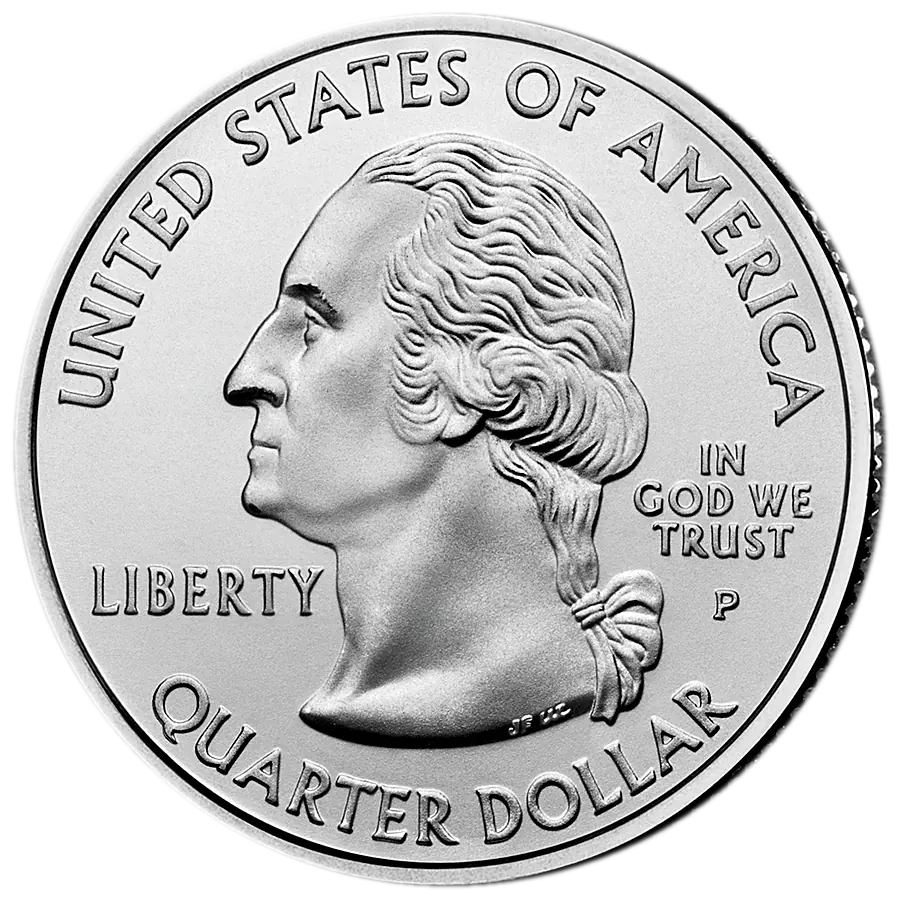
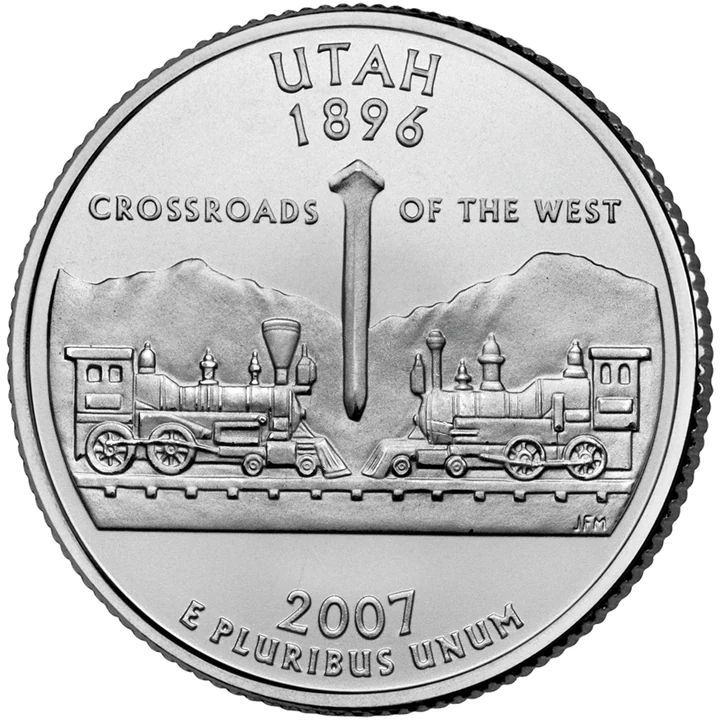
Exact Utah reverse from the U.S. Mint; shared program obverse.
45 / 50release order
4mint/finish issues
P · D · Smint marks
2007release year
Story in 30 Seconds
The reverse shows two steam locomotives facing a tall ceremonial spike, mountains behind them, rails converging below, and CROSSROADS OF THE WEST across the center. The scene refers to Central Pacific's Jupiter and Union Pacific No. 119 at Promontory Summit on May 10, 1869.
Utah chose the railroad junction because it made the state the nationally recognized meeting place of east- and west-building lines. A governor-appointed commission invited narrative recommendations from any Utahn; three Mint candidates reached federal review: Golden Spike, beehive and sego lily, and snowboarder.
CFA preferred a simplified beehive, while CCAC supported the nationally important railroad event but questioned locomotive accuracy and proposed explanatory text. The railroad concept became the issue, designed and sculpted by Joseph Menna.
Collectors distinguish P and D circulation strikes from S clad and 90% silver proofs. No Utah-specific major variety is modeled; alleged extra spikes, doubled rails, smoke, hidden figures, or missing locomotive parts need repeatable die evidence.
Public Law 105-124 ordered reverses by ratification or admission. Utah entered the Union on January 4, 1896 as the forty-fifth state, making this the program's forty-fifth design and fifth 2007 release. One reverse cannot encompass sovereign Tribal nations, Indigenous homelands, Latter-day Saint settlement, migration, mining, water, deserts, public lands, cities, winter sports, or modern communities. The railroad junction is a powerful but partial state identity.
Promontory Summit lies in northern Utah. On May 10, 1869, Central Pacific and Union Pacific representatives marked the joining of the first transcontinental railroad with ceremonial spikes while Jupiter and No. 119 faced one another. The event accelerated travel, trade, communication, migration, land seizure, military power, and environmental change. Chinese and Irish immigrant labor was essential, yet workers are absent from the coin's dignitary-centered emblem.
At Promontory Summit, rails built from west and east met in Utah. Jupiter represented Central Pacific and No. 119 Union Pacific. Several presentation spikes marked the event; the often-invoked golden spike was not left in the working track.
The Mint compresses the event into two locomotives, a single oversized spike, converging rails, and mountains. That is symbolic, not a literal snapshot: the spike was not taller than the engines, the locomotives were not identical, crowds and workers surrounded the ceremony, and the originals were later scrapped. Today's park locomotives are researched replicas.
The three federal candidates offered different identities: railroad junction, Beehive State symbols, and 2002 Olympic snowboarding. CFA preferred emblematic simplicity; CCAC favored the historical event while requesting clarification and more accurate engines.
World Coin Book interpretation: the facing boilers form opposing horizontal masses; rails and mountain slopes funnel the eye toward the upright spike. CROSSROADS OF THE WEST bridges the locomotives, making convergence the visual hierarchy.
The design omits Chinese and Irish workers, Indigenous peoples and lands, casualties and exploitation, federal subsidies, company competition, the ceremony crowd, and unequal consequences. It remembers connection from an official celebratory viewpoint, not the full construction history.
The federal process asked governors to develop three to five concepts. The Mint screened legality and coinability, produced candidate art, consulted CFA and CCAC, returned approved choices for a state recommendation, and the Treasury Secretary retained final approval.
Governor Jon M. Huntsman Jr.'s Executive Order 2005-0005 created a commission of no more than nine members representing arts, history, government, tourism, the legislature, education, and graphic design. It required a process allowing any Utahn to submit a narrative recommendation, public outreach, a website, and both forward-looking and historical ideas.
Mint artists produced three documented candidates: two facing locomotives and a golden spike under CROSSROADS OF THE WEST; a beehive, sego lily, and THE BEEHIVE STATE; and a female snowboarder in mountains with THE WORLD IS WELCOME. They are alternatives, not coin varieties.
On January 19, 2006, CFA preferred the beehive for simplicity. On January 24, CCAC supported the railroad's national importance, criticized locomotive accuracy, and suggested adding railroad, date, and place information.
The Golden Spike concept became Utah's recommendation and the Treasury-approved issue. Reviewed primary records do not establish the complete submission count, commission minutes or score, a certified public vote, signed governor recommendation, Treasury instrument, candidate artist assignments, or full revision log.
Procedures varied by state and changed during the program; each researched state page must document its actual path.
Alternative Designs
Three documented candidates offered the Golden Spike railroad meeting, a beehive with sego lily, and a female snowboarder recalling Utah's 2002 Winter Olympics. CFA preferred the beehive; CCAC supported the railroad concept with accuracy and inscription changes. No reconstructed gallery is published because candidate-art rights, assignments, state deliberation, and complete revisions are unavailable.
Use the complete text cards below as the keyboard and screen-reader equivalent of the image.
Jupiter and No. 119
Official explanation: The Mint identifies two locomotives moving toward the spike, representing the Central Pacific and Union Pacific railroads.
Historical context: Jupiter and No. 119 faced at Promontory in 1869; both originals were later scrapped, while today's park engines are replicas.
World Coin Book interpretation: World Coin Book interpretation: opposed boilers embody east and west while near symmetry makes meeting, rather than speed, the action.
Official explanation: The Mint says the golden spike joined the two railroads on May 10, 1869.
Historical context: Several ceremonial spikes marked the event; the huge upright spike is a readable symbol, not a scale reconstruction or working fastener left in track.
World Coin Book interpretation: World Coin Book interpretation: rails and mountain slopes converge on the spike, making junction the geometric center.
Central Pacific's ceremony locomotive; the original was later scrapped.
Union Pacific No. 119
Union Pacific's ceremony locomotive; the original was later scrapped.
Promontory Summit
The northern Utah railroad junction represented by the scene.
Chinese and Irish railroad workers
Essential builders whose labor and risks are not shown.
Utah quarter commission
The governor-created body charged with public input and advice.
Joseph Menna
The credited reverse designer and sculptor.
Focused Timeline
Railroad construction
Golden Spike ceremony
Statehood
Program authorization
State commission
CFA review
CCAC review
Federal release
Official Explanation and Interpretation
Artists and relief
John Flanagan's Washington portrait, adapted and sculpted by William Cousins, appears on the shared obverse. Public narratives became three Mint candidates reviewed by CFA, CCAC, Utah, and Treasury. The Mint credits sculptor-engraver Joseph Menna as both reverse designer and sculptor; JM appears in the relief. Candidate assignments and the full revision response to accuracy concerns were not recovered.
P and D are circulation issues. Both S issues were sold in proof products; the silver proof is a distinct 90% silver composition. Mintages are established catalog figures retained with an explicit source-audit limit.
Identification Guide
Identify the reverse by two facing locomotives, a tall central spike, converging rails, mountains, and CROSSROADS OF THE WEST. P, D, or S appears on the obverse. P and D are circulation strikes; S coins are proofs. The clad proof has a copper-colored edge core and weighs 5.67 g; the 90% silver proof lacks that stripe and weighs about 6.25 g.
Condition Guide
Inspect smokestacks, boilers, cabs, pilots, wheels, rails, spike, mountain ridges, lettering, and JM. First wear dulls exposed locomotive tops, spike, and ridges. Weak strike or grease can soften wheel spokes, rail ties, fine engine lines, JM, or letters while luster remains.
Open fields reveal contact marks, scuffs, residue, cleaning, and wheel marks. Proofs require checks for hairlines, haze, milk spots, fingerprints, frost breaks, and impaired mirrors. Judge wear, strike weakness, machine doubling, die deterioration, cracks, and damage separately.
Mint Errors vs. Damage
The canonical Utah catalog models no recognized major variety beyond the four normal issues. Seller labels such as extra spike, doubled spike, extra rail, doubled track, smoke, hidden worker, doubled locomotive, or missing wheel are not catalog attributions without repeatable die evidence.
Genuine mint errors can include off-center strikes, broadstrikes, clips, wrong planchets, struck-through material, retained cuds, or substantial die cracks. Authentication requires mint-made geometry, metal flow, weight, and repeatable evidence.
Weak strike or grease may soften wheels, rails, engine detail, mountains, inscriptions, or JM. Machine doubling and die deterioration create flat shelf-like outlines; these are not automatically doubled dies. Raised lines may be die cracks; incuse lines are usually scratches.
Scratches, dents, flattened rims, dryer damage, glue, corrosion, plating disturbance, polishing, paint, heat color, and carving are damage. The oversized spike is intentional symbolism, not an error; the coin does not show a literal gold insert, smoke, a named hidden worker, or today's replicas, and pareidolia is not a variety.
Why Collectors Care
Durable value tiers
Ordinary worn P and D examples generally occupy the face-value design-set tier. Better circulation coins attract interest through full luster, clean fields, crisp smokestacks and wheels, complete rails and spike, strong motto, and legible JM. Clad proofs form a collector-product tier; silver proofs add 90% silver as a separate composition tier. Unsupported error labels alone do not create a premium. Compare dated completed transactions for the exact mint, finish, grade, surfaces, and authenticated error status.
Official law and U.S. Mint records establish program facts and image identity. World Coin Book separates official explanation, historical analysis, and editorial interpretation.
Official descriptions, historical context, and World Coin Book interpretation are labeled separately. No live prices are asserted. Last verified:
The commission's complete roster, appointments, meetings, minutes, submission rules, website capture, rubric, scores, signed recommendations, and preserved narrative corpus were not recovered.
The executive order proves an open narrative-submission process but does not supply counts, eligibility results, duplicates, disqualifications, demographics, or geographic distribution.
Reviewed primary records do not establish a certified statewide public ballot, exact totals, percentages, duplicate controls, certification, or legal weight; none is inferred.
The governor's signed recommendation, Treasury final-approval instrument and date, candidate artist assignments, state feedback, and complete revision log remain unavailable.
CFA preferred the beehive while CCAC supported the railroad event with revisions. The state deliberation weighing those recommendations was not recovered.
CCAC questioned candidate locomotive accuracy. Reviewed sources do not preserve a complete technical comparison between the final relief and Jupiter and No. 119 in 1869.
The single spike is symbolic: multiple ceremonial spikes were present, and the relief is not identified as an exact portrait of one surviving spike or gold left in the track.
The celebratory reverse omits immigrant labor, Indigenous dispossession, casualties, subsidies, labor conflict, environmental effects, and unequal consequences.
No Utah-specific variety is normalized. Future extra-spike, doubled-track, smoke, hidden-worker, or missing-wheel attribution requires stable die markers and specialist documentation.
Normalized mintages remain established catalog figures; direct annual-production evidence remains future work.