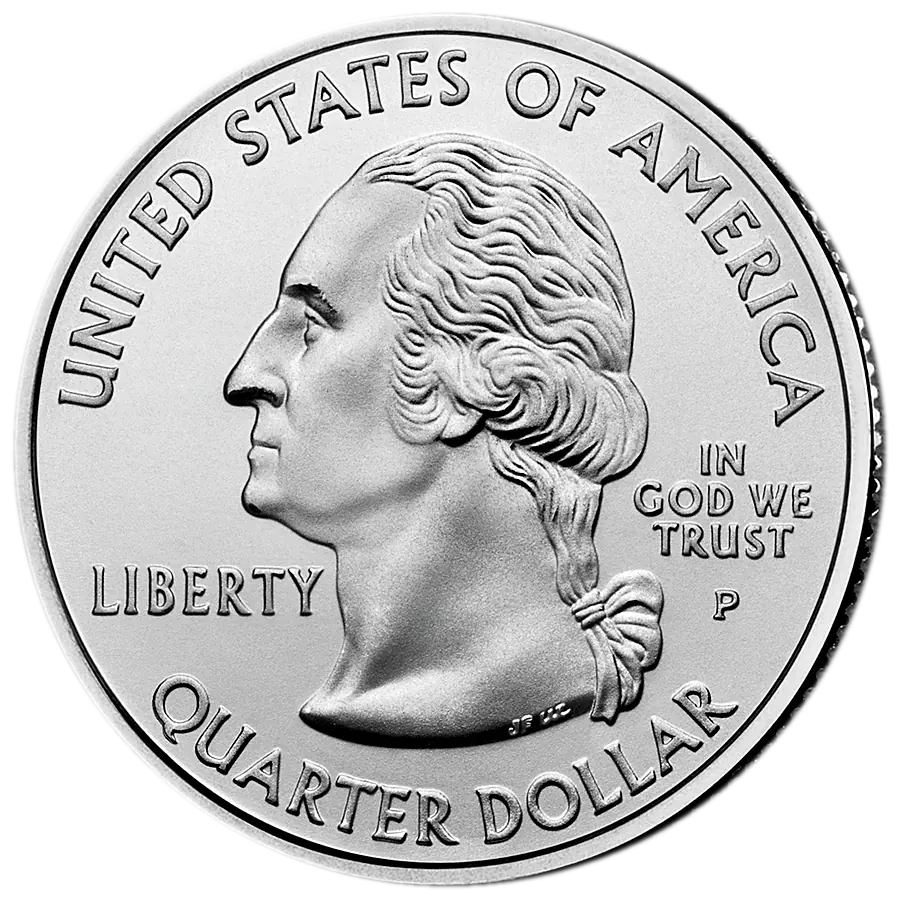
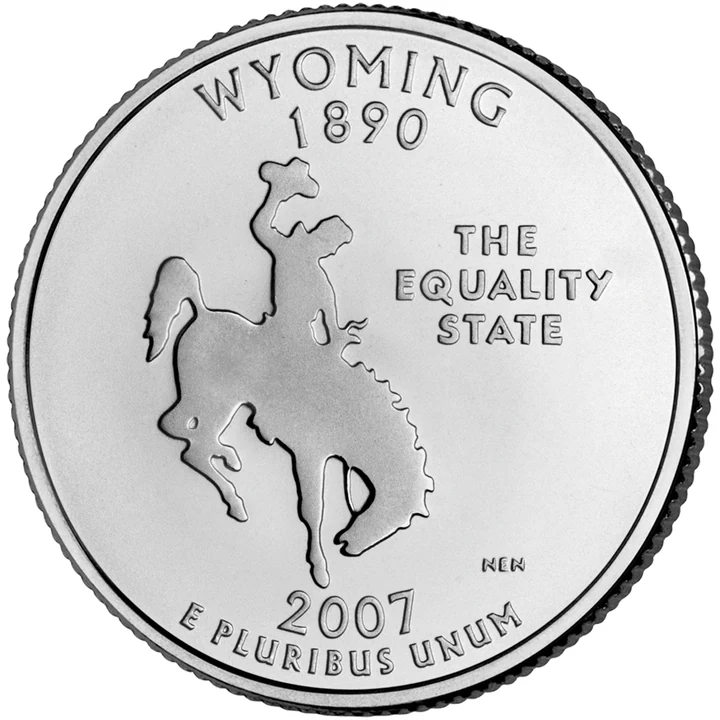
Exact Wyoming reverse from the U.S. Mint; shared program obverse.
44 / 50release order
4mint/finish issues
P · D · Smint marks
2007release year
Story in 30 Seconds
The reverse shows a solid bucking horse and rider silhouette. THE EQUALITY STATE fills the right field; WYOMING, 1890, 2007, E PLURIBUS UNUM, DW, and NEN complete the design.
The Mint says the horse and rider honor Wyoming's Wild West heritage, while the inscription recognizes the state's role in establishing equal voting rights for women. The image is an emblem, not a portrait of one proven horse, rider, rodeo, ranch, or event.
Wyoming gathered public ideas through a state advisory process, but the complete official submission archive was not recovered. Five Mint candidates reached CFA and CCAC: four horse-and-rider treatments and Old Faithful. CFA preferred the silhouette; CCAC preferred a fuller Wyoming scene, while the silhouette became the issued choice.
Collectors distinguish P and D circulation strikes from S clad and 90% silver proofs. No Wyoming-specific major variety is modeled; alleged extra legs, hats, reins, riders, doubled mottoes, or hidden images require repeatable die evidence.
Public Law 105-124 ordered reverses by ratification or admission. Wyoming entered the Union on July 10, 1890 as the forty-fourth state, making this the program's forty-fourth design and fourth 2007 release. One reverse cannot encompass sovereign Tribal nations, women's suffrage in full context, ranching and labor, public lands, energy, railroads, migration, cities, wildlife, or contemporary life. Emblem and equality claim form a recognizable but partial identity.
Wyoming Territory enacted women's suffrage in 1869, and the state constitution later tied civil rights to political equality without distinction of sex. That history supports The Equality State, but the nickname should not be read as proof that equality was complete or universal. The bucking-horse-and-rider image also has multiple histories: George Ostrom's 1918 military emblem, a University of Wyoming version associated with Steamboat, and Allen True's three-legged license-plate design adopted in 1936. Claims that every version depicts Steamboat or one named rider collapse distinct records.
Donna Weaver reduced horse and rider to a nearly flat silhouette; Norman E. Nemeth translated it into coin relief. The raised outer shape and restrained internal modeling make the emblem read quickly at quarter scale.
The Mint officially frames the figure as homage to Wild West heritage. World Coin Book separates that statement from later folklore: the coin does not name Steamboat, Stub Farlow, Guy Holt, Redwing, George Ostrom, Allen True, a ranch, rodeo, military unit, or particular ride.
The silhouette was not the only western option. Other candidates showed the same theme in relief, inside a state-outline motto treatment, before Tetons, or in a broader Wyoming scene; Old Faithful offered a Yellowstone identity. CFA chose silhouette simplicity, while CCAC scored the broader scene higher.
World Coin Book interpretation: the black-looking central mass supplies explosive diagonal movement; the lifted hat and kicking hindquarters define rider and horse with almost no interior detail. THE EQUALITY STATE forms a calm verbal counterweight, asking western independence and political equality to share the same field.
The design omits women and suffrage activists as people, Native nations, the contested reach of equality, specific landscapes, ranch labor, horses' treatment, settlement conflict, mining and energy, railroads, wildlife, and urban life. It is a compressed civic brand, not a complete state history.
The federal process asked governors to develop three to five concepts. The Mint screened legality and coinability, produced candidate art, consulted CFA and CCAC, returned approved choices for a state recommendation, and the Treasury Secretary retained final approval.
Governor Dave Freudenthal appointed a Wyoming Coinage Advisory Committee and the public supplied ideas. Contemporary accounts report either roughly 1,300 ideas or more than 3,200 submissions; because the official corpus and counting method were not recovered, World Coin Book does not merge those figures or claim a public vote.
Mint artists produced five documented candidates: horse and rider in silhouette; horse and rider in relief with the motto in a state outline; horse and rider before the Tetons; horse and rider in a typical Wyoming scene; and Old Faithful adapted from a 1934 postage-stamp composition. They are alternatives, not coin varieties.
On January 19, 2006, CFA preferred the silhouette as the strongest of four horse treatments while also seeing potential in Old Faithful. On January 24, CCAC discussed the silhouette's novel texture but scored the typical-scene design 18 of 27 and the silhouette 14; the remaining designs scored lower.
The silhouette became Wyoming's recommendation and the Treasury-approved issue. Reviewed records do not preserve the committee roster and minutes, submission census, state scoring, signed governor recommendation, public ballot, Treasury approval instrument, candidate artist assignments, or full revision log.
Procedures varied by state and changed during the program; each researched state page must document its actual path.
Alternative Designs
Five documented candidates offered four bucking-horse treatments and Old Faithful. CFA preferred the silhouette; CCAC preferred the broader typical-Wyoming scene. No reconstructed gallery is published because candidate art rights, assignments, state deliberation, and complete revisions are unavailable.
Use the complete text cards below as the keyboard and screen-reader equivalent of the image.
Bucking horse silhouette
Official explanation: The Mint identifies a bucking horse as homage to Wyoming's Wild West heritage.
Historical context: Wyoming's related emblems evolved through military, university, and state-license-plate histories; the coin does not identify one horse.
World Coin Book interpretation: World Coin Book interpretation: the arched back, lowered forequarters, and kicked rear legs compress force and instability into one contour.
Official explanation: The Mint identifies a rider atop the bucking horse.
Historical context: The silhouette does not establish the rider as Stub Farlow, Guy Holt, George Ostrom, or another named person.
World Coin Book interpretation: World Coin Book interpretation: the raised arm and hat separate the rider from the horse and carry movement toward the motto.
Official explanation: The Mint says the inscription recognizes Wyoming's historical role in establishing equal voting rights for women.
Historical context: Territorial suffrage began in 1869 and the state constitution protected political rights without distinction of sex; neither statement proves equality was complete for everyone.
World Coin Book interpretation: World Coin Book interpretation: the horizontal motto steadies the active silhouette and makes equality, rather than landscape, the second design subject.
Official explanation: The reverse bears WYOMING, 1890, 2007, E PLURIBUS UNUM, THE EQUALITY STATE, DW, and NEN.
Historical context: 1890 records statehood; DW identifies designer Donna Weaver and NEN identifies sculptor Norman E. Nemeth.
World Coin Book interpretation: World Coin Book interpretation: perimeter legends frame the silhouette while the initials occupy small lower fields without competing with the emblem.
Wyoming's state-protected emblem, represented on the coin as a silhouette.
The Equality State
A nickname linked to women's suffrage and constitutional political equality.
Wyoming Coinage Advisory Committee
The governor-appointed state body associated with public concept review.
Donna Weaver and Norman E. Nemeth
The credited reverse designer and sculptor.
Focused Timeline
Territorial suffrage
Statehood
Military emblem
License-plate emblem
Program authorization
State process
CFA review
CCAC review
Federal release
Official Explanation and Interpretation
Artists and relief
John Flanagan's Washington portrait, adapted and sculpted for the program by William Cousins, appears on the shared obverse. Public concepts became five Mint candidates reviewed by CFA, CCAC, Wyoming, and Treasury. The Mint credits Artistic Infusion Program artist Donna Weaver as reverse designer and sculptor-engraver Norman E. Nemeth as reverse sculptor; DW and NEN appear in the relief. Candidate assignments and the full silhouette-texture production record were not recovered.
P and D are circulation issues. Both S issues were sold in proof products; the silver proof is a distinct 90% silver composition. Mintages are established catalog figures retained with an explicit source-audit limit.
Identification Guide
Identify the reverse by the solid bucking-horse-and-rider silhouette beside THE EQUALITY STATE. P, D, or S appears on the obverse near Washington's hair ribbon. P and D are circulation strikes; S coins are proofs. The clad proof has a copper-colored edge core and weighs 5.67 g; the 90% silver proof lacks that stripe and weighs about 6.25 g.
Condition Guide
Inspect the rider's hat, head, arm, torso and seat; the horse's muzzle, ears, shoulder, back, belly, tail and three visible legs; motto, dates, DW and NEN. First wear or friction dulls the broad central silhouette and highest contour edges. Weak strike or grease can soften narrow joins, letters, initials, hat, ears, tail, or hooves while luster remains.
The broad silhouette and open fields reveal contact marks, scuffs, residue, cleaning and wheel marks. Proofs require checks for hairlines, haze, milk spots, fingerprints, frost breaks, and impaired mirrors. Judge wear, strike weakness, machine doubling, die deterioration, cracks and post-mint damage separately.
Mint Errors vs. Damage
The canonical Wyoming catalog models no recognized major variety beyond the four normal mint-and-finish issues. Seller labels such as extra leg, fourth leg, extra hat, doubled rider, extra rein, doubled motto, missing hoof, or hidden face are not catalog attributions without stable parent issues, repeatable die markers, and specialist documentation.
Genuine mint errors can include off-center strikes, broadstrikes, clips, wrong planchets, struck-through material, retained cuds, or substantial die cracks. Authentication requires mint-made geometry, metal flow, weight, and repeatable evidence rather than accidental shapes in the silhouette or lettering.
Weak strike or grease may soften hat, hand, ears, legs, tail, motto, DW, or NEN. Machine doubling and die deterioration can create flat shelf-like outlines; these are not automatically doubled dies. Raised lines may be die cracks, while incuse lines crossing relief are usually scratches.
Scratches, gouges, dents, flattened rims, dryer damage, glue, corrosion, plating disturbance, polishing, paint, heat color and carving are post-mint damage. The horse has three intentionally visible legs in the emblem; a supposedly missing or extra fourth leg is not automatically an error. The coin does not prove the horse is Steamboat or the rider is Stub Farlow, and pareidolia is not a variety.
Why Collectors Care
Durable value tiers
Ordinary worn P and D examples generally occupy the face-value design-set tier. Better circulation coins attract interest through full luster, a crisp hat and rider profile, complete horse contours, clean silhouette and fields, strong motto, and legible DW and NEN. Clad proofs form a collector-product tier; silver proofs add 90% silver as a separate composition tier. Unsupported leg, rider, or motto error labels alone do not create a premium. World Coin Book gives no live price promise: compare dated completed transactions for the exact mint, finish, grade, surfaces, and authenticated error status.
Official law and U.S. Mint records establish program facts and image identity. World Coin Book separates official explanation, historical analysis, and editorial interpretation.
Official descriptions, historical context, and World Coin Book interpretation are labeled separately. No live prices are asserted. Last verified:
The Wyoming Coinage Advisory Committee creating instrument, complete roster, appointment record, meetings, minutes, attendance, screening rubric, scores, signed recommendations, and preserved submission corpus were not recovered.
Contemporary secondary reports conflict between roughly 1,300 ideas and more than 3,200 submissions. Without an official census defining ideas, entries, duplicates, and eligibility, neither figure is promoted as settled fact.
Reviewed records do not document a statewide public ballot, electorate, candidate totals, percentages, duplicate controls, certification, or legal weight; none is inferred.
The governor's signed recommendation, Treasury final-approval instrument and date, candidate artist assignments, state feedback, and full drawing-to-die revision log remain unavailable.
CFA preferred the silhouette while CCAC preferred the typical Wyoming scene. The state deliberation explaining how those recommendations were weighed was not recovered.
The coin does not identify a particular horse, rider, pose source, ranch, rodeo, place, event, military unit, or direct copy of the Allen True, George Ostrom, or University of Wyoming emblem.
The Equality State inscription recognizes women's voting rights but does not establish that political, racial, Indigenous, economic, or other equality was complete in 1869, 1890, 2007, or today.
The canonical catalog has no normalized Wyoming-specific variety row. Future extra-leg, doubled-rider, extra-hat, missing-hoof, or doubled-motto attribution requires stable die markers and specialist documentation.
Normalized mintages remain established catalog figures; future work should attach direct Mint annual-production and proof-sales evidence for every issue.