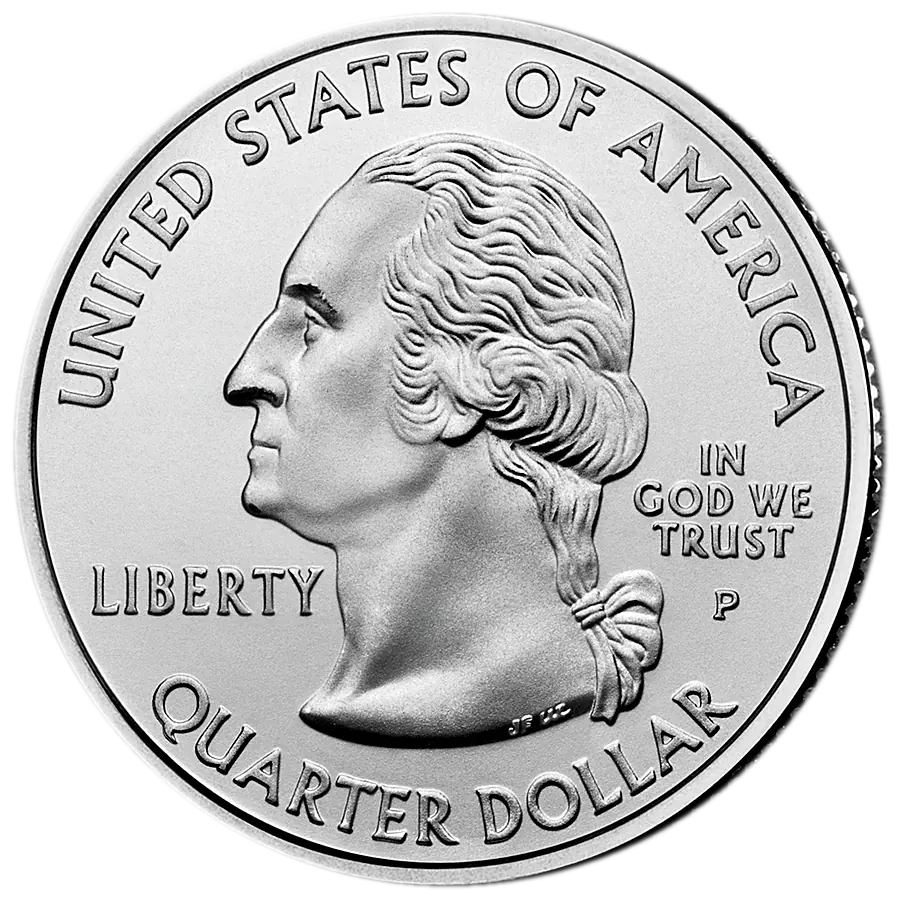
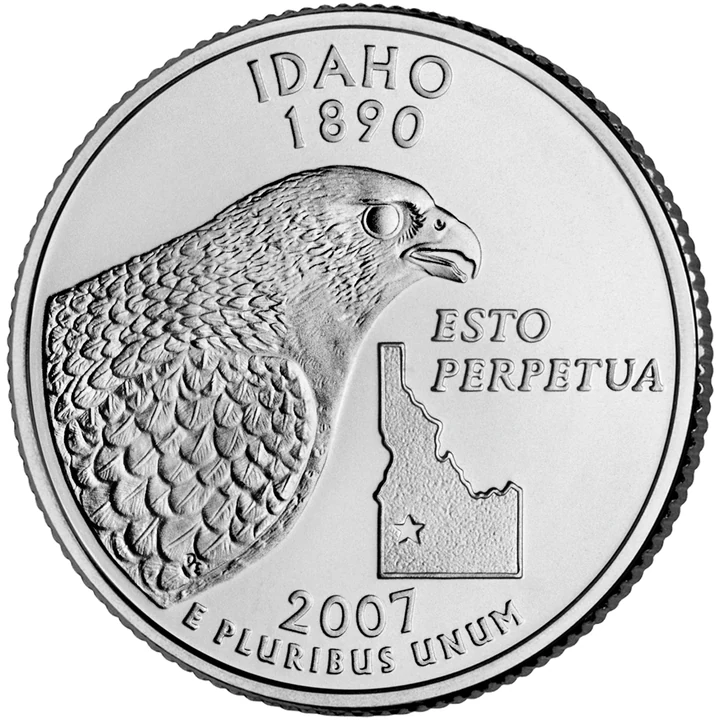
Exact Idaho reverse from the U.S. Mint; shared program obverse.
43 / 50release order
4mint/finish issues
P · D · Smint marks
2007release year
Story in 30 Seconds
The reverse shows a peregrine falcon in close profile above an outline of Idaho. ESTO PERPETUA crosses the open field; IDAHO, 1890, 2007, E PLURIBUS UNUM, DW, and DE complete the design.
The Mint connects the once-endangered falcon with successful conservation. Idaho made the peregrine its state raptor in 2004; the map and motto attach that general species portrait to the state without identifying one bird, nest, cliff, city, or flight.
The Idaho Commission on the Arts solicited public concepts in 2005 and received more than 1,200. Four Mint candidates reached CFA and CCAC: falcon, Sawtooth river landscape, farmland tapestry, and state-song composition. CFA preferred the landscape; CCAC tied it with the falcon at 19 of 27. Reviewed records do not preserve the later state recommendation in detail.
Collectors distinguish P and D circulation strikes from S clad and 90% silver proofs. The catalog models no Idaho-specific major variety; extra feathers, doubled eyes or beaks, missing map details, and alleged hidden images need stable die evidence.
Public Law 105-124 ordered state reverses by ratification or admission. Idaho entered the Union on July 3, 1890 as the forty-third state, making this the program's forty-third coin and third 2007 release. One reverse cannot encompass sovereign Tribal nations, the Snake River Plain, northern forests, Sawtooths, agriculture, mining, migration, cities, labor, or modern life. Falcon, outline, and motto communicate a recognizable but partial identity.
The peregrine falcon is a globally distributed raptor known for its high-speed hunting dive. Idaho designated it the state raptor in 2004, and Boise is home to The Peregrine Fund's World Center for Birds of Prey. Federal and citizen conservation helped the species recover after severe pesticide-era declines and federal endangered listing. Esto Perpetua appears on Idaho's Great Seal and is translated in official state sources as 'Let it be perpetual,' 'May it endure forever,' or related wording; the coin does not settle one exclusive English rendering.
Donna Weaver enlarged the falcon's head and shoulders until eye, hooked beak, cheek, and layered feathers dominate the quarter. Don Everhart translated the drawing into relief; the state outline remains a smaller counterweight below.
The Mint presents the falcon's recovery as a conservation success. World Coin Book separates that official interpretation from the image itself: the portrait does not show speed, a hunting stoop, captivity, release, nest, prey, habitat, pesticide exposure, or one documented Idaho bird.
The four finalists offered sharply different identities. CFA considered the Sawtooth Mountains and river the best coin; CCAC admired that map-shaped river but tied it with the falcon, while criticizing the falcon design's large outline, capital star, balance, and empty field. The issued relief retains the outline but not a visible Boise star.
World Coin Book interpretation: the falcon's eye and hooked beak create the visual center, feather arcs lead downward, and the narrow state map answers the large organic portrait with a geographic label. Esto Perpetua bridges bird and map, allowing endurance to refer simultaneously to wildlife recovery and civic continuity.
The design omits named habitats and conservation partners, Indigenous nations and place names, pesticide history, agriculture, forests, rivers, mountains, mining, potatoes, gems, cities, and social conflict. It is a recovery-centered emblem, not a complete history of Idaho or peregrine conservation.
The federal process asked governors to develop three to five concepts. The Mint screened legality and coinability, made candidate art, consulted CFA and CCAC, returned approved choices for state recommendation, and the Treasury Secretary retained final approval.
In 2005 the Idaho Commission on the Arts solicited public concepts and received more than 1,200 submissions. The reviewed official record does not identify a governor-appointed committee, full submitter corpus, screening panel, rubric, intermediate shortlist, or whether a public vote followed.
Mint artists returned four documented candidates: a peregrine profile with state outline, Boise star, and motto; Sawtooth Mountains framed by ponderosa pines with a river widening into the state outline; an aerial farmland tapestry; and a state-outline composition carrying lines from the state song. They are alternative designs, not varieties.
CFA recommended the Sawtooth river design on January 19, 2006, while asking for less detail. On January 24, CCAC tied that design and the falcon at 19 of 27 points; members liked the strong falcon head but criticized the outline, Boise star, balance, and excess open field.
The falcon design became Idaho's recommendation and the Treasury-approved issue, but the reviewed sources do not preserve the final state deliberation, named decision-makers, public ballot, vote totals, governor's signed recommendation, Treasury instrument, or complete revision log. The issued relief shows the outline without an evident capital star and rebalances the field.
Procedures varied by state and changed during the program; each researched state page must document its actual path.
Alternative Designs
Four documented candidates presented peregrine conservation, a Sawtooth-and-river landscape, agricultural fields, or the state song and outline. CFA preferred the landscape; CCAC tied landscape and falcon. Because the state decision record, candidate artist assignments, art rights, and full revisions are incomplete, no reconstructed gallery is published.
Use the complete text cards below as the keyboard and screen-reader equivalent of the image.
Peregrine falcon profile
Official explanation: The Mint identifies a prominent peregrine falcon in profile and connects it to speed and conservation recovery.
Historical context: Idaho adopted the peregrine as state raptor in 2004; the generic portrait does not identify sex, age, subspecies, individual, or behavior.
World Coin Book interpretation: World Coin Book interpretation: the eye and hooked beak command attention while nested feather curves carry the portrait across the field.
Official explanation: The Mint places an outline map of Idaho below and beside the falcon.
Historical context: The outline identifies jurisdiction, not topography, borders surveyed at coin scale, counties, Tribal lands, cities, or a falcon range map.
World Coin Book interpretation: World Coin Book interpretation: the thin vertical map acts as a geographic signature and counterweight to the broad head.
Official explanation: The reverse bears Idaho's Latin state motto, which Mint material renders as May it Be Forever.
Historical context: The motto also appears on the Great Seal; official state translations vary slightly around permanence and endurance.
World Coin Book interpretation: World Coin Book interpretation: placed between portrait and map, the words join species recovery to enduring state identity without proving that was the artist's sole intent.
Official explanation: The reverse bears IDAHO, 1890, 2007, E PLURIBUS UNUM, ESTO PERPETUA, DW, and DE.
Historical context: 1890 records statehood; DW identifies designer Donna Weaver and DE identifies sculptor Don Everhart.
World Coin Book interpretation: World Coin Book interpretation: perimeter lettering contains the enlarged portrait while motto and initials occupy subordinate open spaces.
Idaho's state raptor and the officially identified conservation-recovery emblem.
Idaho outline
The jurisdictional silhouette anchoring the falcon to one state.
Esto Perpetua
The Latin state motto linking the coin to Idaho's Great Seal.
Idaho Commission on the Arts
The state body that solicited more than 1,200 public concepts in 2005.
Donna Weaver and Don Everhart
The credited reverse designer and sculptor.
Focused Timeline
Statehood
Endangered listing
Program authorization
Federal recovery milestone
State raptor
Public concepts
CFA review
CCAC review
Federal release
Official Explanation and Interpretation
Artists and relief
John Flanagan's Washington portrait, adapted and sculpted for the program by William Cousins, appears on the shared obverse. Public concepts became four Mint candidates reviewed by CFA, CCAC, the state, and Treasury. The Mint credits Artistic Infusion Program artist Donna Weaver as reverse designer and sculptor-engraver Don Everhart as reverse sculptor; DW and DE appear in the relief. The candidate artist assignments and full concept-to-die revision record were not recovered.
P and D are circulation issues. Both S issues were sold in proof products; the silver proof is a distinct 90% silver composition. Mintages are established catalog figures retained with an explicit source-audit limit.
Identification Guide
Identify the reverse by one large peregrine profile above Idaho's outline and ESTO PERPETUA. P, D, or S appears on the obverse near Washington's hair ribbon. P and D are circulation strikes; S coins are proofs. The clad proof has a copper-colored edge core and weighs 5.67 g; the 90% silver proof lacks that stripe and weighs about 6.25 g.
Condition Guide
Inspect the falcon's brow, eye, hooked beak, cheek, neck and shoulder feathers, map edges, lettering, DW, and DE. First wear dulls the brow, beak, and high feather ridges. Weak strike or grease can soften feather separation, eye, map boundary, initials, or letters while luster remains.
Open fields around the motto and map reveal contact marks, scrapes, residue, cleaning, and wheel marks; feather texture can hide hits. Proofs require checks for hairlines, haze, milk spots, fingerprints, frost breaks, and impaired mirrors. Judge wear, weak strike, machine doubling, die deterioration, cracks, and damage separately.
Mint Errors vs. Damage
The canonical Idaho catalog models no recognized major variety beyond the four normal mint-and-finish issues. Seller labels such as extra feather, doubled eye, doubled beak, missing map, extra star, hidden face, or falcon tear are not catalog attributions without stable parent issues, repeatable die markers, and specialist documentation.
Genuine mint errors can include off-center strikes, broadstrikes, clips, wrong planchets, struck-through material, retained cuds, or substantial die cracks. Authentication requires mint-made geometry, metal flow, weight, and repeatable evidence rather than accidental shapes in feathers, eye, map, or lettering.
Weak strike or grease may soften feathers, eye, beak, map, motto, DW, or DE. Machine doubling and die deterioration can create flat shelf-like outlines; these are not automatically doubled dies. Raised lines may be die cracks, while incuse lines crossing relief are usually scratches.
Scratches, gouges, dents, flattened rims, dryer damage, glue, corrosion, plating disturbance, polishing, paint, heat color, and carving are post-mint damage. The bird is a peregrine falcon, not an eagle, hawk, owl, or extinct species; the outline is Idaho, not Delaware or a mint error, and pareidolia is not a variety.
Why Collectors Care
Durable value tiers
Ordinary worn P and D examples generally occupy the face-value design-set tier. Better circulation coins attract interest through full luster, a sharp eye and beak, separated feather layers, a complete map, clean open fields, strong lettering, and legible DW and DE. Clad proofs form a collector-product tier; silver proofs add 90% silver as a separate composition tier. Unsupported falcon or map error labels alone do not create a premium. World Coin Book gives no live price promise: compare dated completed transactions for the exact mint, finish, grade, surfaces, and authenticated error status.
Official law and U.S. Mint records establish program facts and image identity. World Coin Book separates official explanation, historical analysis, and editorial interpretation.
Official descriptions, historical context, and World Coin Book interpretation are labeled separately. No live prices are asserted. Last verified:
The Idaho Commission on the Arts solicitation dates, eligibility, rights terms, submission form, complete corpus, submitter identities, media and geographic counts, preservation location, screening panel, rubric, scores, shortlist, and signed narratives were not recovered.
Reviewed sources identify more than 1,200 public concepts but do not document a later public ballot, electorate, candidate totals, percentages, duplicate controls, certification, or legal weight; none is inferred.
CFA preferred the Sawtooth landscape while CCAC tied it with the falcon. The complete state deliberation explaining how federal advice and public concepts were weighed is unavailable.
The governor's signed recommendation, named state decision-makers, Treasury final-approval instrument and date, candidate artist assignments, state feedback, and full drawing-to-die revision log remain unavailable.
The issued design removes the candidate's evident Boise star and changes balance; the exact approved revisions, dates, responsible artists, and reasons were not recovered.
Official records do not identify a specific falcon specimen, sex, age, subspecies, nest, cliff, city, migration route, release bird, prey, pose source, or direct relationship to The Peregrine Fund.
Official Idaho sources provide several close translations of Esto Perpetua. The coin does not establish one exclusive English translation or prove that the motto was intended only as a conservation statement.
The canonical catalog has no normalized Idaho-specific variety row. Future extra-feather, doubled-eye, doubled-beak, missing-map, extra-star, or hidden-image attribution requires stable die markers and specialist documentation.
Normalized mintages remain established catalog figures; future work should attach direct Mint annual-production and proof-sales evidence for every issue.