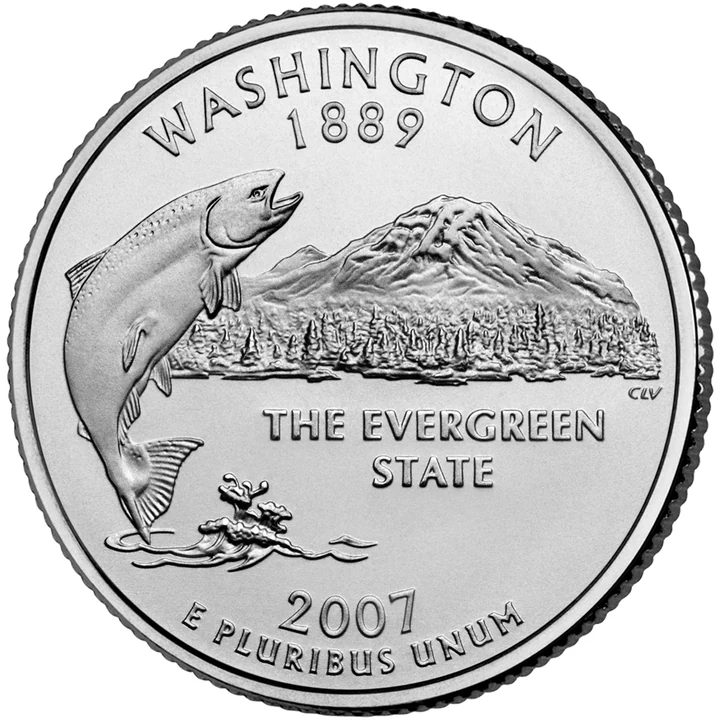
A breaching king salmon crosses an evergreen-framed Mount Rainier, compressing water, forest, mountain, movement, and state nickname into one Washington emblem.
◆
King salmon breaching before Mount Rainier and an evergreen landscape
Exact Washington reverse from the U.S. Mint; shared program obverse.
42 / 50release order
4mint/finish issues
P · D · Smint marks
2007release year
Story in 30 Seconds
The reverse shows a king salmon breaching stylized water before Mount Rainier, with evergreen trees along the lower slopes. THE EVERGREEN STATE crosses the forest; WASHINGTON, 1889, 2007, E PLURIBUS UNUM, SG, and CLV complete the design.
The Mint identifies the salmon and majestic Mount Rainier; the forest and nickname broaden that pair into an evergreen landscape. The image is symbolic, not a documented species portrait, river, viewpoint, season, or literal salmon migration at the mountain.
Residents submitted ideas to a governor-appointed advisory commission. Five state concepts became three Mint candidates: a state-outline collage, the issued salmon-and-mountain scene, and a Northwest Native American-style orca. CFA preferred the orca, CCAC scored the issued theme 24 of 27, and a public poll favored it before Governor Christine Gregoire selected it.
Collectors distinguish P and D circulation strikes from S clad and 90% silver proofs. The catalog models no Washington-specific major variety; extra fins, doubled fish, missing trees, hidden faces, and alleged mountain errors need stable die evidence.
Public Law 105-124 ordered state reverses by ratification or admission. Washington entered the Union on November 11, 1889 as the forty-second state, making this the program's forty-second coin and second 2007 release. One reverse cannot encompass the state's sovereign Tribal nations, treaty fisheries, coast and inland waters, Cascade and Olympic landscapes, eastern drylands, agriculture, ports, cities, industry, migration, or contemporary life. Salmon, mountain, forest, and nickname communicate a recognizable but partial identity.
Mount Rainier is an active, glacier-clad Cascade volcano and regional landmark. The land and waters around it are ancestral homelands with enduring cultural and spiritual meaning for Cowlitz, Muckleshoot, Nisqually, Puyallup, Squaxin Island, Yakama, Coast Salish and other peoples; many names for the mountain remain in use. Salmon connect marine and inland ecosystems and are inseparable from Tribal cultures, treaty rights, fisheries, restoration, and modern environmental pressures. THE EVERGREEN STATE and the tree line emphasize western forests but do not describe all Washington landscapes.
Susan Gamble's composition places the salmon diagonally across the foreground. Its arched body and splash create the strongest motion; Charles L. Vickers translated that drawing into relief while keeping the mountain broad and the conifers legible at quarter scale.
The Mint calls the fish a king salmon and the peak majestic Mount Rainier. The state pamphlet presents salmon, mountain, water, forest, and nickname as familiar Washington identity. World Coin Book keeps that official reading separate from historical context: salmon also invoke Indigenous stewardship, treaty fisheries, habitat change, dams, harvest, and restoration, none of which the coin explains.
The three finalists produced real disagreement. CFA welcomed the Northwest Native American-style orca as relief from landscape designs and asked for bolder relief. CCAC found the collage cluttered, questioned parts of the fish anatomy, and strongly endorsed the simpler salmon-and-mountain scene. Public preference and federal advice did not all point in the same direction.
World Coin Book interpretation: the fish's diagonal leap cuts across the mountain's stable triangle. Water lines form a low stage, trees provide scale and connect the nickname to visible landscape, and open field around Rainier reads as sky. The hierarchy moves from fish to peak to inscription rather than presenting a literal continuous place.
The design omits named rivers and salmon runs, specific Tribal nations and Indigenous names for the mountain, treaty rights, dams and habitat loss, coastal and eastern Washington, agriculture, cities, ports, technology, labor, immigration, wildfire, glacial retreat, and contemporary environmental debates. It is a civic emblem, not a complete ecological or social history.
The federal process asked governors to develop three to five concepts. The Mint screened legality and coinability, made candidate art, consulted CFA and CCAC, returned approved choices for state recommendation, and the Treasury Secretary retained final approval.
Governor Christine Gregoire appointed a 22-member Washington State Quarter Advisory Commission in April 2005, with Mike Gregoire as honorary chair. Residents were invited to submit design ideas; the commission reduced them to five narratives sent to the Mint. The reviewed official pamphlet does not preserve the complete submission corpus or scoring rubric.
Mint artists returned three documented candidates: salmon, Mount Rainier and apples inside a state outline; a salmon breaching before Mount Rainier with THE EVERGREEN STATE beneath the forest; and a Northwest Native American-style orca intended to draw from regional styles. These are alternatives, not coin varieties.
CFA recommended the orca on January 19, 2006, asking for bolder, higher relief. On January 24, CCAC gave the salmon-and-mountain design 24 of 27 points, the orca 8, and the collage 0; it suggested simplifying splash and water and checking salmon anatomy.
The state placed the three finalists before the public online and by mail. The official state pamphlet records more than 130,000 votes and says the salmon-and-mountain design received about 45 percent; the commission recommended it and Governor Gregoire selected it. The reviewed sources do not provide a signed Treasury approval instrument, complete anti-duplication audit, geographic distribution, or full design revision log.
Procedures varied by state and changed during the program; each researched state page must document its actual path.
Alternative Designs
Three documented candidates framed Washington differently: a state-outline collage of salmon, Mount Rainier and apples; the issued breaching salmon, Rainier, forest and nickname; and a Northwest Native American-style orca. CFA preferred the orca, CCAC and the public preferred the issued scene. Because artist assignments, consultation with source communities, candidate-art rights, and full revisions are incomplete, no reconstructed gallery is published.
Official explanation: The Mint identifies the background peak as majestic Mount Rainier.
Historical context: The active Cascade volcano is an icon and ancestral landscape with many Indigenous names and more than 9,000 years of human connection.
World Coin Book interpretation: World Coin Book interpretation: the broad triangular peak anchors the field and contrasts permanence with the salmon's instant of motion.
Official explanation: Trees edge the mountain, water supports the fish, and THE EVERGREEN STATE names the theme.
Historical context: The nickname and western hemlock reflect forest identity but do not make every tree a botanically identified hemlock or represent eastern Washington.
World Coin Book interpretation: World Coin Book interpretation: the tree line provides scale while the inscription bridges landscape and state identity.
Official explanation: The reverse bears WASHINGTON, 1889, 2007, E PLURIBUS UNUM, THE EVERGREEN STATE, SG, and CLV.
Historical context: 1889 records statehood; SG identifies designer Susan Gamble and CLV identifies sculptor Charles L. Vickers.
World Coin Book interpretation: World Coin Book interpretation: perimeter text contains the scene while the nickname sits inside it and the initials remain subordinate.
The officially identified fish, represented as a general emblem rather than one documented individual or run.
Mount Rainier
The active Cascade volcano and culturally layered ancestral landscape behind the fish.
Evergreen landscape
A stylized western forest and water setting linked to the state nickname.
Christine and Mike Gregoire
The governor who selected the design and the advisory commission's honorary chair.
Susan Gamble and Charles L. Vickers
The credited reverse designer and sculptor.
Focused Timeline
Mountain, salmon, and peoples
Statehood
National park
Program authorization
Advisory commission
CFA review
CCAC review
Public poll
Federal release
Official Explanation and Interpretation
Artists and relief
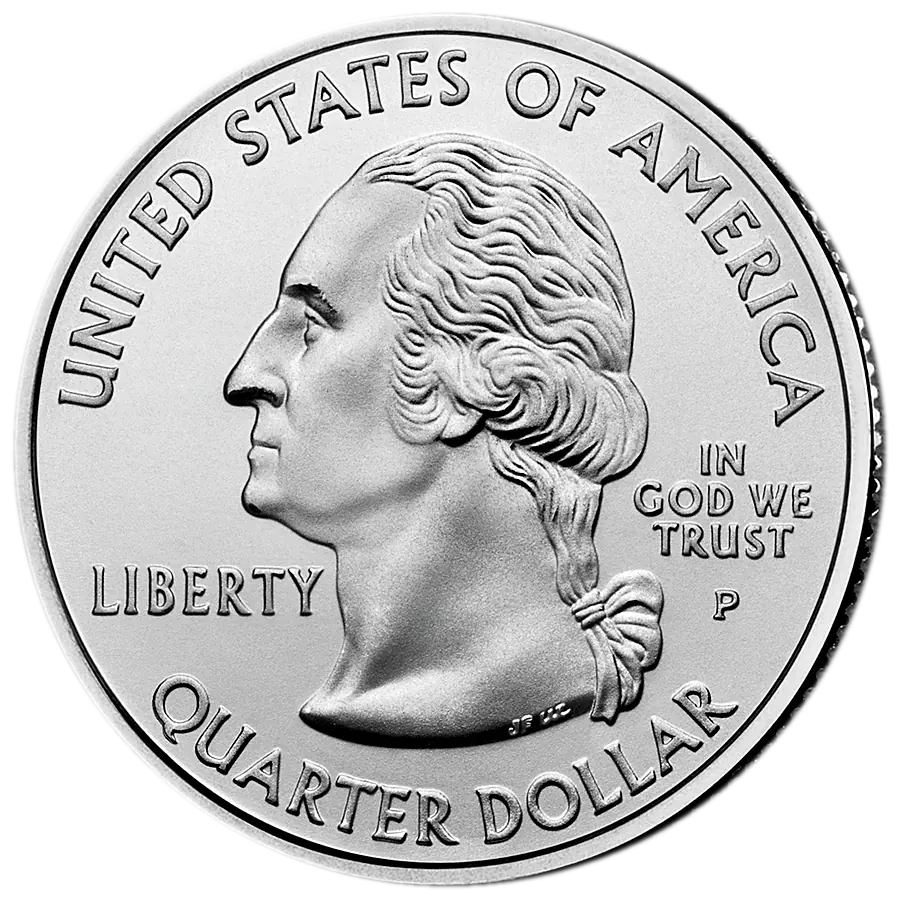
John Flanagan's Washington portrait, adapted and sculpted for the program by William Cousins, appears on the shared obverse. Resident ideas became five state narratives and then three Mint candidates reviewed by CFA, CCAC, the public, the commission, governor, and Treasury. The Mint credits Artistic Infusion Program artist Susan Gamble as reverse designer and sculptor-engraver Charles L. Vickers as reverse sculptor; SG and CLV appear in the relief. The full concept-to-die revision record and alternative artist assignments were not recovered.
P and D are circulation issues. Both S issues were sold in proof products; the silver proof is a distinct 90% silver composition. Mintages are established catalog figures retained with an explicit source-audit limit.
Identification Guide
Identify the reverse by one breaching salmon before Mount Rainier, evergreen trees, water lines, and THE EVERGREEN STATE. P, D, or S appears on the obverse near Washington's hair ribbon. P and D are circulation strikes; S coins are proofs. The clad proof has a copper-colored edge core and weighs 5.67 g; the 90% silver proof lacks that stripe and weighs about 6.25 g.
Condition Guide
Inspect the salmon's head, back, dorsal and tail fins, scales, water splash, mountain summit and ridges, tree tops, lettering, SG, and CLV. First wear dulls the fish's exposed back and head, peak, and prominent trees. Weak strike or grease can soften scales, fins, splash, tree line, initials, or letters while luster remains.
Open sky and water fields reveal contact marks, scrapes, residue, cleaning, and wheel marks; the forest can hide hits. Proofs require checks for hairlines, haze, milk spots, fingerprints, frost breaks, and impaired mirrors. Judge wear, weak strike, machine doubling, die deterioration, cracks, and damage separately.
Mint Errors vs. Damage
The canonical Washington catalog models no recognized major variety beyond the four normal mint-and-finish issues. Seller labels such as extra fin, doubled salmon, missing tree, extra splash, doubled mountain, hidden face, or volcano smoke are not catalog attributions without stable parent issues, repeatable die markers, and specialist documentation.
Genuine mint errors can include off-center strikes, broadstrikes, clips, wrong planchets, struck-through material, retained cuds, or substantial die cracks. Authentication requires mint-made geometry, metal flow, weight, and repeatable evidence rather than accidental shapes in scales, trees, water, snow, or clouds.
Weak strike or grease may soften fish scales, fins, trees, water, inscriptions, SG, or CLV. Machine doubling and die deterioration can create flat shelf-like outlines; these are not automatically doubled dies. Raised lines may be die cracks, while incuse lines crossing relief are usually scratches.
Scratches, gouges, dents, flattened rims, dryer damage, glue, corrosion, plating disturbance, polishing, paint, heat color, and carving are post-mint damage. The fish is officially a king salmon, not a trout, shark, whale, dragon, or flying fish; the mountain is not erupting, the water is not an identified lake, and pareidolia is not a mint error.
Why Collectors Care
Durable value tiers
Ordinary worn P and D examples generally occupy the face-value design-set tier. Better circulation coins attract interest through full luster, clean sky and water fields, complete fins and scales, a sharp summit and tree line, strong lettering, and legible SG and CLV. Clad proofs form a collector-product tier; silver proofs add 90% silver as a separate composition tier. Unsupported fish or mountain error labels alone do not create a premium. World Coin Book gives no live price promise: compare dated completed transactions for the exact mint, finish, grade, surfaces, and authenticated error status.
Official law and U.S. Mint records establish program facts and image identity. World Coin Book separates official explanation, historical analysis, and editorial interpretation.
Official descriptions, historical context, and World Coin Book interpretation are labeled separately. No live prices are asserted. Last verified:
The commission appointment instrument, complete roster and affiliations, authority, meetings, attendance, minutes, votes, minority views, screening rubric, scores, and signed five state narratives were not recovered.
The public solicitation's dates, eligibility, rights terms, submission form, complete concept corpus, submitter identities, counts by medium and geography, preservation location, and exact reduction to five narratives remain unavailable.
The official pamphlet records more than 130,000 public votes and approximately 45 percent for the winner, but exact totals for all three candidates, denominator, rejected ballots, duplicate controls, geographic distribution, certification, and legal weight were not recovered.
CFA preferred the orca while CCAC and the public preferred the salmon-and-mountain scene. The complete commission and governor deliberation weighing those recommendations is not preserved in reviewed sources.
The signed governor recommendation, Treasury final-approval instrument and date, candidate artist assignments, source-community consultation for the orca, state feedback, and full drawing-to-die revision log remain unavailable.
Official records do not identify a specific salmon specimen, sex, age, stock, river, run, hatchery, treaty fishery, migration date, water body, or exact relationship between the foreground water and Mount Rainier.
The trees are stylized evergreens and are not individually identified as western hemlock, Douglas-fir, cedar, or another species; no exact viewpoint, season, snow year, weather, hour, or glacier configuration is documented.
The canonical catalog has no normalized Washington-specific variety row. Future extra-fin, doubled-fish, missing-tree, doubled-mountain, or hidden-image attribution requires stable die markers and specialist documentation.
Normalized mintages remain established catalog figures; future work should attach direct Mint annual-production and proof-sales evidence for every issue.