A bison skull suspended over mountains turns abundance, hardship, Native relationships, open land, and rugged independence into a stark Montana emblem.
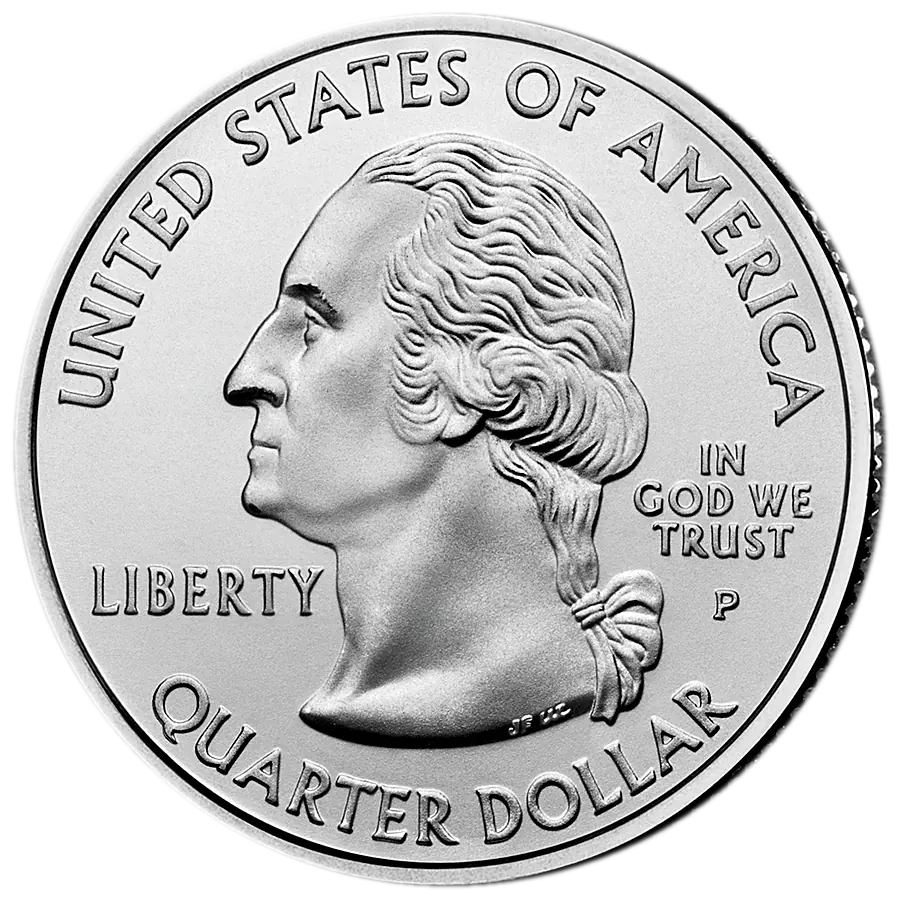
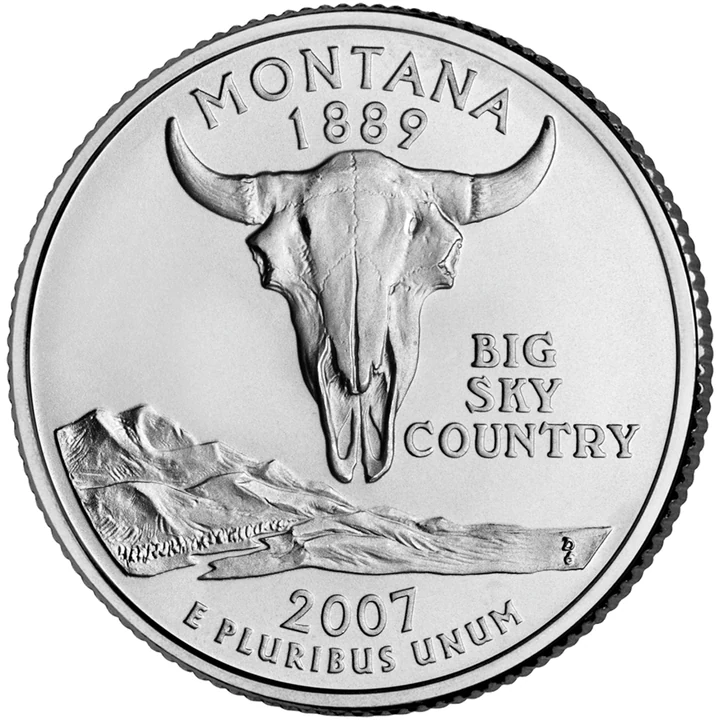
Exact Montana reverse from the U.S. Mint; shared program obverse.
41 / 50release order
4mint/finish issues
P · D · Smint marks
2007release year
Story in 30 Seconds
The reverse centers a horned bison skull above layered mountains and plains. BIG SKY COUNTRY crosses the lower landscape; MONTANA, 1889, 2007, E PLURIBUS UNUM, and Don Everhart's DE initials complete the design.
The Mint calls the skull an evocative image of the American West, its bounty and hardships, and a Montana symbol of rugged, resilient independence. It is not a live bison, cattle skull, trophy, fossil, named specimen, or literal object floating in the sky.
Governor Brian Schweitzer created a state selection commission in 2005. Public ideas informed four narratives; Mint artists produced elk, bison-skull, state-outline, and Big Sky landscape designs. CFA preferred the landscape, CCAC strongly preferred the skull, and Montana later opened the four choices to public voting. The complete certified result was not located.
Collectors distinguish P and D circulation strikes from S clad and 90% silver proofs. The canonical catalog models no Montana-specific major variety; extra horns, doubled skulls, hidden animals, missing mountains, and alleged skull faces require repeatable die evidence.
Public Law 105-124 ordered state reverses by constitutional ratification or admission. Montana entered the Union on November 8, 1889 as the forty-first state, making this the program's forty-first coin and first 2007 release. One reverse could not encompass the state's twelve Tribal nations, treaties and sovereignty, plains and mountains, rivers, cities, mining and labor, ranching, agriculture, wildlife, migration, public lands, or contemporary life. The selected skull, terrain, and nickname create a powerful but partial identity.
Montana spans northern Great Plains, intermountain valleys, and Rocky Mountain ranges. Bison sustained Plains peoples materially and spiritually for generations; nineteenth-century commercial slaughter and federal policy nearly destroyed the vast herds, while Native nations and conservation programs continue restoration work. The coin's skull can carry abundance, death, survival, memory, and resilience at once. BIG SKY COUNTRY is a state nickname, not a precise geographic boundary or claim that one landscape represents all Montana.
Don Everhart made the skull the largest uninterrupted form. Long horns spread almost horizontally while the nasal bones point down into compressed mountain ridges. The emblem reads immediately at coin scale because it is isolated against open field rather than embedded in a crowded naturalistic scene.
The Mint's launch account joins vast landscapes, mountains, high plains, big sky, and bison. It calls the skull an image of western bounty and hardship and says Montanans know it as rugged resilience. World Coin Book preserves that official reading while noting that a skull also records loss: the bison's near-destruction and the violence attached to western expansion cannot be reduced to a generic frontier romance.
Federal advisers read the same motif differently. CFA worried that it might be hard to read at quarter size and too closely recall Georgia O'Keeffe; CCAC member Leon Billings described its power in Montana history, and the committee thought the large image would translate well. The disagreement demonstrates interpretation and design judgment, not an error in the issued coin.
World Coin Book interpretation: the skull's bilateral symmetry and outward horns dominate like a heraldic crest. Low mountains establish place without competing with it; BIG SKY COUNTRY bridges skull and ground. The unusual vertical gap can make the skull seem suspended, turning a physical remnant into an emblem rather than a literal wildlife scene.
The portrait omits living bison, named Native nations and their own interpretations, treaty history, herd destruction and restoration, eastern prairie detail, rivers as distinct systems, mining, agriculture, cities, workers, immigrants, and current debates over land and wildlife. Those omissions make the coin a selective civic symbol, not a complete state history.
The federal framework asked each governor to develop three to five concepts through a state process. The Mint screened legality and coinability, created candidate artwork, consulted CFA and CCAC, returned approved choices for state recommendation, and the Treasury Secretary retained final approval.
Governor Brian Schweitzer established the Montana Quarter Design Selection Commission by Executive Order 10-2005 on June 30, 2005. The state met with Mint representatives on August 3, reviewed public input on September 19, and submitted narratives accepted by the Mint in October. The reviewed archive does not preserve the complete public corpus, screening scores, or meeting minutes.
Mint artists developed four documented candidates: a bull elk on rock above eastern plains at sunrise; a centered bison skull; a Montana outline filled with mountains, plains, sky, clouds, and rising sun; and a broad Big Sky landscape with river, mountains, plains, clouds, and nickname. These are distinct designs, not varieties of the issued coin.
CFA reviewed the designs on January 19, 2006 and recommended the Big Sky landscape, asking for a lower horizon and less intrusive motto. On January 24, CCAC scored the bison skull 25 of 27 possible points, ahead of elk at 13, Big Sky landscape at 9, and state outline at 4. The two federal bodies therefore offered different advice.
The state timeline anticipated returning Mint designs and a public vote. Archived state navigation confirms a Montana Quarter Design Options / Vote page and later unveiling notices. The bison skull became the state choice and Treasury-approved issue, but the reviewed official record did not yield electorate rules, dates, totals, percentages, certification, signed governor recommendation, or final Treasury instrument; none are invented here.
Procedures varied by state and changed during the program; each researched state page must document its actual path.
Alternative Designs
Four documented alternatives framed Montana differently: bull elk and eastern plains; bison skull; a state outline containing a landscape; and a river-and-mountain Big Sky panorama. CFA preferred the fourth, CCAC strongly preferred the skull, and the issued design used the skull over mountainous terrain. Complete candidate art rights, artist assignments, state ballot totals, revisions, and concept-to-die mapping remain unavailable, so no reconstructed gallery is published.
Use the complete text cards below as the keyboard and screen-reader equivalent of the image.
Bison skull and horns
Official explanation: The Mint identifies a bison skull and interprets it as western bounty and hardship and Montana's rugged, resilient nature.
Historical context: Bison have deep ecological and cultural relationships with Plains peoples; a skull can evoke life, death, memory, survival, and near-destruction without identifying one specimen.
World Coin Book interpretation: World Coin Book interpretation: broad horns and bilateral symmetry make the skull a heraldic emblem and the page's strongest visual hierarchy.
Official explanation: The Mint places the skull above diverse mountainous terrain and connects Montana with mountains, high plains, vast landscapes, and big sky.
Historical context: The relief does not name a range, peak, river, valley, reservation, county, viewpoint, season, or exact horizon.
World Coin Book interpretation: World Coin Book interpretation: low layered ridges establish distance and let empty field function as sky around the dominant skull.
Official explanation: The reverse bears Montana's Big Sky Country nickname across the lower landscape.
Historical context: The phrase expresses state identity but is not a legal map, meteorological measurement, or claim that Montana alone has broad skies.
World Coin Book interpretation: World Coin Book interpretation: the horizontal phrase acts as a bridge between the suspended skull and the terrain below.
Official explanation: The reverse carries MONTANA, 1889, 2007, E PLURIBUS UNUM, and DE.
Historical context: 1889 records statehood; 2007 records issue year; DE identifies reverse designer and sculptor Don Everhart.
World Coin Book interpretation: World Coin Book interpretation: perimeter inscriptions contain the open composition while the small initials preserve authorship without competing with the skull.
The animal represented through its skull; central to Plains ecology and many Indigenous cultures.
Montana mountains and plains
A generalized terrain rather than one identified range, valley, or viewpoint.
BIG SKY COUNTRY
The state-identity nickname inscribed across the reverse.
Brian Schweitzer
The governor who created the selection commission and oversaw the state process.
Don Everhart
The U.S. Mint sculptor-engraver credited with both reverse design and sculpture.
Focused Timeline
Bison and Plains peoples
Herd destruction
Statehood
Program authorization
Selection commission
Public input reviewed
CFA review
CCAC review
Federal release
Official Explanation and Interpretation
Artists and relief
John Flanagan's Washington portrait, adapted and sculpted for the program by William Cousins, appears on the shared obverse. Public concepts were reduced to state narratives, and Mint artists translated them into four candidates reviewed by CFA and CCAC. The Mint credits Don Everhart as both reverse designer and sculptor; DE appears at lower right. Surviving records do not assign every alternative to an artist or preserve the complete narrative-to-drawing-to-model-to-die revision log.
P and D are circulation issues. Both S issues were sold in proof products; the silver proof is a distinct 90% silver composition. Mintages are established catalog figures retained with an explicit source-audit limit.
Identification Guide
Identify the reverse by one horned bison skull centered above mountains with BIG SKY COUNTRY below. P, D, or S appears on the obverse near Washington's hair ribbon. P and D are circulation strikes; S coins are proofs. The clad proof has a copper-colored edge core and weighs 5.67 g; the 90% silver proof lacks that stripe and weighs about 6.25 g.
Condition Guide
Inspect horn tips and curves, brow and orbital rims, nasal bones, teeth and lower skull, mountain ridges, BIG SKY COUNTRY, dates, motto, and DE. First wear dulls the skull's exposed forehead, horn surfaces, nasal ridge, and mountain crests. Weak strike or grease may soften thin bone openings, ridge lines, lettering, or initials while luster remains.
Broad open fields around the skull reveal contact marks, scrapes, residue, cleaning, and wheel marks; bone cavities and mountains can hide hits. Proofs require checks for hairlines, haze, milk spots, fingerprints, frost breaks, and impaired mirrors. Judge wear, weak strike, machine doubling, die deterioration, cracks, and damage separately.
Mint Errors vs. Damage
The canonical Montana catalog models no recognized major variety beyond the four normal mint-and-finish issues. Seller labels such as extra horn, doubled skull, missing mountain, floating skull, hidden face, extra tooth, or buffalo ghost are not catalog attributions without stable parent issues, repeatable die markers, and specialist documentation.
Genuine mint errors can include off-center strikes, broadstrikes, clips, wrong planchets, struck-through material, retained cuds, or substantial die cracks. Authentication requires mint-made geometry, metal flow, weight, and repeatable evidence rather than resemblance to eyes, people, animals, letters, or a second skull.
Weak strike or grease may soften horn tips, bone openings, mountains, inscriptions, or DE. Machine doubling and die deterioration can create flat shelf-like outlines; these are not automatically doubled dies. Raised lines may be die cracks, while incuse lines crossing relief are usually scratches.
Scratches, gouges, dents, flattened rims, dryer damage, glue, corrosion, plating disturbance, polishing, paint, heat color, and carving are post-mint damage. The design shows a bison skull, not a cow skull, dinosaur fossil, satanic symbol, Georgia O'Keeffe artwork, or proof of one named tribe's exclusive interpretation; the mountains are generalized and the skull's apparent floating is composition, not an error.
Why Collectors Care
Durable value tiers
Ordinary worn P and D examples generally occupy the face-value design-set tier. Better circulation coins attract interest through full luster, clean open fields, complete horn tips, distinct skull cavities and teeth, separated mountain ridges, strong lettering, and legible DE. Clad proofs form a collector-product tier; silver proofs add 90% silver as a separate composition tier. Unsupported skull or horn error labels alone do not create a premium. World Coin Book gives no live price promise: compare dated completed transactions for the exact mint, finish, grade, surfaces, and authenticated error status.
Official law and U.S. Mint records establish program facts and image identity. World Coin Book separates official explanation, historical analysis, and editorial interpretation.
Official descriptions, historical context, and World Coin Book interpretation are labeled separately. No live prices are asserted. Last verified:
The complete text and member roster of Executive Order 10-2005, appointment records, authority details, meetings, attendance, minutes, votes, minority views, screening rubric, scores, and signed state narratives were not recovered from the reviewed official archive.
The public solicitation, eligibility and rights terms, submission form, concept corpus, submitter identities, preservation location, and exact path from public ideas to the four narratives were not located.
Archived state navigation and chronology document a planned public vote on returned Mint designs, but electorate definition, ballot dates and channels, candidate totals, percentages, turnout denominator, duplicate controls, geographic distribution, certification, and legal weight were not recovered.
CFA recommended the Big Sky landscape while CCAC strongly recommended the bison skull. The reviewed record does not preserve complete state deliberation explaining how advisory comments and public input were weighed before the governor's recommendation.
The signed Governor Schweitzer recommendation, Treasury final-approval instrument and date, candidate artist assignments, state feedback, and full change log from narrative through drawing, model, lettering, hub, die, and issued relief remain unavailable.
Official sources do not identify a specimen, sex or age of the represented bison, skull provenance, horn dimensions, tooth count, exact anatomy, ritual use, owner, collection, fossil status, or one Native nation's exclusive symbolic meaning.
The mountains and plains are generalized. No official source identifies an exact range, peak, river, valley, reservation, county, ranch, viewpoint, compass direction, season, weather, hour, cloud pattern, or literal altitude of the skull.
The canonical catalog has no normalized Montana-specific variety row. Future extra-horn, doubled-skull, missing-mountain, extra-tooth, or hidden-image attribution should require stable die markers and specialist documentation.
Normalized mintages remain established catalog figures; future work should attach direct Mint annual-production and proof-sales evidence for every issue.