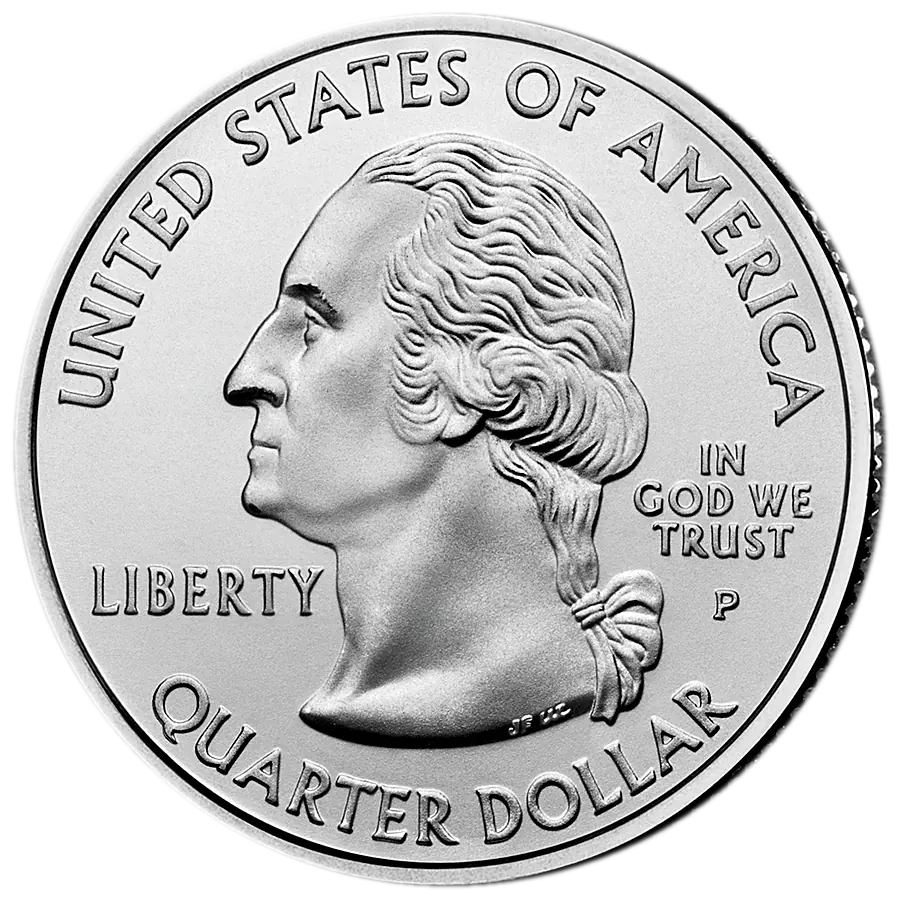
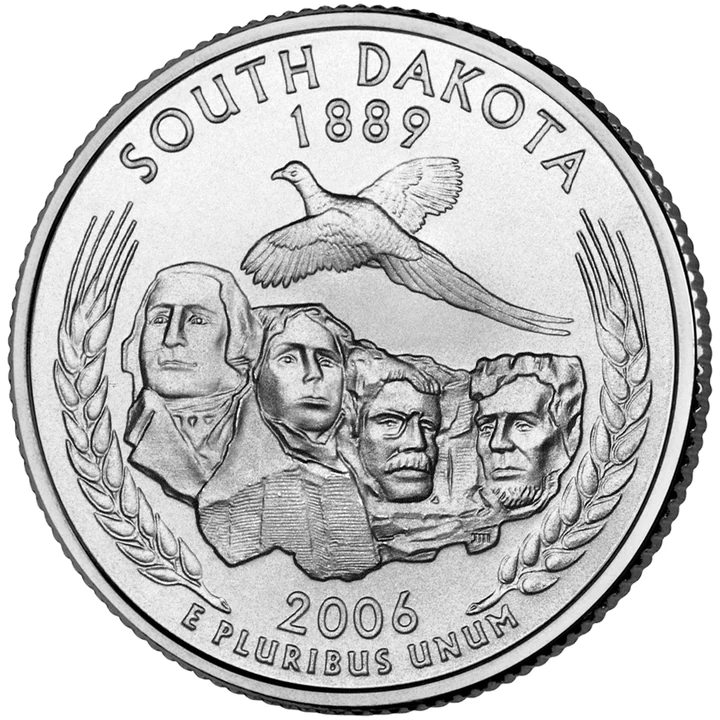
Exact South Dakota reverse from the U.S. Mint; shared program obverse.
40 / 50release order
4mint/finish issues
P · D · Smint marks
2006release year
Story in 30 Seconds
The reverse shows Mount Rushmore's four presidential faces beneath a flying Chinese ring-necked pheasant, framed by wheat heads. SOUTH DAKOTA, 1889, 2006, E PLURIBUS UNUM, ML, and JM complete the design.
The combination joins the state's best-known memorial, official state bird, and agricultural identity. It communicates the Mount Rushmore State quickly, but does not make the introduced pheasant native or reduce the Black Hills to tourism imagery.
Governor Mike Rounds opened a public information website, and Mint artists translated state narratives into five candidates: Mount Rushmore, bison, pheasant, Rushmore with bison, and Rushmore with pheasant. Residents voted online and through banks and credit unions; the issued combination won before state recommendation and Treasury approval, but complete official totals were not located.
Collectors distinguish P and D circulation strikes from S clad and 90% silver proofs. No South Dakota-specific major variety is modeled; alleged extra birds, faces, wheat kernels, doubled monuments, or hidden images require repeatable die evidence.
Public Law 105-124 ordered reverses by ratification or admission. South Dakota entered the Union on November 2, 1889 and was assigned fortieth place, making this the fortieth program design and fifth 2006 release. One reverse could not encompass the state's Native nations and sovereignty, prairie, Missouri River, Badlands, ranching, cities, migration, industry, and contemporary life; this selected emblem group is memorable but partial.
Mount Rushmore is a colossal carving of George Washington, Thomas Jefferson, Theodore Roosevelt, and Abraham Lincoln in the Black Hills. The memorial is internationally recognizable, while the Black Hills remain spiritually and culturally significant to Native nations. The ring-necked pheasant is South Dakota's state bird but originated in Asia and was successfully introduced in the state in 1909. Wheat connects the design to cultivated land and agriculture rather than identifying one farm, cultivar, harvest, or county.
Michael Leidel organized three scales: monumental presidential faces in the center, a pheasant crossing the open upper field, and enlarged wheat heads curving up both sides. John Mercanti translated that concept into shallow relief, balancing tiny facial features, feathers, grain, lettering, and initials at circulation size.
The Mint identifies Mount Rushmore National Memorial, the Chinese ring-necked pheasant as state bird, and bordering wheat. The memorial presents four presidents through a twentieth-century national narrative; the bird and crop broaden the reverse beyond one landmark toward wildlife, hunting culture, and agriculture.
World Coin Book interpretation: the pheasant's diagonal flight supplies movement over the still stone faces; paired wheat creates a heraldic frame and leads the eye upward. The monument dominates by recognition rather than physical scale. This is editorial visual reading, not an official symbolic code.
The memorial stands within the Black Hills, whose meanings did not begin with the carving. Native nations maintain historical, spiritual, and cultural ties to the region. A responsible reading can recognize the memorial's national fame while refusing the simplified claim that the coin depicts an uncontested or culturally empty landscape.
The design emphasizes tourism, presidential commemoration, game-bird identity, and agriculture. It omits Native nations and sovereignty, the contested history of the Black Hills, the carving's workers and creators, native wildlife, ranching, rivers, Badlands, towns, cities, and modern communities.
The federal framework asked the governor for three to five state concepts. The Mint screened legality and coinability, developed artwork, consulted CFA and CCAC, returned approved choices for state recommendation, and Treasury retained final approval.
Governor Mike Rounds announced a public quarter website in June 2004 with Mint guidelines, committee information, educational tools, a schedule, and a planned 2005 vote. The surviving state releases do not preserve the committee's complete roster, meetings, narrative intake, or screening record.
Mint artists developed five drawings from state narratives: Mount Rushmore alone, bison alone, pheasant alone, Mount Rushmore with bison, and Mount Rushmore with pheasant. Every candidate was framed by wheat. CFA reviewed the five on September 21, 2004 and unanimously preferred the bison, while questioning whether grass would read at coin size.
Governor Rounds unveiled the five choices for statewide voting beginning January 12, 2005. Residents could vote online or at state banks and credit unions; schools and service organizations were invited to widen access, including paper ballots for nursing homes, hospitals, and veterans' homes. A state update recorded more than 35,000 online ballots before the April 15 close.
The Mount Rushmore-and-pheasant combination became the state choice and Treasury-approved issue. Complete combined paper-and-online totals, candidate percentages, duplicate controls, certification, signed governor recommendation, and exact Treasury approval instrument were not located, so the page does not invent them.
Procedures varied by state and changed during the program; each researched state page must document its actual path.
Alternative Designs
Five Mint candidates are documented: Mount Rushmore alone; an American bison; a Chinese ring-necked pheasant; Mount Rushmore with bison; and Mount Rushmore with pheasant. Wheat framed all five. CFA unanimously preferred bison, while the statewide vote selected the Rushmore-and-pheasant combination. Reviewed evidence does not provide complete candidate artwork rights, artist assignments, vote totals, or a full revision trail.
Use the complete text cards below as the keyboard and screen-reader equivalent of the image.
Mount Rushmore and four presidents
Official explanation: The Mint identifies the Mount Rushmore National Memorial and George Washington, Thomas Jefferson, Theodore Roosevelt, and Abraham Lincoln.
Historical context: The memorial is a twentieth-century carving in the Black Hills; official interpretation connects the four presidents to founding, expansion, development, and preservation.
World Coin Book interpretation: World Coin Book interpretation: tightly grouped faces create a single monumental center whose instant recognition anchors the state identity.
Official explanation: The Mint identifies South Dakota's state bird, the Chinese ring-necked pheasant, soaring above the memorial.
Historical context: The species originated in Asia, was successfully introduced in South Dakota in 1909, and became state bird in 1943; the coin does not identify sex, age, flock, season, or exact route.
World Coin Book interpretation: World Coin Book interpretation: diagonal flight adds motion and links the open sky to the central stone faces.
Official explanation: The reverse carries SOUTH DAKOTA, 1889, 2006, E PLURIBUS UNUM, ML, and JM.
Historical context: 1889 records statehood; ML identifies Michael Leidel and JM identifies John Mercanti.
World Coin Book interpretation: World Coin Book interpretation: perimeter lettering contains the crowded emblem group while small initials preserve authorship.
The Black Hills carving of Washington, Jefferson, Theodore Roosevelt, and Lincoln.
Chinese ring-necked pheasant
South Dakota's introduced state bird, shown in flight.
Wheat
The agricultural border shared by all five documented candidates.
Mike Rounds
The governor who opened public participation and announced the five-design vote.
Michael Leidel and John Mercanti
The credited reverse designer and sculptor.
Focused Timeline
Black Hills before the memorial
Carving begins
State bird
Program authorization
Public website
Federal advisory review
Statewide vote opens
Vote closes
Federal release
Official Explanation and Interpretation
Artists and relief
John Flanagan's Washington portrait, adapted and sculpted for the program by William Cousins, appears on the shared obverse. State narratives supplied five themes and Mint artists developed the candidates; CFA records that this was the first quarter involving Artistic Infusion Program artists. The Mint credits Michael Leidel as reverse designer and John Mercanti as reverse sculptor. Surviving records do not map every candidate to an artist or preserve the complete drawing-to-model-to-die revision log.
P and D are circulation issues. Both S issues were sold in proof products; the silver proof is a distinct 90% silver composition. Mintages are established catalog figures retained with an explicit source-audit limit.
Identification Guide
Identify the reverse by four Mount Rushmore faces, one flying pheasant, and wheat at both sides. P, D, or S appears on the obverse near Washington's hair ribbon. P and D are circulation strikes; S coins are proofs. The clad proof has a copper-colored edge core and weighs 5.67 g; the 90% silver proof lacks that stripe and weighs about 6.25 g.
Condition Guide
Inspect presidential foreheads, noses, chins, the pheasant's head, wing and tail, wheat kernels and awns, lettering, ML, and JM. First wear dulls exposed faces, bird details, and grain tops. Weak strike or grease may leave tiny facial features, feathers, wheat, inscriptions, or initials soft while luster remains.
Open fields around the bird and faces expose contact marks, scrapes, cleaning, and wheel marks; dense wheat can hide hits. Proofs require checks for hairlines, haze, milk spots, fingerprints, frost breaks, and impaired mirrors. Separate wear, weak strike, machine doubling, die deterioration, and damage.
Mint Errors vs. Damage
The canonical South Dakota catalog models no recognized major variety beyond the four normal mint-and-finish issues. Seller labels such as extra pheasant, fifth face, doubled monument, extra wheat kernel, missing feather, hidden image, or named president anomaly are not catalog attributions without stable parent issues, repeatable die markers, and specialist documentation.
Genuine mint errors can include off-center strikes, broadstrikes, clips, wrong planchets, struck-through material, retained cuds, or substantial die cracks. Authentication requires mint-made geometry, metal flow, weight, and repeatable evidence rather than accidental shapes among faces, feathers, grain, or letters.
Weak strike or grease may soften presidential features, feathers, wheat, inscriptions, or initials. Machine doubling and die deterioration can create flat shelf-like outlines; these are not automatically doubled dies. Raised lines may be die cracks, while incuse lines crossing relief are usually scratches.
Scratches, gouges, dents, flattened rims, dryer damage, glue, corrosion, plating disturbance, polishing, paint, heat color, and carving are post-mint damage. The pheasant is introduced, not native; the wheat does not identify one cultivar or harvest; the four faces are not five, and the coin neither shows the entire memorial nor resolves the Black Hills' contested history.
Why Collectors Care
Durable value tiers
Ordinary worn P and D examples generally occupy the face-value design-set tier. Better circulation coins attract interest through full luster, clean open fields, distinct presidential features, complete pheasant feathers, crisp wheat, and legible ML and JM. Clad proofs form a collector-product tier; silver proofs add 90% silver as a separate composition tier. Unsupported Rushmore, bird, or wheat error labels alone do not create a premium. World Coin Book gives no live price promise: compare dated completed transactions for the exact mint, finish, grade, surfaces, and authenticated error status.
Official law and U.S. Mint records establish program facts and image identity. World Coin Book separates official explanation, historical analysis, and editorial interpretation.
Official descriptions, historical context, and World Coin Book interpretation are labeled separately. No live prices are asserted. Last verified:
The South Dakota quarter committee's creating instrument, complete roster, appointment record, meetings, minutes, attendance, votes, screening rubric, and signed recommendations were not located.
The original state narratives, submitter identities, eligibility and rights terms, preservation location, screening record, and exact route from public ideas to five narratives were not located.
State releases document voting online and through financial institutions and more than 35,000 online ballots, but complete paper-and-online totals, candidate percentages, electorate definition, duplicate controls, geographic distribution, certification, and legal weight were not located.
CFA unanimously preferred bison, while the public selection produced Mount Rushmore with pheasant. A CCAC meeting record or scored recommendation for these five candidates was not located in the reviewed sources.
Complete candidate art rights, candidate artist assignments, state feedback, signed Governor Rounds recommendation, Treasury approval instrument and date, and the full drawing-to-model-to-lettering-to-die revision log remain unavailable.
Official sources do not identify the pheasant's sex, age, individual, flock, flight path, season, or direction; one wheat cultivar, farm, county, harvest, stalk count, or kernel count; or a precise photographic viewpoint for the memorial.
The page recognizes both the memorial's official national interpretation and continuing Native relationships to the Black Hills; it does not claim that one short coin narrative resolves sovereignty, treaty, land, or memorial-history disputes.
The canonical catalog has no normalized South Dakota-specific variety row. Future extra-bird, fifth-face, doubled-monument, missing-feather, or extra-wheat attribution should require stable die markers and specialist documentation.
Normalized mintages remain established catalog figures; future work should attach direct Mint annual-production and proof-sales evidence for every issue.