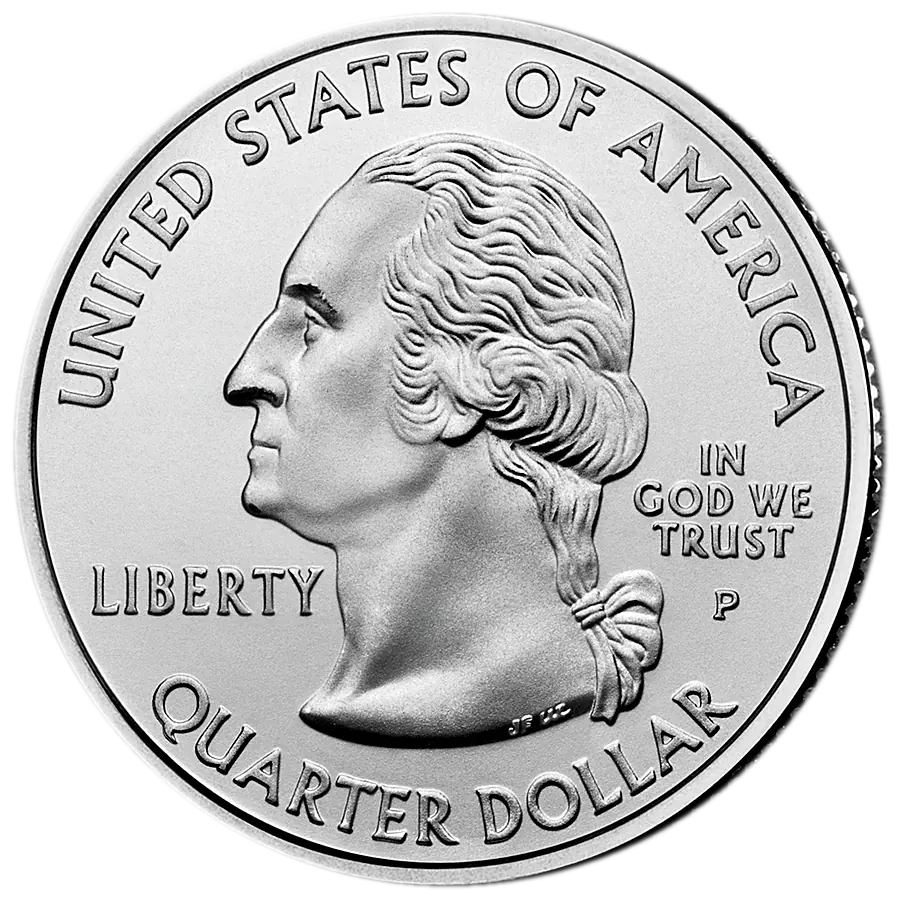
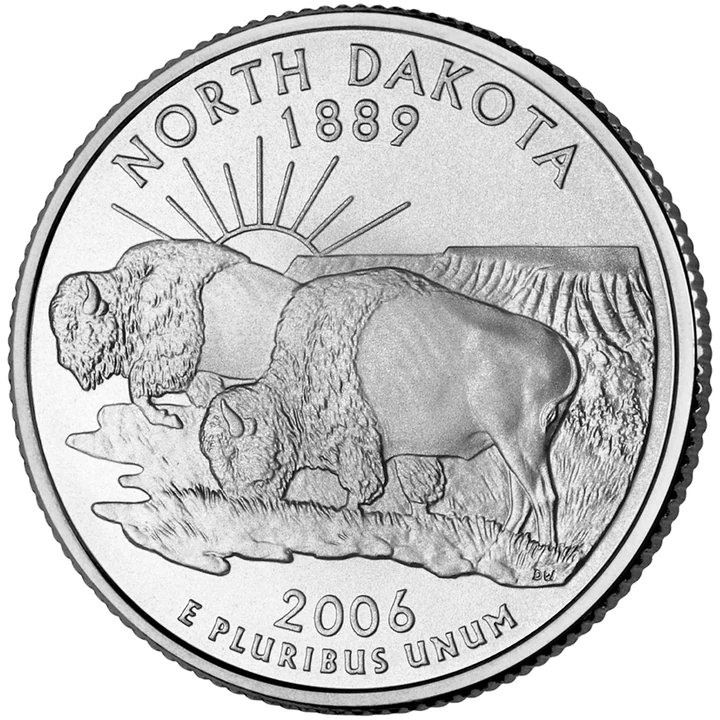
Exact North Dakota reverse from the U.S. Mint; shared program obverse.
39 / 50release order
4mint/finish issues
P · D · Smint marks
2006release year
Story in 30 Seconds
The reverse shows two American bison grazing in the foreground while rugged buttes and canyons recede beneath a low sun. NORTH DAKOTA, 1889, 2006, E PLURIBUS UNUM, SLC, and DW complete the design.
North Dakota chose a scene that joins an animal strongly associated with the Great Plains to the state's western Badlands. The Mint says the view evokes historic wild herds and rugged landscape; it does not identify individual animals, a species sex or age, an exact butte, ranch, park viewpoint, season, or hour.
A commission led by Lieutenant Governor Jack Dalrymple solicited short public narratives, received nearly 400, grouped them into five broad themes, and advanced three concepts. Mint artists made a modern farm, migrating geese, and bison-and-Badlands candidates; CFA preferred bison, CCAC preferred agriculture, and a later public choice favored the bison design before Governor John Hoeven recommended it for Treasury approval.
Collectors distinguish P and D circulation strikes from S clad and 90% silver proofs. The canonical catalog models no North Dakota-specific major variety; alleged extra horns, a third bison, doubled sun, hidden faces, missing legs, or named-landmark shapes require repeatable die evidence.
Public Law 105-124 ordered state reverses by constitutional ratification or admission. North Dakota entered the Union on November 2, 1889 as the thirty-ninth state, making this the program's thirty-ninth coin and fourth 2006 release. One reverse could not encompass the state's Indigenous nations and sovereignty, Missouri River, prairie, agriculture, energy, migration, towns, cities, and contemporary life. The selected wildlife landscape is memorable, but deliberately partial.
The Badlands of western North Dakota are an eroded landscape of buttes, ridges, gullies, and mixed-grass prairie. American bison are large native grazers whose ecological and cultural history reaches far beyond park boundaries and state lines. Their nineteenth-century destruction and later restoration make survival part of the scene's modern meaning, but the coin is not a complete conservation history and does not identify Theodore Roosevelt National Park by name.
Stephen Clark built the design in three depth bands: large grazing bison in the foreground, eroded Badlands forms across the middle distance, and an open sky with a low sun. Donna Weaver translated the drawing into shallow relief, separating shaggy heads, shoulders, backs, legs, grass, buttes, sky, lettering, and initials at circulation scale.
The Mint officially calls the animals American bison and describes rugged buttes and canyons symbolizing the state's Badlands region. Its launch statement connects the scene to wild buffalo herds and Badlands history. ‘Buffalo’ remains common cultural language, but the species represented is the American bison; the coin does not show domestic cattle or the African or Asian buffalo genera.
World Coin Book interpretation: the two downward heads create calm, repeated movement and make grazing—not charging or combat—the human-scale action. Their dark mass anchors the foreground while horizontal landforms widen the scene and the low sun gives distance. This is editorial visual reading, not an official symbolic code.
Bison mattered to Indigenous peoples of the northern Plains long before statehood and remain living animals rather than relics. Their near destruction cannot be reduced to a simple frontier legend; commercial slaughter and government policy were intertwined with dispossession and attacks on Indigenous foodways. Modern protected and managed herds are recovery, not proof that all historical relationships or ecological conditions have been restored.
The design emphasizes western wildlife, open land, and endurance. It omits living Tribal nations and sovereignty, agriculture despite the CCAC preference, eastern prairie and wetlands, the Missouri River, settlement, railroads, extraction, cities, and modern communities. It also turns a complex landscape into a serene sunset without showing drought, fire, erosion, fences, roads, tourism, or herd management.
The federal framework asked each governor to develop three to five concepts through a state process. The Mint screened legality and coinability, produced candidate artwork, consulted CFA and CCAC, returned approved choices for state recommendation, and the Treasury Secretary retained final approval.
Governor John Hoeven opened North Dakota's process on April 14, 2004. The North Dakota Quarter Design Selection Process Commission, led by Lieutenant Governor Jack Dalrymple, invited concepts of no more than 50 words explaining how the state should appear nationally. Submissions were accepted by mail, fax, email, and an online form through July 1.
The institutional account records nearly 400 narratives grouped into agriculture, landscape, International Peace Garden, Badlands, and Native American culture. The commission advanced three concepts to the Mint. The surviving federal candidate set shows a modern farm, migrating geese over similar terrain, and two bison grazing in the Badlands; the exact mapping from five groups to these three narratives is not fully preserved.
On January 25, 2005, CFA chose the bison candidate, asking for clearer separation of the animals, removal of the sun, and greater emphasis on Badlands topography. CCAC instead gave Agriculture 17 of 24 points, Badlands 10, and Landscape 9, citing repeated recent bison imagery and concern that background relief could become unclear.
The state commission later narrowed the field to two and a public choice in May 2005 favored the bison-and-Badlands design. Governor Hoeven recommended it; Treasury retained final approval. No complete official ballot totals or certified canvass were located, so this page documents public participation and the outcome without inventing numbers.
Procedures varied by state and changed during the program; each researched state page must document its actual path.
Alternative Designs
Three federal candidates are documented: an aerial modern farm representing agriculture; two migrating geese above a related landscape; and two grazing bison before the Badlands. CFA preferred bison and considered geese a good second choice if the sun were removed; CCAC preferred the farm. The earlier five public theme groups also included International Peace Garden and Native American culture, but reviewed evidence does not establish separate Mint drawings for all five or identify complete finalist art, artists, submitters, or vote totals.
Use the complete text cards below as the keyboard and screen-reader equivalent of the image.
Two American bison
Official explanation: The Mint identifies a pair of grazing American bison in the foreground.
Historical context: Bison are native Great Plains grazers with deep ecological and Indigenous cultural relationships; the coin does not identify sex, age, herd, or individual animals.
World Coin Book interpretation: World Coin Book interpretation: repeated lowered heads convey calm grazing while overlapping bodies create a strong foreground mass.
Official explanation: The Mint describes the scene as grazing bison at sunset.
Historical context: The low disk establishes time and atmosphere but does not document season, compass direction, exact hour, weather, or a specific sunrise-versus-sunset viewpoint beyond the Mint's sunset description.
World Coin Book interpretation: World Coin Book interpretation: empty sky gives relief breathing room and turns the compact scene into a broad horizon.
Official explanation: The reverse carries NORTH DAKOTA, 1889, 2006, E PLURIBUS UNUM, SLC, and DW.
Historical context: 1889 records statehood; SLC identifies Stephen L. Clark and DW identifies Donna Weaver.
World Coin Book interpretation: World Coin Book interpretation: perimeter text frames the landscape while small initials preserve authorship without competing with the animals.
The two native grazers in the foreground; living animals with ecological and Indigenous cultural histories.
North Dakota Badlands
The eroded western landscape of buttes, ridges, canyons, and prairie behind the bison.
North Dakota Quarter Design Selection Process Commission
The state body led by Lieutenant Governor Jack Dalrymple that organized concepts and finalists.
Stephen Clark and Donna Weaver
The credited reverse designer and sculptor.
John Hoeven
The governor who opened the process and recommended the selected design.
Focused Timeline
Bison, land, and peoples
Statehood
Program authorization
Public process opens
Submission deadline
Federal advisory review
Public choice
Federal release
Bismarck launch
Official Explanation and Interpretation
Artists and relief
John Flanagan's Washington portrait, adapted and sculpted for the program by William Cousins, appears on the shared obverse. Public narratives and North Dakota's commission supplied themes; Mint artists developed three candidates. The Mint credits Artistic Infusion Program artist Stephen Clark as reverse designer and Sculptor-Engraver Donna Weaver as reverse sculptor. CFA's request to separate the bison and emphasize topography documents design review, but the surviving record does not fully map every drawing, model, lettering, hub, and die revision or assign the issued composition to one public submitter.
P and D are circulation issues. Both S issues were sold in proof products; the silver proof is a distinct 90% silver composition. Mintages are established catalog figures retained with an explicit source-audit limit.
Identification Guide
Identify the reverse by two grazing American bison before layered Badlands and a low sun. P, D, or S is on the obverse near Washington's hair ribbon. P and D are circulation strikes; S coins are proofs. The clad proof has a copper-colored edge core and weighs 5.67 g; the 90% silver proof lacks that stripe and weighs about 6.25 g.
Condition Guide
Inspect the bison's horns, forehead and shoulder hair, backs, hips, legs, muzzles, grass line, highest butte ridges, sun rim, lettering, and SLC and DW. First wear dulls exposed heads, shoulders, backs, and ridge tops. Weak strike or grease can leave low-relief legs, grass, initials, or distant landforms soft while original luster remains.
Open sky and broad animal flanks reveal contact marks, scrapes, cleaning, and wheel marks; dense hair and terrain can hide hits. Proofs require checks for hairlines, haze, milk spots, fingerprints, frost breaks, and impaired mirrors. Judge wear, strike weakness, machine doubling, die deterioration, and post-mint damage separately.
Mint Errors vs. Damage
The canonical North Dakota catalog models no recognized major variety beyond the four normal mint-and-finish issues. Seller labels such as extra horn, third bison, doubled sun, missing leg, floating bison, hidden face, spear, bird, or named Badlands landmark are not catalog attributions without a stable parent issue, repeatable die markers, and specialist documentation.
Genuine mint errors can include off-center strikes, broadstrikes, clips, wrong planchets, struck-through material, retained cuds, or substantial die cracks. Authentication requires mint-made geometry, metal flow, weight, and repeatable evidence rather than an accidental shape in hair, sky, grass, or terrain.
Weak strike or grease may soften horns, legs, grass, distant ridges, inscriptions, or initials. Machine doubling and die deterioration can create flat shelf-like outlines around bison, sun, or letters; these are not automatically doubled dies. A raised line may be a die crack, while an incuse line crossing relief is usually a scratch.
Scratches, gouges, dents, flattened rims, dryer damage, glue, corrosion, plating disturbance, polishing, paint, heat color, and carving are post-mint damage. The animals are American bison, not cattle or African buffalo; the scene is not officially one named Theodore Roosevelt National Park viewpoint; two bison do not encode a documented pair, family, sex, age, herd, or exact population count; and the coin does not show a battle, stampede, or extinction event.
Why Collectors Care
Durable value tiers
Ordinary worn P and D examples generally occupy the face-value design-set tier. Better circulation coins attract interest through full luster, clean sky and animal flanks, distinct hair, complete horns and legs, separated bison, crisp landforms, and legible SLC and DW. Clad proofs form a collector-product tier; silver proofs add 90% silver as a separate composition tier. Unsupported bison or Badlands error labels alone do not create a premium. World Coin Book gives no live price promise: compare dated completed transactions for the exact mint, finish, grade, surfaces, and authenticated error status.
Official law and U.S. Mint records establish program facts and image identity. World Coin Book separates official explanation, historical analysis, and editorial interpretation.
Official descriptions, historical context, and World Coin Book interpretation are labeled separately. No live prices are asserted. Last verified:
The commission's creating instrument, appointment roster, complete meeting files, attendance, minutes, votes, minority views, screening rubric, scores, and signed recommendations were not located.
The nearly 400 public narratives, eligibility rules beyond the surviving solicitation, submitter identities, preservation location, geographic distribution, five-theme classification worksheet, and complete screening record were not located.
Institutional evidence says the commission narrowed the field to two and thousands participated in a May 2005 public choice, but the exact two-image ballot, voting dates and channels, electorate definition, complete totals, duplicate controls, county distribution, certification, and legal weight were not located.
Federal records preserve three candidate themes and advisory preferences, but complete candidate artwork rights, artist assignments, state feedback, and mapping from public narratives through Mint drawings to the issued relief remain incomplete.
The signed Governor Hoeven recommendation, Treasury final-approval instrument, exact approval date, complete correspondence, and full change log from concept through drawing, model, lettering, hub, die, and issued relief remain unavailable.
CFA requested removal of the sun, yet the issued coin and Mint description retain a low sun and sunset. The reviewed record does not explain when or why that recommendation was declined or modified.
Official sources do not identify individual bison, sex, age, relationship, herd, breed or subspecies, exact animal count symbolism, named butte, canyon, park unit, ranch, viewpoint, season, compass direction, precise hour, or weather.
The canonical catalog has no normalized North Dakota-specific variety row. Future extra-horn, third-bison, doubled-sun, missing-leg, or hidden-face attribution should require stable die markers and specialist documentation.
Normalized mintages remain established catalog figures; future work should attach direct Mint annual-production and proof-sales evidence for every issue.