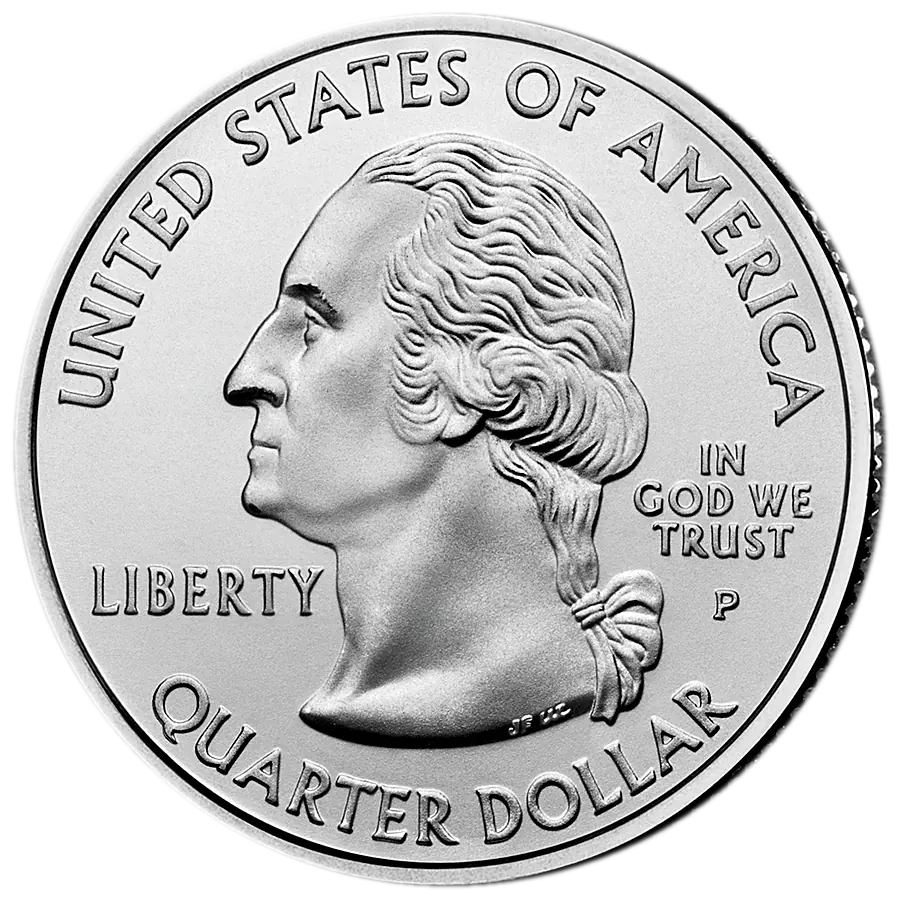
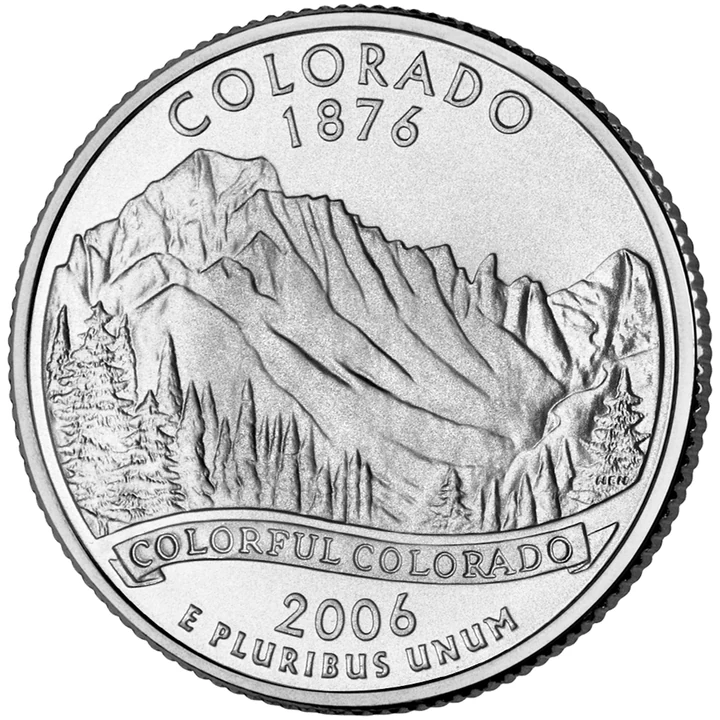
Exact Colorado reverse from the U.S. Mint; shared program obverse.
38 / 50release order
4mint/finish issues
P · D · Smint marks
2006release year
Story in 30 Seconds
The reverse shows a sweeping Rocky Mountain panorama above evergreen trees, crossed by a banner reading COLORFUL COLORADO. COLORADO, 1876, 2006, E PLURIBUS UNUM, LB, and NEN complete the design; no official source reviewed here identifies the range as Longs Peak.
Colorado chose a landscape that could communicate the state's mountain identity immediately at quarter scale. The Mint calls the mountains rugged and the launch account connects the design to Colorado's beauty and color; the trees establish a forested foreground rather than a documented species or exact place.
A twelve-member commission chaired by First Lady Frances Owens traveled the state, spoke with hundreds of residents including schoolchildren, considered about 1,500 suggestions, and sent five narratives to the Mint. Mint artists made five candidates; federal advisory bodies reviewed them, Governor Bill Owens chose the issued design, and Treasury retained final approval.
Collectors distinguish P and D circulation strikes from S clad and 90% silver proofs. The canonical catalog models no Colorado-specific major variety; alleged extra trees, doubled peaks, missing letters, hidden faces, or map shapes require repeatable die evidence and are not automatically mint varieties.
Public Law 105-124 ordered state reverses by constitutional ratification or admission. Colorado entered the Union on August 1, 1876 as the thirty-eighth state, making this the program's thirty-eighth coin and third 2006 release. One reverse could not encompass Indigenous homelands and living nations, plains, mesas, deserts, rivers, mining, agriculture, cities, migration, labor, or contemporary life. Colorado selected a mountain landscape as an instantly legible but partial identity.
The Rocky Mountains cross Colorado from north to south and dominate the state's public image, but Colorado also includes eastern plains, western plateaus, canyons, basins, forests, grasslands, and cities. The quarter depicts an emblematic mountain-and-tree panorama, not a surveyed viewpoint or named summit. COLORFUL COLORADO was already a familiar state identity phrase; on the coin it frames varied scenery through one idealized alpine view.
Leonard Buckley arranged layered ridgelines across the upper field, a dark evergreen band below, and a curved COLORFUL COLORADO banner through the middle. Norman E. Nemeth translated the drawing into shallow relief, separating peaks, snow or rock planes, trees, banner folds, lettering, and initials at circulation scale.
The Mint officially identifies rugged Rocky Mountains, evergreen trees, and a banner. It does not name Longs Peak, Pikes Peak, a park, a pass, a particular valley, a tree species, season, weather event, or exact viewpoint. The broad subject is therefore more accurate than assigning the scene to one summit.
World Coin Book interpretation: repeated ridges create depth and make the mountains the dominant visual mass; the low trees provide scale and a transition from viewer to distance; the banner turns scenery into an explicit civic slogan. This compositional reading is editorial, not an official symbolic formula.
The launch account says the quarter evokes Colorado's beauty and color and echoes the mountain language of America the Beautiful. The monochrome coin cannot literally show color, so the inscription asks viewers to supply remembered skies, stone, snow, vegetation, and seasonal change.
The design emphasizes a scenic alpine ideal. It leaves out Colorado's plains and plateau country, Indigenous sovereignty and histories, Hispanic and other communities, mining and labor, water conflict, agriculture, urban life, tourism pressures, wildfire, and environmental change. Those omissions do not invalidate the symbol, but they define its limits.
The federal framework asked each governor to develop three to five concepts through a state process. The Mint screened legality and coinability, produced candidate artwork, consulted CFA and CCAC, returned approved choices for state recommendation, and the Treasury Secretary retained final approval.
Governor Bill Owens created the Colorado Commemorative Quarter Advisory Commission by Executive Order B 001 04. Up to twelve voting members were appointed, First Lady Frances Owens chaired it, seven formed a quorum, and majority votes adopted final recommendations. Public narratives were due May 10, 2004 and had to explain why a concept represented Colorado.
The governor's contemporary account says the commission traveled the state, spoke with hundreds of citizens including many schoolchildren, and received suggestions from about 1,500 Coloradans. It could edit, combine, or create narratives and forwarded five to the Mint. This was broad public consultation, not a documented statewide winner-take-all ballot.
Mint artists turned the narratives into five candidates: Colorful Colorado mountains; Mesa Verde Cliff Palace; a 10th Mountain Division alpine soldier; mountains, a large C, columbine, and THE CENTENNIAL STATE; and Pikes Peak with PIKES PEAK OR BUST, mining tools, and snowflakes. CFA favored simplifying candidates 1 or 5 and strengthening the mountain profile.
CCAC preferred the mountain-and-columbine candidate and ranked the issued mountain design second. Governor Owens chose the Colorful Colorado design from federally approved options and submitted it for Treasury approval. The Mint credits Leonard Buckley as reverse designer and Norman E. Nemeth as reverse sculptor; complete commission minutes, scores, governor instrument, Treasury instrument, and revision log were not located.
Procedures varied by state and changed during the program; each researched state page must document its actual path.
Alternative Designs
Five documented candidates all included mountains but represented different identities: the issued Colorful Colorado panorama; Mesa Verde's Cliff Palace and ancestral Pueblo architecture; a 10th Mountain Division skier and military history; a large C with columbine and Centennial State identity; and Pikes Peak with mining tools, snowflakes, and PIKES PEAK OR BUST. CFA and CCAC preferences differed. Complete candidate-art rights, artist assignments, state feedback, commission scoring, and concept-to-relief mapping remain incomplete, so no reconstructed gallery is published.
Use the complete text cards below as the keyboard and screen-reader equivalent of the image.
Rocky Mountains
Official explanation: The Mint identifies a sweeping view of rugged Rocky Mountains.
Historical context: The range is a central Colorado landform and public identity, but the issued scene is not officially tied to one summit.
World Coin Book interpretation: World Coin Book interpretation: layered ridges create depth and visual dominance while avoiding one named-place portrait.
Official explanation: The reverse carries COLORADO, 1876, 2006, E PLURIBUS UNUM, COLORFUL COLORADO, LB, and NEN.
Historical context: 1876 records statehood; LB and NEN identify Leonard Buckley and Norman E. Nemeth.
World Coin Book interpretation: World Coin Book interpretation: curved perimeter text and central banner frame the landscape while the small initials preserve authorship.
The twelve-member state body chaired by Frances Owens.
Leonard Buckley and Norman E. Nemeth
The credited reverse designer and sculptor.
Focused Timeline
Statehood
Program authorization
State commission
Public deadline
Five narratives
CCAC review
CFA review
Governor selection
Denver launch
Official Explanation and Interpretation
Artists and relief
John Flanagan's Washington portrait, adapted and sculpted for the program by William Cousins, appears on the shared obverse. Public suggestions and Colorado's commission supplied narrative themes, while Mint artists developed candidate artwork. The Mint credits Artistic Infusion Program artist Leonard Buckley with the issued reverse design and Sculptor-Engraver Norman E. Nemeth with translating it into coin relief. The reviewed record does not assign the exact composition to a public submitter or preserve the complete drawing, model, lettering, hub, and die revision history.
P and D are circulation issues. Both S issues were sold in proof products; the silver proof is a distinct 90% silver composition. Mintages are established catalog figures retained with an explicit source-audit limit.
Identification Guide
Identify the reverse by layered Rocky Mountains, evergreen trees, and the COLORFUL COLORADO banner—not by an asserted Longs Peak portrait. P, D, or S is on the obverse near Washington's hair ribbon. P and D are circulation strikes; S coins are proofs. The clad proof has a copper-colored edge core and weighs 5.67 g; the 90% silver proof lacks that stripe and weighs about 6.25 g.
Condition Guide
Inspect the highest ridge crests and snow or rock planes, evergreen tips, banner folds and letters, COLORADO and date lettering, and LB and NEN. First wear dulls exposed ridge crests, banner high points, and tree tops. Luster remaining in shallow valleys or letters can indicate weak strike or grease rather than wear.
Open sky and broad mountain planes reveal contact marks, scrapes, cleaning, and wheel marks; dense trees and lettering can conceal hits. Proofs require checks for hairlines, haze, milk spots, fingerprints, frost breaks, and impaired mirrors. Judge alleged doubled peaks, extra trees, missing letters, strike weakness, wear, and damage separately.
Mint Errors vs. Damage
The canonical Colorado catalog models no recognized major variety beyond the four normal mint-and-finish issues. Seller labels such as extra tree, doubled mountain, missing snow, doubled banner, missing letter, hidden face, or Colorado map are not catalog attributions without a stable parent issue, repeatable die markers, and specialist documentation.
Genuine mint errors can include off-center strikes, broadstrikes, clips, wrong planchets, struck-through material, retained cuds, or substantial die cracks. Authentication requires mint-made geometry, metal flow, weight, and repeatable evidence rather than an accidental shape resembling a person, animal, letter, map, or second summit.
Weak strike or grease may soften tree tips, ridge lines, banner letters, dates, or artist initials. Machine doubling and die deterioration can create flat shelf-like outlines; these are not automatically doubled dies, and overlapping ridge lines do not prove an extra-mountain variety.
Scratches, gouges, dents, flattened rims, dryer damage, glue, corrosion, plating disturbance, polishing, paint, heat color, and carving are post-mint damage. The scene is not officially Longs Peak or Pikes Peak; pale relief is not real snow composition; the banner is not a road; and accidental stains or scratches do not document wildfire, lightning, ski runs, faces, or a hidden state map.
Why Collectors Care
Durable value tiers
Ordinary worn P and D examples generally occupy the face-value design-set tier. Better circulation coins attract interest through full luster, clean sky and mountain planes, distinct ridge layers, separated tree tips, a complete banner, and legible LB and NEN. Clad proofs form a collector-product tier; silver proofs add 90% silver as a separate composition tier. Unsupported mountain or tree error labels alone do not create a premium. World Coin Book gives no live price promise: compare dated completed transactions for the exact mint, finish, grade, surfaces, and authenticated error status.
Official law and U.S. Mint records establish program facts and image identity. World Coin Book separates official explanation, historical analysis, and editorial interpretation.
Official descriptions, historical context, and World Coin Book interpretation are labeled separately. No live prices are asserted. Last verified:
The commission's appointment roster, complete meeting files, attendance, minutes, votes, minority views, screening rubric, scores, travel schedule, and signed five-narrative recommendation were not located.
The approximately 1,500 suggestions, submission forms, narratives, submitter identities, preservation location, geographic distribution, and complete screening record were not located.
No binding statewide public ballot is documented; public participation is established through solicitation, suggestions, meetings, and school outreach, not through invented vote totals.
Federal records preserve five candidate themes and advisory preferences, but complete candidate artwork rights, artist assignments, state feedback, and mapping from public narratives through Mint drawings to the issued relief remain incomplete.
The signed Governor Owens recommendation, Treasury final-approval instrument, exact approval date, complete correspondence, and full change log from concept through drawing, model, lettering, hub, die, and issued relief remain unavailable.
Official sources do not identify Longs Peak, Pikes Peak, another named summit, an exact viewpoint, valley, park, tree species, season, snow condition, weather, or time of day in the issued design.
The current Mint page appears to list 1874 among reverse inscriptions, while the coin, statehood history, and Mint narrative identify 1876; this page follows the coin and records the webpage discrepancy rather than repeating it.
The canonical catalog has no normalized Colorado-specific variety row. Future extra-tree, doubled-peak, missing-letter, or hidden-map attribution should require stable die markers and specialist documentation.
Normalized mintages remain established catalog figures; future work should attach direct Mint annual-production and proof-sales evidence for every issue.